
Why Commercial Insulation Is One of the Smartest Investments You Can Make
Commercial insulation is the material used in commercial buildings to slow heat transfer through walls, roofs, and floors — keeping conditioned air in and outdoor temperatures out.
Here’s a quick overview of what matters most:
| Topic | Key Facts |
|---|---|
| Energy savings | Proper insulation cuts energy use by 13% to 35% |
| Main types | Spray foam, fiberglass, mineral wool, rigid foam (polyiso, XPS) |
| Best metric | R-value — higher means better thermal resistance |
| Top performer | Spray foam (closed-cell): ~6.5 R-value per inch |
| Biggest benefit | Lower energy bills, better comfort, mold and moisture control |
| Code compliance | Must meet ASHRAE 90.1 and IECC requirements |
If your building runs hot in summer, cold in winter, or your energy bills feel out of control — insulation is almost always part of the problem.
Heating and cooling account for 50 to 70% of energy use in a typical building. In commercial properties, that number translates directly to your operating costs. Poor insulation means your HVAC system works harder, costs more, and wears out faster.
And it’s not just about temperature. Gaps in your building envelope let in moisture, which leads to mold. They let in air, which creates drafts. Over time, these problems compound — damaging your structure and your bottom line.
The good news? The right commercial insulation solves all of this at once.
I’m Dave Brocious, founder of ClimaShield Industries and a specialist in commercial insulation systems including spray foam, air barriers, and protective coatings, with over 20 years of hands-on experience across commercial and industrial projects. In this guide, I’ll walk you through everything you need to know to make a smart insulation decision for your building.
Understanding Commercial Insulation Materials
When we talk about commercial insulation, we aren’t just talking about the pink stuff you see in attics. In the commercial world, materials are selected based on high-stakes performance metrics: thermal resistance (R-value), fire safety, moisture management, and structural contribution.
Common Types of Commercial Insulation
- Fiberglass: Available in batts or rolls, this is often the most budget-friendly upfront option. It’s made of fine glass fibers and is commonly used in metal buildings and between wall studs. While it’s cost-effective—sometimes costing as little as 1/4 the price of spray foam—it doesn’t stop air movement on its own.
- Mineral Wool: Also known as rock wool, this material is a champion of fire resistance. It’s made from volcanic rock and slag, can withstand extremely high temperatures, and offers excellent sound dampening.
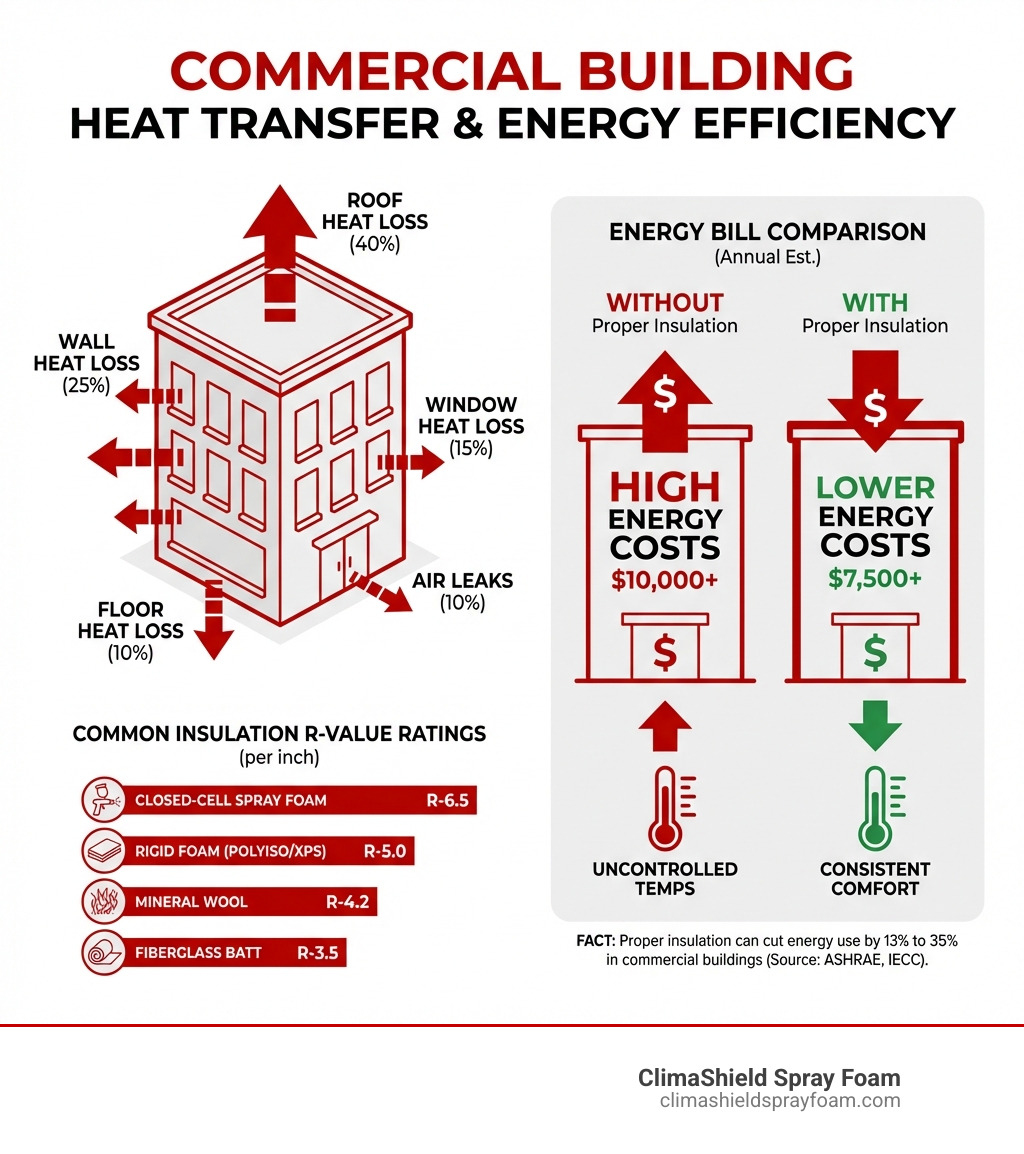
- Rigid Foam Boards: These include Expanded Polystyrene (EPS), Extruded Polystyrene (XPS), and Polyisocyanurate (Polyiso). Polyiso is particularly popular in commercial roofing because it offers a high R-value of about 6.5 per inch.
- Spray Foam Insulation: This is the “gold standard” for modern building envelopes. It’s applied as a liquid that expands into a solid, sealing every nook and cranny.
Key Characteristics of Effective Insulation
To be truly effective in a Pennsylvania climate—where we deal with humid summers and freezing winters—insulation needs to do more than just sit there. It needs to:
- Provide a High R-Value: This measures the material’s resistance to conductive heat flow.
- Offer Superior Air Sealing: If air can move through your insulation, your R-value drops significantly.
- Control Moisture: In commercial settings, moisture is the enemy of longevity. Effective insulation prevents condensation that leads to rust in metal buildings or mold in drywall.
- Ensure Durability: Commercial buildings are long-term assets. The insulation shouldn’t sag, settle, or degrade over time.
While traditional materials like fiberglass have their place, they often require additional vapor barriers and air-sealing tapes to meet modern energy codes. Spray foam, on the other hand, provides thermal, air, and often moisture protection in a single application.
The Unmatched Performance of Spray Foam Insulation
If you’re looking for the highest ROI on your building envelope, spray foam is hard to beat. At ClimaShield Spray Foam, we specialize in this because it addresses the three biggest threats to building efficiency: heat loss, air leakage, and moisture intrusion.
Closed-Cell vs. Open-Cell
In commercial applications, we often lean toward closed-cell spray foam. It is incredibly dense and becomes rigid once cured. This density gives it an R-value of approximately 6.5 per inch, which is significantly higher than fiberglass or open-cell foam. Because the cells are closed and packed tight, it acts as its own vapor barrier and can even add structural strength to your walls.
Superior Air Sealing
Traditional insulation is like wearing a wool sweater on a windy day; it keeps you warm until the wind blows right through it. Spray foam is more like a windbreaker. It expands to fill gaps around conduits, pipes, and structural beams that are impossible to seal with batts or boards. This creates an airtight seal that prevents the “chimney effect,” where warm air escapes out the top of the building while sucking cold air in through the bottom.
Longevity and Versatility
Unlike fiberglass rolls that can sag or mineral wool that can be displaced, spray foam adheres directly to the substrate. Whether you are insulating a warehouse, a cold-storage facility, or a high-end office space, it stays in place for the life of the building. For a deeper dive into which type might fit your specific project, check out our guide on Which Foam is for You: Exploring Insulation Types, Perks, and Prices.
The Importance of Continuous Insulation (ci) and Building Codes
One of the biggest shifts in commercial construction over the last decade is the move toward Continuous Insulation (ci). If you look at modern building codes like ASHRAE 90.1 or the International Energy Conservation Code (IECC), you’ll see “ci” mentioned everywhere.
What is Thermal Bridging?
Imagine a steel-framed building. Even if you pack the space between the studs with the best insulation, those steel studs act as “thermal bridges.” Steel conducts heat much faster than insulation. In the winter, heat bypasses your insulation by traveling through the metal studs to the outside. This can reduce the “effective” R-value of your wall by as much as 50%.
Continuous insulation solves this by wrapping the entire building in a layer of insulation, typically on the exterior side of the framing. This “breaks” the thermal bridge and ensures the building stays at a consistent temperature.
Staying Compliant
Compliance isn’t just about passing inspection; it’s about safety and sustainability.
- ASHRAE 90.1: This has been the benchmark for commercial energy codes for over 35 years. It sets the minimum requirements for energy-efficient designs.
- NFPA 285: This is a critical fire safety standard for commercial wall assemblies. Since many high-performance insulations (like polyiso and spray foam) are plastic-based, they must be tested as part of a complete wall system to ensure they don’t contribute to the spread of fire.
By following these standards, we don’t just save you money; we ensure your building is a safe, long-lasting asset. You can find more technical details on the ASHRAE 90.1 Energy Standard to see how these benchmarks apply to your next project.
Maximizing Efficiency with Air Sealing and Moisture Control
We often tell our clients: “Insulate tight, ventilate right.” If you insulate a building but leave air leaks, you’re throwing money out the window. If you seal it tight but don’t manage moisture, you’re asking for mold.
The Building Envelope Integrity
The “building envelope” is the physical separator between the conditioned and unconditioned environment. A break in this envelope—whether it’s a gap in the roof insulation or an unsealed pipe penetration—allows for uncontrolled air exchange. This forces your HVAC system to work overtime to compensate for the lost air.
Vapor Barriers and Mold Prevention
Moisture moves through buildings in two ways: air movement and vapor diffusion. In Pennsylvania’s climate, moisture often wants to move from the humid outdoors to the cool, air-conditioned indoors during the summer. If that moisture hits a cold surface inside your wall, it condenses into water.
Properly installed commercial insulation with an integrated vapor barrier (like closed-cell spray foam or faced polyiso boards) prevents this condensation. This is essential for preventing mold growth and protecting the structural integrity of your steel or wood framing. For more on how this impacts your bottom line, visit our page on Energy Saving Insulation.
Strategic Selection for Commercial Insulation Projects
Choosing the right insulation isn’t a “one size fits all” process. When we consult with building owners in Indiana, PA, and the surrounding areas, we look at several specific factors.
1. Climate Zones
Pennsylvania falls primarily into Climate Zones 4 and 5. This means we have significant heating and cooling loads. Building codes for these zones require specific R-values for roofs and walls to ensure the building can handle the temperature swings. You can check your specific requirements in the 2021 International Energy Conservation Code.
2. Operational Costs and Sustainability
Are you looking for the lowest bid today, or the lowest operating cost over the next 20 years? High-performance insulation can reduce energy bills by up to 60%. Furthermore, if you are aiming for LEED credits, your choice of insulation is a major factor. Materials with low Global Warming Potential (GWP) blowing agents and high recycled content help you hit those sustainability goals.
3. Application-Specific Needs
- Roofing: Polyiso is the industry standard here because it’s lightweight and handles the heat of a roof deck exceptionally well.
- Below-Grade: Below-ground walls need insulation that can handle moisture and soil pressure without losing R-value.
- Interior Walls: If you’re insulating an office, mineral wool or open-cell spray foam might be better for soundproofing between rooms.
Frequently Asked Questions about Commercial Insulation
How much can commercial insulation save on energy bills?
On average, proper commercial insulation in the outer walls, ceilings, and floors produces energy savings of 13% to 35%. However, when you combine high-quality materials like spray foam with professional air sealing, we’ve seen customers save up to 60% on their monthly energy costs. This reduction in operational costs often allows for a smaller (and cheaper) HVAC system during new construction or replacement. You can find more industry benchmarks at Commercial Building Insulation Facts.
What is the best insulation for metal buildings?
Metal buildings are notorious for “sweating” (condensation) and being difficult to heat. While fiberglass batts are common and cheap, they often sag and lose effectiveness if they get damp. Spray foam is widely considered the best option for metal buildings because it adheres directly to the metal, eliminating the air gap where condensation forms. It provides a seamless thermal blanket that won’t sag or pull away over time. Check out our dedicated page on Commercial Insulation for more metal building solutions.
Why is R-value important for commercial properties?
R-value is the measure of thermal resistance. In simple terms, it tells you how well a material resists heat “leaking” through it. For commercial properties, R-value is the law; building codes dictate exactly how much R-value you need based on your location and building type. However, “installed R-value” is what matters. If you compress a 6-inch fiberglass batt into a 4-inch space, you lose a significant portion of its R-value. Spray foam and rigid boards maintain their R-value because they don’t settle or compress. Learn more about these measurements at R-Value Explained.
Conclusion
Investing in high-quality commercial insulation is one of the few building upgrades that pays for itself. Whether you are retrofitting a century-old landmark or breaking ground on a modern warehouse in Western Pennsylvania, the goal remains the same: create a durable, efficient, and comfortable environment.
At ClimaShield Spray Foam, we take pride in helping our neighbors in Indiana, PA, and beyond achieve up to 60% savings on their energy bills. Our solutions provide more than just warmth; they offer a waterproof, airtight seal that resists mold and pests, ensuring your building stands strong for decades.
Ready to lower your operating costs and improve your building’s performance? We’re here to help you navigate the codes, the materials, and the installation process.
If you’re ready to start your project or just have more questions about how we can help, visit our Commercial Insulation page to request a consultation. Let’s build something efficient together.
