
Why Your Roof is Costing You More Than It Should
Above rafter insulation is a method where insulation is installed on top of the roof rafters, creating what’s known as a “warm roof” system. This approach brings the entire roof structure into your home’s thermal envelope, eliminating heat loss through the rafters themselves and delivering superior energy efficiency compared to traditional methods.
Key Facts About Above Rafter Insulation:
- What it is: A continuous insulation layer installed on the exterior side of roof rafters, underneath the roof covering
- Heat loss prevented: Up to 25% of a home’s heat escapes through an uninsulated or poorly insulated roof
- Best for: New construction, major re-roofing projects, and loft conversions where maximum performance is needed
- Cost range: $7–$12 per square foot for professional installation
- Main advantage: Eliminates thermal bridging through rafters, creating an airtight, gap-free insulation layer
- Living space: Preserves full headroom inside and allows exposed rafters as a design feature
The difference between above-rafter and traditional insulation is significant. Traditional “cold roof” methods place insulation between or under the rafters, leaving the structural timbers exposed to temperature extremes and creating thermal bridges where heat escapes. Above rafter insulation wraps your entire roof structure in a protective thermal blanket, keeping the rafters warm and dry while dramatically reducing energy waste.
As Dave Brocious, Director of ClimaShield Industries with 20 years of experience in specialty coatings and insulation, I’ve seen how above rafter insulation transforms both new builds and re-roofing projects into high-performance thermal envelopes. Our spray foam solutions create the seamless, airtight barrier that makes this method so effective.
Understanding Above-Rafter Insulation vs. Traditional Methods
When insulating a pitched roof, there are two main philosophies: the “warm roof” and the “cold roof.” These terms describe how the roof interacts with your home’s thermal envelope—the barrier separating conditioned indoor air from the outside.
In a traditional “cold roof” system, insulation is placed between or under the rafters. This leaves the attic space unconditioned and relies on ventilation to manage moisture. The rafters themselves become thermal bridges, allowing heat to escape and undermining the insulation’s overall performance. Think of it like wearing a warm coat but leaving it unzipped.
Above rafter insulation, on the other hand, creates a “warm roof.” The insulation is installed on the exterior of the rafters, bringing the entire roof structure, including the rafters, into the conditioned space of your home. The result is a complete, continuous thermal envelope that wraps your home in a snug blanket, virtually eliminating thermal bridges and ensuring consistent temperatures throughout your living spaces.
Here’s a quick comparison to highlight why we often recommend a superior approach like above rafter insulation:
| Feature | Above-Rafter Insulation (Spray Foam) – Continuous, unbroken thermal envelope. | – Interrupted thermal envelope by rafters (thermal bridging). |
| Performance | – Superior thermal performance. | – Reduced overall R-value due to thermal bridging. |
| Moisture Management | – Creates an unvented “warm roof” assembly, simplifying moisture management. | – Requires complex ventilation strategies (air gaps) to avoid moisture issues. |
| Airtightness | – Excellent airtightness, contributing to overall building performance. | – More difficult to achieve full airtightness due to numerous gaps around rafters. |
| Cost | – Higher upfront investment. | – Lower upfront investment. |
| Living Space | – Preserves full headroom and allows for exposed rafters. | – Can reduce headroom and usable attic space. |
| Best For | – New construction, major re-roofing, and loft conversions. | – Budget-conscious retrofits or when the roof covering is not being replaced. |
How does it differ from traditional insulation?
Traditional “cold roof” insulation is placed between the rafters, leaving the wooden rafters themselves to act as thermal bridges—pathways for heat to escape. This significantly reduces the overall effectiveness of the insulation. Think of it like wearing a warm coat but leaving it unzipped.
Above rafter insulation, on the other hand, creates a continuous, unbroken layer of insulation over the entire roof structure. This “warm roof” approach wraps your home in a protective thermal blanket, eliminating thermal bridges and keeping the rafters warm and dry. This dramatically reduces energy waste and prevents potential moisture issues.
As Dave Brocious, Director of ClimaShield Industries with 20 years of experience in specialty coatings and insulation, I’ve seen how above rafter insulation transforms both new builds and re-roofing projects into high-performance thermal envelopes. Our spray foam solutions create the seamless, airtight barrier that makes this method so effective.
When is above rafter insulation the best choice?
Above rafter insulation is the superior choice in several key scenarios:
- New Construction: It’s the gold standard for building an energy-efficient home from the ground up.
- Major Re-Roofing Projects: The perfect time to upgrade, as the roof deck is already exposed.
- Loft Conversions: It maximizes interior headroom, allowing you to create a comfortable, usable living space with features like exposed rafters.
- High-Performance Goals: If you’re aiming for the lowest possible energy bills and a consistently comfortable home, this method is best.
As Dave Brocious often says, “Insulating the roof above the rafters is the common method chosen for new builds and re-roofing existing detached buildings as it provides superior thermal performance for the building.” It also retains the existing interior space, allowing for those beautiful exposed rafter designs. For more in-depth guidance on rafter insulation, we recommend reading How to Choose and Install Insulation for Rafters.
The Superior Benefits of Insulating Above the Rafters
Investing in above rafter insulation is more than just adding a layer of material to your roof; it’s about upgrading your home’s entire performance, comfort, and long-term value. We’re talking about a comprehensive solution that tackles energy waste head-on.

This diagram vividly illustrates the difference. In a cold roof (left), heat finds its way out through the rafters, creating cold spots and energy loss. With a warm roof (right), the continuous layer of above rafter insulation acts as a protective shield, keeping the entire roof structure within your home’s thermal envelope, preventing heat escape, and ensuring optimal airtightness.
Best Thermal Performance and Comfort
Imagine a home where every room maintains a consistent, comfortable temperature, regardless of the scorching Pennsylvania summer sun or the biting winter winds. That’s the promise of above rafter insulation. By creating a continuous, unbroken thermal envelope, we virtually eliminate cold spots and drafts that are common with traditional insulation methods.
The rafters, now part of the conditioned space, are over-insulated, effectively eliminating them as potential thermal bridges. This means your heating and cooling systems don’t have to work as hard, reducing their workload and extending their lifespan. In the summer, those living spaces under your roof won’t heat up unbearably, and in the winter, the thermal insulation will restrict the loss of expensive heating energy. It’s about achieving an ideal climate under your roof, all year long. This superior thermal performance is a key component of Improve your home’s energy efficiency.
Maximize Your Living Space and Home Value
One of the most exciting benefits of above rafter insulation is its ability to open up the full potential of your attic space. When insulation is placed between or under the rafters, it often reduces the available headroom, making the space feel smaller and less usable. With above rafter insulation, the entire rafter depth is preserved on the interior, allowing us to create what we affectionately call a “room-in-the-roof.”
This means you gain valuable, fully conditioned living space without sacrificing ceiling height. Imagine exposed wooden rafters, a design feature that’s both neat and rustic, now beautifully integrated into your interior design. This increased usable square footage, combined with the improved energy efficiency, translates directly into a higher property value for your home. It’s a win-win: more space for you to enjoy now, and a more attractive asset for the future.
Long-Term Energy and Cost Savings
Let’s talk numbers, because this is where above rafter insulation truly shines as a smart investment. As we know, up to 25% of a home’s heat loss can occur through the roof structure. That’s a significant amount of energy literally flying out of your home, and money flying out of your wallet.
By implementing above rafter insulation, especially with our high-performance spray foam, we create an airtight, continuous layer of insulation that drastically reduces this heat loss. This directly translates to lower energy bills for both heating and cooling. Our customers, here in Indiana, PA, and across Pennsylvania, have seen savings of up to 60% on their energy bills! While the upfront investment for external roof insulation might be higher, typically ranging from $7–$12 per square foot, the long-term return on investment is substantial. This method provides superior thermal performance for the building, reducing the workload on your HVAC systems and contributing to a lower carbon footprint. It’s not just about saving money; it’s about making a responsible, durable investment in your energy bill and the comfort of your home for decades to come.
How to Install Above Rafter Insulation
Installing above rafter insulation is a precise process best left to professionals like ClimaShield Spray Foam. It’s a key step in creating a high-performance roof.
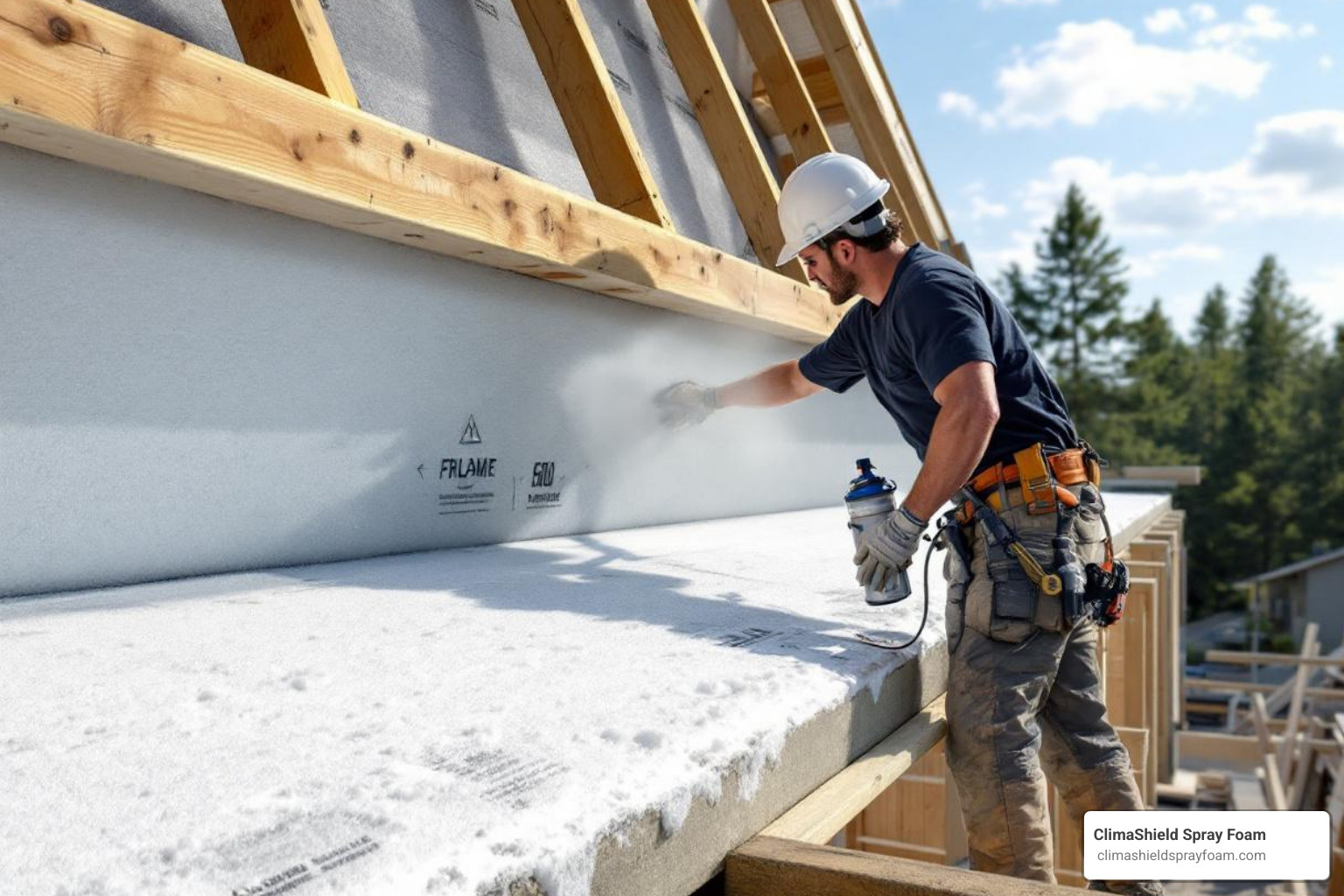
Choosing Materials for Above Rafter Insulation
While rigid foam boards are an option, we at ClimaShield Spray Foam champion Spray Polyurethane Foam (SPF) for its unparalleled benefits in above rafter insulation:
- Seamless Air Barrier: Spray foam expands to fill every gap, creating a monolithic, airtight layer that eliminates air leakage and prevents moisture ingress.
- High R-value: Closed-cell spray foam offers an impressive R-value of R-6 to R-7 per inch, providing superior thermal performance with less thickness.
- Structural Strength: Once cured, closed-cell spray foam adds rigidity to the roof deck, enhancing its resistance to wind and other forces.
- Water Resistance: Closed-cell spray foam is highly resistant to water absorption, adding a crucial layer of moisture protection for your roof structure.
Step-by-Step Installation Guide
The process for installing above rafter insulation is systematic and ensures a robust, energy-efficient roof. Here’s a general overview:
- Prepare the Roof Deck: The existing roof covering is removed, and the deck is inspected and prepared.
- Install a Vapour Control Layer (VCL): A membrane is installed on the interior side of the roof deck to prevent moisture from inside the home from reaching the roof structure.
- Apply Spray Foam Insulation: Our technicians apply spray foam directly onto the exterior of the roof deck, covering it and the rafters to create a continuous, airtight layer.
- Install a Breathable Membrane: A vapour-open, water-resistant underlay is placed over the insulation as a secondary moisture barrier.
- Fix Counter-Battens: Timber counter-battens are installed over the rafters, creating a ventilation cavity.
- Install Tiling Battens and Roof Covering: Horizontal battens are fixed, and the final roof covering (shingles, tiles, etc.) is installed.
This meticulous process, especially when using our high-performance spray foam, guarantees the long-term durability and thermal efficiency of your roof. This method is also ideal for commercial insulation projects seeking maximum energy efficiency.
Key Considerations and Potential Challenges
While above rafter insulation offers superior benefits, it’s important to consider the practicalities. The main points are the higher initial cost, the need for professional installation, and compliance with building codes.
Building Codes and Regulations
Any major roof alteration must comply with local building codes. In Pennsylvania, these codes ensure safety, structural integrity, and energy efficiency.
Key aspects include:
- U-value Requirements: Codes specify maximum U-values (a measure of heat transfer). Above rafter insulation easily meets and exceeds these standards.
- Fire Safety: Insulation materials must meet fire safety codes. Our spray foam products are tested and installed to comply with all regulations.
- Structural Load: Adding insulation and new roofing materials increases the load on your rafters. We ensure that structural calculations are performed to confirm your roof can safely support the new weight.
Navigating these codes can be complex, but our professional team is well-versed in Pennsylvania’s requirements, ensuring your project is fully compliant. You can find more general information on State Energy Code Fact Sheets.
Cost vs. Performance
Above rafter insulation has a higher upfront cost than traditional methods, typically ranging from $7–$12 per square foot, compared to $3–$6 for between-rafter insulation. This is due to the more involved process, which includes removing and replacing the roof covering.
However, this is an investment with a significant return. The benefits include:
- Major Energy Savings: You can save up to 60% on your energy bills, which accumulate over time.
- Increased Home Value: Adding usable, conditioned living space in the attic boosts your property’s market value.
- Improved Comfort: Enjoy consistent temperatures and no drafts.
- Long-Term Durability: Protecting the roof structure extends its lifespan and reduces future repair costs.
While the initial cost is higher, the long-term savings and added value make above rafter insulation a smart financial decision for your home. Learn more about how this can impact your energy bill.
Frequently Asked Questions about Above-Rafter Insulation
We often hear similar questions from homeowners considering above rafter insulation. Let’s tackle some of the most common ones to give you a clearer picture.
Can I install above-rafter insulation on an existing roof?
Yes, but it’s most practical during a major re-roofing project. The process requires removing the existing roof covering (shingles, tiles, etc.) to access the roof deck and rafters. This makes it an ideal upgrade when your roof already needs replacement, allowing for a seamless and efficient installation.
Does a roof with above-rafter insulation need to be ventilated?
No, a properly installed above rafter insulation system creates an unvented or “warm” roof. The continuous insulation layer keeps the entire roof structure, including the rafters, within the home’s conditioned thermal envelope. This prevents the temperature differences that cause condensation, eliminating the need for traditional attic ventilation and improving overall energy efficiency.
What U-value or R-value can be achieved?
The achievable R-value (a measure of thermal resistance) is very high. Because above rafter insulation creates an unbroken thermal barrier, it eliminates thermal bridging through the rafters, allowing the insulation to perform at its maximum potential. With high-performance closed-cell spray foam, which offers an R-value of R-6 to R-7 per inch, we can easily meet and exceed modern energy code requirements, ensuring superior thermal performance and significant energy savings.
The Ultimate Solution for a High-Performance Roof
We’ve explored above rafter insulation, from its fundamental differences with traditional methods to its myriad benefits and installation considerations. It’s clear that this approach represents a significant leap forward in home energy efficiency and comfort.
By choosing above rafter insulation, you’re opting for:
- Superior thermal performance that wraps your home in a continuous, thermal bridge-free blanket.
- Significant energy savings that can dramatically reduce your heating and cooling bills, putting money back in your pocket year after year.
- Increased living space by changing your attic into a comfortable, conditioned room, maximizing your home’s usable square footage and value.
- Improved comfort with consistent indoor temperatures, eliminating cold spots and drafts, and protecting your roof structure from external elements.
- A smart, long-term investment that not only pays for itself over time through energy savings but also adds lasting value and durability to your property.
For the best results in creating a seamless, airtight, and highly insulated roof, we firmly believe in the benefits of spray foam. Its ability to create a seamless, high-R-value barrier makes it the ideal choice for above rafter insulation, delivering the performance and peace of mind you deserve.
Ready to transform your home with a high-performance roof? Explore the many uses of spray foam and contact us to see how we can help you build a more comfortable, energy-efficient future.
