
Why Spray Foam for Lifting Concrete is Getting Attention
Spray foam for lifting concrete is a modern method that uses expanding polyurethane foam to raise sunken slabs back to their original position. While professional concrete lifting with specialized foam offers fast, precise, and durable results, DIY attempts with canned spray foam often lead to damage, safety hazards, and costly repairs.
Quick Answer: Should You Use Spray Foam to Lift Concrete?
| Approach | Foam Type | Result | Best For |
|---|---|---|---|
| Professional | High-density polyurethane (4+ lb/ft³) | Precise, durable lift with warranty | Driveways, patios, sidewalks, pool decks |
| DIY Canned Foam | Low-density insulation foam | Over-lifting, damage, structural failure | Not recommended for concrete lifting |
| DIY Kits | Variable quality | High risk without proper equipment | Requires training and specialized tools |
If you’ve seen YouTube videos of homeowners pumping canned spray foam under a sunken sidewalk or garage floor, you might wonder if it’s a viable solution. The reality is that professional-grade polyurethane foam is engineered specifically for concrete lifting, while canned spray foam is designed for insulation and sealing gaps—not supporting heavy loads.
Sunken concrete creates real problems. Uneven driveways, sidewalks, and patios aren’t just unsightly—they’re trip hazards that can lead to injuries and liability issues. Water pools in low spots, creating ice in winter and accelerating further damage. Left untreated, the problem only gets worse as soil continues to erode beneath the slab.
Professional concrete lifting can save up to 70% compared to replacement and is typically completed within hours. The foam cures rapidly (often in 15-30 minutes), the concrete is immediately usable, and the repair lasts for decades. In contrast, DIY attempts with improper materials frequently result in over-lifting, cracking, or incomplete void filling that requires expensive professional correction.
I’m Dave Brocious, and with 20 years in the coatings industry and as the founder of ClimaShield Industries, I’ve seen how professional spray foam for lifting concrete delivers lasting results when applied correctly with the right equipment and expertise. Understanding the difference between professional-grade geotechnical foam and consumer insulation products is the first step toward making an informed decision about your sunken concrete.
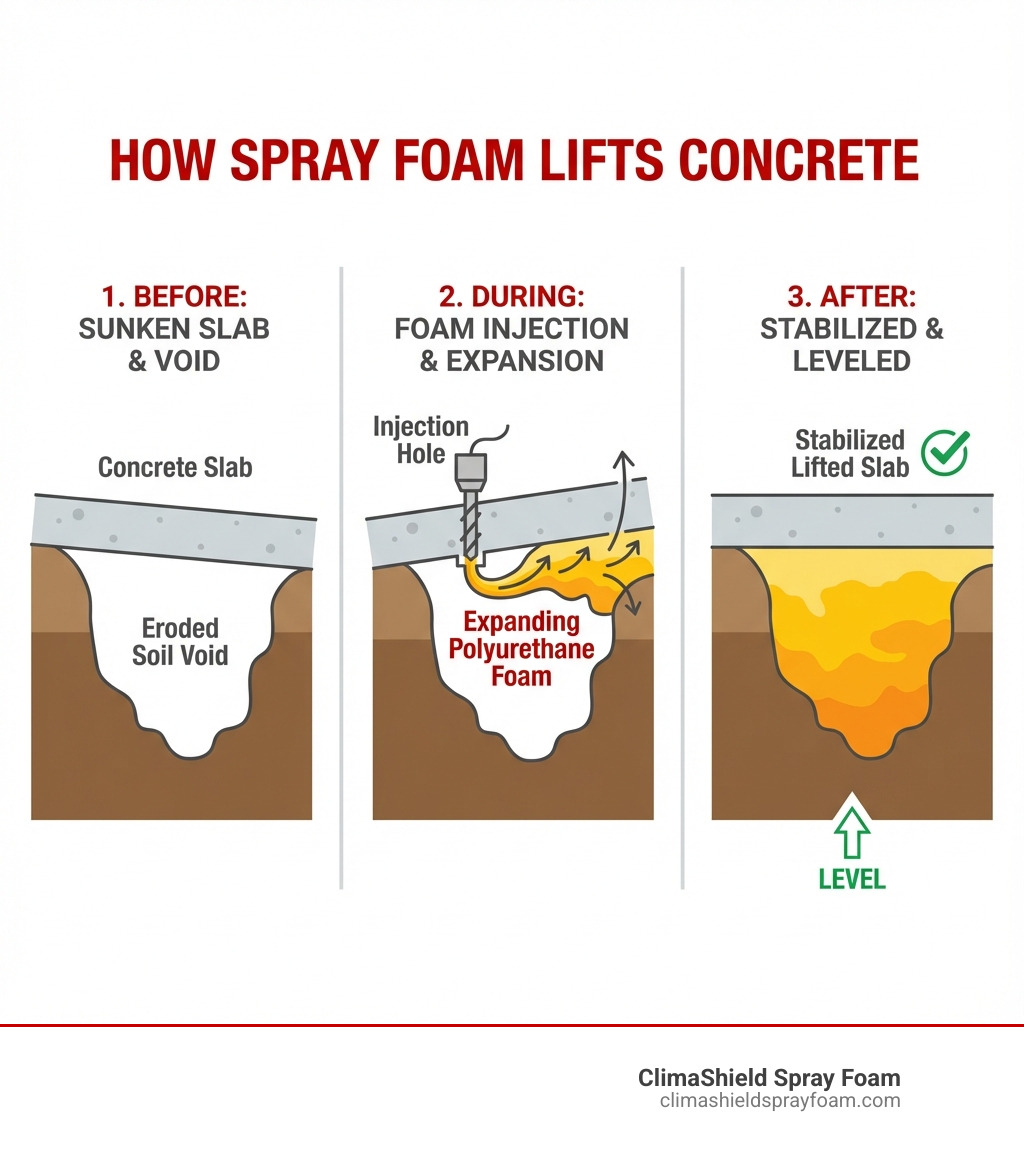
Step 1: Know the Material – What is Concrete Lifting Foam?
When we talk about spray foam for lifting concrete, we’re specifically referring to a specialized material: high-density polyurethane foam. This isn’t the same stuff you grab from the hardware store to seal a window gap; it’s an engineered solution designed for demanding geotechnical applications.
Polyurethane foam used for concrete lifting is typically a two-component system. This means two liquid chemicals are mixed together at the point of application, initiating a rapid chemical reaction that causes the mixture to expand and harden. This controlled expansion is what allows us to lift heavy concrete slabs.
Key characteristics of this material include its high-density and closed-cell structure. High density is crucial because it provides the compressive strength needed to support the immense weight of concrete. Unlike lower-density foams, professional-grade lifting foam won’t compress or degrade under load. The closed-cell structure means the foam is largely impervious to water. This is a significant advantage, as it prevents moisture absorption, helps stabilize the soil beneath, and prevents future erosion, which is often the root cause of sunken concrete. In fact, when water is present under concrete structures, the system creates a hydrophobic MDI, effectively pushing water away.
Another benefit of this material is its lightweight properties. Compared to traditional mudjacking methods that use heavy cementitious grout, polyurethane foam is significantly lighter—up to 28 times lighter than cement grout. This reduced weight puts less stress on the underlying soil, minimizing the risk of future settling.
The foam’s ability to expand and harden quickly is central to its effectiveness. As it expands, it flows into and fills any voids beneath the concrete slab, effectively stabilizing the soil and creating a solid, supportive base. This expansion is precise, allowing us to lift concrete with incredible accuracy, often within 1/8 of an inch.
Professional-grade spray foam for lifting concrete is a robust, engineered material specifically formulated to:
- Fill subterranean voids.
- Provide stable, long-lasting support.
- Resist water and prevent further erosion.
- Lift concrete slabs precisely and efficiently.
This specialized foam is a far cry from the consumer-grade products available, and understanding this distinction is the first critical step in addressing sunken concrete effectively and safely.
Step 2: Learn the Process – How Professionals Lift Concrete with Foam
At ClimaShield Spray Foam, our approach to concrete lifting is a precise, multi-step process that ensures effective and long-lasting results. It all begins with a thorough site assessment. We carefully evaluate the extent of the concrete settlement, identify potential causes like soil erosion or poor compaction, and check for any underlying utilities to ensure a safe and efficient operation in Indiana PA and throughout Pennsylvania.
Next, we prepare the concrete slab for injection. This involves strategic drilling of small, unobtrusive holes—typically just 5/8-inch in diameter—into the affected concrete. These holes are carefully placed to ensure even foam distribution and controlled lifting. This minimal drilling is far less invasive than the larger holes required for traditional mudjacking, which can be 1.5 to 2 inches in diameter.
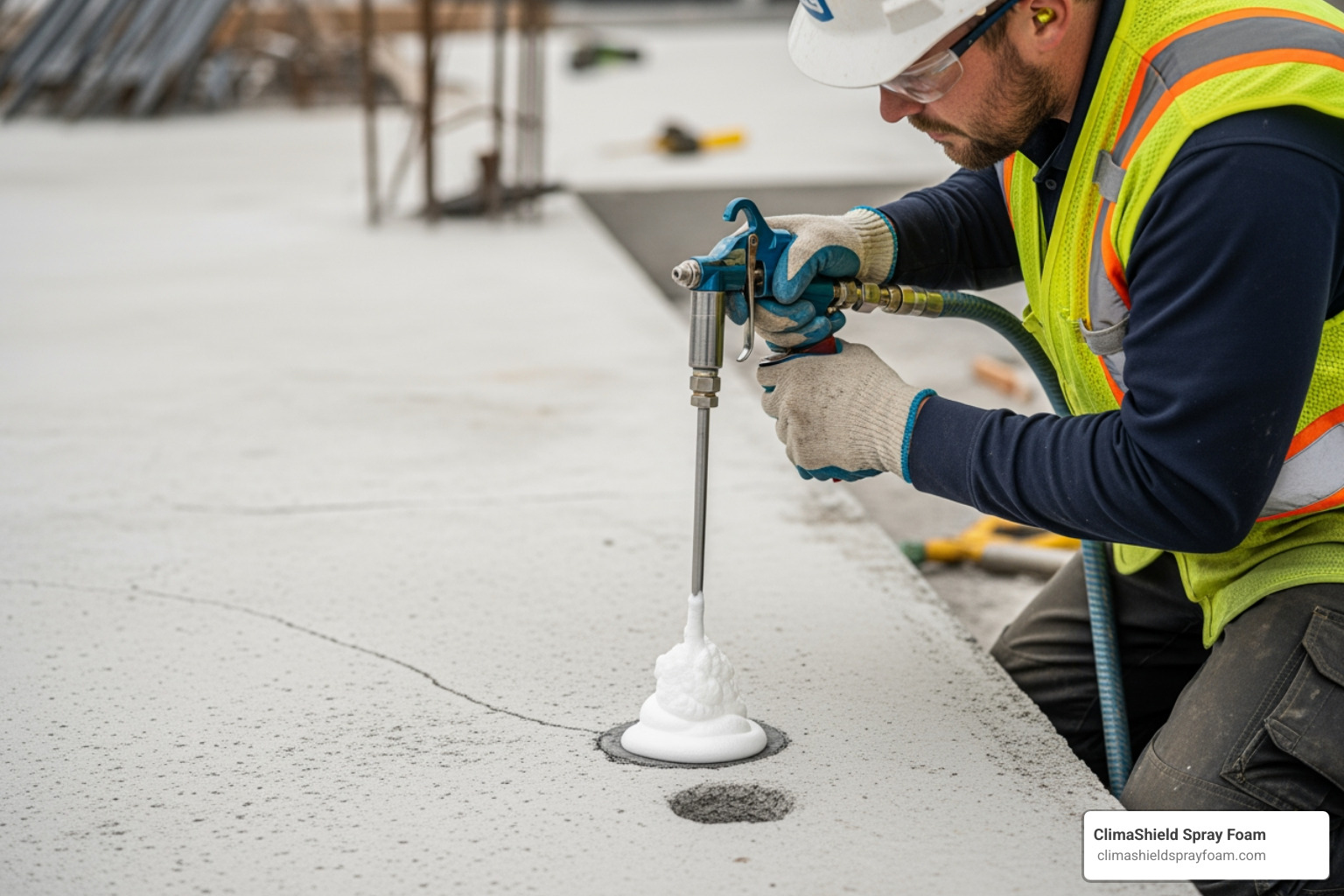
Once the holes are drilled, our trained technicians use specialized equipment to inject foam beneath the slab. This isn’t a hand-held can; it’s a high-pressure, plural-component spray system operating at 800-1000 psi, with component temperatures precisely controlled between 110°F and 125°F. This powerful equipment ensures the two-part polyurethane foam mixes correctly and expands as intended.
As the foam is injected, it flows into the voids under the concrete, expanding to fill them completely. This expansion creates an upward force that allows for a controlled lift. Our technicians constantly monitor the slab’s movement using laser levels or other measuring devices, ensuring the concrete is raised precisely to its desired level without over-lifting or cracking. This precision is a hallmark of professional foam lifting, allowing us to achieve results within 1/8″ accuracy.
One of the most impressive aspects of professional spray foam for lifting concrete is its rapid curing time. The foam cures in minutes, achieving 90% of its full compression strength after just 15 minutes. This means the repaired surface is typically ready for use almost immediately—you can often park a car on a driveway that’s been foam-lifted within 15 to 30 minutes! This drastically reduces downtime compared to other methods.
Finally, after the concrete is lifted and the foam has cured, we address the small injection holes. These are neatly patched with a cement-based filler that matches the existing concrete, leaving a clean, finished appearance. The entire process is designed for minimal disruption to your property and landscaping, completing most projects within a few hours.
The effectiveness and efficiency of this process are why professional spray foam for lifting concrete is becoming the preferred solution for many concrete problems. It’s a testament to the versatility of spray foam technology, which has many other applications beyond just lifting concrete. More info about the many uses of spray foam.
Step 3: Why Professional Spray Foam Lifting is the Smart Choice
Choosing professional spray foam for lifting concrete is a smart investment for homeowners and businesses in Indiana PA and Pennsylvania. It’s a solution that offers numerous advantages over traditional repair methods and certainly over risky DIY attempts. Here’s why:
| Feature | Professional Spray Foam Lifting | Traditional Mudjacking | DIY Canned Spray Foam |
|---|---|---|---|
| Cost-effectiveness | Saves up to 70% vs. replacement | Cheaper than replacement, but heavier material | Cheaper upfront, but costly repairs if failed |
| Time Savings | Completed within hours, fast cure (15-30 min) | Takes longer, multi-day cure | Quick application, but slow/unpredictable cure for lifting |
| Invasiveness | Small 5/8″ holes, minimal disruption | Larger 1.5-2″ holes, more mess | No drilling for surface use, but uncontrolled lifting |
| Material Weight | Lightweight, reduces future settling | Heavy cementitious grout, can cause more settling | Very lightweight, but lacks structural strength |
| Precision | 1/8″ accuracy, controlled lift | Less precise, harder to control | Unpredictable, high risk of over-lifting |
| Durability | Long-lasting, waterproof, soil stabilization | Can re-settle due to weight/erosion | Very poor, short-term, not designed for load bearing |
| Warranty | Often includes professional warranty | Varies by contractor | None, high risk of failure |
| Safety | Trained professionals, safety protocols | Can be hazardous with heavy equipment | High risk of injury, chemical exposure, property damage |
As you can see, the benefits are clear. Professional concrete leveling is usually done within a few hours, and it can last for the life of the concrete itself, assuming underlying issues are addressed. This means less disruption to your daily life and a faster return to normal use of your driveways, sidewalks, and patios.
Why Not Use Canned Spray Foam or DIY Kits?
Many people wonder, “Can canned spray foam lift concrete slabs?” Technically, yes—it can exert some upward pressure. However, using canned spray foam or generic DIY kits for concrete lifting is a recipe for disaster. While it might seem like a cost-effective solution upfront, the long-term consequences often lead to more expense and frustration.
The fundamental issue lies in the design and properties of these products. Canned foam is primarily intended for insulation and sealing gaps—applications where its low density and moderate expansion are perfectly suitable. It is not engineered to support the immense weight of a concrete slab.
Here’s why we strongly advise against using canned spray foam for lifting concrete:
- Low-density and Lack of Structural Strength: Canned foams are typically low-density and open-cell, meaning they lack the compressive strength required for structural support. They will crush under the weight of concrete, leading to rapid re-settlement.
- Unpredictable Expansion: The expansion of canned foam is often uncontrolled and difficult to gauge, especially when injected into an unseen void. This can lead to irreversible over-lifting, where the slab is pushed too high, creating new trip hazards or even cracking the concrete.
- Not Designed for Lifting: These products are made for filling small gaps, not for exerting controlled, significant lifting force. They form “pancakes” under the slab, leaving unfilled pockets and uneven support.
- Risk of Failure: Because canned foam lacks the necessary strength and control, any lift achieved will likely be temporary, failing quickly and requiring professional intervention to fix the original problem, plus the damage from the failed DIY attempt.
- Moisture Sensitivity: Some canned foams can be sensitive to moisture, compromising their effectiveness when used in damp conditions common under concrete slabs.
- Mess and Staining: Uncontrolled expansion can lead to foam oozing out of cracks or joints, creating a sticky, unsightly mess that is difficult to remove and can permanently stain concrete and surrounding surfaces.
As experts, we cannot stress enough that professional-grade foam and equipment are required for safe, effective results when lifting concrete. Don’t be fooled by tempting YouTube videos; the specialized, high-density polyurethane we use is a completely different product designed for a completely different job.
Step 4: Recognize the Risks – Why DIY Concrete Lifting Often Fails
The allure of a quick, cheap fix for sunken concrete with a can of spray foam is strong, especially after watching a few viral videos. However, we’ve seen the significant and often expensive problems that arise from DIY concrete lifting attempts. The risks far outweigh any perceived savings.
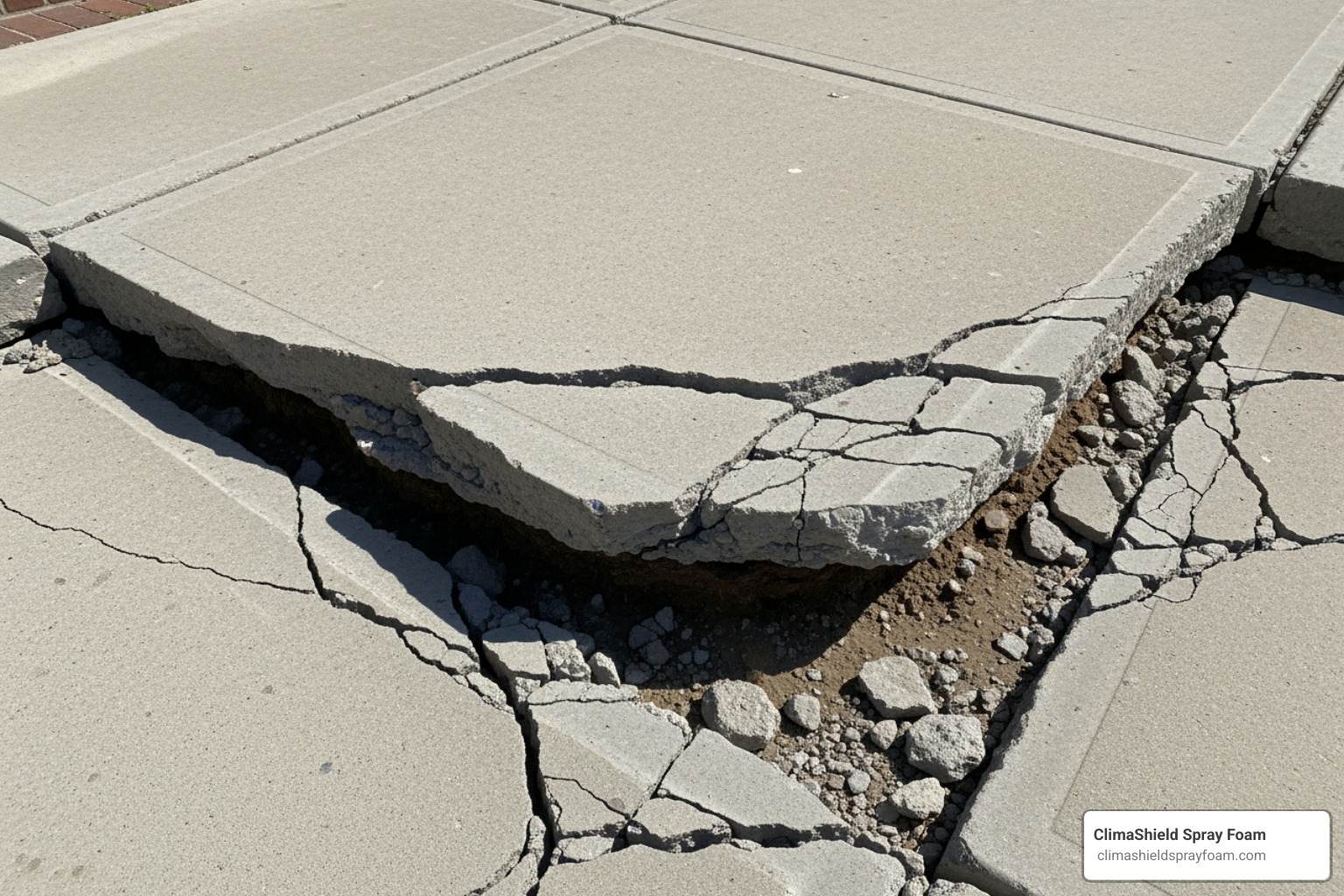
Common DIY Failures and Damage
When homeowners attempt to lift concrete with canned spray foam, they often encounter a range of issues that can exacerbate the original problem:
- Irreversible Over-lifting: This is perhaps the most common and frustrating failure. Canned foams expand unpredictably. Once the foam cures, there’s no way to undo an over-lifted slab without breaking it apart. This can create a new, even more dangerous trip hazard. We’ve seen instances where DIYers pumping canned spray foam under a sunken sidewalk or garage floor resulted in over-expansion, lifting not just the intended slab but also adjacent walkway slabs, causing new problems. See an example of a risky DIY attempt.
- Uneven Surfaces: Without precise control and monitoring equipment, it’s nearly impossible to achieve a level surface. The foam might expand more in one area than another, leading to a wavy or tilted slab.
- Cracking the Slab: Concrete is strong, but it’s also brittle. Uneven lifting or excessive pressure from uncontrolled foam expansion can easily cause the slab to crack, turning a repairable problem into a need for full replacement. Professionals often saw-cut slabs to prevent them from sticking together or cracking during a lift, a step rarely considered in DIY.
- Damaging Adjacent Property: Uncontrolled foam can push against nearby structures, walls, or landscaping, causing damage that extends beyond the concrete slab itself.
- Incomplete Void Fill (“Pancakes”): Canned foams tend to form layers or “pancakes” under the slab, leaving significant air pockets and voids. This means the slab isn’t fully supported, leading to rapid re-settlement and an ineffective repair.
- Wasted Material and Messy Cleanup: Multiple cans of foam are often needed, costing more than anticipated. If the foam expands out of control, it can create a sticky, hard-to-remove mess on the concrete surface, surrounding areas, and even your tools.
Failed DIY jobs often cost more to fix in the long run. What started as a small, fixable problem can become a major, expensive headache requiring professional intervention to correct both the original issue and the damage from the DIY attempt.
Potential Safety Hazards of DIY Foam Lifting
Beyond property damage, attempting DIY concrete lifting with foam presents serious safety hazards:
- Chemical Exposure: Polyurethane foams contain isocyanates, which can be irritants and sensitizers. Without proper ventilation and personal protective equipment (PPE), exposure can lead to respiratory issues, skin irritation, and allergic reactions.
- Need for PPE: Professional application requires gloves, safety goggles, and respirators. DIYers often overlook these critical safety measures, putting themselves at risk.
- High-Pressure Injection Risk: While professional systems use high pressure, they are operated by trained individuals. DIY attempts to create pressure or use improvised injection methods can result in uncontrolled foam discharge or material coming back out of the injection point, causing injury.
- Uncontrolled Slab Movement: Lifting heavy concrete slabs is dangerous. If the slab moves unexpectedly or tips, there’s a risk of crushing injuries to hands, feet, or other body parts. We always recommend keeping fingers and toes clear of moving slabs, a critical safety warning that DIYers may disregard.
- Silica Dust from Drilling: Drilling into concrete generates crystalline silica dust, a known respiratory hazard. Proper dust control measures, such as shrouds and vacuum systems, are essential, along with appropriate respiratory protection (OSHA 1926.1153). Ignoring this can lead to serious lung conditions over time.
For these reasons, we strongly recommend leaving spray foam for lifting concrete to the professionals. Your safety, and the integrity of your property, are simply too important to risk.
Step 5: Choose the Right Solution – Recommendations for Sunken Concrete
When faced with sunken concrete, making the right decision is crucial for the longevity of your property and the safety of your family or customers. While DIY options might appear tempting, we at ClimaShield Spray Foam firmly believe that professional solutions offer the best value, durability, and peace of mind.
Why Professional Concrete Lifting is the Best Choice
For most cases of sunken, settled, or uneven concrete in Indiana PA and Pennsylvania, professional spray foam for lifting concrete is unequivocally the best choice. Here’s why:
- Precision and Control: Our trained technicians use specialized equipment and techniques to achieve an incredibly precise lift, often within 1/8 of an inch. This level of control is impossible to achieve with DIY methods, ensuring a perfectly level and stable surface.
- Durable, Long-lasting Results: The high-density, closed-cell polyurethane foam we use is engineered to provide permanent support. It’s waterproof, resists erosion, and stabilizes the underlying soil, preventing future settlement. This means your lifted concrete will remain level for decades, often for the life of the concrete itself.
- Warranty: Unlike DIY projects, professional concrete lifting services typically come with a warranty, giving you confidence in the quality and longevity of the repair.
- Peace of Mind: Knowing that your concrete is safely and professionally repaired eliminates trip hazards, prevents further water damage, and protects your property’s value.
- Cost Savings: Professional concrete lifting can save you a significant amount of money—up to 70% off the cost of full concrete replacement. This is because it’s less labor-intensive, requires less material than replacement, and the job is completed quickly.
- Minimal Disruption: The process is fast, clean, and minimally invasive, often completed within a few hours. You can use the repaired surface almost immediately, avoiding the long curing times and extensive demolition associated with replacement.
At ClimaShield Spray Foam, we specialize in providing these reliable solutions. Learn more about professional Geotech Slab Lifting.
When to Consider Other Concrete Repair Approaches
While professional spray foam for lifting concrete is highly versatile and effective for a wide range of applications—from driveways and sidewalks to patios and pool decks—there are specific situations where other approaches might be necessary:
- Severely Cracked or Crumbling Slabs: If a concrete slab is extensively cracked, severely spalled, or crumbling, it may have lost too much structural integrity to be effectively lifted. In such cases, full replacement might be the only viable option. Foam lifting works best when the concrete is still largely intact.
- When to Consult a Professional for Assessment: If you’re unsure about the condition of your concrete or whether foam lifting is appropriate, always consult with a professional. We can assess the slab’s integrity, identify the underlying causes of settlement, and recommend the most suitable and cost-effective solution for your specific situation. This expert assessment can save you from costly mistakes and ensure you get the right repair.
Addressing sunken concrete promptly is key. Ignoring it can lead to liability issues, structural damage to adjacent foundations or walls, vehicle damage, and increased water pooling, which can cause slick surfaces and ice accumulation.
Frequently Asked Questions About Concrete Lifting Foam
We understand you might have more questions about this innovative solution. Here are some of the most common inquiries we receive:
How long does professional spray foam for lifting concrete last?
When applied professionally, spray foam for lifting concrete is designed for durability and longevity. The high-density, closed-cell polyurethane foam is incredibly stable and resistant to environmental factors. It addresses the underlying soil issues by filling voids and stabilizing the base, which is often the cause of settlement in the first place. Its water-resistant properties prevent future erosion beneath the slab. In many cases, a professionally lifted concrete slab with foam can last for the lifespan of the concrete itself, providing a permanent solution that you won’t have to revisit year after year.
Can any sunken concrete be lifted with spray foam?
Professional spray foam for lifting concrete is incredibly versatile and can be used for a wide range of applications. We regularly lift and level sunken driveways, sidewalks, patios, pool decks, and garage floors for our clients in Indiana PA and Pennsylvania. It’s also effective for basement floors, hot tub pads, and even commercial pavements.
However, there are limitations. The most significant one is the condition of the concrete itself. If the slab is severely cracked or crumbling, foam lifting may not be possible or effective. In these instances, the concrete may have lost too much structural integrity to be lifted safely or to hold together after the lift. A professional assessment is always recommended to determine the best course of action.
How does spray foam for lifting concrete compare to traditional methods?
Spray foam for lifting concrete offers several key advantages over older, traditional methods like mudjacking:
- Hole Size: One of the most noticeable differences is the hole size. Foam lifting requires only small, 5/8-inch diameter holes for injection, which are easily patched and blend seamlessly with the existing concrete. Mudjacking, conversely, requires much larger holes, typically 1.5 to 2 inches in diameter, which are more intrusive and noticeable.
- Material Weight: The material weight is another major distinction. Professional polyurethane foam is incredibly lightweight, up to 28 times lighter than the cementitious grout used in mudjacking. This reduced weight puts less stress on the underlying soil, significantly reducing the risk of future settlement. Mudjacking’s heavy grout can sometimes contribute to further sinking over time.
- Cure Time: Foam lifting boasts a remarkably fast cure time—minutes, not days. Most foam is ready for full load-bearing in 15-30 minutes, allowing immediate use of the repaired area. Mudjacking can take days for the grout to fully cure and achieve strength, meaning extended downtime.
- Invasiveness: Because of the smaller holes and lighter material, foam lifting is a much less invasive process. There’s less mess, less heavy equipment on your property, and minimal disruption to your landscaping.
- Water Resistance: Polyurethane foam is a closed-cell material, making it water-resistant and hydrophobic. This means it won’t absorb water, helping to prevent future erosion and stabilize the soil. Mudjacking grout can still be susceptible to water erosion over time.
In summary, professional spray foam for lifting concrete is a modern, efficient, and superior alternative that provides faster, cleaner, and more durable results compared to traditional methods. It’s often considered the best alternative to DIY foam lifting.
Conclusion
We’ve explored spray foam for lifting concrete in five easy steps, from understanding the specialized material to recognizing the risks of DIY and appreciating the benefits of professional intervention. The key takeaway is clear: while the concept of using expanding foam to lift concrete is sound, the execution and material choice are paramount.
DIY attempts with canned spray foam are not only ineffective for heavy concrete slabs but also carry significant risks, from irreversible over-lifting and cracking to chemical exposure and personal injury. These shortcuts often lead to more costly repairs in the long run.
In contrast, professional spray foam for lifting concrete is a smart investment that provides a fast, effective, and long-lasting solution for your sunken concrete problems. It’s less disruptive than full replacement, can save you up to 70% compared to replacement costs, and offers the precision and durability you need.
At ClimaShield Spray Foam, we are committed to providing top-tier professional concrete lifting services throughout Indiana PA and Pennsylvania. We use specialized, high-density polyurethane foam and employ trained technicians to ensure your concrete is lifted safely, precisely, and permanently.
For a permanent solution to your sunken concrete, explore our professional slab lifting services. Let us help you restore the safety and appearance of your property with confidence and expertise.
