
Why Pest-Resistant Spray Foam is Your Home’s Best Defense
Pest resistant spray foam is an insulating material that creates a seamless physical barrier by filling gaps and cracks where pests commonly enter your home, while also providing superior insulation and air sealing. Unlike traditional insulation materials, it’s not a food source or ideal nesting material, making it less attractive to rodents, insects, and other unwanted critters.
Quick Answer: Top Pest-Blocking Foam Solutions
- GREAT STUFF Pestblock – Specifically designed to block insects and pests, seals gaps up to 1 inch, pesticide-free
- Closed-Cell Spray Foam (2 lb/ft³) – Dense, rigid barrier that’s difficult for pests to chew through, R-value of 6.5 per inch
- Airkrete Magnesium Oxide Foam – Desiccant properties that literally dry out insects, abrasive texture wears down exoskeletons
- Open-Cell Spray Foam (0.5 lb/ft³) – Expands to fill cavities, creates airtight seal blocking tiny entry points, not ideal for nesting
You’ve probably dealt with the frustration of hearing mice scurrying in your attic or watching ants invade your kitchen despite your best efforts. The truth is, pests are resourceful—they can squeeze through openings as small as a quarter inch. Traditional insulation materials like fiberglass or cellulose can actually provide ideal nesting spots for rodents, making the problem worse.
Here’s what makes spray foam different: It creates an airtight seal that blocks tiny entry points insects use to crawl through walls, ceilings, and floors. For larger pests like mice and rats, the foam closes off the avenues they’d otherwise use to enter your crawl space or attic. Most importantly, spray foam isn’t a food source and its rigid structure (especially closed-cell foam) makes it challenging for pests to carve out nesting areas.
The research is clear: homeowners face fewer pest infestations with spray foam insulation than with traditional materials. Some specialty formulations like Airkrete even have desiccant properties that actively dehydrate insects, causing their exoskeletons to wear away.
I’m Dave Brocious, founder of ClimaShield Industries, with 20 years of experience in the coatings industry and specialty applications including pest resistant spray foam insulation for commercial and residential properties. Throughout my career, I’ve seen how proper foam application transforms pest-prone homes into sealed fortresses.
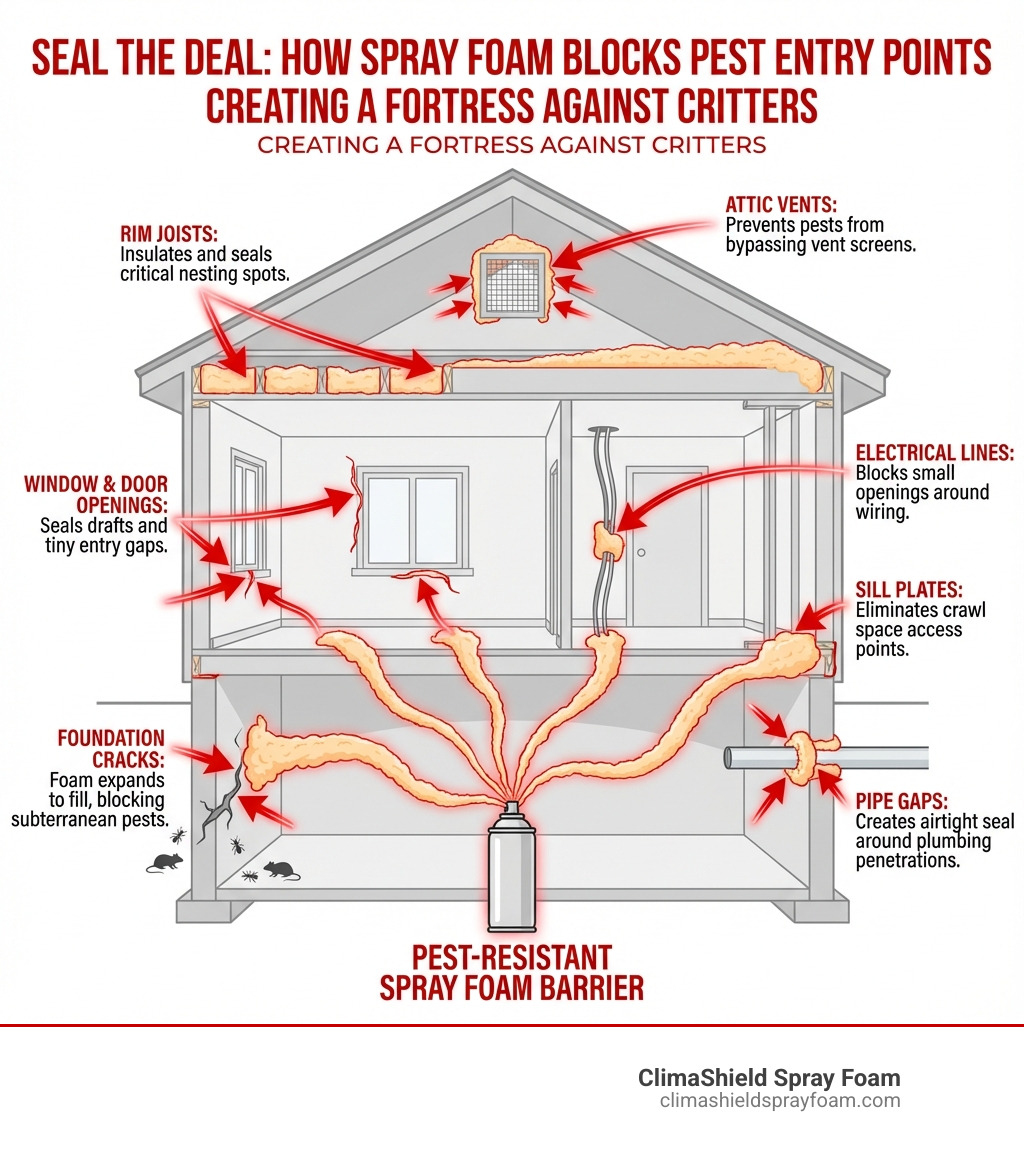
How Spray Foam Creates a Fortress Against Pests
When we talk about creating a fortress against pests, we’re not just using a fancy metaphor—we’re describing the tangible, physical barrier that pest resistant spray foam provides. Unlike fluffy, fibrous insulation that pests can easily tunnel through or nest within, spray foam hardens into a dense, impenetrable layer that actively deters unwelcome guests.
The primary mechanism behind spray foam’s pest-resistant qualities is its ability to form a complete, airtight seal. This seal is crucial because it eliminates the tiny cracks, gaps, and holes that serve as common entry points for all sorts of critters. Imagine a mouse needing only a quarter-inch gap to squeeze through, or an ant finding its way through a hairline crack. Traditional insulation leaves plenty of these vulnerabilities. Spray foam, however, expands to fill every void, creating a monolithic barrier.
Furthermore, spray foam is an inhospitable material for pests. It offers no nutritional value, meaning rodents won’t find it an appealing food source. Its cured structure, particularly closed-cell foam, is too dense and rigid to be easily carved out for nesting. This is a significant advantage over materials like fiberglass or cellulose, which can become cozy homes for mice, rats, and insects. For more information on the various applications of this versatile material, you can explore the many Uses of Spray Foam.
This comprehensive sealing not only deters pests but also aligns with the principles of creating a “Perfect Wall” system, where insulation acts as multiple control layers—water, air, vapor, and thermal. By excelling in these areas, spray foam significantly improves your home’s envelope, making it far less inviting for pests. You can dig into the technical aspects of exterior spray foam as a control layer by reviewing BSI-048: Exterior Spray Foam .
The Science of Deterrence: From Physical Blocks to Desiccant Dust
The science behind how pest resistant spray foam deters pests is fascinating and multifaceted. It goes beyond just filling a hole; it involves the physical and sometimes even chemical properties of the foam itself.
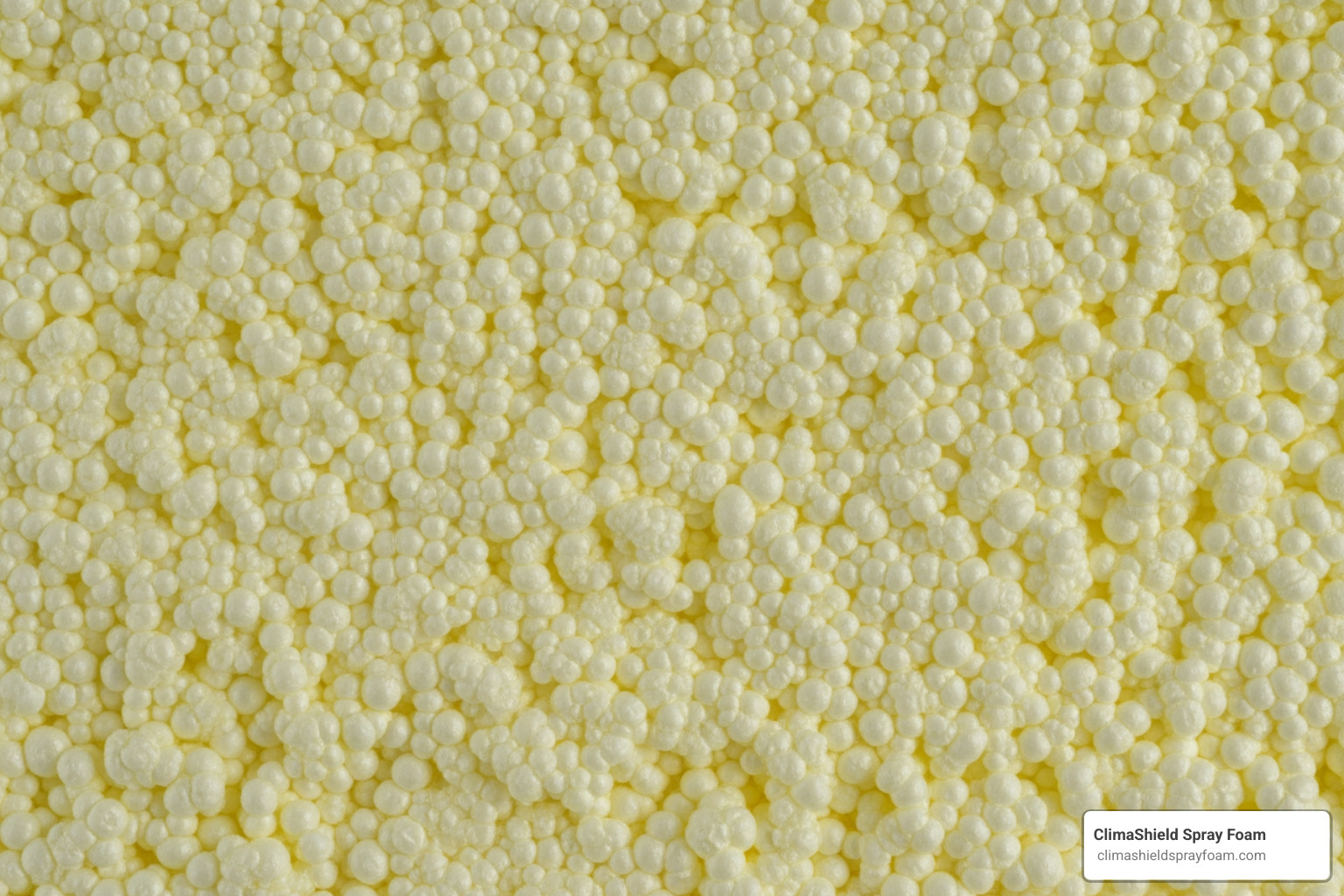
At its core, the rigidity of cured foam is a major deterrent. Closed-cell spray foam, in particular, forms a dense, hard structure that is incredibly difficult for rodents to chew through. Its tightly packed cells create a robust barrier that simply doesn’t yield to their persistent gnawing. While open-cell foam is less rigid, its expansive nature still fills cavities thoroughly, removing the voids that pests seek for shelter and travel. Neither type offers the soft, pliable material that rodents prefer for nesting.
Beyond physical toughness, some advanced foams employ unique properties to repel pests. Certain magnesium oxide foams, for example, are known for their desiccant properties. This means they actively absorb moisture from their surroundings. For insects, this can be devastating: burrowing through such a material induces dryness, causing their exoskeletons to wear away and ultimately leading to dehydration. Insects literally hate it, and cannot survive burrowing through it due to its abrasiveness and de-oiling effect, which dries them up! This isn’t just an inconvenience for pests; it’s a physiological attack that makes the insulated area uninhabitable.
We also see some specialty foams incorporating non-toxic bittering agents. These compounds give the foam an unpleasant taste that deters rodents from chewing on it. It’s a clever, pesticide-free way to add an extra layer of defense without introducing harmful chemicals into your home environment. This means we can achieve effective pest deterrence without harming beneficial insects like bees, as these formulations contain no pesticides.
Targeting Different Critters: Rodents, Insects, and More
The beauty of pest resistant spray foam lies in its broad spectrum of deterrence, effectively targeting a wide array of common household pests.
- Mice and Rats: Our furry friends (or foes, in this case) are constantly looking for shelter, food, and nesting sites. Spray foam’s airtight seal closes off the many avenues rodents would typically use to enter your house and crawl space. More importantly, unlike fibrous insulation, spray foam is not an ideal nesting material or a food source. This makes it significantly less attractive to rodents, often prompting them to seek shelter elsewhere. We’ve seen how mice, rats, and squirrels will move out when pest resistant spray foam moves in!
- Squirrels and Bats: Similar to mice and rats, squirrels and bats often seek refuge in attics, basements, and exterior walls. By sealing off entry points and removing potential nesting cavities, spray foam makes your home a much less appealing habitat for these larger critters.
- Spiders and Ants: These tiny invaders can exploit the smallest cracks. Spray foam insulation’s airtight seal blocks these minuscule entry points for insects, preventing them from crawling through walls, ceilings, and floors. Imagine a solid wall where there used to be a network of hidden highways for ants and spiders—that’s what spray foam delivers.
- Termites: This is a common concern, and it’s important to understand the facts. Spray foam is not a food source for termites. It does not attract them. However, determined termites can burrow through it if they are already established or seeking a path to wood. The key takeaway here is that while spray foam doesn’t invite termites, it also doesn’t eliminate the need for ongoing pest control if these wood-destroying insects are a concern in your area. For some advanced foams with abrasive properties, termites cannot survive burrowing through it.
- Snakes: While less common indoors, snakes can also enter homes through small openings, especially in crawl spaces or foundations. By sealing these gaps, spray foam effectively eliminates their entry paths, helping to keep them outside where they belong.
Pest resistant spray foam works by blocking physical entry, denying nesting sites, and presenting an unappealing or even harmful environment for pests, making your home significantly less vulnerable to infestations.
Choosing the Right Pest Resistant Spray Foam for Your Home
Selecting the ideal pest resistant spray foam involves understanding the different types available and how their properties contribute to pest deterrence and overall home performance. Here’s a comparison to guide your decision:
| Feature | Closed-Cell Foam (e.g., WALLTITE®) | Open-Cell Foam (e.g., ENERTITE®) | Specialty Sealants (e.g., GREAT STUFF Pestblock) |
|---|---|---|---|
| R-value (per inch) | 6.5 – 7.4 (Superior) | 3.5 – 4 (Good) | 3.8 (Small gaps only) |
| Pest Resistance | Excellent (Dense, rigid, difficult to chew, no nesting) | Good (Expands, seals, no nesting, but less rigid) | Good (Bittering agents, physical block for small pests, pesticide-free) |
| Structural Support | Adds significant structural strength | Minimal | Minimal (For sealing, not structural) |
| Moisture Barrier | Excellent (Water-resistant, controls vapor transfer, FEMA-approved) | Limited (Allows moisture vapor to pass, not a moisture barrier) | Good (Water-resistant seal for small gaps) |
High-Density Closed-Cell Foam: The Ultimate Barrier
For an uncompromising defense against pests and the elements, high-density closed-cell foam is often our top recommendation. This type of pest resistant spray foam creates an incredibly dense and rigid barrier that pests find exceptionally difficult to penetrate.
With a superior R-value typically ranging from 6.5 to 7.4 per inch, closed-cell foam offers outstanding thermal performance. But its benefits extend far beyond insulation. Its robust nature adds significant structural rigidity to your home’s walls, providing an extra layer of strength against external forces. Crucially for our climate in Pennsylvania, closed-cell foam acts as an excellent moisture barrier, controlling vapor transfer and resisting water absorption. In fact, some closed-cell foams are even FEMA-approved as flood-damage resistant materials, a testament to their durability. This dense, unyielding structure makes it incredibly difficult for pests to chew through, eliminating their ability to create tunnels or nesting sites.
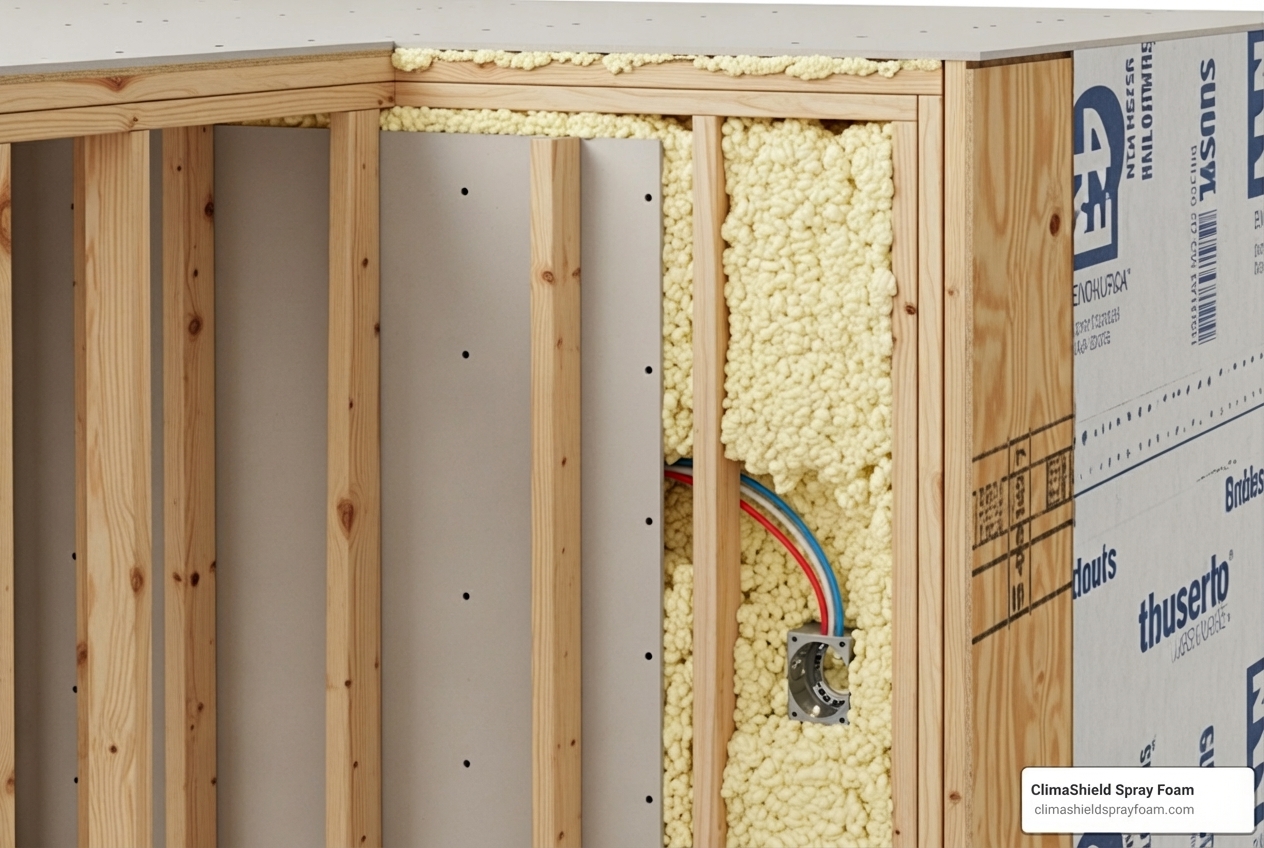
Open-Cell Foam: A Budget-Friendly Deterrent
While not as dense or rigid as its closed-cell counterpart, open-cell foam still offers significant advantages in pest deterrence, often at a more budget-friendly price point. This type of pest resistant spray foam is characterized by its expansive coverage. It flows into every crevice and cavity, expanding to completely fill the space and creating a seamless, airtight seal. This thorough sealing is highly effective at blocking the tiny entry points that insects like spiders and ants exploit.
Open-cell foam is also an excellent sound dampener, significantly reducing noise transfer within your home—a welcome bonus! Critically, like all spray foams, open-cell foam is not a food source and does not provide an attractive nesting material for pests. While its less rigid structure might theoretically be more penetrable by a highly determined rodent compared to closed-cell, the sheer act of filling all voids and denying soft nesting material makes it a powerful deterrent. For more insights into how different insulation types can benefit your home, especially in residential applications, we invite you to explore our page on Residential Insulation.
What to Look for in a Pest Resistant Spray Foam
When considering any pest resistant spray foam solution, whether it’s a whole-house application or a targeted sealant, we advise looking for several key features to ensure optimal performance and safety:
- Pesticide-Free Formulation: We prioritize solutions that deter pests without introducing harmful chemicals. Many effective pest-blocking foams achieve their goal through physical barriers or non-toxic deterrents like bittering agents, ensuring they won’t harm beneficial insects or pose risks to your family or pets.
- Adhesion to Multiple Surfaces: A good foam should adhere reliably to a wide range of common building materials, including wood, metal, masonry, glass, and most plastics. This ensures a consistent, long-lasting seal regardless of the application surface.
- Appropriate Curing Time: For DIY spot applications, a foam that is tack-free within 5-15 minutes and trimmable in about an hour offers convenience. For professional whole-house applications, we manage the curing process to ensure optimal performance.
- Paintable Finish for UV Protection: If you’re applying foam in outdoor areas, such as around exterior pipe penetrations or foundation cracks, it’s crucial that the cured foam can be painted or covered. Cured foam will discolor and eventually crumble if exposed to ultraviolet (UV) light. Painting it protects it from degradation, maintaining its integrity and pest-blocking ability for years to come.
- Water-Resistance: A quality pest resistant spray foam should form a water-resistant seal. This helps prevent moisture intrusion, which is vital for preventing mold growth and maintaining the structural integrity of your home, especially in our often damp Pennsylvania climate.
Beyond the Seal: Other Benefits of Spray Foam Insulation
While our focus here is on keeping pests out, the advantages of installing pest resistant spray foam in your home extend far beyond pest control. We’re talking about a holistic improvement to your living environment, delivering comfort, efficiency, and peace of mind.
- Energy Efficiency: This is where spray foam truly shines. By creating a continuous, airtight seal, spray foam dramatically reduces air leakage—one of the biggest culprits of energy waste in homes. This leads to significantly improved energy efficiency, meaning your heating and cooling systems don’t have to work as hard.
- Lower Utility Bills: The direct result of improved energy efficiency is a noticeable reduction in your monthly utility bills. Our customers often save up to 60% on their energy costs after installing our durable, airtight insulation. That’s real money back in your pocket! You can dive deeper into how spray foam impacts your energy consumption on our page dedicated to Your Energy Bill.
- Air Quality Improvement: By sealing off tiny cracks and gaps, spray foam helps prevent the infiltration of outdoor pollutants, dust, and allergens. This means cleaner, healthier indoor air for you and your family, especially beneficial for those with allergies or respiratory sensitivities.
- Moisture Control and Mold Prevention: Spray foam, particularly closed-cell varieties, forms an excellent moisture barrier. This prevents moisture-laden air from entering your wall cavities, significantly reducing the risk of condensation and, consequently, mold and mildew growth. In Pennsylvania’s humid summers and damp winters, this is an invaluable benefit.
- Sound Reduction: Both open-cell and closed-cell spray foams offer impressive sound-dampening properties. They fill voids and absorb sound waves, creating a quieter and more peaceful indoor environment by reducing noise from outside, between rooms, and even from plumbing and HVAC systems.
When you choose pest resistant spray foam, you’re not just solving a pest problem; you’re investing in a more comfortable, healthier, and energy-efficient home for years to come.
Limitations and Best Practices for Pest Prevention
While pest resistant spray foam is an incredibly powerful tool in your home’s defense arsenal, it’s important to approach pest prevention with realistic expectations and a comprehensive strategy.
Limitations of Pest Resistant Spray Foam
No insulation material, including spray foam, is 100% pest-proof. Pests are remarkably resourceful, and a truly determined rodent might still find a way if the conditions are right.
- Not 100% Pest-Proof: We always emphasize that while spray foam is a superior deterrent, it’s not an impenetrable force field. Pests, especially rodents, are driven by survival and can sometimes overcome barriers.
- Determined Rodents: Rodents and small animals, if sufficiently motivated by food or shelter, can chew through many materials, including some types of spray foam. This is why combining spray foam with other physical barriers is often recommended for high-risk areas.
- Not a Standalone Solution: Spray foam is a crucial component of pest control, but it shouldn’t be your only line of defense. It works best as part of a broader, integrated pest management strategy.
- Importance of a Comprehensive Pest Control Strategy: Effective pest control involves regular inspections, proper sanitation, and, when necessary, professional pest control services. Spray foam provides the foundation, but ongoing vigilance is key.
Best Practices for an Impenetrable Seal
To maximize the pest-resistant benefits of spray foam and achieve an truly impenetrable seal, we follow a set of best practices:
- Professional Installation: This is paramount. Our trained professionals have the expertise to identify all potential entry points, apply the foam correctly, and ensure a seamless, gap-free barrier. Proper mixing and application are critical for the foam to cure optimally and provide its intended resistance.
- Sealing All Entry Points: We conduct thorough assessments to seal every tiny crack, crevice, and penetration—around pipes, electrical lines, vents, and foundation gaps—where pests could potentially enter.
- Combining with Steel Wool or Mesh: For areas particularly vulnerable to determined rodents, like larger gaps or pipe penetrations, we often recommend supplementing the spray foam with physical barriers such as steel wool or copper mesh. These materials are difficult for rodents to chew through, and when encapsulated by spray foam, create an almost unassailable barrier.
- Regular Home Inspections: Even after installation, we encourage homeowners to conduct regular visual inspections of their property. Addressing any new vulnerabilities promptly is part of a proactive pest management plan.
- Proper Sanitation: Keeping your home and yard clean, managing waste properly, and eliminating food sources will always be fundamental to pest prevention, working hand-in-hand with your spray foam insulation.
Safety First: Applying Spray Foam Correctly
When dealing with any specialized building material, safety is always our top priority. While cured pest resistant spray foam is inert and non-toxic, the application process involves chemical components that require careful handling.
The key ingredients in spray polyurethane foam (SPF) include isocyanates, which are reactive chemicals. During the application process, these chemicals are mixed and react, expanding and curing into the foam you see. It’s during this reaction, and before the foam is fully cured, that vapors, aerosols, and dust can be present.
For this reason, professional installation is crucial. Our certified installers are equipped with proper Personal Protective Equipment (PPE), including respirators, gloves, and eye protection, to prevent exposure to these chemicals. We also ensure adequate ventilation during application, often utilizing specialized equipment to vent the area.
A critical aspect of spray foam safety for homeowners is understanding the “vacate and re-entry” times. It’s standard practice for occupants to vacate the premises during installation and for a specified period afterward, allowing the foam to fully cure and any airborne chemicals to dissipate. The exact re-entry time can vary depending on the specific product used, the amount applied, and ventilation conditions, but it’s typically between 24-72 hours. We always provide clear guidance on this to ensure your family’s safety.
Once cured, the foam forms a non-hazardous solid and is considered non-toxic if ingested. However, adhering to safety protocols during application is non-negotiable. For comprehensive information and guidelines on the safe use of spray polyurethane foam, we encourage you to consult resources like the US EPA guidance on spray foam safety. Our commitment is to ensure that your home is not only pest-free and energy-efficient but also a safe environment for everyone.
Conclusion: Seal Your Home and Your Peace of Mind
In the battle against unwanted houseguests, pest resistant spray foam emerges as a formidable ally. We’ve seen how its unique properties transform your home into a less inviting space for critters, offering a multi-layered defense that traditional insulation simply can’t match. From creating an impenetrable physical barrier that blocks entry points to denying nesting sites and even employing scientific deterrents like desiccant properties or bittering agents, spray foam actively works to keep pests out.
Beyond pest control, the decision to insulate with spray foam brings a cascade of benefits that improve your home’s overall performance and your quality of life. We’re talking about significant energy savings, often up to 60% on your utility bills, improved indoor air quality, superior moisture control that combats mold, and a quieter, more comfortable living environment. It’s a long-term solution that pays dividends in comfort, health, and cost savings.
While no solution is 100% foolproof against the most determined pests, professional application of pest resistant spray foam by experts like us at ClimaShield Spray Foam, combined with sound pest management practices, creates the most robust defense possible. We pride ourselves on our expertise in serving homeowners and businesses across Indiana, PA, and the wider Pennsylvania region, delivering not just insulation, but genuine peace of mind.
Ready to transform your home into a sealed, energy-efficient, and pest-free sanctuary? We invite you to explore the many Uses of Spray Foam for your property and find how we can help you seal the deal on a better home.
