
Why Homeowners Are Searching for DIY Solutions to Sunken Concrete
DIY spray foam concrete lifting has become a hot topic on YouTube and home improvement forums, with videos showing homeowners drilling holes and pumping canned expanding foam under sunken sidewalks and garage floors. But before you grab a drill and a few cans of foam, here’s what you need to know:
Quick Answer: Should You Try DIY Spray Foam Concrete Lifting?
- Can it physically lift concrete? Yes, but unpredictably
- Is it safe? No—high risk of over-lifting, cracking, and chemical exposure
- Is it durable? No—canned foam lacks the structural strength for lasting support
- Is it cheaper long-term? No—failed DIY attempts often cost more to fix than hiring a pro
- Best alternative? Professional polyurethane foam injection with specialized equipment
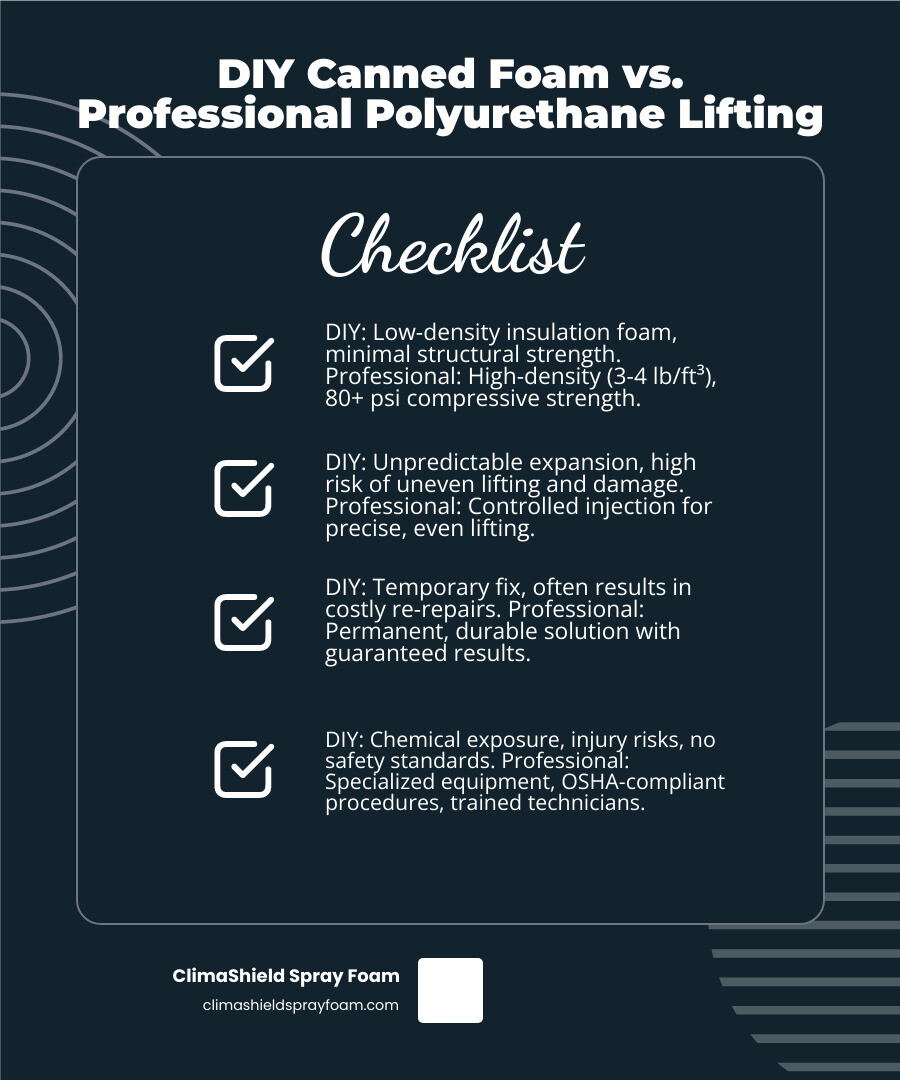
If you’ve seen those DIY videos, you might wonder: Can you lift concrete with foam yourself? The short answer is that while canned spray foam can physically move a slab, it’s not designed for structural loads. Professional concrete lifting uses high-density polyurethane foam (3-4 pounds per cubic foot with 80+ psi compressive strength) applied with specialized equipment. Canned insulation foam typically has far lower density and strength—it’s meant for sealing gaps, not supporting thousands of pounds of concrete.
The appeal is understandable. A sunken sidewalk or patio creates a trip hazard, looks terrible, and threatens to get worse. When you see someone online “fix” it for the cost of a few foam cans, it seems like an easy win. But according to industry experts and concrete lifting professionals, most DIY attempts lead to more problems than they solve—including cracked slabs, uneven surfaces, and expensive professional repairs to undo the damage.
As Dave Brocious, founder of ClimaShield Industries with 20 years of experience in specialty coatings and spray foam applications, I’ve seen the aftermath of failed DIY spray foam concrete lifting attempts firsthand. Understanding the real risks and alternatives can save you thousands in repairs and give you a solution that actually lasts.
What is Concrete Lifting and How Does DIY Spray Foam Work?
Before we dive into the nitty-gritty of DIY spray foam concrete lifting, let’s understand what concrete lifting is all about. Concrete lifting, also known as slabjacking or mudjacking, is a repair method designed to correct uneven concrete surfaces and return them to their original level position. The goal is to fill voids beneath a sunken slab, stabilize the soil, and gently raise the concrete.
Why does concrete sink in the first place? In our experience, soil issues are the culprit 99.9% of the time. This could be due to poorly compacted soil during construction, moisture changes causing soil to expand and contract, or even natural erosion washing away the supporting earth beneath your slab. When these voids form, the heavy concrete above loses its support and begins to settle, creating unsightly and often hazardous uneven surfaces.
Professional concrete lifting, specifically polyurethane foam injection, addresses these issues by filling the voids with an expanding material. This expansion process lifts the slab back into place.
The Theory Behind DIY Spray Foam Concrete Lifting
The concept behind DIY spray foam concrete lifting seems simple enough. Homeowners, inspired by online videos, attempt to replicate professional methods using readily available canned spray foam. The theory goes something like this:
- Drilling holes: Small holes are drilled into the sunken concrete slab.
- Injecting canned foam: Canned expanding foam, typically used for insulation or gap sealing, is injected into these holes and underneath the slab.
- Foam expansion: The foam expands, supposedly filling the voids and generating enough force to lift the concrete.
- Lifting force: As the foam expands, it exerts upward pressure, theoretically raising the slab.
- Hardening and support: The foam hardens, providing new support for the concrete in its liftd position.
It sounds straightforward, right? But as we’ll explore, the reality is often far more complicated and fraught with problems.
Popular (and Risky) DIY Methods Seen Online
We’ve all seen the videos. From simple “drill and fill” approaches to more elaborate setups, DIYers try various methods to achieve a level slab. Here are a few popular (and risky) examples we’ve observed:
-
The “Drill and Fill” Method: This is the most basic approach. A homeowner drills a few holes and starts pumping can after can of expanding foam under the concrete. While this might seem to work initially, the foam’s unpredictable expansion often leads to uneven lifting, or worse, the foam expanding into unintended areas. We’ve seen videos where the foam expanded so much that it lifted not only the sunken slab but also a nearby walkway slab, creating new, unexpected problems!
-
Using Mechanical Jacks: Some DIYers recognize that foam alone might not provide enough controlled lift. In these cases, they build makeshift lifting devices, often involving jacks. For instance, some videos show building a lifting device that drills into the concrete to provide leverage for jacking the slab up.
-
Combining Jacks and Foam for a Lift: This method attempts to combine the brute force of jacks with the void-filling properties of foam. One video showed a DIYer attaching C-clamps to a walkway slab, then using bottle jacks and 4×4 posts chained to the C-clamps to lift the slab before injecting foam through holes. Another example involved a more complicated device with wood, chains, C clamps, and two car jacks to suspend the slab, then installing cement brick, wood wedges, and foam at the edges. While these methods might achieve a partial lift, they often result in over-lifting, cracking, or still leave trip hazards due to unevenness.
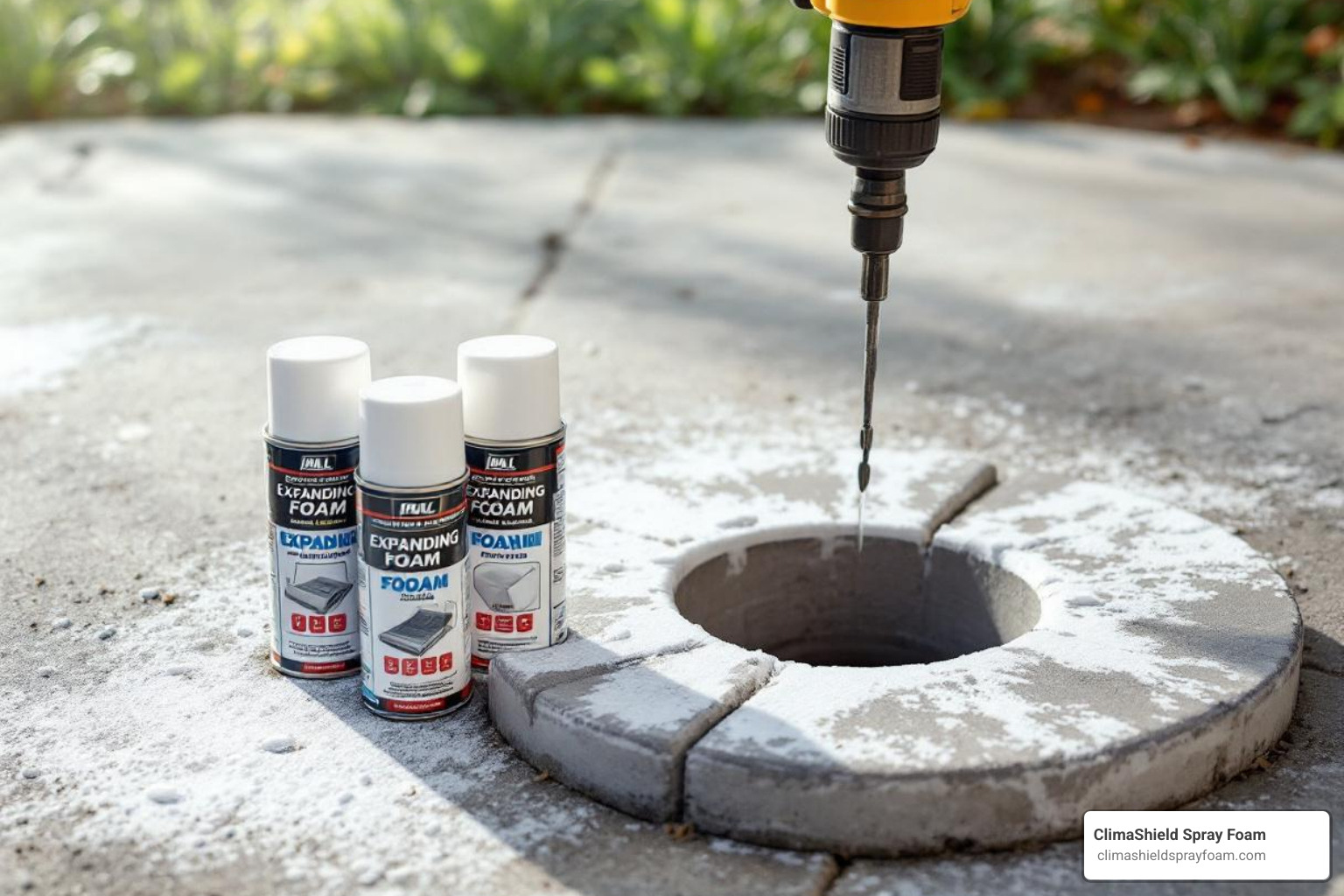
These methods, while creative, often demonstrate the inherent difficulties and risks of attempting a precision task with imprecise tools and materials. The lack of control and understanding of the foam’s properties can turn a seemingly simple fix into a much larger headache.
The Hidden Dangers: Why Experts Warn Against DIY Spray Foam Concrete Lifting
We understand the allure of a quick, cheap fix. But when it comes to DIY spray foam concrete lifting, the risks far outweigh any perceived benefits. Experts across the industry, including us at ClimaShield Spray Foam, strongly advise against it. The inherent unpredictability and limitations of canned foam, coupled with the lack of specialized equipment and expertise, can lead to significant problems.
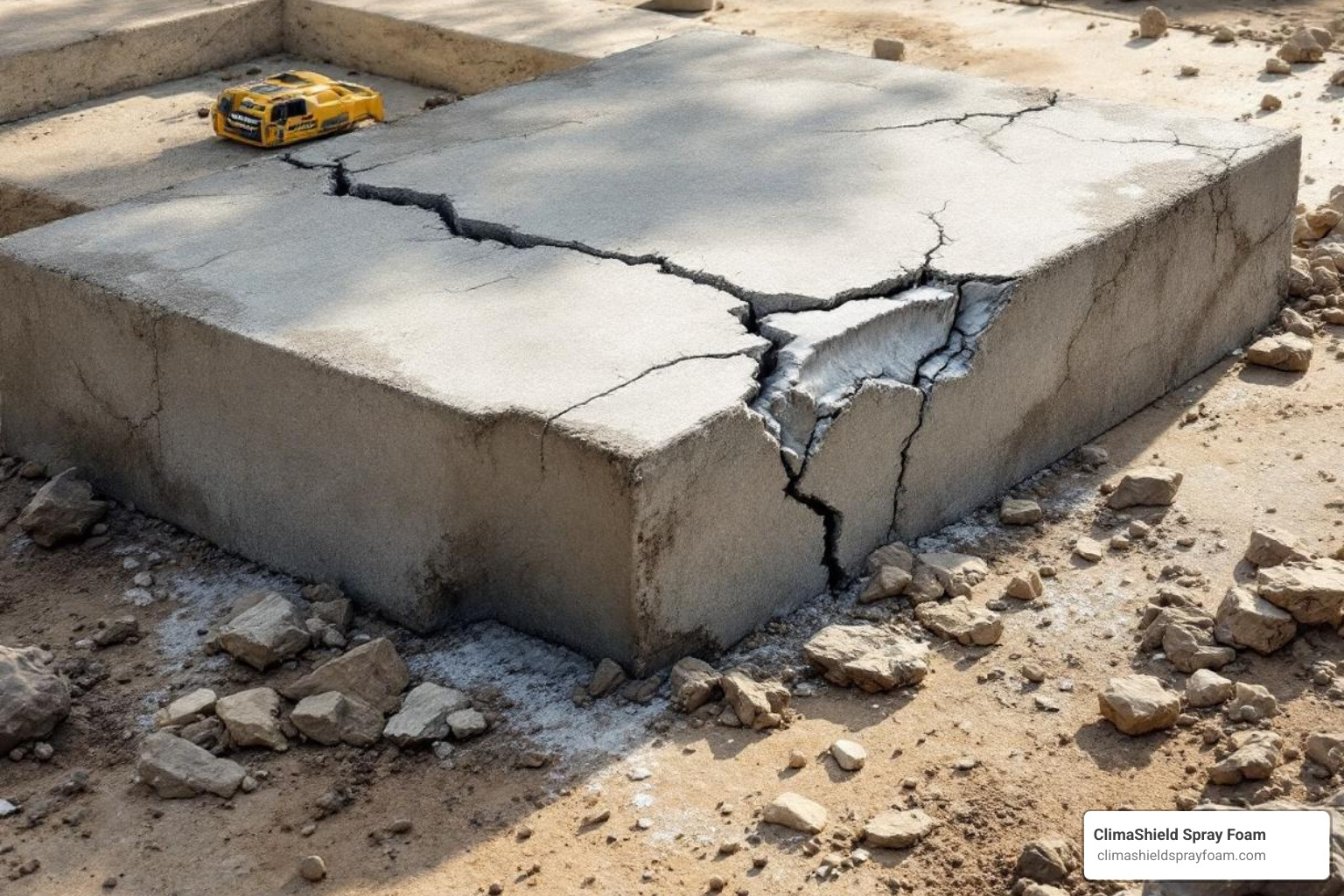
One of the biggest issues is the unpredictable expansion of canned foam. Unlike professional-grade polyurethane, which is designed for controlled geotechnical applications, canned foam expands in an uncontrolled manner. This can lead to over-lifting a portion of the slab, creating a new, often worse, uneven surface. We’ve seen instances where this over-expansion resulted in structural damage to the concrete itself, leading to concrete cracking that wasn’t there before. A failed DIY lift can make subsequent professional repairs more difficult and expensive.
Furthermore, there’s a significant difference between canned foam vs. professional foam. Canned foam is formulated for insulation and sealing gaps, not for supporting thousands of pounds of concrete. It has inadequate compressive strength for such a load. Finally, let’s not forget the chemical exposure and other safety hazards involved. Working with expanding foam and heavy concrete without proper training and equipment can lead to injuries, from chemical burns to smashed fingers or toes if a slab shifts unexpectedly.
Problem #1: Canned Foam Isn’t Designed for Heavy Lifting
Think of it this way: you wouldn’t use a toy hammer to build a house, right? The same principle applies to DIY spray foam concrete lifting. Canned foam, often labeled as “insulation foam,” has properties suited for insulating and sealing, not for structural support. It’s typically a low-density foam, lacking the compressive strength needed to permanently hold up heavy concrete.
Professional geotechnical polyurethane foam, like what we use at ClimaShield, is a two-component system specifically engineered for concrete lifting. It has a high density, typically 3.0-4.0 pounds per cubic foot (pcf), and boasts a compressive strength of at least 80 psi. This foam is also hydrophobic, meaning it reacts well in the presence of water, displacing it and creating a stable, long-lasting base. Canned foam simply can’t compare to these technical specifications. Using it for concrete lifting is like asking a feather to hold up a brick; it’s just not designed for the job. Attempting to use a product for a purpose it wasn’t intended for can also void warranties on your concrete or even your home’s foundation if issues arise. To understand more about the diverse applications of spray foam, including its structural uses, you can explore our page on the Uses of Spray Foam.
Problem #2: The Risk of Uncontrolled and Uneven Lifting
The biggest Achilles’ heel of DIY spray foam concrete lifting is the lack of control. Canned foams have unpredictable expansion rates. You inject it, and then you just have to hope it expands exactly where you want it, at the right speed, and with the right force. This rarely happens.
The result? You’re highly likely to end up creating new trip hazards by over-lifting one side of a slab while another remains sunken. We’ve seen concrete slabs get stuck on each other during DIY attempts, leading to damage to adjacent slabs. Professionals often saw-cut slabs before lifting to ensure they can move independently, a crucial step almost always missed by DIYers. When slabs get stuck, they can crack or chip, turning a small problem into a much larger, more visible one. These are often irreversible mistakes that require professional intervention to correct, which brings us to our next point.
Is DIY Spray Foam Concrete Lifting Cheaper in the Long Run?
At first glance, buying a few cans of spray foam seems significantly cheaper than hiring a professional. A can might cost you $10-$20, whereas professional services will certainly be more. So, is DIY spray foam concrete lifting cheaper? Upfront, yes. In the long run? Almost certainly not.
While the upfront material costs are low, the likelihood of a successful, lasting repair is equally low. As the saying goes, “buy cheap, buy twice.” When a DIY attempt fails, and it often does, you’re left with the original problem, potentially worse damage (cracked concrete, over-lifted sections), and now the cost of professional repair after a failed DIY is often higher than if you had called us in the first place. Why? Because we might have to fix the damage caused by the DIY attempt before we can even begin the actual concrete lifting.
Professional concrete leveling can save you up to 70% off the cost of replacing your concrete entirely. This statistic alone highlights the value of doing it right the first time. Our solutions offer long-term durability, designed to last for the life of the concrete itself. A temporary DIY fix just pushes the problem down the road, usually at a greater expense.
The Professional Alternative: Polyurethane Foam Injection by ClimaShield
When it comes to concrete lifting, we firmly believe in the power and precision of professional polyurethane foam injection. At ClimaShield Spray Foam, we use advanced techniques and materials to ensure a durable, effective, and safe solution for your sunken concrete in Indiana, PA, and surrounding areas.
Our process involves using high-density polyurethane foam, a stark contrast to the low-density canned foam used in DIY projects. This specialized material is injected using specialized equipment, including high-pressure, plural-component spray rigs and mechanical purge guns. These tools allow for incredibly controlled injection and precision lifting. We can lift slabs to within 1/8″ accuracy, ensuring a smooth, even surface.
This professional-grade foam not only lifts the concrete but also provides crucial soil stabilization. It fills voids, compacts loose soil, and creates a stable base, preventing future settlement. Many of our foams are also hydrophobic, meaning they react with any moisture present to form a watertight barrier, protecting the subgrade from further erosion. The cure time for our foam is minutes, not days, meaning your concrete can be back in use almost immediately.
| Feature | DIY Canned Foam | ClimaShield Professional Polyurethane Lifting |
|---|---|---|
| Cost | Low upfront, high potential long-term due to failure | Higher upfront, cost-effective long-term due to durability |
| Durability | Temporary, prone to failure | Long-lasting, often for the life of the concrete |
| Safety | High risk of injury, chemical exposure, property damage | OSHA-compliant, trained technicians, minimal risk |
| Precision | Unpredictable, uneven lifting, over-lifting common | Highly precise, lifts to within 1/8″ accuracy |
| Material | Low-density insulation foam | High-density geotechnical polyurethane foam (3-4 pcf, 80+ psi) |
| Equipment | Handheld cans | Specialized high-pressure injection rigs, mechanical purge guns |
| Support | Minimal, no structural guarantee | Strong structural support, soil stabilization |
Benefits of Hiring ClimaShield Professionals
Choosing ClimaShield for your concrete lifting needs means investing in peace of mind and a lasting solution. Here’s why our professional approach stands out:
- Guaranteed Results: We stand by our work. Our expertise ensures that your concrete is lifted precisely and safely, providing a durable solution.
- Long-Lasting Solution: Our high-density polyurethane foam is designed to last. Unlike temporary DIY fixes, professional concrete lifting is a permanent repair that addresses the root cause of settlement.
- Proper Equipment and Materials: We use state-of-the-art equipment and specialized geotechnical foams specifically engineered for concrete lifting. This ensures optimal performance, controlled expansion, and superior strength that canned foam simply cannot deliver.
- Safety Compliance: Our technicians are trained in safety protocols, including OSHA standards for chemical handling, high-pressure equipment, and silica dust exposure. We wear appropriate PPE and take every precaution to ensure a safe work environment for everyone involved.
- Addresses Root Cause: We don’t just lift the concrete; we fill the voids beneath it and stabilize the soil, preventing future sinking. This comprehensive approach is crucial for long-term effectiveness. Our services also extend to ensuring your home’s overall energy efficiency, including solutions like Air Sealing Basement areas to prevent moisture and air intrusion that can contribute to soil issues.
When Should You Call a Professional?
While we strongly advise against DIY spray foam concrete lifting in almost all cases, there are clear indicators that it’s time to call in the professionals at ClimaShield Spray Foam:
- Slabs sunken more than an inch: Significant settlement requires precise lifting that only professional equipment can provide.
- Large areas like driveways or garage floors: These areas bear heavy loads and require structural integrity that DIY methods cannot guarantee.
- Slabs connected to a foundation: Any concrete attached to your home’s foundation needs careful attention to avoid compromising the structural integrity of your entire property.
- Cracks wider than a hairline: Larger cracks often indicate significant underlying issues that demand expert assessment and repair.
- Water drainage issues: If sinking concrete is causing water to pool near your home or flow towards your foundation, it’s a critical issue that needs professional attention to prevent further damage.
Don’t let a sunken slab become a bigger problem. If you’re in Indiana, PA, or the surrounding areas, we’re here to help.
Frequently Asked Questions about Concrete Lifting
We often hear many questions from homeowners considering concrete repair. Here are some of the most common ones we address:
Can canned spray foam actually lift a concrete slab?
Yes, it can physically move a concrete slab. However, this is where the positive aspects end. While canned spray foam can expand and exert enough force to lift concrete to some extent, it lacks the necessary strength, density, and control for a safe, level, or durable repair. The result is often more damage, uneven surfaces, over-lifting, and a temporary fix at best. It’s not designed for the structural loads required to support concrete, meaning any lift achieved is unlikely to last, and can lead to expensive follow-up repairs.
What safety precautions are necessary for concrete lifting?
Professional concrete lifting involves specific and stringent safety precautions. Our technicians at ClimaShield are trained to handle the specialized equipment and materials safely. This includes wearing appropriate Personal Protective Equipment (PPE) for chemical handling, working with high-pressure fluids, and mitigating exposure to crystalline silica dust generated from drilling concrete. For any DIY attempt, while eye protection, gloves, and steel-toed boots are minimal safety measures, the chemical and pressure risks from improper use of canned foam, not to mention the weight of the concrete, remain extremely high and are not recommended for untrained individuals.
What is the best alternative to DIY foam lifting?
Professional-grade polyurethane concrete lifting, as provided by ClimaShield, is unequivocally the safest, most effective, and most durable alternative to DIY spray foam concrete lifting. This method uses specialized, high-density, closed-cell polyurethane foam injected with precision equipment. It not only lifts and levels the concrete but also stabilizes the underlying soil, creates a moisture barrier, and provides a long-lasting solution that often comes with a warranty. Professional concrete leveling is safer, stronger, and longer-lasting than any DIY attempt, ensuring your concrete remains stable for years to come.
The Smart Choice for Sunken Concrete
While the DIY spray foam concrete lifting trend might look appealing on social media, we hope this guide has shed light on the significant risks and potential pitfalls. The initial appeal of saving a few dollars can quickly turn into a much larger expense when faced with cracked slabs, uneven surfaces, or the need for professional remediation.
At ClimaShield Spray Foam, we believe in providing solutions that are not only effective but also durable and safe. Our professional polyurethane foam injection offers the precision, strength, and longevity that homeowners in Indiana, PA, and the surrounding areas deserve. Choosing professional expertise means investing in a long-term solution, rather than a temporary fix that creates more problems.
For a lasting and reliable solution to your sunken concrete problems, consider a professional assessment. Learn more about our specialized services, including Geotech Slab Lifting, and let us help you restore safety and aesthetic appeal to your property.
