
Why Concrete Slabs Sink and What You Can Do About It
Slab lifting is a repair technique that raises sunken or uneven concrete back to its original level by injecting material underneath to fill voids and lift the surface. Here’s what you need to know:
Quick Facts About Slab Lifting:
- What it fixes: Sunken driveways, sidewalks, patios, pool decks, and garage floors
- How it works: Material is injected through small holes to fill voids and raise concrete
- Main methods: Polyurethane foam injection (modern) or mudjacking (traditional)
- Time required: Most projects complete in 4-8 hours
- Cost: Typically half the price of concrete replacement
- Ready to use: Walk or drive on repaired areas within 15 minutes (polyurethane method)
If you’ve noticed cracks in your driveway, uneven sidewalk sections, or gaps appearing between your floor and baseboards, you’re dealing with concrete settlement. This happens when the soil underneath can no longer support the weight above it.
The good news? You don’t need to tear out and replace everything. Slab lifting offers a faster, more affordable solution that addresses both the immediate problem and helps prevent future settling.
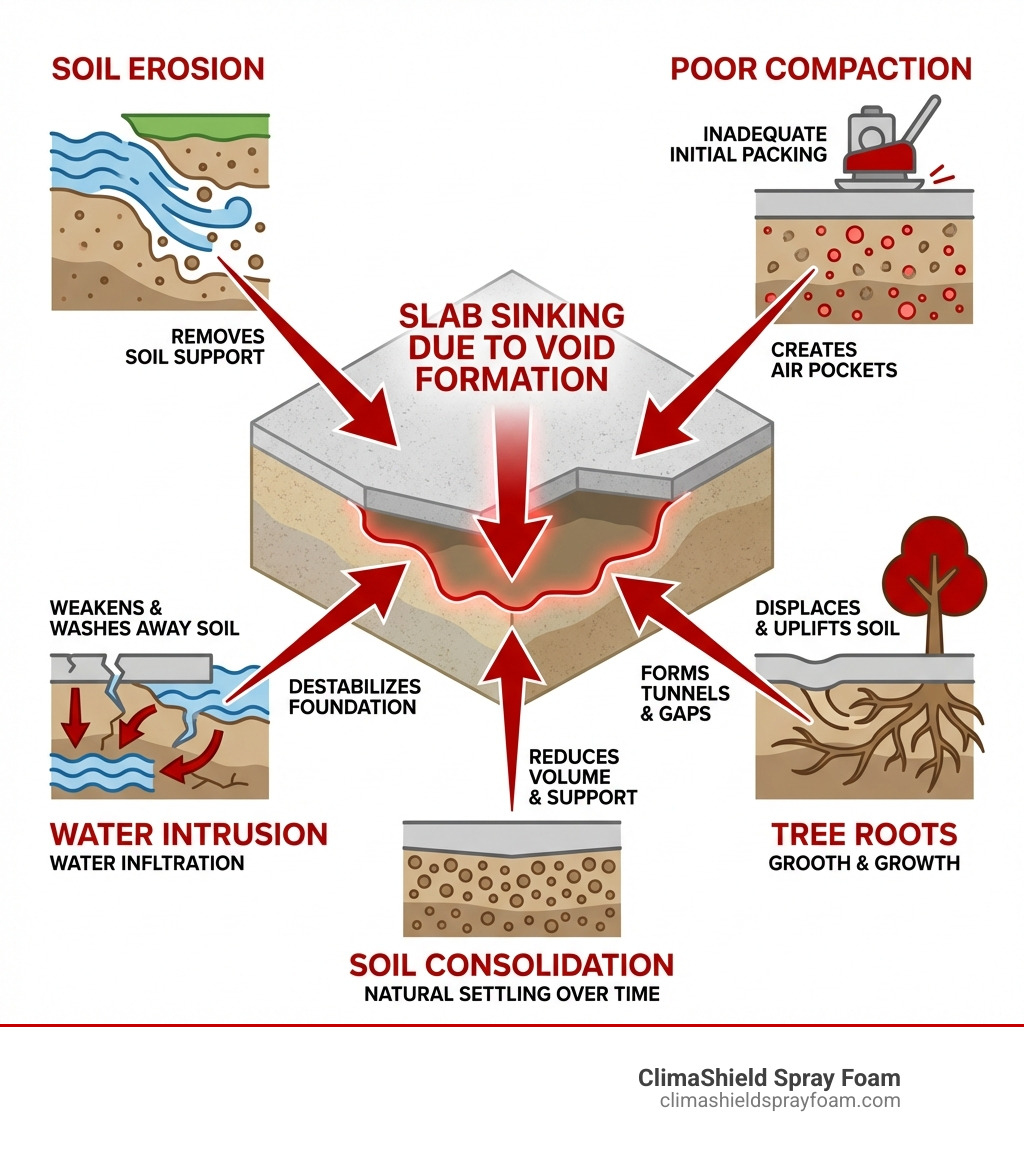
Common causes of concrete settlement include:
- Poorly compacted fill dirt during initial construction
- Soil erosion from water intrusion or drainage issues
- Shrinking and expanding soils due to moisture changes
- Tree roots growing beneath the concrete
- Natural soil consolidation over time
Left unaddressed, sunken concrete creates serious safety hazards. Trip hazards can lead to injuries and liability issues. Water pooling around settled slabs erodes more soil and leads to additional cracking. What starts as a minor cosmetic issue can quickly compromise your property’s structural integrity and value.
I’m Dave Brocious, founder of ClimaShield Industries with 20 years of experience in specialty coatings and protective applications, including polyurethane systems used in slab lifting and concrete stabilization. Throughout my career, I’ve seen how proper slab lifting techniques protect properties while delivering long-term durability.
Understanding Concrete Settlement and the Need for Repair
In Pennsylvania, we see a lot of concrete movement. Between our humid summers and the freezing winters in Indiana, PA, our soil goes through a lot of stress. At its core, slab lifting is about fixing what’s happening under the concrete, not just what’s on top.
Concrete is incredibly heavy, but it’s also rigid. It relies entirely on the soil beneath it for support. When that support disappears, gravity takes over, and the slab sinks. This loss of support usually happens due to a few key factors:
- Poor Soil Compaction: When a home or driveway is built, the dirt moved around is often “loose.” If a contractor doesn’t properly compact this fill dirt, it will naturally settle over time under the weight of the concrete.
- Moisture and Drainage: Water is the primary enemy of stable soil. Heavy rain or poorly directed downspouts can wash away the sub-base, creating empty pockets called “voids.” Conversely, certain clay soils expand when wet and shrink when dry, leading to a constant “yo-yo” effect that cracks slabs. You can learn more about managing soil conditions to see how moisture levels impact stability.
- The Freeze-Thaw Cycle: In our region, water gets under the slab, freezes (and expands), then thaws. This cycle creates gaps and weakens the soil structure, making slab lifting a common necessity for local homeowners.
- Tree Roots: While they can sometimes lift concrete up, roots can also dehydrate the soil or create paths for water to travel, leading to localized sinking once the roots decay or shift.
Ignoring these signs isn’t just a cosmetic choice; it’s a structural risk. For a deeper dive into the warning signs, check out our more info about slab foundation settling.
The Slab Lifting Process: How Polyurethane Foam Works
If you’ve ever watched a slab lifting project, it looks a bit like magic. We take a sunken, multi-ton piece of concrete and watch it rise back into place in minutes. But it isn’t magic—it’s chemistry and physics.
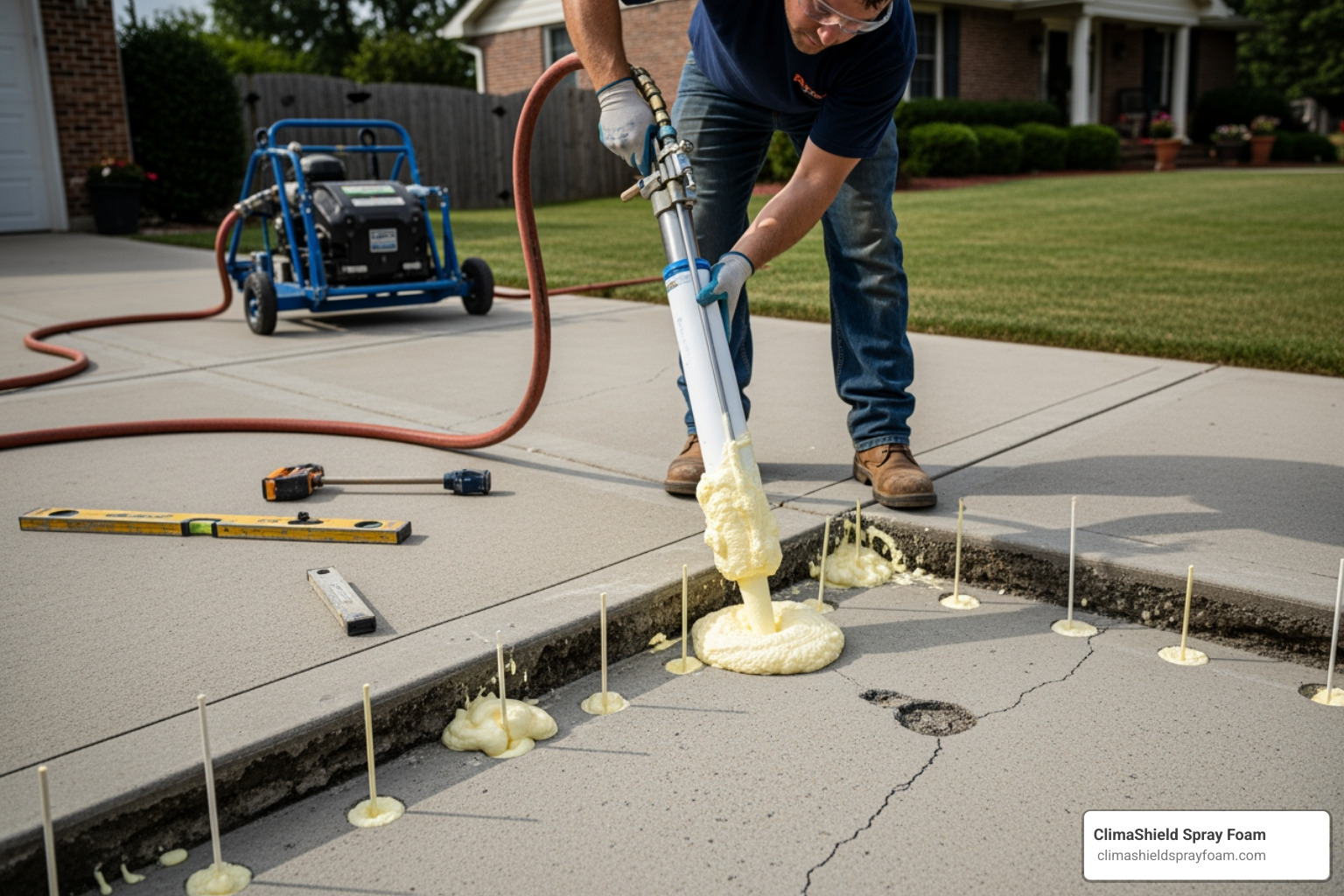
The process we use at ClimaShield Spray Foam involves a high-density, two-part polyurethane polymer. Here is the step-by-step breakdown of how we restore your surfaces:
- Step 1: Inspection & Preparation: We identify the “low spots” and map out the injection points. We also check for any binding where the slab might be stuck against a wall or another slab.
- Step 2: Drilling: We drill tiny, “penny-sized” holes (about 5/8 inch) in a strategic pattern. Because the holes are so small, they are nearly invisible once patched.
- Step 3: Injection: We inject the two-part liquid polymer through these holes. As the two parts mix, a chemical reaction occurs, causing the liquid to expand into a rigid, structural foam.
- Step 4: Expansion and Lift: This expansion is powerful. It first fills every tiny void and crevice in the soil, effectively stabilizing the ground. Once the voids are full, the upward pressure begins to lift the concrete slab with incredible precision.
- Step 5: Sealing: Once the slab is level, we remove the injection ports and patch the small holes with a concrete-colored grout.
This method, often called “polyjacking,” provides a permanent fix because the foam is hydrophobic—it won’t wash away with the next heavy rain. For more technical details, you can read about our details on slab lifting foam.
Why Choose Polyurethane Foam for Slab Lifting?
When homeowners realize their concrete is sinking, they usually face three choices: leave it alone, use traditional mudjacking, or use polyurethane foam. While mudjacking has been around for decades, polyurethane is the gold standard for modern repairs.
Polyurethane vs. Mudjacking: A Comparison
| Feature | Polyurethane Foam | Traditional Mudjacking |
|---|---|---|
| Hole Size | Penny-sized (5/8″) | Soda can-sized (1.5″ – 2″) |
| Material Weight | 2-4 lbs per cubic foot | 100-120 lbs per cubic foot |
| Cure Time | 15-30 minutes | 24-48 hours |
| Durability | Waterproof; won’t wash away | Can erode or shrink over time |
| Soil Impact | Compacts and stabilizes soil | Adds significant weight to weak soil |
One of the biggest issues with mudjacking (which uses a slurry of sand, cement, and water) is the weight. If your concrete sank because the soil was weak, adding a heavy “mud” mixture can actually cause more sinking later on. Polyurethane is incredibly lightweight, so it doesn’t add stress to the underlying ground.
Researchers have spent years perfecting these materials. You can even look into the technical research on polymer foams to see how they handle compressive loads. For most families, the biggest win is the convenience. Our residential concrete lifting applications allow you to fix your driveway in the morning and host a graduation party on it that afternoon.
The Advantages of Polyurethane Slab Lifting
We prefer this method because it offers several unique benefits that traditional concrete work simply can’t match:
- Waterproof: Polyurethane is a closed-cell foam. It doesn’t absorb water and it won’t be affected by the wet Pennsylvania soil. It acts as a barrier, preventing future erosion.
- Fast Curing: You can walk or drive on the concrete within 15 minutes of the application. No 28-day wait like you’d have with a new pour!
- Eco-Friendly: By lifting your existing concrete, we keep old slabs out of landfills. The foam itself is also inert once cured, meaning it won’t leach chemicals into your garden.
- Minimal Disruption: Our equipment is mobile. We don’t need to tear up your lawn with heavy trucks or leave a mess of wet cement everywhere.
For those interested in the industrial-strength side of things, we also offer geotech slab lifting benefits for larger commercial projects.
Cost Analysis: Repairing vs. Replacing Concrete
Let’s talk about the “elephant in the room”: the price. Many homeowners assume that because slab lifting uses high-tech polymers, it must be more expensive than just pouring a new driveway. Actually, the opposite is true.
The Price Breakdown
- Polyurethane Lifting: Typically costs between $5 and $25 per square foot. Most residential projects fall in the $1,000 to $3,000 range.
- Mudjacking: Usually cheaper upfront, ranging from $3 to $8 per square foot ($600 to $2,500 per project). However, because it can fail or erode, you might end up paying for it twice.
- Replacement: This is the most expensive route. You have to pay for demolition, hauling away the old concrete, the new material, and the labor. Replacement often costs double or triple the price of lifting.
The Hidden Costs of Replacement
When you replace concrete, you aren’t just paying for the slab. You’re paying for the downtime. A new concrete slab takes 28 days to fully cure. That means you can’t park your car in your garage or use your driveway for a month.
Furthermore, replacing the slab doesn’t always fix the soil problem. If you pour new, heavy concrete on top of the same loose soil that caused the first slab to sink, your brand-new driveway will likely start sinking within a few years. Slab lifting with foam addresses the soil voids directly, giving you a better long-term ROI.
Frequently Asked Questions
We get a lot of questions from folks in Indiana, PA, about how this process works in the “real world.” Here are the most common ones.
Is slab lifting a safe DIY project?
We’ve seen the YouTube videos, too—people trying to use canned “Gap Filler” foam from the hardware store to lift a sidewalk. Please, don’t do this.
Canned spray foam is designed for insulation, not structural support. It lacks the compressive strength to hold up concrete and will collapse under the weight. Professional slab lifting requires specialized hydraulic equipment that monitors pressure to ensure we don’t “over-lift” and crack the slab. If you over-lift with foam, it is almost impossible to reverse. For more on this, check out these expert warnings on DIY lifting.
How long does the concrete take to cure?
This is the best part! Polyurethane foam reaches 90% of its full strength within 15 minutes. While we recommend waiting about 30 minutes for heavy vehicle traffic just to be extra safe, you can walk on it the moment we finish patching the holes.
What specific areas can be lifted?
If it’s a concrete slab, we can likely lift it. Common areas include:
- Driveways: Fixing that annoying “bump” as you pull into the garage.
- Patios: Ensuring your grill and patio furniture sit level.
- Pool Decks: Eliminating trip hazards where guests walk barefoot.
- Sidewalks: Keeping your property ADA-compliant and safe for neighbors.
- Garage Floors: Filling the voids that often form under the heavy front section of the garage.
Conclusion
At ClimaShield Spray Foam, we believe in providing solutions that are as durable as they are efficient. Whether we are helping you save 60% on your energy bills with our airtight insulation or stabilizing your home’s foundation through slab lifting, our goal is always the same: to protect your investment.
By choosing polyurethane injection, you’re opting for a waterproof, mold-resistant, and pest-resistant solution that treats the root cause of your sinking concrete. Don’t wait for a small crack to become a major liability or a foundation failure.
If you’re in Indiana, PA, or the surrounding areas and you’re tired of looking at that sunken sidewalk or uneven driveway, we’re here to help. Our team has the expertise and the high-density systems needed to get your property back on level ground—fast.
Ready to see the “magic” for yourself? Schedule Geotech Slab Lifting with us today and let’s get your concrete back where it belongs!
