
Why Energy Saving Insulation is Critical for Your Home
Energy saving insulation is the most effective way to reduce your heating and cooling costs, improve home comfort, and stop energy waste. Here’s what you need to know:
- Average savings: Homeowners save 15% on heating and cooling costs (11% on total energy) by adding insulation and air sealing
- The problem: 9 out of 10 U.S. homes are under-insulated
- The impact: Heating and cooling account for 50-70% of energy use in the average American home
- The solution: Proper insulation creates a barrier to heat flow, reducing your HVAC workload year-round
If you’re experiencing high energy bills, uncomfortable temperature swings, or drafty rooms, your home is likely losing energy through inadequate insulation. Adding up all the leaks, holes, and gaps in a typical home’s envelope is like having a window open every day of the year.
The good news? Insulation is one of the best investments you can make in your home. It pays for itself through lower utility bills, increases your property value, and creates a more comfortable living environment by maintaining consistent temperatures throughout your home.
I’m Dave Brocious, and with 20 years of experience in the coatings and construction industry, I’ve helped countless homeowners and businesses implement energy saving insulation solutions through ClimaShield Industries. As a specialty coatings contractor and Director with experience in energy efficiency projects, I’ve seen how proper insulation transforms homes from energy-draining money pits into comfortable, efficient spaces.
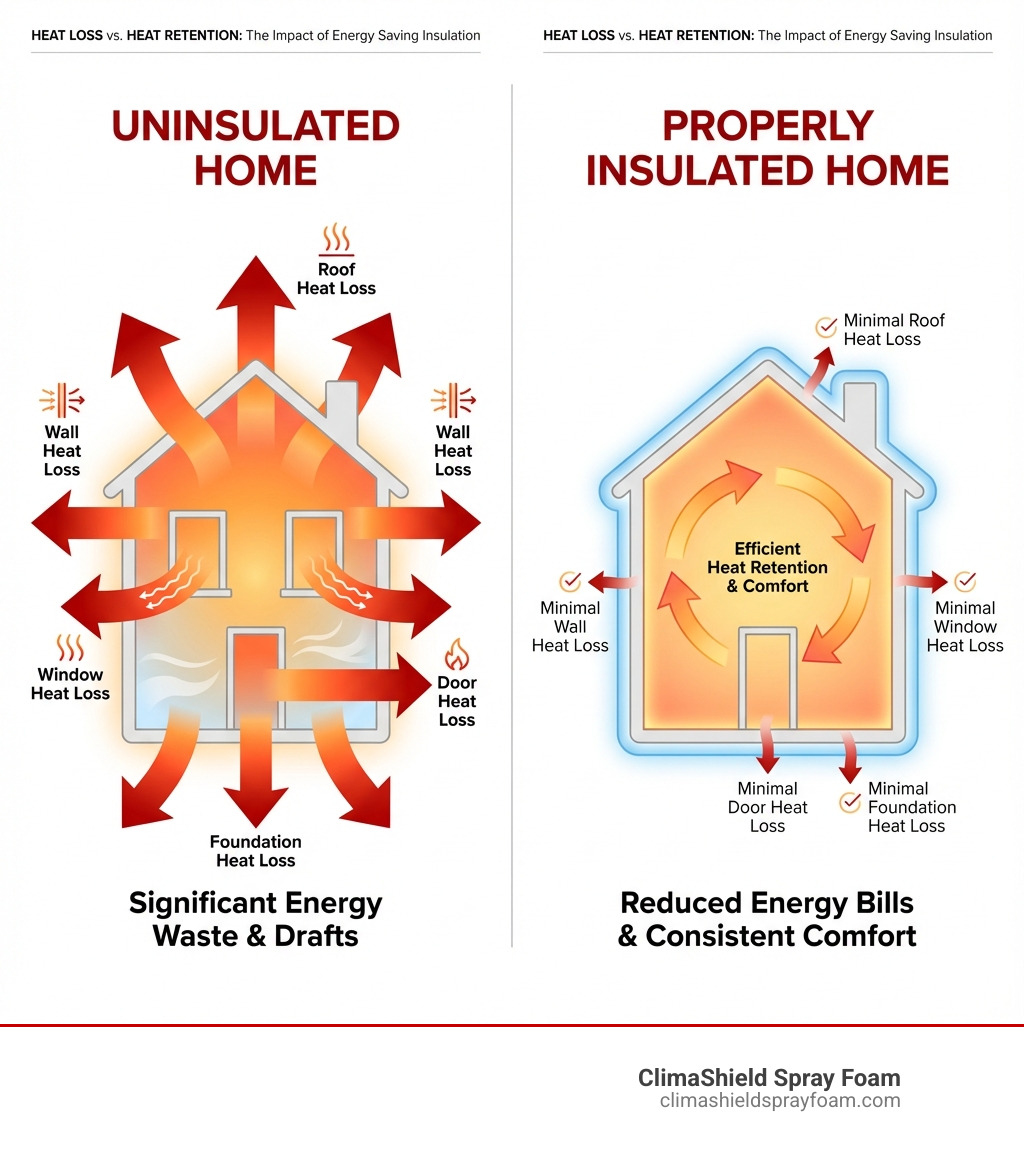
Why Insulation is Your Home’s Best Investment
When we talk about making a home truly efficient and comfortable, the conversation always starts with insulation. It’s not just about keeping warm in winter or cool in summer; it’s about creating a stable, healthy, and cost-effective living environment year-round. Investing in high-quality energy saving insulation is one of the smartest decisions you can make for your home in Indiana, PA, or anywhere in Pennsylvania. It offers a multitude of benefits, from immediate savings to long-term comfort and environmental stewardship.

Slash Your Energy Bills
Let’s be honest, those monthly utility bills can be a real headache. But what if we told you that a significant portion of that expense could be drastically cut? Our research shows that heating and cooling alone can account for a staggering 50% to 70% of the energy used in the average American home. That’s a huge chunk of change!
This is where energy saving insulation comes into play. Insulation’s primary job is to provide resistance to heat flow. Think of it like a cozy blanket for your home. In winter, it keeps the expensive heat you generate inside, preventing it from escaping through your walls, attic, and floors. In summer, it acts as a barrier to keep the scorching Pennsylvania heat out, so your air conditioning doesn’t have to work overtime.
By effectively slowing down this heat transfer, insulation dramatically reduces the workload on your HVAC systems. When your furnace or AC isn’t constantly struggling to maintain your desired temperature, it uses less energy, leading directly to lower energy consumption and reduced costs. Homeowners can see impressive savings, with averages around 15% on heating and cooling costs, which translates to about 11% on total energy costs, simply by air sealing and adding insulation. And for areas like the attic, which is often a major culprit for heat loss, proper insulation can save up to 30% on heating and cooling usage! It’s a direct path to a healthier bottom line. For a deeper dive into how insulation impacts your household budget, visit our page on Your Energy Bill.
Improve Home Comfort and Health
Beyond the financial benefits, insulation transforms your home into a haven of comfort. Have you ever noticed cold spots near windows or along exterior walls, even when your furnace is blasting? That’s typically a sign of inadequate insulation and air leaks. Proper energy saving insulation creates a uniform thermal envelope, maintaining consistent temperatures throughout your home. This means no more chilly drafts in winter or stuffy rooms in summer. Just pure, unadulterated comfort, exactly how a home should feel.
But the benefits extend beyond just temperature regulation. A well-insulated and air-sealed home offers a significant reduction in outside noise. Whether it’s traffic, noisy neighbors, or general outdoor commotion, insulation acts as a barrier, absorbing and dampening sound waves. This provides a quieter indoor environment, enhancing your overall peace and relaxation.
Furthermore, proper insulation, especially when combined with effective air sealing, plays a crucial role in moisture control and improved indoor air quality. By preventing uncontrolled air and moisture infiltration, it helps reduce pollen, dust, and insects from entering your home. Crucially, it lowers the chance of ice dams forming on your roof in winter and significantly reduces the risk of condensation inside walls or attics. Condensation can lead to wet insulation, which doesn’t work well, and worse, creates a breeding ground for mold and mildew – posing serious health hazards and structural damage. Our insulation solutions are designed to be durable, waterproof, airtight, and resist mold and pests, contributing to a healthier living space for your family.
The Environmental Impact
Being mindful of our environmental footprint is more important than ever. Your home’s insulation choices have a direct impact on the planet. By reducing your energy consumption, energy saving insulation significantly lowers your home’s carbon footprint. Less energy used means fewer fossil fuels burned, which translates to fewer greenhouse gas emissions contributing to climate change.
It’s a tangible way to practice sustainable living and contribute to a healthier planet. We’re proud to be part of the energy efficiency and construction industry, helping homeowners and businesses build greener futures. The development of sustainable materials, like mineral wool with ECOSE® Technology, which uses a formaldehyde-free binder based on rapidly renewable materials, highlights the industry’s commitment to environmental responsibility. Mineral wool insulation is already considered a strong performer in terms of environmental impact, and technologies like ECOSE® further improve its sustainability. For more information on sustainable materials, you can visit More on sustainable materials like ECOSE® Technology. By making your home more energy-efficient, you’re not just saving money; you’re also conserving valuable resources and promoting a more sustainable future for generations to come.
Decoding Insulation: R-Value, Air Sealing, and Your Home’s Envelope
To truly understand how energy saving insulation works, we need to think of your home as a holistic system. Just like a finely tuned machine, all its parts—from the foundation to the roof—work together to create its overall performance. This “system” is often referred to as your home’s thermal envelope, which includes the outer walls, windows, doors, and all other openings that separate your conditioned indoor space from the unconditioned outdoors.
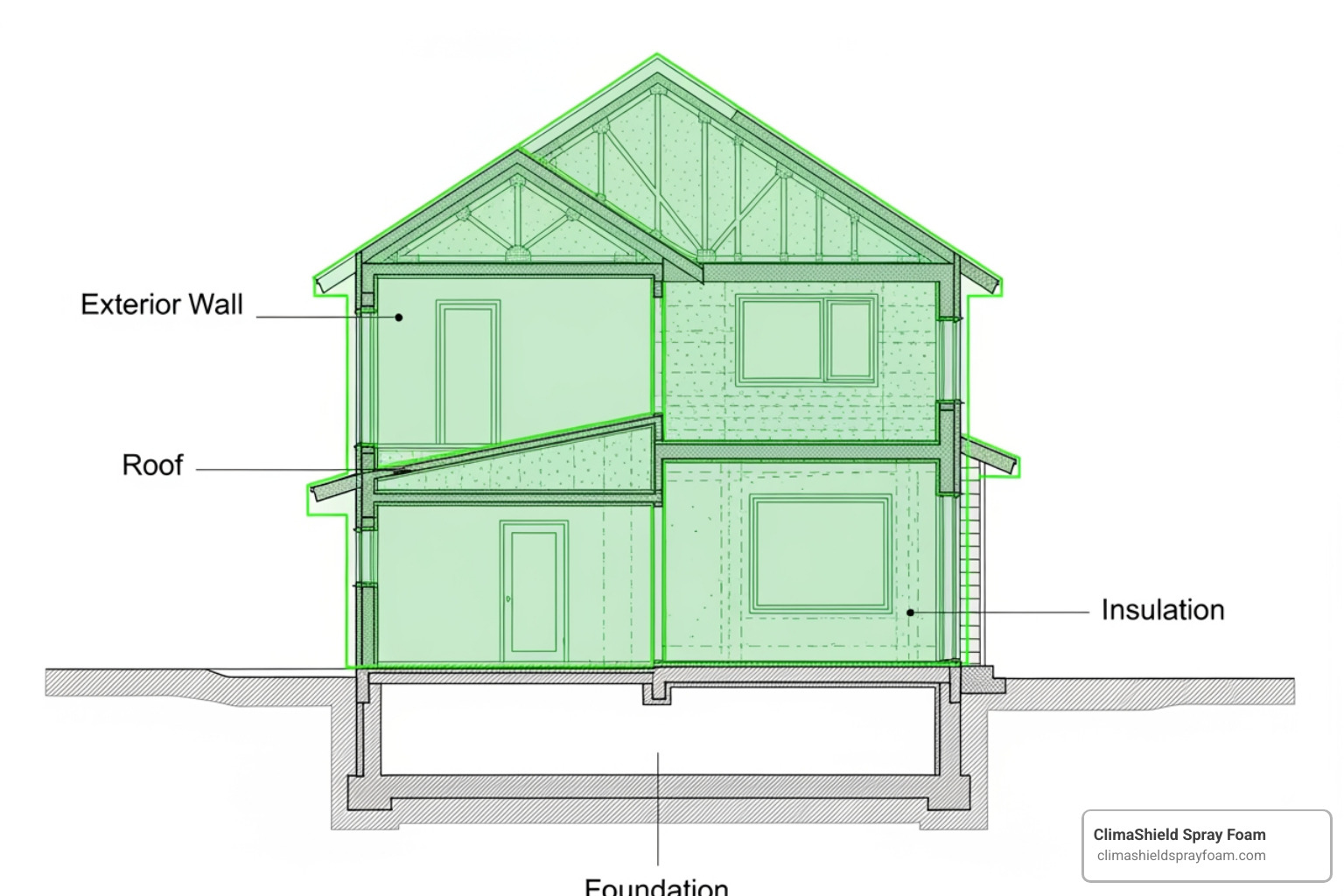
Heat naturally wants to move from warmer areas to colder areas. This movement can happen in three ways: conduction (direct transfer through materials), convection (transfer through air movement), and radiation (transfer through electromagnetic waves). Insulation primarily tackles conduction and convection.
Our goal with energy saving insulation is to create an effective barrier within this thermal envelope, preventing unwanted heat flow and air leakage, which are the leading causes of energy waste.
What is R-Value and Why Does It Matter?
When you look at insulation, you’ll often see a number followed by “R-value.” But what exactly does that mean? Simply put, R-value is a measure of an insulating material’s resistance to conductive heat flow. The “R” stands for thermal resistance, and it’s your best friend when choosing insulation. The higher the R-value, the greater the insulating effectiveness. It’s like having a thicker, more protective blanket for your home.
This value isn’t just a random number; it depends on several factors, including the type of insulation, its thickness, its density, and even environmental conditions like temperature, aging, and moisture accumulation. Generally, installing more insulation will increase the R-value and resistance to heat flow. For most insulation types, increasing thickness proportionally increases the R-value. However, it’s important to note that for loose-fill insulation, if it’s installed too thickly, the settled density can increase due to compression under its own weight, which might affect the R-value proportionality.
A critical point: insulation that is compressed will not provide its full rated R-value. This is why proper installation is so vital. Furthermore, the overall R-value of a wall or ceiling isn’t just about the insulation itself. Heat flows more readily through studs, joists, and other building materials (a phenomenon called “thermal bridging”) than through the insulation. This means the overall R-value of a structure can be different from the insulation’s R-value alone. For a comprehensive understanding, consult the Consumer Guide to Home Insulation Fact Sheet.
The Critical Role of Air Sealing
While insulation is fantastic at resisting heat flow through materials, it’s only half the battle. Think of it this way: a winter coat keeps you warm, but if it’s full of holes, the cold wind will still cut right through. That’s where air sealing comes in.
Air leakage, or uncontrolled air movement, is distinct from the heat flow that insulation resists, but equally, if not more, important. Air that leaks through your home’s envelope—the tiny cracks, gaps, and openings around windows, doors, electrical outlets, plumbing penetrations, and attic hatches—wastes a lot of energy and increases your utility costs. In fact, if you added up all the leaks, holes, and gaps in a typical home’s envelope, it would be the equivalent of having a window open every day of the year!
Air sealing involves closing these cracks and gaps between building components. It’s an essential step towards improving energy efficiency and complements insulation perfectly. By tackling both air sealing and adding insulation, homeowners in Pennsylvania can maximize comfort and save significantly on annual energy bills. Not only does air sealing stop energy loss, but it also prevents moisture-laden air from entering wall cavities and attics, which can lead to condensation, mold, and mildew. This is why we often perform blower door tests as part of a home energy assessment to pinpoint exactly where your home is leaking air. For more insights into how we optimize your home’s thermal performance, explore our services in Residential Insulation.
A Guide to the Best Energy Saving Insulation Types
When it comes to choosing the right energy saving insulation for your home or commercial property in Pennsylvania, you’re faced with a variety of materials, each with its own strengths and ideal applications. While there are many types of insulation available, such as batts and rolls, loose-fill, rigid foam boards, and reflective systems, we specialize in high-performance spray foam insulation due to its superior benefits for energy efficiency, comfort, and durability.
Here’s a comparison of the two main types of spray foam insulation we use:
| Feature | Open-Cell Spray Foam | Closed-Cell Spray Foam |
|---|---|---|
| R-Value per inch | R-3.5 to R-3.8 | R-6.0 to R-7.0+ |
| Application Areas | Walls, attics, crawl spaces, rim joists, sound dampening | Walls, attics, crawl spaces, basements, foundations, exterior applications, structural reinforcement |
| Pros | – Excellent air barrier | – Superior air barrier |
| – Good sound dampening | – Excellent vapor barrier | |
| – More flexible, allows for building movement | – Adds structural integrity | |
| – Lower cost than closed-cell | – Higher R-value in less space | |
| – Expands to fill cavities completely | – Resists water absorption | |
| Cons | – Not a vapor barrier | – More expensive than open-cell |
| – Absorbs water if exposed (can dry out) | – Denser, less sound dampening than open-cell | |
| – Lower R-value per inch | – Less flexible, can be too rigid for some applications | |
| – Requires professional installation | – Requires professional installation |
High-Performance Spray Foam Insulation
At ClimaShield Spray Foam, we champion spray foam insulation as one of the most effective energy saving insulation solutions available today. Why? Because it offers unparalleled performance in creating a sealed, insulated envelope for your home or commercial building. Spray foam, whether open-cell or closed-cell, is applied as a liquid that expands rapidly to fill every nook and cranny, creating a continuous, monolithic layer of insulation. This means it not only insulates but also acts as a powerful air sealant.
Open-cell spray foam is a lower-density material with a sponge-like texture. It’s an excellent air barrier and provides fantastic sound-dampening properties, making your home quieter and more peaceful. It’s ideal for attics, walls, and crawl spaces where a vapor barrier isn’t strictly required, but superior air sealing and sound control are desired.
Closed-cell spray foam is a denser, more rigid material. It boasts a higher R-value per inch, meaning you get more insulating power in a thinner application. Crucially, closed-cell spray foam also acts as an effective vapor barrier, making it perfect for basements, foundations, and exterior wall applications where moisture control is paramount. Its rigidity can even add structural integrity to your walls. This type of foam is durable, waterproof, airtight, and actively resists mold and pests—qualities that align perfectly with our commitment to providing top-tier solutions.
Both types of spray foam are phenomenal for irregular shaped areas and around obstructions, ensuring a complete and seamless insulation layer that traditional materials often can’t match. They can be used effectively in enclosed existing wall cavities, open new wall cavities, and unfinished attic floors. While some small spray containers are available for minor DIY fixes, achieving optimal performance and ensuring proper application requires professional expertise and specialized equipment. For a detailed look at where spray foam can be applied, check out our Uses of Spray Foam.
The Smart Approach: Assessment, Selection, and Installation
Choosing and installing energy saving insulation isn’t a one-size-fits-all process. To truly maximize your home’s energy efficiency and comfort, a thoughtful, systematic approach is key. This involves understanding your home’s unique needs, selecting the right materials, and ensuring impeccable installation.
How to Choose the Right Energy Saving Insulation for Your Climate
The amount and type of insulation your home needs largely depend on where you live. Pennsylvania experiences a full range of seasons, from hot, humid summers to cold, snowy winters. Our region, including Indiana, PA, generally falls within Climate Zone 5, which means we need robust insulation to combat both heat loss in winter and heat gain in summer.
To determine the precise R-values recommended for your home’s attic, walls, and floors, we consult resources like the 2021 International Energy Conservation Code. This code provides detailed guidance based on climate zones, ensuring your home meets or exceeds minimum energy performance standards. For example, attics in our climate zone typically require higher R-values than walls, as heat naturally rises and escapes through the roof.
The “right” insulation balances your climate’s demands with the specific area of your home being insulated and your heating and cooling system type. A local insulation contractor, like us, can help you steer these recommendations and choose the optimal energy saving insulation solution for your specific needs, ensuring your home is prepared for whatever Pennsylvania weather throws its way.
DIY vs. Hiring a Professional Contractor
We get it – the idea of a DIY project can be appealing. But when it comes to energy saving insulation, especially spray foam, the complexity and safety considerations often make professional installation the smartest choice.
Spray foam application requires specialized equipment, training, and a deep understanding of building science to ensure proper mixing, expansion, and coverage. An improperly installed spray foam can lead to costly mistakes, underperformance, and even potential health issues if not handled correctly. For instance, the National Electric Code has strict rules about insulation placement around certain types of wiring, like old knob and tube, due to fire safety concerns – something a professional will always be aware of.
Hiring a trained and certified insulation contractor ensures efficient and expert installation. We know how to prepare the space, handle the materials safely, and achieve the maximum R-value and air-sealing benefits. A professional can also identify potential issues like moisture problems or existing air leaks that need to be addressed before insulation. This expertise ensures that your investment in energy saving insulation truly pays off. For more information on our professional services, including those for commercial properties, visit our page on Commercial Insulation.
Calculating the ROI of Energy Saving Insulation
Investing in energy saving insulation is a significant decision, but it’s one that consistently delivers a strong return on investment (ROI). While there are upfront costs, the long-term savings on your energy bills often lead to a relatively quick payback period.
Consider this: our clients often see savings of up to 60% on their energy bills after upgrading their insulation! These aren’t just one-time savings; they continue year after year, effectively paying for the initial investment. The conserved energy translates directly into money saved, especially as utility rates continue to rise.
Beyond the monthly savings, upgrading your insulation also increases your property value. An energy-efficient home is more attractive to buyers, often commanding a higher price and selling faster.
Furthermore, homeowners in Pennsylvania may have access to government programs, rebates, or incentives that can offset the initial cost. For example, the Weatherization Assistance Program (WAP) helps low-income families in Pennsylvania reduce their energy bills by making their homes more energy-efficient. Home energy assessments, often performed by trained contractors, can also open up access to higher rebates for improvements. We can help you explore available programs and ensure you take advantage of every opportunity to make your insulation upgrade even more affordable.
Frequently Asked Questions about Home Insulation
We often hear similar questions from homeowners and business owners in Indiana, PA, and across Pennsylvania when they consider upgrading their insulation. Here are some of the most common ones, answered with our expert insight.
How much money can I really save with new insulation?
This is usually the first question on everyone’s mind, and for good reason! The savings can be substantial. As we mentioned, homeowners can save an average of 15% on heating and cooling costs, or about 11% on total energy costs, by air sealing and adding insulation. For specific areas like the attic, which is often the biggest culprit for heat loss, upgrading the insulation can lead to savings of up to 30% on heating and cooling usage alone.
However, the exact amount you save depends on several factors: your local climate, the size and construction of your home, your living habits, the efficiency of your current heating and cooling system, and the type of fuel you use. Older, under-insulated homes in Pennsylvania with outdated HVAC systems will naturally see the most dramatic improvements. Our comprehensive approach, which includes assessing your home as a system, aims to deliver savings that could even reach up to 60% on your total energy bills.
Will insulation make my home completely soundproof?
While energy saving insulation significantly improves your home’s acoustics, it’s important to clarify the difference between sound dampening and complete soundproofing. Insulation, particularly open-cell spray foam, is excellent at dampening and absorbing sound waves. By adding insulation to your walls, floors, and ceilings, you create a barrier that blocks and reduces the transmission of noise from outside and between rooms. This provides you with a much quieter and more peaceful indoor environment.
So, while insulation won’t make your home hermetically sealed against all sound (that would require specialized, often very expensive, soundproofing techniques), it will dramatically reduce unwanted noise, making your home a more serene and comfortable place to live.
What are the most common mistakes homeowners make with insulation?
Even with the best intentions, it’s easy to make mistakes that can undermine the effectiveness of your energy saving insulation. Here are some of the most common pitfalls we see:
- Ignoring air sealing: This is perhaps the biggest mistake. Many homeowners focus solely on R-value, but without proper air sealing, air leaks will negate much of the insulation’s benefit. It’s like putting on a thick sweater but leaving the windows open.
- Compressing insulation: Whether it’s fiberglass batts crammed into a too-small cavity or loose-fill insulation that settles excessively, compressed insulation loses its R-value and effectiveness. It needs its full loft to trap air and resist heat flow.
- Blocking ventilation: Especially in attics, homeowners sometimes accidentally cover attic vents with insulation. Proper attic ventilation is crucial for moisture control and preventing heat buildup, so ensuring vents remain clear (often with baffles) is vital.
- Choosing the wrong R-value: Not understanding the recommended R-values for different areas of your home and your climate zone can lead to under-insulating, which means you won’t get the desired energy savings and comfort.
- Improper installation: This covers a wide range of issues, from leaving gaps and voids to incorrect handling of vapor barriers. For complex materials like spray foam, DIY installation without proper training and equipment almost always leads to suboptimal results. For instance, installing insulation around old knob and tube wiring can be a fire hazard and is forbidden by the National Electric Code.
- Not addressing moisture: Installing insulation without first controlling existing moisture problems (leaks, condensation) can trap moisture, leading to mold, mildew, and structural damage. Wet insulation is also ineffective.
These mistakes highlight why a professional assessment and installation are so important. We ensure that your energy saving insulation is installed correctly, safely, and to its maximum potential, avoiding these common and costly errors.
Conclusion
We’ve explored energy saving insulation, from its fundamental benefits to the technical details of R-value and air sealing, and the advantages of high-performance spray foam. It’s clear that investing in proper insulation is one of the most impactful decisions you can make for your home or commercial property in Pennsylvania.
By upgrading your insulation, you’re not just making a purchase; you’re investing in:
- Significant Cost Savings: Drastically reducing your heating and cooling bills, potentially by up to 60%.
- Improved Comfort: Enjoying consistent temperatures, eliminating drafts, and reducing outside noise for a truly peaceful living environment.
- Environmental Responsibility: Lowering your carbon footprint and contributing to a more sustainable future.
- Improved Home Health: Controlling moisture, preventing mold, and resisting pests for a healthier indoor space.
Your home is a system, and optimizing its thermal envelope requires a holistic approach that combines the right insulation with meticulous air sealing. Don’t let your hard-earned money escape through an under-insulated home.
At ClimaShield Spray Foam, we are dedicated to providing expert energy saving insulation solutions custom to your specific needs. With our experience and commitment to quality, we transform homes and businesses into more efficient, comfortable, and sustainable spaces.
Ready to take the next step towards a more energy-efficient and comfortable home?
Learn more about the uses of spray foam and get a professional assessment or Read our Blog for more tips.