
The Modern Fix for Sunken Concrete
Slab jacking foam is a polyurethane-based material injected beneath sunken concrete to lift and level it. This modern repair method uses expanding foam that cures quickly, requires minimal drilling, and provides a permanent solution without the mess and weight of traditional mudjacking.
Quick Facts About Slab Jacking Foam:
- What it is: Two-part polyurethane foam that expands up to 24 times its original volume
- How it works: Injected through small 5/8-inch holes to fill voids and lift concrete
- Cure time: 15-60 minutes (same-day use)
- Weight: Only 2-4 pounds per cubic foot (versus 100+ lbs for concrete slurry)
- Applications: Driveways, sidewalks, patios, garage floors, warehouse floors, and even airport runways
If you’ve watched a foam leveling video online, it probably looked simple: drill a few holes, inject some foam, and the concrete slab floats right back into place. The reality is more nuanced, but the core concept remains true—polyurethane foam jacking is a less invasive, faster alternative to traditional concrete repair methods like mudjacking or complete slab replacement.
Over time, concrete slabs settle due to soil erosion, poor compaction, or water intrusion beneath the surface. What was once a level driveway or sidewalk becomes uneven, creating tripping hazards and drainage problems. More contractors are turning to foam slab jacking instead of mud jacking to lift driveways, sidewalks, garage floors, and even airport runways.
Unlike mudjacking, which pumps a heavy slurry mixture beneath the slab, foam jacking uses high-density polyurethane foam that expands to fill all voids completely. The process requires smaller drill holes, creates minimal mess, and the foam cures in minutes rather than hours or days. The foam is also waterproof and hydro-insensitive, meaning it works even in wet conditions by displacing water.
I’m Dave Brocious, founder of ClimaShield Industries with 20 years of experience in specialty coatings and protective applications including spray foam technology. Through our work in commercial and residential protective coatings, I’ve seen how slab jacking foam provides a durable, efficient solution for concrete repair that saves property owners from costly replacements.
How Slab Jacking Foam Works: The Process and Science
When we talk about slab jacking foam, we’re referring to a sophisticated process that leverages the power of chemistry to solve a common problem: sunken concrete. It begins with a two-part polyurethane material, a liquid resin, and a hardener, which are mixed together at the point of injection. This mixture then undergoes a rapid chemical reaction, changing from a liquid into an expanding foam.

This expansion is key. As the foam expands, it flows into every crevice and void beneath the sunken concrete slab, filling them completely. This is a significant advantage over traditional methods where concrete slurry often fails to fill all underfloor cavities. When we inject foam under pressure, all air cavities are filled permanently, creating a stable and lasting support system. This thorough void filling is crucial because it addresses the root cause of settlement, preventing future movement.
Beyond just filling voids, the expanding foam also serves to stabilize the underlying soil. As it permeates loose soil pockets, it compacts and densifies them, improving their load-bearing capacity. This dual action of void filling and soil stabilization creates a robust and uniform foundation for the concrete slab. The foam is also designed to be hydro-insensitive, meaning it works effectively even in wet conditions by displacing any water present beneath the slab. This ensures a consistent and reliable lift, regardless of the moisture levels in the soil.
The expansion property of polyurethane foam is what truly contributes to its effectiveness in lifting heavy slabs. When you are slab jacking with foam, it expands more than many other materials used for this purpose. This powerful expansion generates the necessary force to gently lift even large slabs back to their original level.
The Step-by-Step Professional Process
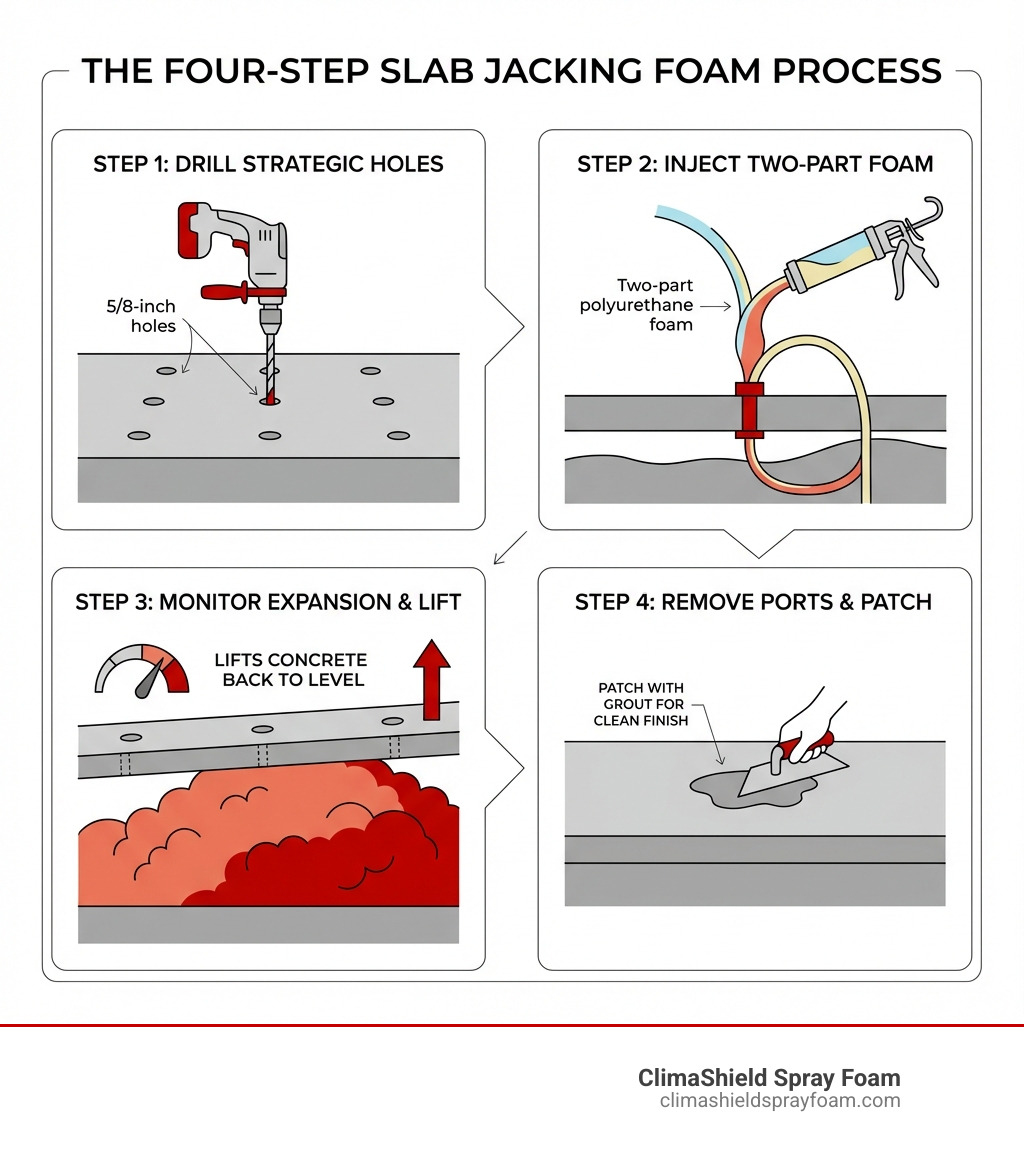
Our professional slab jacking foam process is carefully designed for precision and efficiency, ensuring a lasting repair with minimal disruption. Here’s how we typically proceed:
- Site Assessment: Before any drilling begins, we conduct a thorough assessment of the area. This involves locating all buried utilities to prevent accidental damage. We also evaluate the extent of the concrete settlement, identifying any misaligned joints that might need to be sawed full depth to ensure adjacent slabs don’t lift unintentionally. Protecting adjacent structures and property from potential foam blowouts with plastic sheeting is also part of our preparation.
- Drilling 5/8-inch Holes: Small, strategically placed holes, typically 5/8-inch in diameter, are drilled through the concrete slab. We ensure these holes are a minimum of two feet from the edge of the slab to prevent foam from escaping laterally. For larger slabs, multiple holes are placed approximately three to five feet on center. Thinner, less reinforced slabs might require more frequent holes, while thick, heavily reinforced ones need fewer.
- Port Insertion: Once the holes are drilled, we insert specialized injection ports. These ports provide a clean and secure channel for the foam to be delivered beneath the slab.
- Controlled Injection: Using specialized equipment, we inject the two-part polyurethane foam beneath the slab. Before full injection, we perform a test shot to ensure the equipment is dispensing the material on ratio. We begin injecting at the lowest point of the slab in controlled intervals. If the foam travels too far laterally, we shorten the “on” cycle of the injection. This controlled approach is vital because the expansion of the foam continues after injection, and too much foam can lead to over-lifting.
- Monitoring the Lift: Precision is paramount. We set up equipment like string lines, laser levels, or dial indicators to continuously monitor the slab’s movement. This allows us to ensure an even lift and prevent over-raising the concrete. We never raise the slab more than 1/4 inch from a single injection point to avoid stress and potential damage. It is also crucial to inject foam in interior portions of the slab that may lose contact with supporting soils during the jacking process, ensuring complete support.
- Removing Ports and Patching Holes: Once the desired level is achieved and the foam has cured, the injection ports are removed. We then patch the small drill holes with a suitable material, leaving a clean and aesthetically pleasing finish. Sometimes, re-drilling previously injected holes is necessary to ensure the drill bit penetrates the foam layer but not the underlying supporting soils.
The Science Behind the Lift: Understanding Expanding Foam
At the heart of slab jacking foam is the remarkable science of high-density polyurethane. This material is not just any foam; it is engineered for specific geotechnical applications. It boasts a closed-cell structure, meaning each tiny cell within the foam is sealed, preventing water absorption and providing exceptional compressive strength. This closed-cell nature is what makes the foam waterproof and durable. The chemistry behind polyurethane foam involves complex polymer reactions that create these unique properties.
One of the most impressive characteristics of this foam is its light weight. While it is incredibly strong and capable of providing substantial lifting force, the cured foam itself weighs only about 2-4 pounds per cubic foot. This is a stark contrast to traditional mudjacking slurries, which can weigh over 100 pounds per cubic foot. The lighter weight of the polyurethane foam means it adds minimal additional load to the underlying soil, significantly reducing the risk of future settlement, which is a common issue with heavier fill materials.
The two-part polyurethane foam mixture, when injected, rapidly expands (up to 24 times its original volume, as mentioned in the intro) and hardens. This expansion is carefully controlled by our technicians, allowing for precise lifting of the concrete. This rapid yet controlled expansion, combined with its high strength-to-weight ratio and ability to stabilize soil, makes polyurethane foam an ideal solution for lifting and leveling concrete slabs.
Why Choose Foam Jacking for Concrete Lifting?
We understand you have options when it comes to concrete repair, but we firmly believe that slab jacking foam offers a superior solution compared to traditional methods like mudjacking. The advantages are clear, making it a preferred choice for homeowners and businesses across Pennsylvania. More contractors are turning to foam slab jacking instead of mud jacking, and for good reason.
Here’s a comparison highlighting why foam jacking stands out:
| Feature | Foam Jacking (Polyurethane Foam) | Mudjacking (Concrete Slurry) |
|---|---|---|
| Hole Size | Small (5/8-inch) | Large (1-2 inches) |
| Material Weight | Lightweight (2-4 lbs/cu. ft.) | Heavy (100+ lbs/cu. ft.) |
| Cure Time | Fast (15-60 minutes) | Slow (24-48 hours) |
| Mess & Cleanup | Minimal mess and cleanup | Can be messy, requires extensive cleanup |
| Durability | Permanent, waterproof, and won’t wash away | Can erode or wash out over time |
| Water Resistance | Hydro-insensitive, displaces water | Can be washed out by water |
Slab jacking foam is a polyurethane-based material injected beneath sunken concrete to lift and level it. This modern repair method uses expanding foam that cures quickly, requires minimal drilling, and provides a long-lasting solution without the mess and weight of traditional mudjacking.
Quick Facts About Slab Jacking Foam:
- What it is: Two-part polyurethane foam that expands up to 24 times its original volume
- How it works: Injected through small 5/8-inch holes to fill voids and lift concrete
- Cure time: 15-60 minutes (same-day use)
- Weight: Only 2-4 pounds per cubic foot (versus 100+ lbs for concrete slurry)
- Applications: Driveways, sidewalks, patios, garage floors, warehouse floors, and even airport runways
If you have watched a foam leveling video online, it probably looked simple: drill a few holes, inject some foam, and the concrete slab floats right back into place. The reality is more nuanced, but the core concept remains true—polyurethane foam jacking is a less invasive, faster alternative to traditional concrete repair methods like mudjacking or complete slab replacement.
Over time, concrete slabs settle due to soil erosion, poor compaction, or water intrusion beneath the surface. What was once a level driveway or sidewalk becomes uneven, creating tripping hazards and drainage problems. More contractors are turning to foam slab jacking instead of mud jacking to lift driveways, sidewalks, garage floors, and even airport runways.
Unlike mudjacking, which pumps a heavy slurry mixture beneath the slab, foam jacking uses high-density polyurethane foam that expands to fill all voids completely. The process requires smaller drill holes, creates minimal mess, and the foam cures in minutes rather than hours or days. The foam is also waterproof and hydro-insensitive, meaning it works even in wet conditions by displacing water.
I am Dave Brocious, founder of ClimaShield Industries with 20 years of experience in specialty coatings and protective applications including spray foam technology. Through our work in commercial and residential protective coatings, I have seen how slab jacking foam provides a durable, efficient solution for concrete repair that saves property owners from costly replacements.
How Slab Jacking Foam Works: The Process and Science
When we talk about slab jacking foam, we’re referring to a sophisticated process that leverages the power of chemistry to solve a common problem: sunken concrete. It begins with a two-part polyurethane material, a liquid resin, and a hardener, which are mixed together at the point of injection. This mixture then undergoes a rapid chemical reaction, changing from a liquid into an expanding foam.
This expansion is key. As the foam expands, it flows into every crevice and void beneath the sunken concrete slab, filling them completely. This is a significant advantage over traditional methods where concrete slurry often fails to fill all underfloor cavities. When we inject foam under pressure, all air cavities are filled permanently, creating a stable and lasting support system. This thorough void filling is crucial because it addresses the root cause of settlement, preventing future movement.
Beyond just filling voids, the expanding foam also serves to stabilize the underlying soil. As it permeates loose soil pockets, it compacts and densifies them, improving their load-bearing capacity. This dual action of void filling and soil stabilization creates a robust and uniform foundation for the concrete slab. The foam is also designed to be hydro-insensitive, meaning it works effectively even in wet conditions by displacing any water present beneath the slab. This ensures a consistent and reliable lift, regardless of the moisture levels in the soil.
The expansion property of polyurethane foam is what truly contributes to its effectiveness in lifting heavy slabs. When you are slab jacking with foam, it expands more than many other materials used for this purpose. This powerful expansion generates the necessary force to gently lift even large slabs back to their original level.
The Step-by-Step Professional Process
Our professional slab jacking foam process is carefully designed for precision and efficiency, ensuring a lasting repair with minimal disruption. Here’s how we typically proceed:
- Site Assessment: Before any drilling begins, we conduct a thorough assessment of the area. This involves locating all buried utilities to prevent accidental damage. We also evaluate the extent of the concrete settlement, identifying any misaligned joints that might need to be sawed full depth to ensure adjacent slabs don’t lift unintentionally. Protecting adjacent structures and property from potential foam blowouts with plastic sheeting is also part of our preparation.
- Drilling 5/8-inch Holes: Small, strategically placed holes, typically 5/8-inch in diameter, are drilled through the concrete slab. We ensure these holes are a minimum of two feet from the edge of the slab to prevent foam from escaping laterally. For larger slabs, multiple holes are placed approximately three to five feet on center. Thinner, less reinforced slabs might require more frequent holes, while thick, heavily reinforced ones need fewer.
- Port Insertion: Once the holes are drilled, we insert specialized injection ports. These ports provide a clean and secure channel for the foam to be delivered beneath the slab.
- Controlled Injection: Using specialized equipment, we inject the two-part polyurethane foam beneath the slab. Before full injection, we perform a test shot to ensure the equipment is dispensing the material on ratio. We begin injecting at the lowest point of the slab in controlled intervals. If the foam travels too far laterally, we shorten the “on” cycle of the injection. This controlled approach is vital because the expansion of the foam continues after injection, and too much foam can lead to over-lifting.
- Monitoring the Lift: Precision is paramount. We set up equipment like string lines, laser levels, or dial indicators to continuously monitor the slab’s movement. This allows us to ensure an even lift and prevent over-raising the concrete. We never raise the slab more than 1/4 inch from a single injection point to avoid stress and potential damage. It is also crucial to inject foam in interior portions of the slab that may lose contact with supporting soils during the jacking process, ensuring complete support.
- Removing Ports and Patching Holes: Once the desired level is achieved and the foam has cured, the injection ports are removed. We then patch the small drill holes with a suitable material, leaving a clean and aesthetically pleasing finish. Sometimes, re-drilling previously injected holes is necessary to ensure the drill bit penetrates the foam layer but not the underlying supporting soils.
The Science Behind the Lift: Understanding Expanding Foam
At the heart of slab jacking foam is the remarkable science of high-density polyurethane. This material is not just any foam; it is engineered for specific geotechnical applications. It boasts a closed-cell structure, meaning each tiny cell within the foam is sealed, preventing water absorption and providing exceptional compressive strength. This closed-cell nature is what makes the foam waterproof and durable.
One of the most impressive characteristics of this foam is its light weight. While it is incredibly strong and capable of providing substantial lifting force, the cured foam itself weighs only about 2-4 pounds per cubic foot. This is a stark contrast to traditional mudjacking slurries, which can weigh over 100 pounds per cubic foot. The lighter weight of the polyurethane foam means it adds minimal additional load to the underlying soil, significantly reducing the risk of future settlement, which is a common issue with heavier fill materials.
The two-part polyurethane foam mixture, when injected, rapidly expands (up to 24 times its original volume, as mentioned in the intro) and hardens. This expansion is carefully controlled by our technicians, allowing for precise lifting of the concrete. This rapid yet controlled expansion, combined with its high strength-to-weight ratio and ability to stabilize soil, makes polyurethane foam an ideal solution for lifting and leveling concrete slabs.
Why Choose Foam Jacking for Concrete Lifting?
We understand you have options when it comes to concrete repair, but we firmly believe that slab jacking foam offers a superior solution compared to traditional methods like mudjacking. The advantages are clear, making it a preferred choice for homeowners and businesses across Pennsylvania. More contractors are turning to foam slab jacking instead of mud jacking, and for good reason.
Here’s a comparison highlighting why foam jacking stands out:
| Feature | Foam Jacking (Polyurethane Foam) | Mudjacking (Concrete Slurry) |
|---|---|---|
| Hole Size | Small (5/8-inch) | Large (1-2 inches) |
| Material Weight | Lightweight (2-4 lbs/cu. ft.) | Heavy (100+ lbs/cu. ft.) |
| Cure Time | Fast (15-60 minutes) | Slow (24-48 hours) |
| Mess & Cleanup | Minimal mess and cleanup | Can be messy, requires extensive cleanup |
| Durability | Permanent, waterproof, and won’t wash away | Can erode or wash out over time |
| Water Resistance | Hydro-insensitive, displaces water | Can be washed out by water |
