
Why Your Cargo Van Needs Professional Insulation
Cargo van insulation is the critical barrier between you and uncomfortable temperature swings, condensation damage, and excessive road noise. Without it, your steel van shell conducts heat rapidly—baking in summer sun and freezing in winter cold—while creating condensation that leads to rust, mold, and structural damage.
Quick Answer for Cargo Van Insulation:
- Best Material: Closed-cell spray foam (R-6 to R-7 per inch)
- Key Benefits: Temperature control, condensation prevention, noise reduction, rust protection
- Professional Cost: Starting at $1,950 for complete coverage
- Installation Time: 2-4 hours for application
- Top Concerns: Thermal bridging through metal, space constraints, moisture management
A van is fundamentally a steel shell. Steel conducts heat quickly, meaning your interior temperature swings happen fast without proper insulation. In summer, solar radiation heats the metal, turning your van into an oven. In winter, that same metal pulls heat away, creating an icebox. The result without insulation is a space that feels like a tin can, not a comfortable workspace or living area.
But temperature isn’t your only enemy. When warm, humid interior air touches cold metal surfaces, condensation forms. That moisture leads to rust on your van’s structure, mold growth behind panels, and damage to cargo or finishes. Add in the constant road noise, rattling tools, and engine vibration, and you have a recipe for an uncomfortable, short-lived vehicle conversion.
Professional spray foam insulation solves all three problems simultaneously. It creates a thermal barrier that slows heat transfer through conduction, convection, and radiation. It seals air gaps to prevent moisture from reaching cold metal surfaces. And it dampens sound by absorbing vibrations and reducing noise transmission. The difference is dramatic—a properly insulated van maintains steady temperatures, stays dry inside, and provides a quieter, more professional environment.
I’m Dave Brocious, and I’ve spent 20 years in the coatings industry specializing in spray foam insulation applications, including countless cargo van insulation projects for work vehicles, camper conversions, and specialty transport vans. Through ClimaShield Industries, I’ve seen how proper insulation transforms a basic steel shell into a comfortable, durable, and energy-efficient mobile workspace or living space.

Why Insulating Your Van is a Game-Changer
Insulating your cargo or sprinter van isn’t just about adding a layer of material; it’s about fundamentally changing your vehicle into a more comfortable, durable, and efficient space. Whether you’re using your van for work, as a camper, or for transporting specialty goods, the benefits of professional cargo van insulation are immediate and long-lasting.
We’re talking about year-round comfort, where your van stays cooler in the summer and warmer in the winter. We’re talking about eliminating the headache of condensation, protecting your valuable cargo, and extending the life of your vehicle. This isn’t just a minor upgrade; it’s a game-changer for anyone who spends significant time in their van. It contributes directly to our mission of helping customers save up to 60% on energy bills, even in a mobile setting!
For a general overview of how insulation performance is measured, you can also review the basics of R-value), which is the standard way to compare thermal resistance.
The Battle Against Temperature and Condensation
Imagine working in your van on a scorching summer day in Indiana, PA, or trying to sleep in your camper on a freezing winter night. Without proper cargo van insulation, your van’s metal shell acts like a giant conductor, quickly transferring outside temperatures directly inside. This means blazing summer heat turns your van into an oven, while below-zero winter nights make it an icebox.
Our closed-cell spray foam insulation is designed to slow heat flow through all three mechanisms: conduction, convection, and radiation. This creates a robust thermal barrier that keeps the interior much closer to your desired temperature, no matter what the weather is doing outside.
But temperature control is only half the battle. One of the most insidious problems van owners face is condensation. This happens when warm, humid air inside your van comes into contact with cold metal surfaces. Think of a cold soda can on a humid day – it “sweats.” In your van, this “sweat” can lead to serious issues:
- Mold and Mildew: Condensation creates the perfect breeding ground for mold and mildew, which can cause unpleasant odors, health problems, and damage to your van’s interior finishes.
- Rust and Corrosion: Moisture is the enemy of metal. Over time, condensation can lead to rust and corrosion on the van’s frame and panels, compromising its structural integrity and resale value.
- Cargo Protection: If you’re transporting moisture-sensitive goods, condensation can ruin your products, leading to financial losses and unhappy customers. We’ve even seen cases where professional insulation protected a van transporting saltwater fish tanks from salt corrosion – a testament to its protective power!
Our closed-cell spray foam acts as an air and vapor barrier, preventing that warm, humid air from ever reaching the cold metal surfaces. This keeps the interior surfaces above the dew point, effectively eliminating condensation and all the problems that come with it. It’s a crucial step in protecting your van’s structure and ensuring a healthy environment.
Creating a Quieter, More Professional Space
Have you ever driven down the highway in an empty cargo van? The roar of the road, the drone of the engine, the rattle of tools and equipment – it can be an overwhelming symphony of noise. This isn’t just annoying; it can be fatiguing, distracting, and even unprofessional if you’re meeting clients or trying to relax in a camper conversion.
This is where the sound-deadening properties of cargo van insulation come into play. While some materials primarily focus on thermal insulation, closed-cell spray foam offers significant acoustic benefits. It works by absorbing vibrations and dampening sound waves, reducing the amount of noise that penetrates your van’s interior.
For work vans, this means:
- A more peaceful and less stressful driving experience.
- Reduced noise from tools clanking against metal sidewalls, allowing for clearer communication with colleagues or clients.
- A more professional image, as your van feels more solid and quiet.
For camper vans, the benefits are even more pronounced:
- Quieter nights, whether you’re parked in a busy campground or a remote wilderness spot.
- Reduced road noise during travel, making conversations easier and music more enjoyable.
- A greater sense of privacy and tranquility within your mobile home.
Sound deadening is often overlooked, but it’s a critical component of changing a noisy metal box into a comfortable, functional space. By reducing noise pollution, we help create a more professional and serene environment inside your van. For more insights into how insulation can impact your operational costs and comfort, you can always check out our resources on Your Energy Bill.
Choosing the Right Insulation: Why Spray Foam is Ideal for Cargo Vans
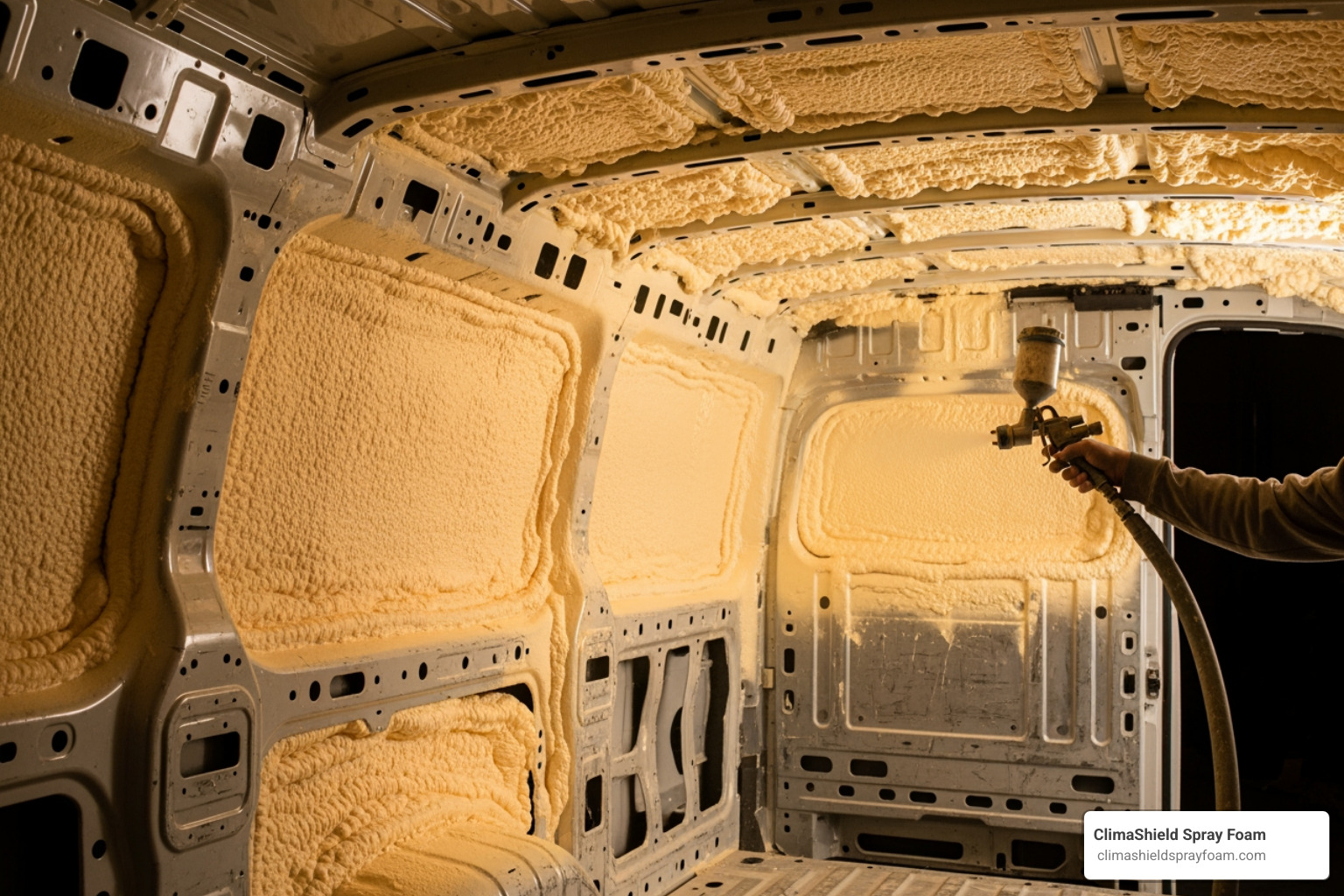
The “R-value” is a key term you’ll hear. It measures thermal resistance—the higher the R-value, the better the insulation’s ability to resist heat flow. But in a van, R-value isn’t the only consideration. We also need to think about:
- Thermal Bridging: Metal conducts heat very efficiently. The ribs and frame of your van act as “thermal bridges,” allowing heat to bypass insulation and transfer directly between the inside and outside. Effective insulation must minimize this.
- Space Constraints: Vans have limited interior space. We need insulation that offers high performance in a thin application.
- Vibration Resistance: Insulation must be able to withstand constant movement and vibration without settling, shifting, or breaking down.
- Moisture Management: The potential for condensation and moisture buildup is high, so a material that acts as a vapor barrier or can manage moisture is crucial.
Here’s a quick look at some common insulation types and how they stack up:
| Material Type | R-Value per inch | Pros | Cons |
|---|---|---|---|
| Closed-Cell Spray Foam | R-6 to R-7 per inch | Excellent thermal barrier, air and vapor barrier, adds structural rigidity, sound dampening, permanent. | Requires professional installation, higher initial cost. |
| Fiberglass Batts | R-3.1 to R-4.3 per inch | Inexpensive, readily available. | Can absorb moisture, leading to mold and rust. Settles over time due to vehicle vibrations, creating gaps. |
| Rigid Foam Boards (XPS/Polyiso) | R-5 to R-6.5 per inch | High R-value, DIY-friendly. | Difficult to cut and fit perfectly into the van’s irregular shapes, leaving air gaps. Requires separate sealing of seams. |
| Wool Insulation | R-3.5 to R-3.8 per inch | Natural, moisture-wicking, good sound absorption. | Can be expensive, may sag or compress over time, lower R-value per inch compared to foam. |
| Reflectix/Bubble Foil | Varies (Radiant Barrier) | Lightweight, easy to install. | Not a true insulator; reflects radiant heat but has very low R-value. Ineffective without a proper air gap. |
Why Closed-Cell Spray Foam is the Top Choice for Cargo Van Insulation
For us at ClimaShield Industries, and for many experts in the van conversion world, closed-cell spray foam stands out as the superior choice for cargo van insulation. Its properties are uniquely suited to the demanding environment of a mobile vehicle, especially here in Indiana, PA, where we experience all four seasons with gusto!
Here’s why we recommend it:
- Exceptional R-Value: With an impressive R-value of R-6 to R-7 per inch, closed-cell spray foam offers one of the highest thermal resistances available. This means we can achieve excellent insulation performance without sacrificing precious interior space.
- Air and Vapor Barrier: This is critical for vans. Closed-cell spray foam expands and cures into a dense, rigid foam that creates an impenetrable barrier against both air and moisture. This completely eliminates condensation by preventing humid interior air from reaching cold metal surfaces, thus protecting your van from rust, mold, and mildew.
- Fills Irregular Cavities: Vans are full of awkward curves, ribs, and crevices that are difficult for rigid boards or batts to fill completely. Spray foam, applied as a liquid, expands to perfectly conform to every contour, creating a seamless, monolithic layer of insulation with no gaps or voids. This ensures a complete thermal envelope.
- Adds Structural Rigidity: Once cured, closed-cell spray foam is incredibly dense and rigid. It bonds strongly to the van’s metal, adding a surprising amount of structural integrity and preventing panels from flexing and rattling. This contributes to the overall quietness and durability of your van.
- Durability: Unlike batt or loose-fill insulations that can settle or shift with vibration, closed-cell spray foam remains stable and effective for the lifetime of your van. It can even withstand accidental bumps and drilling for shelves, making it ideal for both work and camper van builds.
In contrast, open-cell spray foam, while a good insulator for homes, is generally not recommended for vans. It’s less dense, has a lower R-value, and, crucially, is permeable to vapor, meaning it doesn’t offer the same condensation protection that closed-cell foam does. For a deeper dive into the many applications of this versatile material, you can explore the various Uses of Spray Foam.
Why Professional Installation Matters
While the benefits of closed-cell spray foam are clear, its effectiveness hinges entirely on professional application. This isn’t a DIY job for the faint of heart, especially when dealing with the intricate contours of a van.
Our experienced technicians at ClimaShield Industries are trained to:
- Achieve a Complete Seal: We understand how to steer the van’s unique structure to ensure every cavity is filled and every thermal bridge is addressed, creating a truly continuous thermal and vapor barrier.
- Avoid Common Pitfalls: Incorrect application can lead to issues like minor metal bowing or uneven coverage, compromising the insulation’s performance. Our expertise ensures these issues are avoided.
- Ensure Long-Term Performance: Professional application guarantees that the foam adheres properly, cures correctly, and provides its full R-value and protective benefits for years to come. We also ensure proper ventilation during and after the process, which is crucial for safety and optimal curing.
An investment in professional cargo van insulation is an investment in comfort, durability, and peace of mind.
The Professional Insulation Process: A Step-by-Step Guide
At ClimaShield Industries, we pride ourselves on a meticulous and efficient process for insulating cargo and sprinter vans. We understand that your van is a valuable asset, and we treat it with the utmost care, ensuring the highest quality application of closed-cell spray foam. The typical process for insulating the interior of a cargo or sprinter van with spray foam is straightforward, but it requires careful preparation and expert execution.
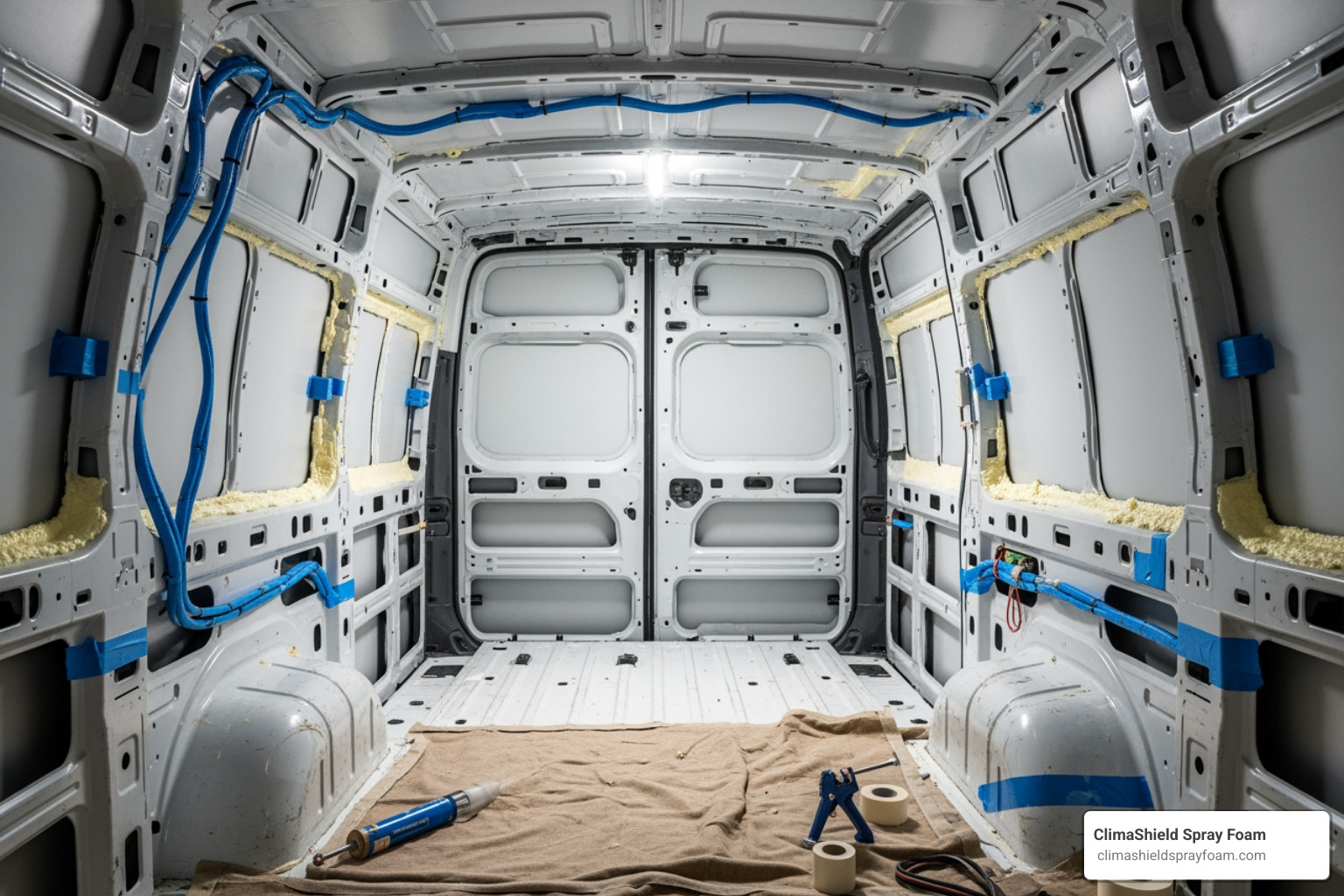
Preparing Your Van for Insulation
Proper preparation is the cornerstone of a successful insulation project. Before we even think about spraying foam, we need your van to be ready. This involves a few key steps on your part:
- Removing Interior Panels and Fixtures: All furniture, wall panels, ceiling panels, and any other interior fixtures that would obstruct access to the metal shell must be removed. We need a clear, unobstructed view of all surfaces that will receive the foam.
- Cleaning All Surfaces: The metal surfaces must be as clean as possible. This means free from dirt, dust, grease, and any loose debris. A clean surface ensures optimal adhesion of the spray foam.
- Taping and Securing Wiring: Any existing wiring (electrical, audio, etc.) needs to be carefully taped or zip-tied together and secured away from the spray path. This protects the wiring and ensures it remains accessible if needed in the future. Our technicians are careful not to cover fastening points if you plan to re-hang panels.
- Protecting Windows and Floors: While we take extreme care, overspray can happen. We’ll help you protect any windows, the floor, and other areas you don’t want foam on using plastic sheeting and painter’s tape.
Our goal is to create a clean, organized workspace that allows our technicians to apply the foam uniformly and effectively, achieving a complete and seamless seal throughout your van.
Best Practices for Insulating Floors, Walls, and Ceilings
Once your van is prepped, our skilled team gets to work. We apply closed-cell spray foam to the walls, ceiling, and even the doors of your van.
- Insulating Walls and Ceiling: Our technicians expertly spray the foam into all the cavities, around the ribs, and across the flat panels of your van’s walls and ceiling. The foam expands to fill every void, creating a monolithic, airtight, and vapor-tight layer. We pay close attention to addressing thermal bridges—the metal ribs and frame that would otherwise conduct heat. By encapsulating these, we prevent heat from bypassing the insulation.
- Insulating the Van Floor: While often overlooked, insulating the floor makes a significant difference in overall comfort and thermal performance. This is especially true for those cold Indiana winters, as heat can easily escape or enter through the chassis. For floor insulation, it’s typically recommended to frame out the floor first, creating cavities for the foam. This ensures a level surface and allows for consistent, effective insulation.
- Achieving Consistent Coverage: We aim for approximately two inches of closed-cell spray foam coverage. This thickness provides the optimal R-value (R-6 to R-7 per inch) for a van while leaving enough space for interior paneling. Our experienced applicators ensure a uniform thickness, which is crucial for maximizing insulation performance.
This comprehensive approach ensures that your entire van—from floor to ceiling, and wall to wall—is enveloped in a high-performance insulation layer, providing unparalleled temperature control, condensation prevention, and sound dampening.
Frequently Asked Questions About Professional Van Insulation
We know you’ve got questions, and we’re here to answer them! Investing in professional cargo van insulation is a big decision, and we want you to feel confident and informed every step of the way. Here are some of the most common concerns and questions we address at ClimaShield Industries.
What factors influence the cost of professional cargo van insulation?
The cost of insulating a cargo or sprinter van with closed-cell spray foam can vary based on several factors, but to give you an idea, the cost for complete coverage generally starts at $1950. This price is typically based on two inches of closed-cell spray foam coverage.
The main factors influencing the final cost include:
- Van Size and Type: Larger vans (like extended Sprinters or Transit vans) will naturally require more material and labor than smaller cargo vans.
- Thickness of Application: While two inches is standard and highly effective, specific needs might require slight adjustments, which can impact material cost.
- Labor: The expertise of our technicians ensures a flawless application, which is factored into the cost.
- Prep Work Required: While we ask you to do initial prep (removing panels, cleaning), any additional prep work needed on our end could slightly influence the final price.
- Additional Services: If you opt for floor insulation that requires specific framing, this would be an additional cost to the project.
We believe in transparent pricing and will provide a detailed estimate for your specific van.
Is spray foam safe and will it damage my van?
Safety is always a top concern, and it’s one we take very seriously.
- Safety During and After Application: The foam insulation we use is safe for your van, home, or commercial building. During the application process, our technicians wear specialized protective gear, and the workspace is thoroughly ventilated. After application, there is a curing period during which the foam off-gasses. Once cured, the foam is completely inert and safe for occupants. While there might be a lingering odor for a short time, it’s safe to drive your van the same day it’s insulated.
- Potential for Metal Bowing: It’s not common, but in some rare instances, the expansion of spray foam could slightly bow out the outer metal skin of the van. However, this is generally cosmetic and does not cause structural damage to the van. Our experienced applicators are trained to apply the foam carefully to minimize this possibility.
- Rust and Corrosion Concerns: A common misconception is that closed-cell spray foam can cause rust by trapping moisture against the metal. This is simply not true when applied correctly. Our closed-cell spray foam creates an air and vapor barrier that prevents moisture from reaching the metal in the first place. In fact, by eliminating condensation, it actively protects your van’s metal interior from corrosion, as demonstrated by our customer who transported saltwater fish tanks!
The key here is professional installation. When done by experts like us at ClimaShield Industries, spray foam is a safe, durable, and protective solution for your van.
How long does the process take and can I still build out my van?
We understand that your time is valuable, and you’re eager to get your van back on the road or continue your build.
- Typical Timeline: The actual time to spray foam your van typically ranges between 2 to 4 hours, depending on the size and complexity of the interior.
- Curing Time: While the application is quick, the foam needs time to fully cure. However, as mentioned, it is generally safe to drive your van the same day it is insulated. We will advise you on any specific ventilation recommendations for the first 24-48 hours.
- Hanging Panels and Cabinets: Absolutely! You can still hang panels and build out the interior of your van after it’s insulated. Our technicians are careful to apply the foam at approximately two inches thick and to avoid covering critical fastening points where panels might attach. Because closed-cell spray foam is so rigid and durable, it can even provide a solid base for screwing into if needed, though we always recommend securing panels to the van’s frame or furring strips for maximum stability.
Our efficient process ensures minimal downtime, allowing you to quickly move on to the next phase of your van conversion or get your work vehicle back into service.
Conclusion: Invest in Comfort and Durability
As we’ve explored, professional cargo van insulation is far more than just an accessory; it’s a foundational element that dramatically improves the functionality, comfort, and longevity of your vehicle. From the sweltering summers to the freezing winters here in Indiana, PA, proper insulation ensures your van remains a comfortable, controlled environment.
By choosing closed-cell spray foam from ClimaShield Industries, you’re investing in:
- Superior Temperature Control: Enjoy a van that stays cooler in the heat and warmer in the cold, making every journey and every workday more pleasant.
- Complete Moisture Prevention: Say goodbye to condensation, mold, mildew, and the costly rust that can damage your van’s structure and spoil your cargo.
- Effective Noise Reduction: Transform a noisy metal box into a quieter, more professional, and more peaceful space, whether you’re driving or parked.
- Long-Term Durability and Value: Our spray foam adds structural rigidity and lasts the lifetime of your van, protecting your investment and potentially increasing its resale value.
At ClimaShield Industries, we bring 20 years of experience to every project, ensuring a flawless application that maximizes these benefits. We’re not just insulating vans; we’re creating mobile environments that are healthier, more efficient, and simply better to be in.
Ready to transform your cargo or sprinter van into a comfortable, durable, and energy-efficient space? Don’t settle for less than the best. Get a free estimate for your van insulation project with ClimaShield Industries today.
