Why Choosing the Best Insulation for Home Comfort Matters
The best insulation for home improvement depends on your specific needs, but here’s a quick overview:
| Insulation Type | Best For | R-Value per Inch | Key Benefit |
|---|---|---|---|
| Spray Foam | Attics, crawl spaces, air sealing | R-6.0 to R-6.5 | Superior air seal + moisture barrier |
| Fiberglass Batts | Walls, basic DIY projects | R-3.0 to R-4.3 | Entry-level, widely available option |
| Blown-In Cellulose | Attics, existing walls | R-3.2 to R-3.8 | Eco-friendly, fills gaps |
| Rigid Foam Board | Basements, foundation walls | R-5.0 to R-6.5 | Moisture resistant, durable |
If your home is drafty in winter or hot in summer, inadequate insulation is likely the cause. Since heating and cooling account for 50% to 70% of energy use in an average American home, upgrading your insulation can significantly cut energy bills and boost comfort.
However, the best insulation for home projects isn’t a one-size-fits-all solution. The right choice depends on your climate, budget, and the specific area you’re insulating. You must consider R-value (thermal resistance), moisture resistance, and air sealing capabilities to ensure long-term performance. A cheaper option that allows air leaks can cost you more in energy bills over time.
I’m Dave Brocious, founder of ClimaShield Industries. With 20 years in the coatings and insulation industry, I’ve helped countless homeowners improve energy efficiency. In this guide, I’ll break down each insulation type so you can make an informed decision that saves money and improves comfort for years to come.
Insulation 101: Decoding R-Value and Climate Zones
Insulation resists the flow of heat, keeping your home’s temperature stable and your energy bills down. The primary measure of this resistance is the R-value.
What is R-Value and Why is it Important?
An insulating material’s resistance to heat flow is rated by its R-value. Simply put, the higher the R-value, the greater the insulating effectiveness. The R-value depends on the insulation’s type, thickness, and density, as well as external factors like temperature and moisture. Wet insulation, for instance, drastically loses its insulating properties.
When adding new insulation over existing material, you simply add the R-values of the individual layers to find the total R-value. Installing more insulation increases the total R-value and its resistance to heat flow, directly improving home energy efficiency and comfort.
Finding Your Home’s Ideal R-Value: Climate Zones and Recommendations
The ideal R-value isn’t universal; it depends on your climate zone. Colder climates, like Pennsylvania’s, require higher R-values for optimal energy efficiency. The U.S. is divided into climate zones with specific recommendations. For example, EnergyStar recommends the following R-values for homes in Pennsylvania:
| Part of Home | Recommended R-Value (Non-Insulated) | Recommended R-Value (Previously Insulated) |
|---|---|---|
| Attic | R-60 | R-49 |
| Floors | R-30 | Not specified (typically R-30 for uninsulated) |
| Basement/Crawl Space | R-15 to R-19 | Not specified (typically R-15 to R-19 for uninsulated) |
| Walls (Sheathing) | R-5 to R-10 | Not specified (typically R-5 to R-10 for uninsulated) |
These recommendations are crucial for comfort and energy savings. You can find guidelines for your specific climate zone on the EnergyStar website or in the 2021 International Energy Conservation Code. This helps you tailor your insulation strategy to your local climate, preventing overspending or energy waste.
Comparing Popular Insulation Solutions for Your Home
Choosing the best insulation for home projects means comparing options based on R-value, air sealing, moisture resistance, and soundproofing. Let’s look at the main types available to homeowners in Pennsylvania.
| Insulation Type | R-Value per Inch | Approx. Cost (per sq ft) | Pros | Cons |
|---|---|---|---|---|
| Fiberglass Batts | 2.9 – 3.8 | Low to moderate | Widely available, easy to find for basic DIY projects, decent thermal resistance. | Can irritate skin/lungs/eyes, loses R-value when wet, poor air sealing, can settle, prone to air gaps, not pest-resistant. |
| Blown-In Fiberglass | 2.2 – 2.9 | Low to moderate | Fills irregular spaces better than batts, common for existing walls/attics. | Lower R-value than batts, can settle over time, requires blowing machine, poor air sealing, not pest-resistant. |
| Cellulose | 3.1 – 3.8 | Low to moderate | Eco-friendly (recycled paper), good sound dampening, fills irregular spaces, treated for fire/mold/pest resistance. | Can settle up to 20%, susceptible to moisture if not installed correctly, can be dusty, requires blowing machine. |
| Open-Cell Spray Foam | Around 3.9 | Higher initial investment | Excellent air seal, remains flexible, expands significantly to fill cavities, good sound dampening, doesn’t retain water. | Lower R-value than closed-cell, not a vapor barrier, professional installation required. |
| Closed-Cell Spray Foam | 6.0 – 7.0 | Higher initial investment | Superior air seal, highest R-value, moisture/vapor barrier, adds structural strength, doesn’t retain water, pest-resistant. | Higher upfront cost and professional installation needed, very dense/hard, less flexible. |
| Rigid Foam Board | 4.5 – 5.0 / 6.0 – 6.5 | Moderate to higher | High R-value per inch, moisture resistant, durable, high compressive strength, can block thermal short circuits, good for exterior/basement walls. | Must be covered by a fire barrier indoors, seams must be taped for air sealing, can be more labor-intensive to cut/fit, not ideal for irregular spaces. |
For a broader overview of different insulation materials and their characteristics, you can explore resources like the U.S. Department of Energy’s Types of Insulation page.
Traditional Insulation: Common Choices in Many Homes
When most people think of insulation, they often picture fiberglass, a staple in homes for decades.
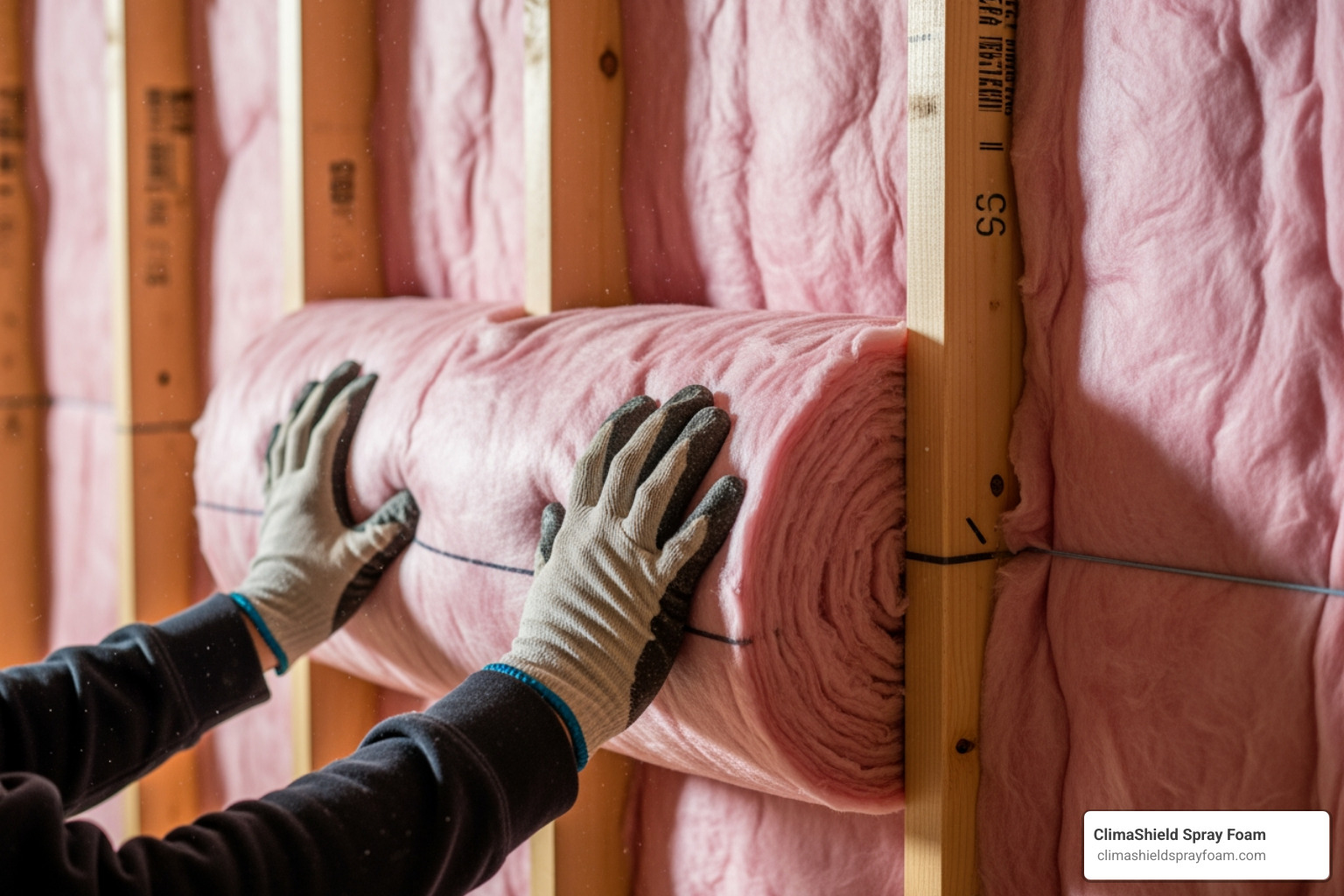
Fiberglass insulation comes in batts (pre-cut sheets) and loose-fill (blown-in).
Pros of Fiberglass Insulation:
- Entry-Level Cost: Often the lowest upfront-cost choice for basic upgrades.
- Widely Available: Found at most home improvement stores.
- DIY-Friendly (Batts): Batts are relatively straightforward for homeowners to place in open cavities.
- Decent Thermal Resistance: Offers solid performance with an R-value of roughly R-2.2 to R-3.8 per inch.
Cons of Fiberglass Insulation:
- Irritant: Can irritate skin, lungs, and eyes; requires protective gear.
- Loses R-Value When Wet: Absorbs water, which reduces its insulating properties and can lead to mold.
- Poor Air Sealing: Does not stop air leakage, leading to drafts and energy loss.
- Settling: Blown-in fiberglass can settle over time, reducing its effectiveness.
- Prone to Air Gaps: Batts must be cut perfectly to avoid gaps that compromise performance.
While inexpensive, fiberglass’s poor air sealing and vulnerability to moisture make it less ideal for achieving maximum energy efficiency compared to high-performance spray foam solutions.
Eco-Friendly Insulation: Sustainable and Sound Dampening
For an insulation option that’s kind to the planet and your ears, consider cellulose.
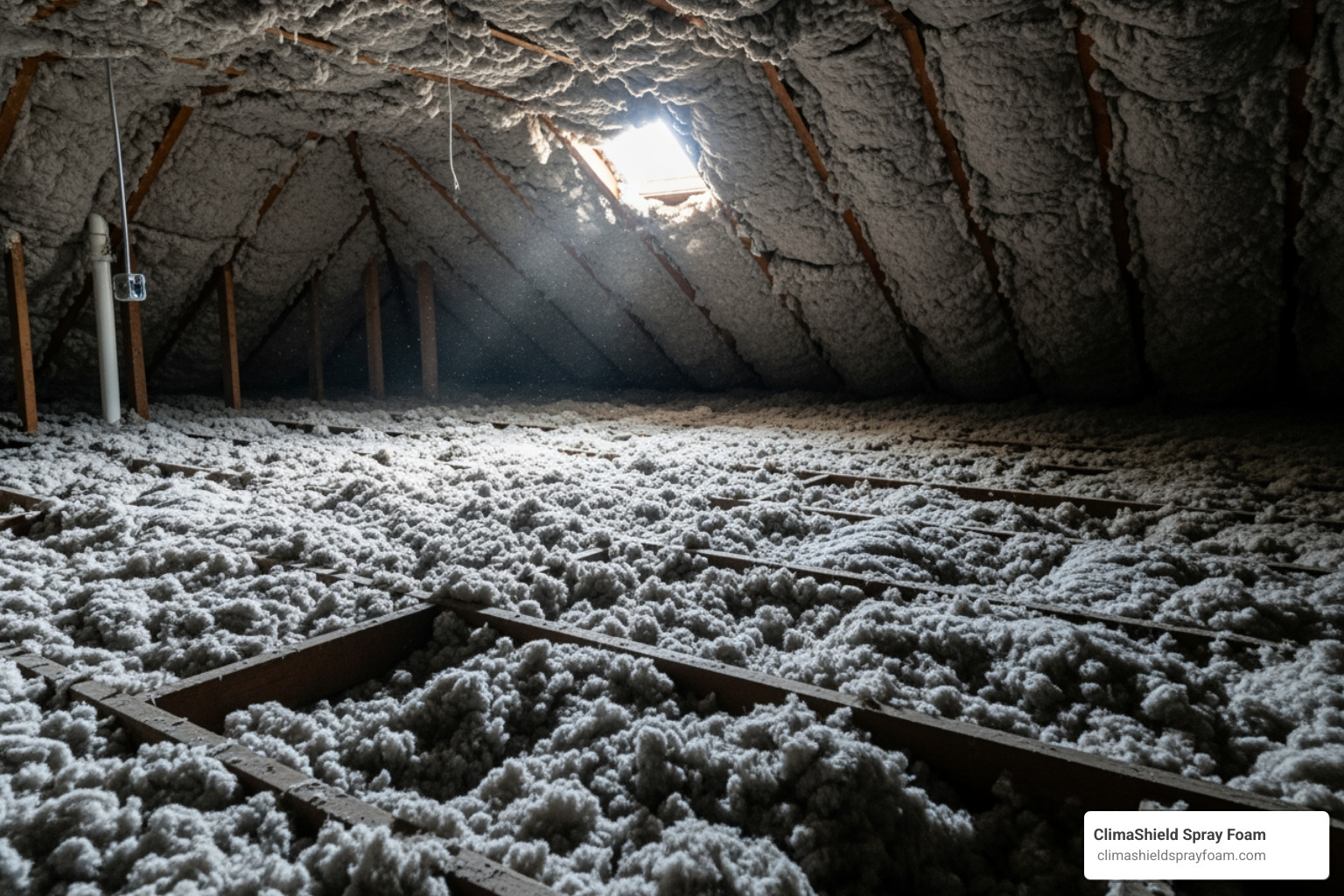
Cellulose insulation is made primarily from recycled paper products and is typically blown into place, making it excellent for filling irregular spaces.
Pros of Cellulose Insulation:
- Eco-Friendly: Made from a high percentage of recycled materials.
- Good Sound Dampening: Effectively reduces noise transmission.
- Fills Irregular Spaces: As a loose-fill product, it conforms to any shape, reducing gaps.
- Treated for Resistance: Treated with minerals for fire, mold, and insect resistance.
- Budget-Conscious: Pricing is often comparable to other basic options.
Cons of Cellulose Insulation:
- Can Settle Over Time: Can settle up to 20%, potentially reducing its R-value.
- Susceptible to Moisture: Can absorb moisture if exposed to leaks, which reduces its effectiveness.
- Requires Blowing Machine: Installation is not as DIY-friendly as batts.
- Dusty Installation: The process can be dusty, requiring proper ventilation and gear.
Cellulose offers a compelling blend of affordability, environmental responsibility, and performance, especially where sound control is important.
Spray Foam Insulation: The High-Performance Air Sealant
For creating an airtight, energy-efficient home, spray foam insulation is a high-performance solution that offers superior thermal resistance and air sealing.
Spray foam insulation is a liquid that expands to fill every crack and crevice, creating a seamless barrier against air leakage. We offer comprehensive residential insulation services using this advanced material.
There are two main types:
-
Open-Cell Spray Foam:
- Structure: Lighter, less dense, with interconnected cells.
- R-Value: Around R-3.9 per inch.
- Pros: Excellent air seal, remains flexible, expands significantly to fill large cavities, and provides good sound dampening.
- Cons: Not a vapor barrier, has a lower R-value than closed-cell, requires professional installation, and has a higher upfront cost than basic insulation options.
-
Closed-Cell Spray Foam:
- Structure: Dense and rigid, with completely closed cells.
- R-Value: The highest of all common insulation types, at R-6.0 to R-7.0 per inch.
- Pros: Provides the absolute best insulation for home energy efficiency by creating a superior air and moisture barrier. It adds structural strength, resists pests, and is a long-term solution that doesn’t settle.
- Cons: Has a higher upfront cost and requires professional installation due to its rigidity and specialized equipment.
Spray foam’s key advantage is its ability to expand and create a near-perfect air seal, which is crucial for energy efficiency. It keeps conditioned air inside, ensuring comfort and lower energy bills. For more on how this material can benefit your home, explore the many Uses of Spray Foam.
Rigid Foam Board Insulation: The Durable, Versatile Barrier
Rigid foam board insulation panels are a fantastic choice for specific applications where durability and moisture resistance are key.
These boards are made from common foam plastics designed for building applications.
Pros of Rigid Foam Board Insulation:
- High R-Value per Inch: Offers excellent thermal performance (roughly R-4.5 to R-6.5) in a thin profile.
- Moisture Resistant: Highly resistant to moisture, making it ideal for damp areas like basements.
- Durable and High Compressive Strength: Strong enough for use under concrete slabs or on exterior walls.
- Blocks Thermal Short Circuits: Can block heat loss through framing when installed as a continuous layer.
Cons of Rigid Foam Board Insulation:
- Requires Fire Barrier: Must be covered by a material like drywall for interior use to meet fire codes.
- Seams Must Be Taped: Seams between boards must be sealed to create an effective air barrier.
- Not Ideal for Irregular Spaces: Less suitable for filling odd-shaped cavities than spray or blown-in types.
- Can Be More Labor-Intensive: Cutting and fitting panels can be time-consuming.
Rigid foam board offers a robust solution for areas requiring high R-value, durability, and moisture control, and it can work especially well alongside spray foam in a whole-house efficiency strategy.
How to Choose the Best Insulation for Your Home
Selecting the best insulation for home comfort isn’t about one “best” product, but about making informed choices for your house, budget, and goals.
Matching Material to Application: A Strategic Approach
Different areas of your home have different needs. We help homeowners find the perfect match through our residential insulation services.
Best Insulation for Attics, Walls, and Basements:
- Attics: A major source of heat loss. In Pennsylvania, recommended R-values are R-60 for uninsulated attics and R-49 for existing insulation.
- Blown-In Insulation (Fiberglass or Cellulose): Common for adding insulation to existing attics, as it easily covers joists and fills gaps.
- Spray Foam (Open or Closed-Cell): The top performer, especially for unvented attics. It provides a high R-value and an excellent air seal, with closed-cell offering maximum thermal resistance (R-6.0 to R-7.0 per inch).
- Walls:
- Batts in Open Cavities: Often used for new construction or open walls during a renovation.
- Blown-In Options for Existing Walls: Less invasive options for existing walls that can be blown into cavities through small holes.
- Spray Foam (Open or Closed-Cell): Provides the ultimate performance in new walls by creating a complete air barrier.
- Basements & Crawl Spaces: These moisture-prone areas significantly impact home comfort. An R-value of R-15 to R-19 is recommended for walls in Pennsylvania.
- Rigid Foam Board: A strong choice for basement walls due to its high R-value and moisture resistance.
- Closed-Cell Spray Foam: The absolute best insulation for home basements and crawl spaces. It forms an impenetrable air and moisture barrier, helping stop drafts and reduce mold risk. Experts recommend air-impermeable, non-water-sensitive insulation like spray foam or rigid foam in these areas to control moisture, a task for which fiberglass is ill-suited.
Finding the Best Insulation for Home Upgrades: Existing vs. New Construction
Your home’s age influences your choices.
- Existing Homes (Retrofit): The challenge is adding insulation without major demolition.
- Blown-In Insulation (Cellulose or Fiberglass): Commonly used for insulating existing walls and topping up attics.
- Spray Foam (especially Closed-Cell): A superior investment for attics, crawl spaces, and rim joists due to its air-sealing and moisture-resistant properties. It is a long-term solution that doesn’t settle.
- New Construction: This is the best opportunity to maximize energy efficiency from the start.
- Spray Foam (Open or Closed-Cell): Often considered the best insulation for home new construction for its ability to create a complete air barrier.
- Rigid Foam Board: Can be used on exterior sheathing for continuous insulation.
- Batts in Wall Cavities: A cost-conscious option for wall cavities when combined with careful air sealing.
Balancing upfront cost with long-term savings is key. While spray foam has a higher initial price than basic insulation, its superior performance often leads to greater energy savings, making it a wise investment.
Frequently Asked Questions About Home Insulation
We get a lot of questions about insulation—it’s a big decision. Let’s tackle some common queries.
Can I install insulation myself?
Some insulation tasks are DIY-friendly, while others require a professional.
- DIY-Friendly Options: Fiberglass batts and some loose-fill attic top-ups can be DIY projects if you use proper safety gear (gloves, mask, long sleeves).
- Professional-Only Options:
- Spray Foam: This is not a DIY job. It requires specialized equipment and training to ensure safety and effectiveness. Improper application can lead to poor performance and off-gassing.
- Dense-Pack and Injection Foam: Insulating existing walls requires special equipment and is best left to professionals.
- Risks of Improper Installation: DIY mistakes can lead to reduced R-value, moisture issues (mold, rot), and safety hazards. For optimal results, especially with high-performance materials like spray foam, professional installation is the recommended route.
What insulation is best for soundproofing?
Insulation can also make your home quieter. The best options for sound dampening are dense and fill cavities completely.
- Eco-Friendly Insulation (Cellulose): Its dense, fibrous structure is excellent for absorbing sound in walls and floors.
- Mineral Wool (Stone Wool): A fantastic sound dampener due to its high density. It’s also fire-resistant.
- Open-Cell Spray Foam: Its flexible, sponge-like structure is very effective at absorbing airborne sound.
If soundproofing is a priority for your best insulation for home project, focus on cellulose, mineral wool, or open-cell spray foam.
How often does home insulation need to be replaced?
The lifespan of insulation varies by material and conditions.
- Spray Foam Insulation: A permanent, “one and done” solution. It doesn’t settle, sag, or degrade and will not need to be replaced.
- Fiberglass and Cellulose: Can last for decades but may settle over time or suffer damage from moisture or pests, requiring replenishment or replacement.
- Rigid Foam Board: Very durable, often lasting over 50 years when properly installed and protected.
Regular inspections of your attic and crawl spaces can help you determine if your insulation needs an upgrade.
The Final Layer: Creating a Comfortable and Efficient Home
Choosing the best insulation for home energy efficiency is one of the smartest investments you can make. It’s about creating a comfortable living environment while significantly reducing your utility bills.
We’ve explored options from affordable fiberglass to high-performance spray foam. The best choice depends on your specific needs, the area of your home, and your budget.
Properly installed insulation is a critical part of your home’s building envelope, contributing to:
- Significant Energy Savings: Reduces the workload on your HVAC system.
- Improved Comfort: Eliminates drafts and stabilizes indoor temperatures.
- Improved Indoor Air Quality: Air sealing reduces the entry of pollutants and allergens.
- Increased Home Value: An energy-efficient home is a desirable asset.
- Reduced Noise Pollution: Creates a quieter home environment.
ClimaShield Spray Foam specializes in durable, waterproof, and airtight insulation that resists mold and pests for Pennsylvania homeowners. We help our customers save up to 60% on their energy bills while creating more comfortable, sustainable homes.
Are there any rebates or incentives available for home insulation upgrades? Yes! Many government and utility programs offer rebates or tax credits for energy efficiency upgrades. We encourage you to check with local authorities and state energy programs in Pennsylvania for available programs.
Don’t let inadequate insulation compromise your comfort or budget. Take the proactive step to assess your home’s needs. Find how the right insulation transforms your home by exploring the many Uses of Spray Foam and find how we can help you achieve a more comfortable, energy-efficient, and valuable home.
