What Spray Foam Roofing Insulation Actually Does (And Why It Matters)
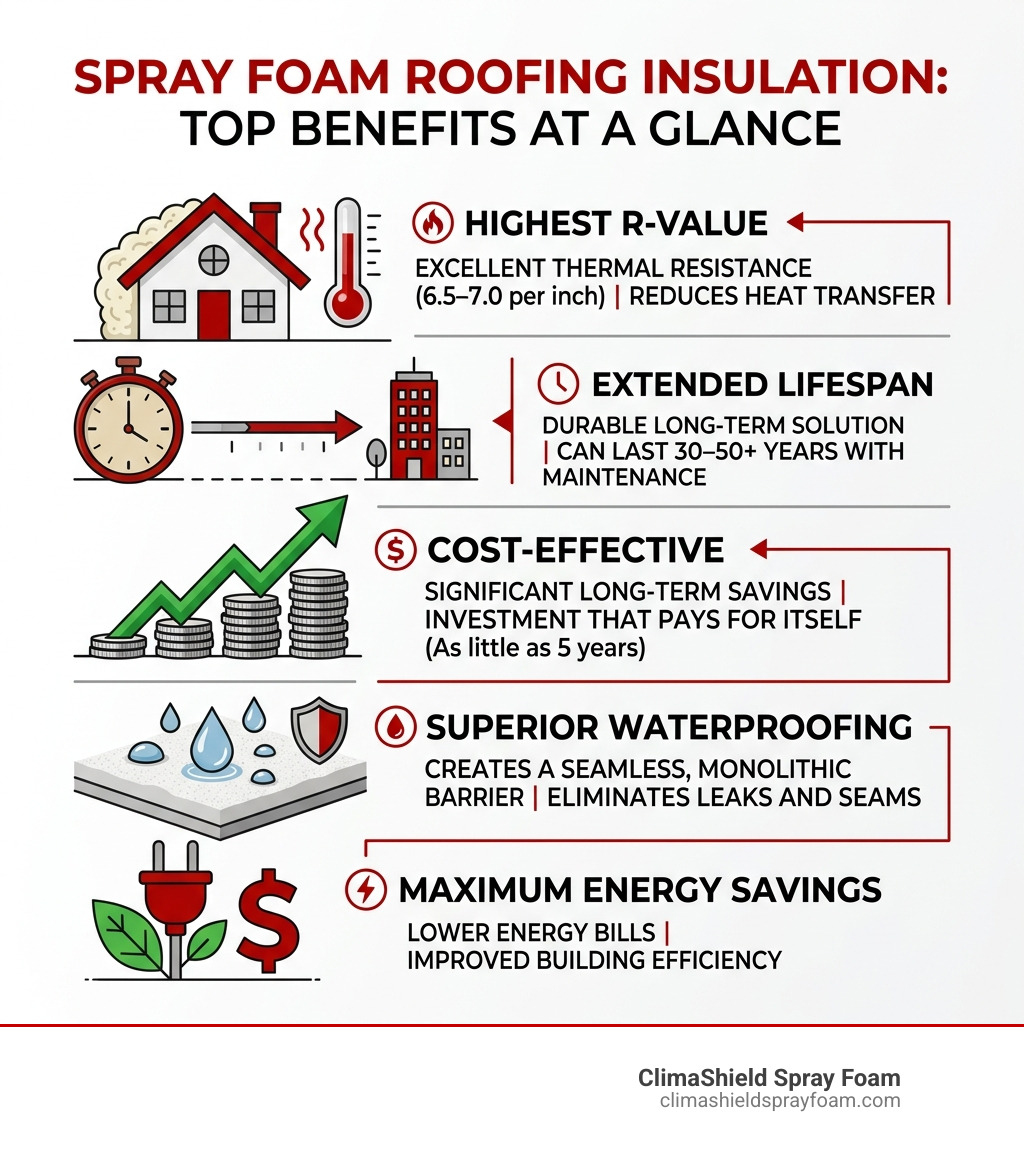
Spray foam roofing insulation is one of the most energy-efficient and durable roofing systems available today. Here’s a quick overview of what you need to know:
| Feature | Details |
|---|---|
| R-value | 6.5–7.0 per inch (highest of any common roofing material) |
| Lifespan | 30–50+ years with proper maintenance |
| Cost | $5.00–$10.00 per sq ft installed |
| Energy savings | Can pay for itself in as little as 5 years |
| Weight | Only 0.5–0.75 lbs per sq ft added to the roof |
| Waterproofing | Seamless, monolithic barrier with no seams or joints |
| Maintenance | Recoat every 10–15 years to extend lifespan indefinitely |
If your building has high energy bills, leaks, or an aging roof, spray foam roofing may be the most cost-effective long-term fix available.
It’s not a new technology. Spray polyurethane foam has been used in roofing since the late 1960s — and some of the earliest installations are still performing today after multiple recoats.
But it’s not right for every project. The system requires skilled installation, specific weather conditions, and ongoing maintenance to perform as promised.
This guide walks you through everything you need to know to decide if it’s the right fit for your building.
I’m Dave Brocious, founder of ClimaShield Industries, with 20 years of experience in the coatings industry and hands-on expertise in spray foam roofing insulation for commercial and residential properties. I’ll walk you through the real-world considerations — costs, performance, and common pitfalls — so you can make a confident, informed decision.
What is Spray Polyurethane Foam (SPF) Roofing?
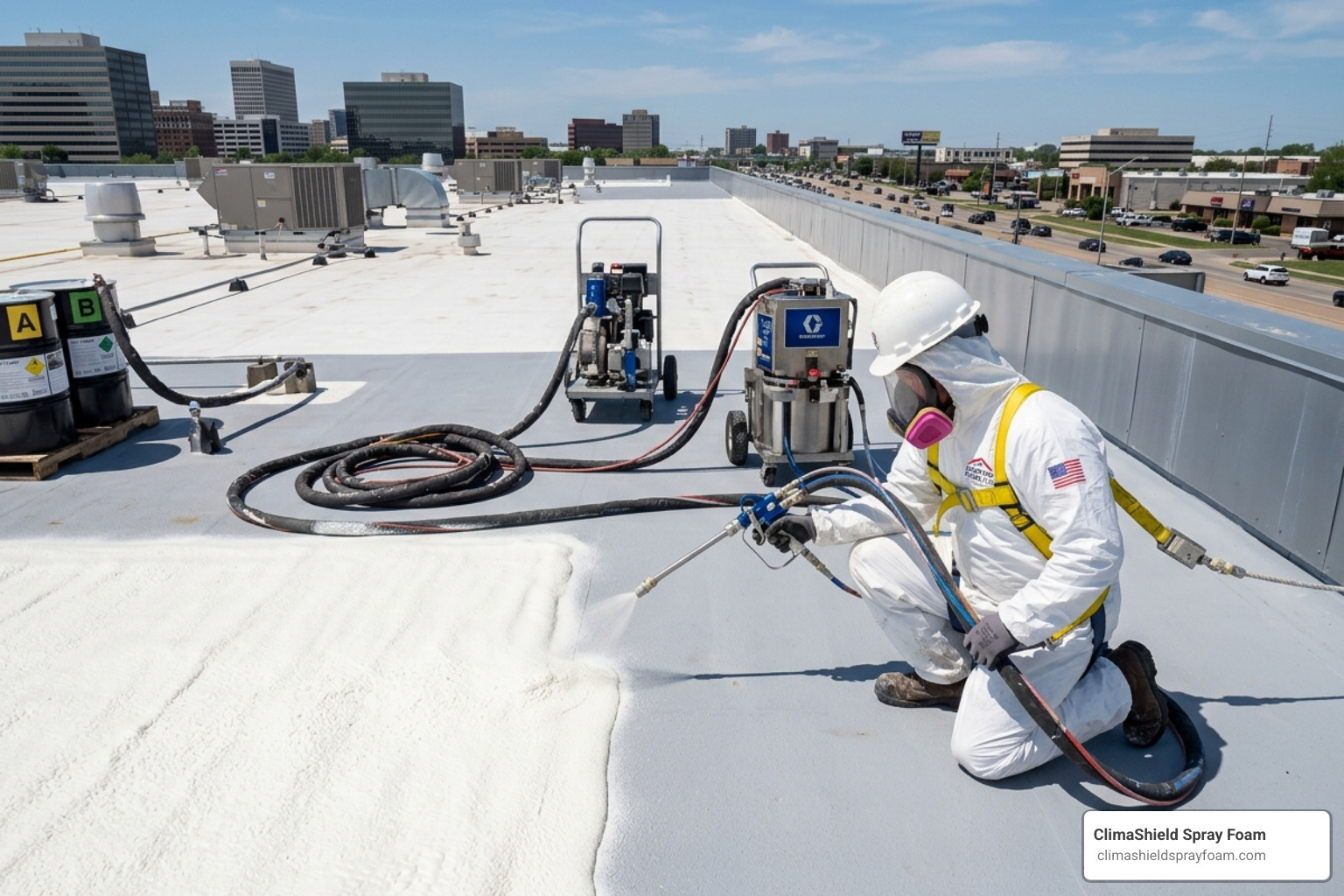
When we talk about spray foam roofing insulation, we are referring to Spray Polyurethane Foam (SPF). This isn’t your average “stuff-in-a-can” foam you find at the hardware store. This is a high-performance, plural-component material created by blending two specific chemicals: isocyanate (often called Part A) and polyol resin (Part B).
These two components are kept separate until the very moment they reach the spray gun. When they mix under high pressure and heat, a chemical reaction occurs. The liquid is sprayed onto the roof substrate, where it expands roughly 30 times its original volume. Within seconds, it transforms from a liquid into a solid, seamless, and rigid foam layer.
For roofing specifically, we use a high-density, closed-cell foam. Unlike the “fluffy” open-cell foam used in some interior walls, roofing-grade SPF usually has a density of 2.7 to 3.0 lbs per cubic foot. This density is crucial because it provides the compressive strength needed to handle foot traffic and the weight of HVAC equipment. It essentially creates a monolithic “shell” over the top of your building.
Because it’s a liquid application, it fills in every crack, gap, and crevice, making it an incredible air barrier and roofing insulation. You can learn more about the variety of these systems in the-ultimate-roundup-of-spray-foam-roofing-systems.
The Benefits of spray foam roofing insulation
Why do we get so excited about SPF? Because it solves multiple problems with one single application. Most roofing systems are just a “lid.” SPF is a lid, a blanket, and a waterproof seal all in one.
Unmatched R-Value and Energy Efficiency
The R-value of spray foam roofing insulation is approximately 6.5 to 7.0 per inch. To put that in perspective, that is the highest R-value of any common roofing material. Because it is seamless, it eliminates “thermal bridging”—those pesky spots where heat escapes through fasteners or seams in traditional roofing. Research from Texas A&M has shown that these systems can pay for themselves in as little as five years through energy savings alone. At ClimaShield, we’ve seen customers save up to 60% on their energy bills after a professional installation.
Superior Waterproofing and Self-Flashing
Traditional roofs fail at the seams and the “penetrations” (pipes, vents, and HVAC curbs). SPF has no seams. It is a monolithic membrane. Furthermore, it is “self-flashing.” This means as we spray it, the foam rises up and around vents and pipes, creating a permanent, watertight bond without the need for separate flashing materials or caulks that eventually dry out and crack. Check out an-essential-guide-to-roof-insulation for more on how this protects your structure.
Lightweight and Strong
A common concern is whether a roof can handle the weight of new insulation. SPF is incredibly lightweight, adding only 0.5 to 0.75 lbs per square foot. Compare that to a built-up gravel roof, which can weigh 8 to 12 lbs per square foot! Despite being light, its 50–60 PSI compressive strength means you can walk on it for maintenance without damaging the system.
Wind Uplift Resistance
Because the foam is fully adhered to the substrate, it has incredible wind uplift resistance. In fact, SPF roofs have a history of surviving major hurricanes, like the one on the Biloxi Coliseum which has survived 12 hurricanes since 1979. It doesn’t “blow off” because there are no edges for the wind to catch.
Installation Process and Safety Requirements
Installing spray foam roofing insulation is a science. It’s not just about “pointing and shooting” a spray gun; it requires meticulous preparation and climate control.
Step 1: Surface Preparation
We can’t spray over just anything. The substrate must be clean, dry, and secure. We start by removing dirt, dust, and loose debris. If we are spraying over an existing roof, we often perform an infrared survey. This helps us identify any saturated areas of old insulation. We “cut out” those wet spots and replace them before the foam goes down. You can’t trap moisture under the foam, or it will eventually cause blisters.
Step 2: The Temperature Window
SPF is “weather-sensitive.” We generally need temperatures to be at least 50°F and rising. Humidity must be low, and the roof deck must be bone-dry. Even a little bit of morning dew can act as a “release agent,” preventing the foam from sticking. Inside our rigs, we keep the core temperature of the chemical tanks between 75-85°F to ensure the perfect mix.
Step 3: Spraying the Foam
Using plural-component equipment, we apply the foam in “lifts.” We typically spray about 1/4 inch thick, which then expands to roughly 1 to 1.5 inches. If a customer needs a higher R-value or better drainage, we can add more layers. We can even “taper” the foam to create slopes, ensuring that water flows toward the drains rather than ponding in the middle of the roof.
Step 4: Protective Coating
This is the most critical step. SPF is amazing, but it has one “Achilles’ heel”: UV rays. If left unprotected, the sun will degrade the foam at a rate of about 1/16 inch per year. To prevent this, we apply an elastomeric coating—usually silicone or acrylic—immediately after the foam cures. This coating provides the UV protection and the final waterproof layer. Some systems even include granules embedded in the coating for extra durability and grip. For more on how this works for different roof types, see above-the-rafters-the-smart-way-to-insulate-your-pitched-roof.
Safety First
Safety is non-negotiable. Our installers wear full PPE, including Tyvek suits, nitrile gloves, and fresh-air respirators. We also have to be mindful of “overspray.” On windy days, those tiny droplets of foam can travel. We use windscreens and spray tents to ensure the foam stays on your roof and off the cars in the parking lot!
Understanding Costs and Warranties
Let’s talk numbers. While spray foam roofing insulation might have a higher upfront cost than some thin single-ply membranes, the lifetime ROI is where it shines.
The Upfront Investment
Generally, a spray foam roof costs between $5.00 and $10.00 per square foot for an average 20,000 sq. ft. commercial project. The price varies based on:
- The thickness of the foam (more inches = more R-value).
- The condition of the existing roof (how much prep work is needed).
- The type of coating (silicone is typically more expensive but lasts longer than acrylic).
- The length of the warranty requested.
The Long-Term Economics
The real magic happens over 30 years. Because you don’t have to tear off an SPF roof, you save a fortune on labor and landfill fees.
- 30-Year SPF Cost: ~$380,000 (includes initial install plus two recoats).
- 30-Year Single-Ply Cost: ~$560,000 (includes initial install plus one full replacement/tear-off).
Recoating a spray foam roof usually costs only 1/3 to 1/2 of the original installation price. It’s like getting a brand-new roof for a fraction of the cost. For more on residential-scale insulation costs, visit attic-spray-foam.
Warranties
Most professional systems come with warranties ranging from 10 to 20 years. These aren’t just “product” warranties; they are often “full system” warranties that cover both labor and materials. To keep these warranties valid, you simply need to have the roof inspected and recoated when the coating begins to thin (usually every 10–15 years).
Maintenance and Longevity
An SPF roof is likely the last roof you will ever have to buy for your building. With proper care, these systems can last 50 years or more.
Bi-Annual Inspections
We recommend a quick check-up twice a year—once in the spring and once in the fall. You’re looking for any “mechanical damage.” If a HVAC technician drops a heavy tool or a sharp panel and punctures the foam, it needs to be fixed. The good news? You can usually fix small punctures yourself with a bit of high-quality caulk or sealant. Because the foam is closed-cell, water won’t “travel” through the roof if it gets a small hole; it stays localized to that one spot.
The Recoating Process
Every 10 to 15 years, the protective coating will naturally wear down due to weathering. When it reaches a thickness of about 7–10 mils (down from the original 20–30 mils), it’s time for a recoat. We power-wash the surface, prime it if necessary, and apply a fresh layer of coating. This “renews” the roof and extends the warranty.
Case Study: The Biloxi Coliseum
This is one of the most famous examples in our industry. The coliseum had an SPF roof installed in the 1970s. Since then, it has survived over a dozen hurricanes. While other buildings in the area lost their entire roofs, the SPF roof remained intact, proving that the bond between the foam and the structure is incredibly resilient.
Common Problems with spray foam roofing insulation
No system is perfect, and we believe in being honest about the challenges.
- UV Sensitivity: As mentioned, the foam cannot be left naked. If the coating is damaged and not repaired, the sun will eventually turn the top layer of foam into a “dusty” orange powder.
- Overspray: This is the “invisible enemy.” If a contractor is reckless on a windy day, they can accidentally “mist” nearby buildings or vehicles. We mitigate this with wind shields and by monitoring weather stations on-site.
- Installer Expertise: This is the most common cause of failure. SPF is “manufactured” on your roof. If the chemicals aren’t heated correctly or the mix is off, the foam won’t cure properly. This is why you must vet your contractor thoroughly to ensure they are qualified and follow industry best practices.
Frequently Asked Questions
Can it be installed over my existing roof? In many cases, yes! SPF has excellent adhesion to Built-Up Roofing (BUR), Metal, Concrete, and even some single-ply membranes like TPO (though TPO often requires a cover board first). This saves you the massive cost and mess of a “tear-off.”
Is it environmentally friendly? Very. Besides the massive energy savings, new systems like GacoRoofFoam use HFO blowing agents, which reduce Global Warming Potential (GWP) by more than 99%. Plus, because you aren’t tearing off your old roof, you are keeping thousands of pounds of waste out of Pennsylvania landfills.
What certifications should I look for? Look for contractors who are members of the Spray Polyurethane Foam Alliance and have completed the PCP (Professional Certification Program). This ensures they follow ISO 17024 standards for safety and quality. Certified professionals are great resources for seeing these standards in action.
Conclusion
Is spray foam roofing insulation the right choice for your next project? If you value long-term energy savings, a leak-free monolithic seal, and a roof that can be renewed indefinitely rather than replaced, the answer is a resounding yes. It is an investment that protects your building like armor while keeping your interior climate comfortable and your utility bills low.
At ClimaShield Spray Foam, we specialize in providing these high-performance solutions across Indiana, PA, and the surrounding regions. Whether you are looking to restore a commercial warehouse or want the best protection for a residential structure, we are here to help you achieve that 60% energy savings goal.
Ready to see if your roof is a candidate for SPF? Find out more about our residential and commercial insulation services and let’s build something that lasts.
