
Why Outdoor Noise Is Quietly Ruining Your Quality of Life
The fastest ways to reduce outdoor noise:
- Seal gaps and add mass to walls, windows, and doors to block sound entry points
- Install a solid fence or masonry wall close to the noise source (can reduce noise by 15-25 dB)
- Plant dense evergreen hedges like Arborvitae or Holly in staggered rows for year-round buffering
- Build an earthen berm 3-6 feet high between your space and the noise source
- Add a water feature near your seating area to mask remaining noise through acoustic masking
- Apply acoustic panels or mass-loaded vinyl to fences, porch ceilings, or exterior walls
Reducing outdoor noise isn’t just about comfort — it’s a health issue that affects millions of homeowners right now, in April 2026, as urban density and traffic levels continue to climb. Busy street traffic regularly hits 70-85 decibels. That’s enough for long-term exposure to cause elevated stress, disrupted sleep, and even cardiovascular problems, according to the World Health Organization.
Your backyard, patio, or screened porch should be a place to unwind. When it isn’t — when every moment outside is filled with traffic hum, construction clatter, or neighbor noise — your home stops feeling like a sanctuary.
The good news: there are proven, practical solutions. Some are as simple as planting the right shrubs. Others involve physical barriers or acoustic products. And some of the most effective fixes happen inside your home’s structure itself — in the walls, windows, and air gaps where sound sneaks through.
I’m Dave Brocious, founder of ClimaShield Industries and a specialist in spray foam insulation and protective coatings, with over 20 years of experience helping homeowners seal their properties against the elements — including unwanted noise. In this guide, I’ll walk you through exactly how to reduce outdoor noise at every level, from your landscaping all the way to your walls.
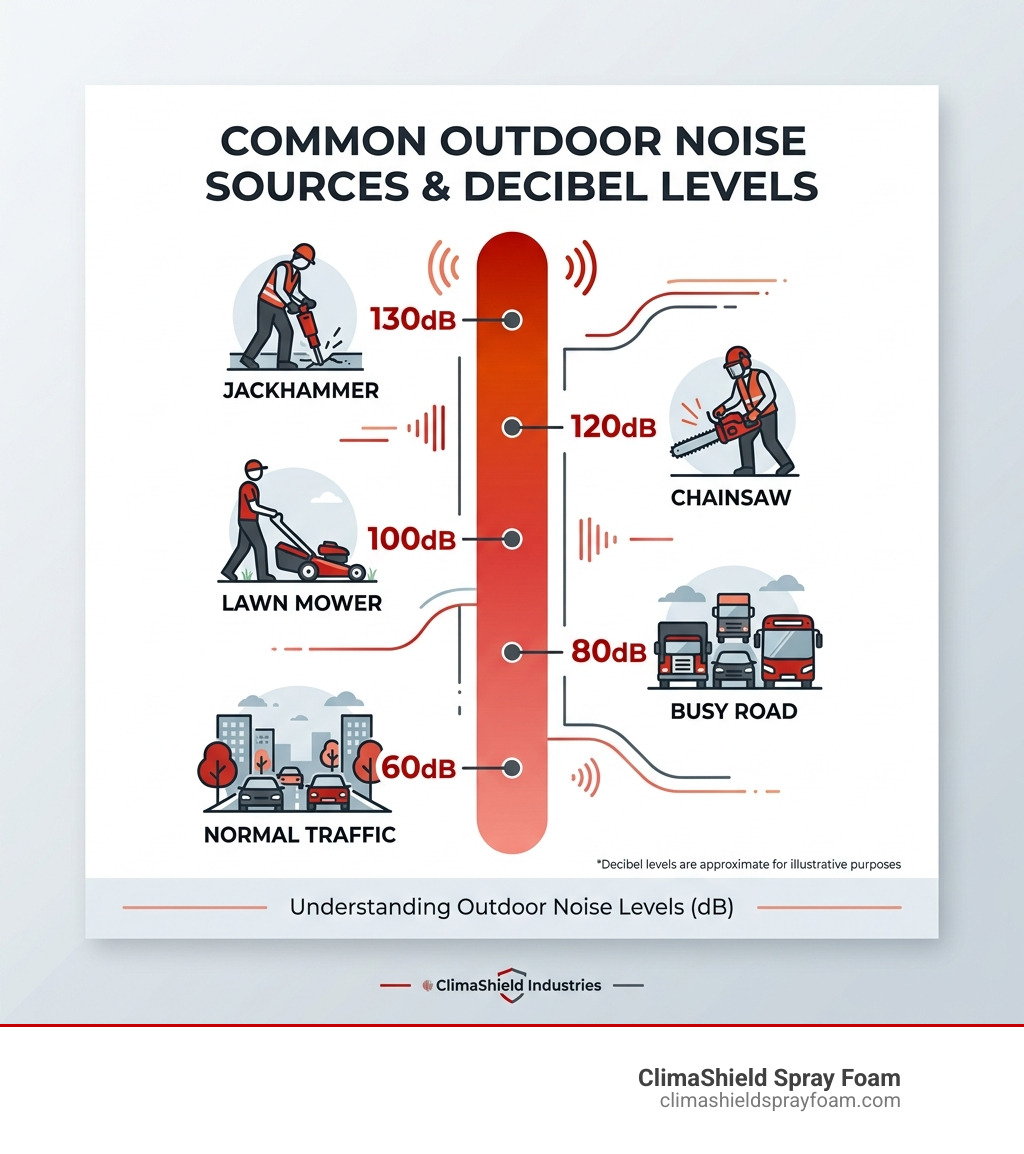
Essential reduce outdoor noise terms:
Why You Must Reduce Outdoor Noise for Your Health

When we talk about noise, we often treat it as a minor annoyance. But if you live in Indiana, PA, near a busy corridor or a construction site, you know that the constant “hum” of the world is anything but minor. As of April 2026, research continues to show that chronic exposure to environmental noise poses serious health risks.
Think about the numbers: busy street traffic typically sits between 70-85 dB. To put that in perspective, long-term exposure to anything over 70 dB can start to damage your hearing. If a car horn blares 15 feet away, you’re looking at 100 dB. These sounds trigger a “fight or flight” response in our bodies, leading to elevated cortisol levels and chronic stress.
This isn’t just about being “grumpy” because the neighbors are loud. Noise pollution is linked to:
- Cardiovascular Health: Chronic noise is a known contributor to high blood pressure and heart disease.
- Sleep Disturbance: Even if you don’t “wake up,” noise shifts your brain into lighter sleep stages, leaving you exhausted.
- Cognitive Performance: It is harder to concentrate and process information when your brain is constantly filtering out background clatter.
The Federal Highway Administration notes in their research on highway traffic noise abatement that effective barriers can cut the perceived loudness of traffic in half. Furthermore, keeping that noise out of your living space is a key part of improving indoor air quality and overall home wellness. When you seal your home properly, you aren’t just stopping drafts; you’re stopping the invisible waves of sound that disrupt your peace.
Strategic Landscaping: Using Nature as a Sound Buffer
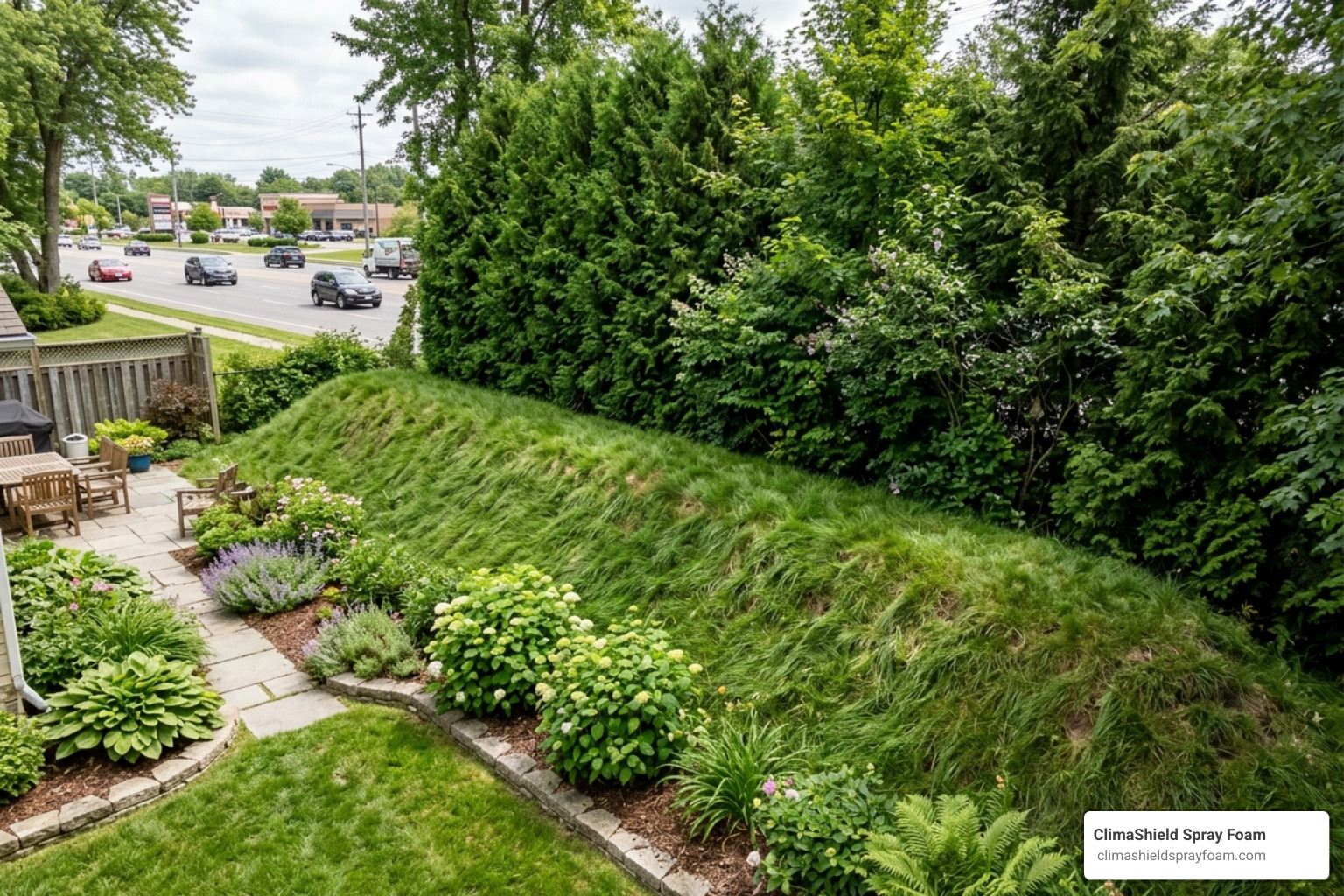
If you want to reduce outdoor noise without building a literal fortress, landscaping is your best friend. However, you can’t just plant a few daisies and expect silence. Effective noise-reduction landscaping relies on four scientific principles: absorption, deflection, refraction, and masking.
One of the most powerful tools in a landscaper’s arsenal is the earthen berm. A berm is essentially a man-made hill or mound of soil. To be effective, a berm should be 3-6 feet high and placed as close to the noise source as possible. Because soil is dense and irregular, it excels at reflecting and absorbing low-frequency road noise.
To maximize a berm’s effectiveness:
- Use Organic Mulch: Avoid gravel or stone on your berms. Soft, organic mulch acts like a sponge for sound waves.
- Layering: Don’t stop at the berm. Combine it with fences and plants to create a “noise sandwich.”
- Slope: Keep the slope gradual (a 3:1 or 4:1 ratio) to prevent erosion and allow for easier planting.
According to the experts at This Old House, these methods can achieve noticeable reductions, often perceived as cutting noise levels by 5-10 decibels. While that might sound small, a 10 dB drop is perceived by the human ear as a 50% reduction in volume!
Best Plants to reduce outdoor noise Year-Round
When selecting plants to reduce outdoor noise, density is the name of the game. You need foliage that stays thick from the ground up, all year long. This is why evergreens are the gold standard for Pennsylvania properties.
- Arborvitae: Specifically the ‘Emerald Green’ variety. These grow tall and narrow, making them perfect for creating a living wall.
- Hollies: Their thick, waxy leaves are excellent at reflecting sound waves.
- Southern Magnolia: If your zone allows, these have massive, broad leaves that provide superior sound absorption.
- Staggered Rows: Never plant in a single straight line. Staggering two or three rows of trees creates a much denser thicket that sound can’t easily whistle through.
A common question we get while insulating homes is, “Does all this moisture from thick plants cause mold?” It’s a valid concern. While your garden thrives, you want to ensure your home’s structure is protected. You might wonder, is spray foam insulation mold resistant? The answer is yes—high-quality closed-cell spray foam creates an airtight, waterproof barrier that keeps the “outside” (including dampness and noise) where it belongs.
Physical Barriers and Fencing to reduce outdoor noise
Sometimes, nature needs a little help from engineering. If you live right next to a highway or a noisy commercial zone, a living hedge might not be enough. You need mass. In acoustics, mass equals silence.
Masonry walls (brick, stone, or stucco-covered concrete) are the heavy hitters. They can provide a 15-25 dB reduction because they are too heavy for sound waves to vibrate easily. If a wall isn’t in the budget, a high-quality noise reduction fence is your next best bet.
To make a fence actually reduce outdoor noise, it must follow three rules:
- No Gaps: Sound behaves like water. If there is a gap under the fence or between the slats, the noise will pour through.
- Height: The fence must break the “line of sight” between you and the noise source. If you can see the tires of the cars on the road, you can hear them.
- Density: Use thick, solid wood panels or composite materials.
Many homeowners are now using Mass-Loaded Vinyl (MLV). This is a dense, flexible material that you can sandwich between fence panels. It adds incredible mass without the footprint of a concrete wall. You can also use acoustic quilts—weatherproof blankets designed to hang on fences to absorb sound rather than reflecting it back into your yard.
Noise Reduction Comparison by Material
| Material | Estimated Noise Reduction (dB) | Best For |
|---|---|---|
| Masonry Wall | 15 – 25 dB | Heavy highway traffic |
| Solid Wood Fence (No gaps) | 5 – 10 dB | Neighbor noise, light traffic |
| Earthen Berm (3-6 ft) | 5 – 15 dB | Low-frequency rumbling |
| Dense Evergreen Hedge | 3 – 7 dB | High-frequency sounds |
Using Acoustic Panels to reduce outdoor noise on Screened Porches
Screened porches are notoriously difficult to soundproof because, well, they are mostly screen! However, you can significantly improve the acoustic comfort of these spaces.
- Ceiling Clouds: Installing outdoor-rated acoustic panels on a high porch ceiling can stop sound from “bouncing” around the space.
- Acoustic Blankets: For temporary relief during construction, heavy-duty sound blankets can be hung over the screens.
- Floor Treatments: Use thick outdoor rugs with dense padding to absorb footsteps and ambient echoes.
At ClimaShield, we often talk about air sealing for better sound control. While a porch is an open space, the same logic applies to the transition areas where your porch meets your house. Ensuring these joints are airtight prevents outdoor noise from leaking into your quiet living room.
Masking Unwanted Sounds with Water and Psychoacoustics
Sometimes you can’t block the noise, so you have to “mask” it. This is where psychoacoustics comes in—the study of how we perceive sound. Our brains are remarkably good at filtering out sounds if there is a more pleasant sound to focus on.
Water features are the ultimate masking tool. But not all fountains are created equal. If you are trying to drown out a highway, a gentle “trickle” won’t do it. You need a scupper-style or multi-tier fountain. These create “white noise” across a broad frequency spectrum, which effectively “hides” the grating sound of tires on pavement or a neighbor’s lawnmower.
Tips for effective masking:
- Proximity is Key: Place the water feature within 10-15 feet of where you sit. A fountain 50 feet away won’t help you much.
- The McGurk Effect: This is a fascinating psychological phenomenon where what we see influences what we hear. If you have a beautiful, lush visual barrier, your brain will actually perceive the environment as quieter than it really is.
- Broadband Sound: Look for fountains where the water hits a hard surface or another pool of water. This creates a more complex sound profile that masks a wider range of noises.
Frequently Asked Questions about Outdoor Noise Reduction
How much noise reduction can landscaping realistically achieve?
While a single tree won’t do much, a well-designed, layered landscape (berm + fence + dense plants) can achieve a 5-10 decibel reduction. This is often perceived as cutting the noise level in half. The key is structural integration—using multiple methods together rather than relying on just one.
What are the most common mistakes to avoid when soundproofing a yard?
The biggest mistake is leaving gaps. A fence with a 1-inch gap at the bottom loses much of its effectiveness. Another mistake is insufficient height. If the noise source is a large truck, a 4-foot fence won’t block the sound coming from the elevated exhaust and engine. Lastly, don’t ignore maintenance. If your evergreen hedge gets thin or develops holes, the sound will find its way through.
When should I hire a professional acoustic consultant?
If you are dealing with high-decibel industrial noise, constant heavy trucking, or if you are planning a major structural modification to your home, a professional is worth the investment. They can provide a decibel map of your property and help you calculate the ROI of advanced acoustic products versus standard DIY fixes.
Conclusion
Creating a quiet home is a multi-step process. Whether you are planting a row of Hollies or building a stone wall, every step you take to reduce outdoor noise is an investment in your health and happiness.
At ClimaShield Spray Foam, we specialize in the “final frontier” of soundproofing: your home’s envelope. By using high-performance spray foam, we create an airtight seal that doesn’t just lower your energy bills—it creates a massive barrier against outdoor noise. In April 2026, as the world gets louder, your home should be the one place where you can find true silence.
Don’t let your hard-earned money leak out through thin walls and unsealed gaps. Stop throwing money out the window with home insulation and start building the quiet sanctuary you deserve. Ready to see the difference for yourself? Start saving on your energy bills today and let us help you turn down the volume on the outside world.
