When Your Concrete Starts Sinking, the Fix Needs to Last
A permanent slab leveling solution is the most cost-effective and long-lasting way to fix sunken or uneven concrete — without tearing it out and starting over.
The fastest answer: Polyurethane foam injection lifts and stabilizes settled concrete slabs by filling voids beneath them. It cures in 15 minutes, supports up to 4,800 lbs per square foot, and is waterproof — making it a genuinely permanent repair.
Quick comparison:
| Method | Cure Time | Permanence | Invasiveness |
|---|---|---|---|
| Polyurethane foam injection | 15 minutes | High (waterproof, non-degrading) | Very low (5/8″ holes) |
| Mudjacking | Days | Moderate (can wash out) | Moderate (large holes) |
| Full slab replacement | 7–10 days | Moderate (same soil problem) | Very high |
That sunken slab in your driveway or backyard patio might look like a minor eyesore. But it’s more than that. Uneven concrete creates real trip hazards — especially for kids and older adults. It can direct water toward your foundation. And left alone, it almost always gets worse.
The good news? You don’t need to replace it. In most cases, a single visit from a trained technician can lift the slab back to its original position — permanently — with almost no disruption to your property.
This guide walks you through exactly how that works, what it costs, and how to know if it’s the right fix for your situation.
I’m Dave Brocious, founder of ClimaShield Industries, with 20 years of experience in specialty coatings, spray foam systems, and concrete repair solutions — including delivering permanent slab leveling solutions for both residential and commercial properties. Whether you’re dealing with a sunken driveway or a settling warehouse floor, the sections below give you everything you need to make a smart, informed decision.
Understanding Why Concrete Slabs Sink and Settle
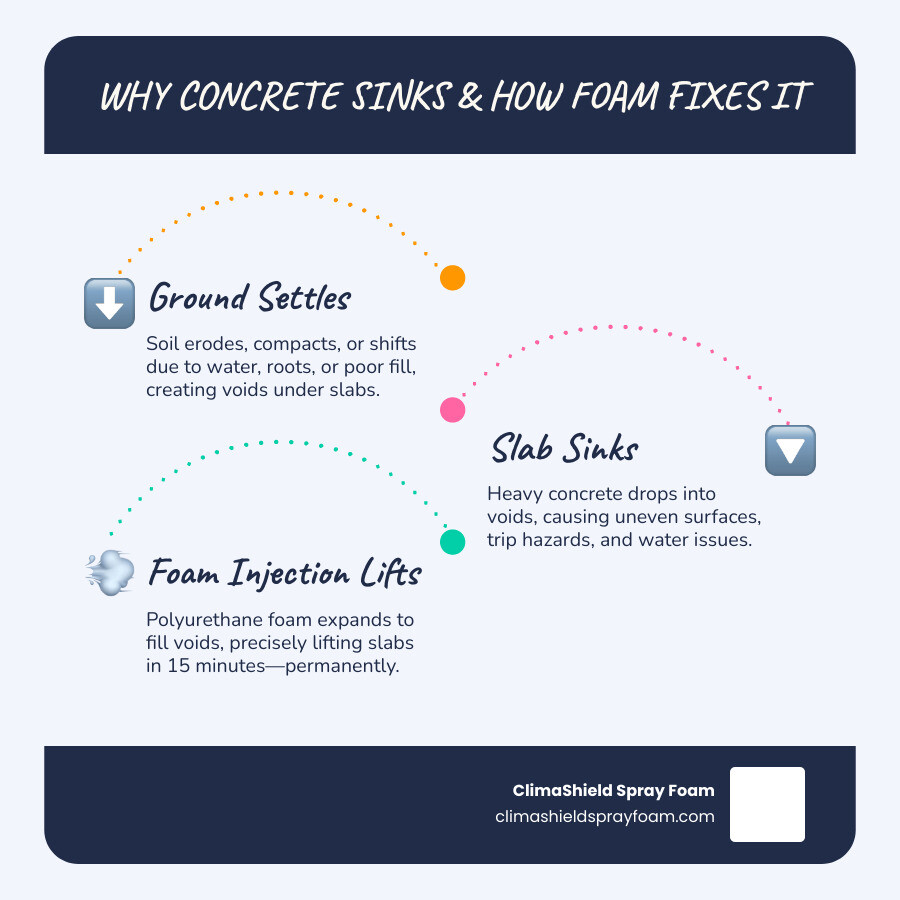
If you’ve lived in Pennsylvania for any length of time, you know our soil is rarely “set in stone.” Concrete is incredibly heavy, but it is only as stable as the ground beneath it. When that ground moves, the concrete follows.
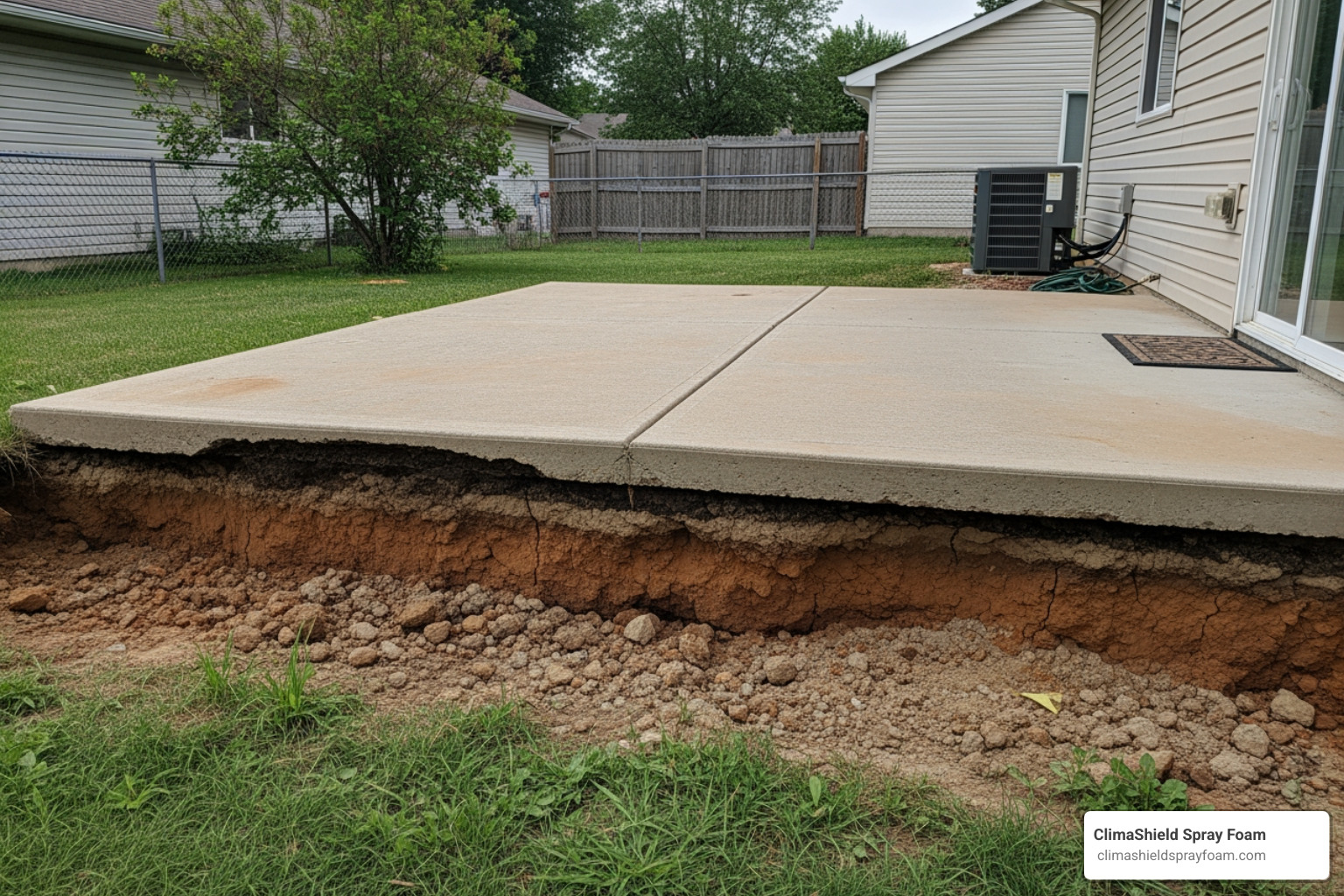
There are several primary reasons we see slabs failing in the Indiana, PA area:
- Soil Compaction Issues: Often, during the original construction of a home, the “backfill” soil placed around the foundation isn’t compacted properly. Over time, gravity takes over, and that loose soil settles, leaving a hollow space (a void) under your front porch or garage floor.
- Moisture Variation and Washout: Heavy rains can seep through cracks or joints in your concrete. As this water flows, it carries tiny particles of soil with it. Eventually, this creates a cavern under the slab. Without support, the concrete simply snaps or sinks into the hole.
- Freeze-Thaw Cycles: This is a big one for us in PA. Water in the soil freezes and expands, pushing the concrete up (heaving). When it melts, the soil can become saturated and soft, causing the slab to settle deeper than it was before.
- Tree Root Decay: If a large tree was removed near your driveway years ago, the old roots underground eventually rot away. This leaves behind “tunnels” in the dirt that collapse under the weight of a vehicle.
Understanding these root causes is the first step toward a fix. If you just pour more concrete on top (like a self-leveling resurfacer), you’re just adding more weight to the problem. To truly stop the sinking with foam concrete lifting, you have to address the void, not just the surface. For a deeper dive into these mechanics, check out our essential guide to concrete lifting or our homeowner’s guide to PolyLevel and concrete lifting.
Polyurethane Injection: The Permanent Slab Leveling Solution
When we talk about a permanent slab leveling solution, we are talking about high-density, structural-grade polyurethane foam. This isn’t the stuff you find in a can at the hardware store for sealing windows. This is a sophisticated two-part polymer designed specifically for the rigors of geotechnical engineering.
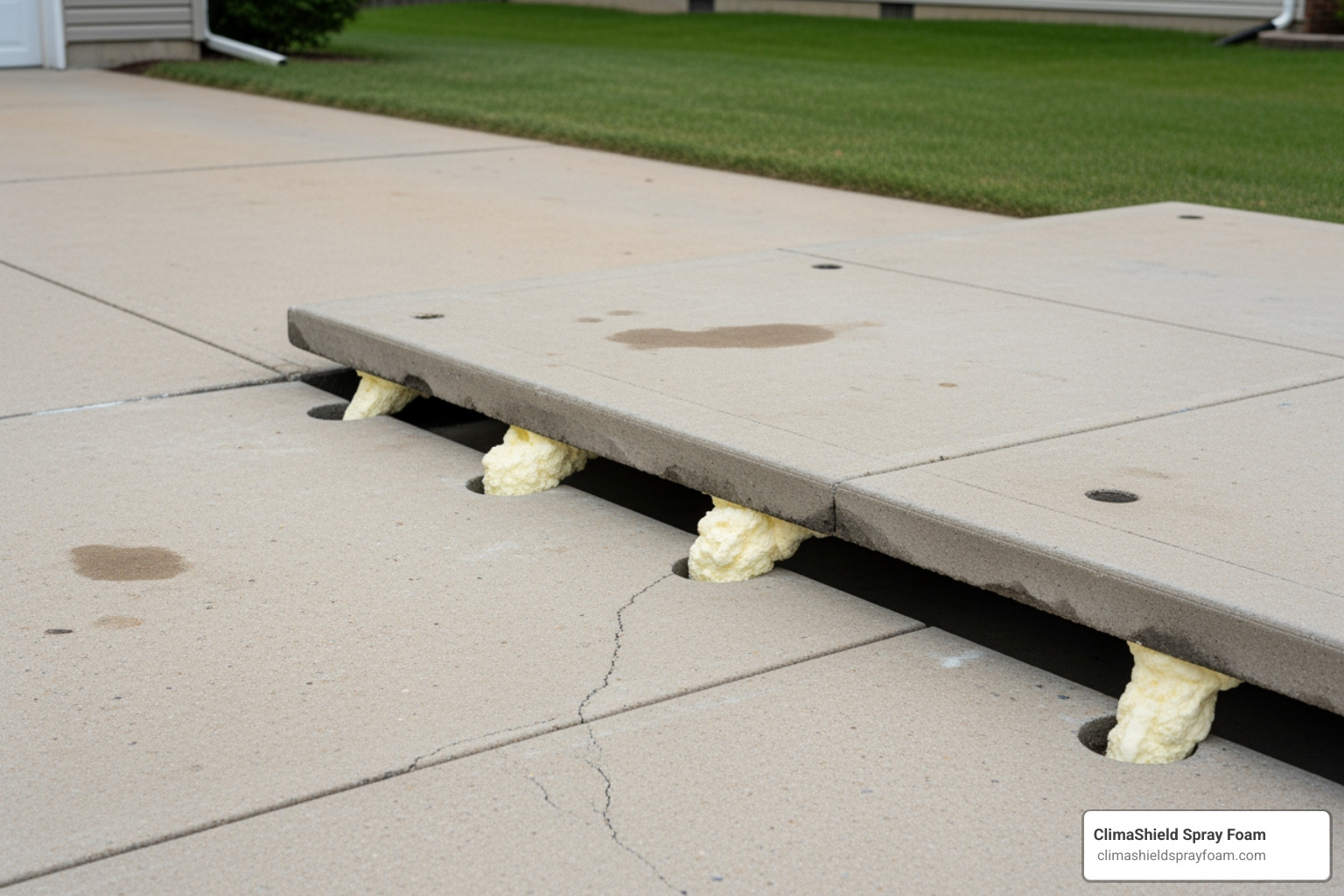
How does it work? We inject two liquid components that mix at the tip of an injection gun. A chemical reaction occurs, causing the liquid to expand into a rigid, closed-cell foam. As it expands, it follows the path of least resistance, filling every nook and cranny of the void. Once the void is full, the foam continues to expand upward, providing the massive pressure needed to lift the concrete slab back to its original elevation.
This material is a game-changer for several reasons:
- Dimensional Stability: Once it’s cured, it doesn’t shrink or change shape.
- Waterproof: Unlike mud or dirt, it won’t wash away during the next Pennsylvania thunderstorm.
- Longevity: In an underground environment, this foam is estimated to have a 1,000-year lifespan. It is effectively a “forever” fix.
You can find more technical details on the PolyLevel system and how it provides superior lifting power compared to old-school methods. We often refer to this specialized material as slab jacking foam because of its incredible ability to “jack” up heavy structures.
Key Benefits of a Permanent Slab Leveling Solution
Why choose foam over other options? The statistics speak for themselves:
- Incredible Strength: Don’t let the word “foam” fool you. This material can support loads of up to 4,800 to 6,000 lbs per square foot. It’s strong enough for airport runways and industrial warehouses.
- Speed of Use: The foam reaches 90% of its full strength in just 15 to 20 minutes. You can drive your car over the repaired driveway before our truck even leaves your property.
- Minimally Invasive: We only need to drill holes about 5/8-inch in diameter (the size of a penny). Traditional mudjacking requires holes the size of a soda can.
- Lightweight: This is the “secret sauce.” Polyurethane foam weighs only about 4 lbs per cubic foot. Compare that to mudjacking slurry, which weighs 120 lbs per cubic foot. By using a lightweight material, we ensure we aren’t adding a massive new load to the already weak soil.
Choosing this method is essentially providing residential concrete lifting for a stable home foundation.
Versatile Applications for a Permanent Slab Leveling Solution
One of the best things about this permanent slab leveling solution is that it works almost anywhere you have concrete flatwork.
- Driveways and Sidewalks: Eliminate trip hazards and restore curb appeal in a single afternoon.
- Garage Floors: Fix those annoying cracks and “hollow” sounds when you drive in.
- Pool Decks: Leveling a pool deck is tricky because you don’t want heavy machinery or messy mud near your filtration system. Foam is the perfect, clean solution.
- Interior Slabs: Because the equipment is just a hose, we can level interior floors in sunrooms or basements without tearing up the house. We can even use the “carpet flap” technique to reach the slab without ruining your flooring.
- Commercial and Industrial: We handle everything from commercial slab lifting for warehouses to specialized interior slab leveling in Pennsylvania for retail spaces.
Comparing Foam to Traditional Methods
To understand why polyurethane is the modern standard, we have to look at what people used to do (and unfortunately, some still do).
| Feature | Polyurethane Foam | Mudjacking | Slab Replacement |
|---|---|---|---|
| Material Weight | ~4 lbs/cu. ft. | ~120 lbs/cu. ft. | ~150 lbs/cu. ft. |
| Hole Size | 5/8″ (Penny-sized) | 1.5″ – 2″ (Soda can) | N/A (Total Demo) |
| Cure Time | 15 Minutes | 24 – 72 Hours | 7 – 28 Days |
| Water Resistance | Waterproof | Can erode/wash out | Soil still erodes |
| Mess Factor | Zero / Very Low | High (Slurry spills) | Extreme (Dust/Debris) |
| Aesthetics | Nearly invisible holes | Large, obvious patches | Mismatched concrete color |
The Mudjacking Problem: Mudjacking uses a heavy mixture of dirt, cement, and water. While it’s cheaper in the short term, its weight often causes the soil to sink again a few years later. Plus, it’s a “wet” process that can wash out if the underlying drainage issue isn’t fixed.
The Replacement Problem: Tearing out concrete is expensive and loud. But the real issue is that you are pouring new, heavy concrete on top of the same bad soil that caused the first slab to sink. Unless you fix the soil, the new slab will likely sink too.
Learning how to repair a concrete slab the right way means looking at the long-term physics, not just the short-term level.
The Step-by-Step Installation Process
We like to keep things simple and transparent. Here is how we implement a permanent slab leveling solution on your property.
- Site Mapping: We inspect the slab to find the “low points” and identify where the voids are likely located.
- Strategic Drilling: We drill small, 5/8-inch holes in a grid pattern. These are the entry points for the foam.
- Port Installation: Small injection ports are placed into the holes to ensure a tight seal for the foam delivery.
- Injection and Expansion: We pump the two-part polymer under the slab. We do this in short “bursts” to maintain total control over the lift. You can actually watch the concrete rise in real-time.
- Monitoring: Using laser levels or string lines, we ensure the slab is perfectly flush with the surrounding sections, eliminating any trip hazards (which the ADA defines as any vertical change over 1/4 inch).
- Cleanup and Patching: We remove the ports and fill the tiny holes with a custom-color-matched concrete grout.
- Final Seal: We often recommend sealing the cracks and joints afterward to prevent water from getting back under the slab.
This process is so efficient that most residential jobs are finished in 2 to 4 hours. For a visual breakdown, see our guide on understanding concrete lifting foam in 5 easy steps or our Slab Lifting 101 overview.
Frequently Asked Questions
How much does a permanent slab leveling solution cost?
Cost is the most common question we get. While every job is unique, polyurethane leveling typically costs less than half of what you would pay to tear out and replace the concrete.
Factors that influence the price include:
- Size of the Slab: Larger areas require more material.
- Depth of the Void: A 2-inch drop takes much less foam than a 6-inch drop.
- Accessibility: Can we get our hose to the area easily, or is it in a hard-to-reach basement?
- Location: We focus our services on Indiana, PA, and the surrounding regions, which helps keep our travel costs down for local homeowners.
Is the polyurethane foam safe for the environment?
Absolutely. The high-density foam we use is “water-blown,” meaning it doesn’t use ozone-depleting chemicals. Once it cures (which happens in seconds), it is environmentally inert. It won’t leach chemicals into your soil or groundwater, and it is resistant to mold and pests. This makes it a “green” choice for residential concrete rehabilitation.
How long will the concrete leveling repair last?
We call it a permanent slab leveling solution for a reason. Because the foam is a closed-cell plastic, it does not decay, rot, or settle. It is waterproof and won’t wash away. Most reputable contractors offer a significant warranty (often 5 to 10 years) against resettlement, but the material itself is designed to last for decades—if not centuries.
Conclusion
At ClimaShield Spray Foam, we believe in doing things right the first time. Whether we are helping you save 60% on your energy bills with our insulation services or stabilizing your home’s foundation, our goal is durability and efficiency.
Sinking concrete isn’t just an aesthetic issue; it’s a safety and structural liability. By choosing a permanent slab leveling solution, you are protecting your property value and your family’s safety without the mess and expense of a full demolition.
If you’re tired of tripping over that uneven sidewalk or watching water pool against your garage, it’s time for a professional inspection. We can help you determine the exact cause of your settlement and provide a fast, clean, and lasting fix.
Ready to stabilize your property? Get a permanent slab leveling solution today and let us help you stand on solid ground again.
