Why Your Crawlspace Foam Insulation Could Be a Termite Highway
Termite resistant foam insulation is one of the smartest upgrades you can make for a crawlspace, basement, or slab foundation — especially if you live in a termite-prone region.
Here’s a quick answer if that’s all you need:
What is termite resistant foam insulation?
Foam board insulation (typically EPS or XPS) that has been treated with an EPA-registered additive — such as a borate compound or a pyrethroid like deltamethrin — to deter termites from tunneling through it. It meets building code standards (ICC-ES AC239, IBC Section 2603.8, IRC Section R320.5) for use in high-risk termite zones.
Top termite resistant foam insulation options:
| Product | Type | R-Value | Key Treatment | Code Compliant |
|---|---|---|---|---|
| Bora-Foam (Nisus) | EPS | R-10 at 2.5″ | Borate-based | ICC-ES AC239 |
| Foam-Control with Perform Guard (ACH Foam) | EPS | Varies by thickness | EPA-registered mineral additive | ICC-ES AC239 |
| Terma-Foam Graphite Board | GPS | R-10 at 2.125″ | PREVENTOL TM EPS | Yes |
| Insulfoam R-Tech EPS | EPS | Varies | Borate-treated | ICC-ES AC239 |
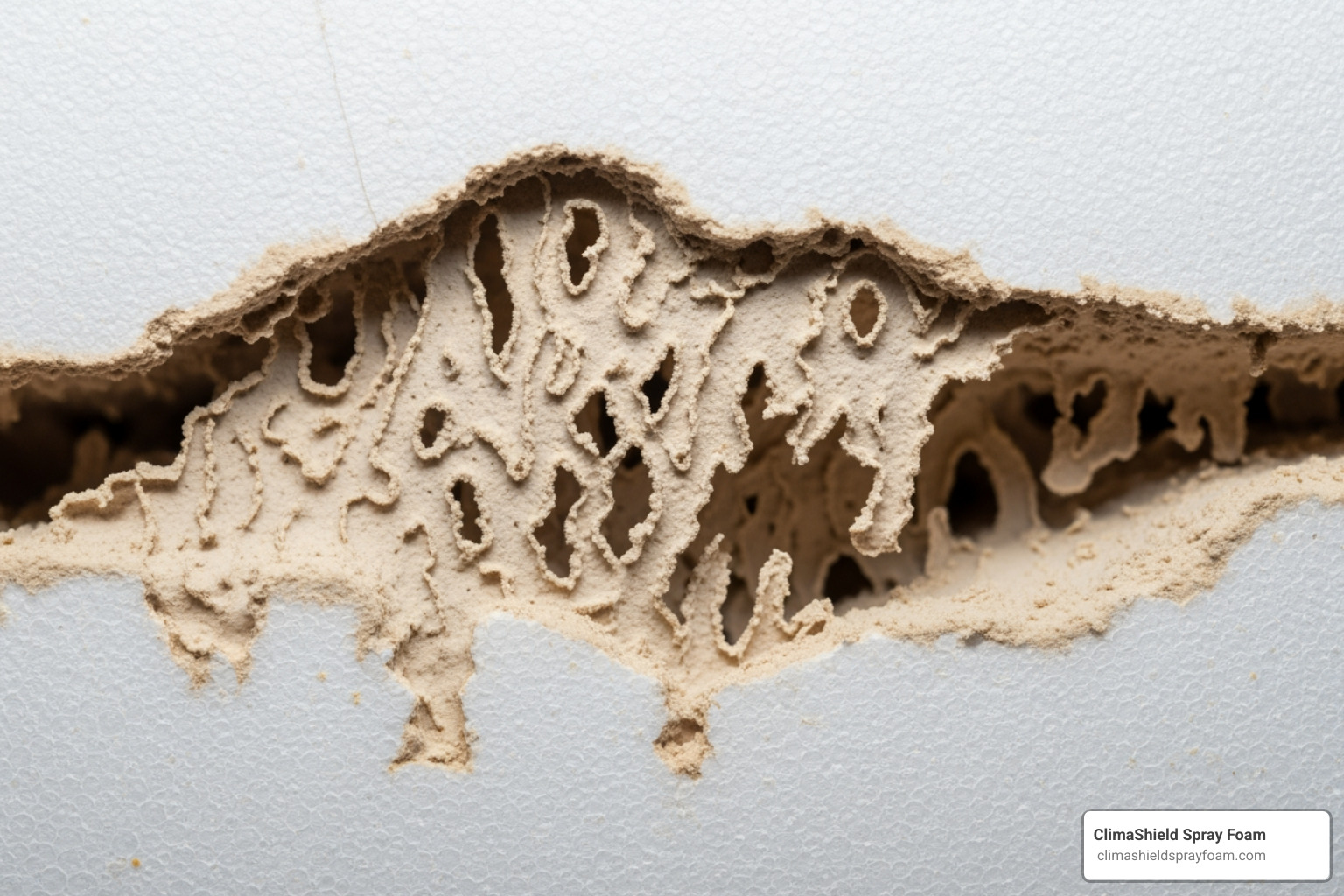
Termites cause an estimated $5 billion in damage across the U.S. every year. And here’s the part most homeowners don’t know: termites don’t even eat foam insulation. They tunnel through it — using it as a hidden highway straight to your wood framing. By the time you see the damage, it’s often already serious.
Standard foam board installed below grade gives termites exactly what they love: stable temperature, moisture retention, and cover from predators. That’s why untreated foam in a crawlspace or against a foundation wall isn’t just a pest problem — it’s an energy problem too. Damaged, tunneled insulation loses thermal performance, and foundation energy loss already accounts for roughly 15% of total residential energy loss.
The good news? Treated foam options exist that are specifically engineered to stop termites before they start — and they meet the building codes that apply in the highest-risk zones.
I’m Dave Brocious, founder of ClimaShield Industries and a specialty coatings and spray foam contractor with over 20 years of experience in building envelope systems — including installations where termite resistant foam insulation is critical to long-term performance. In the sections below, I’ll walk you through everything you need to choose, specify, and install the right product for your project.
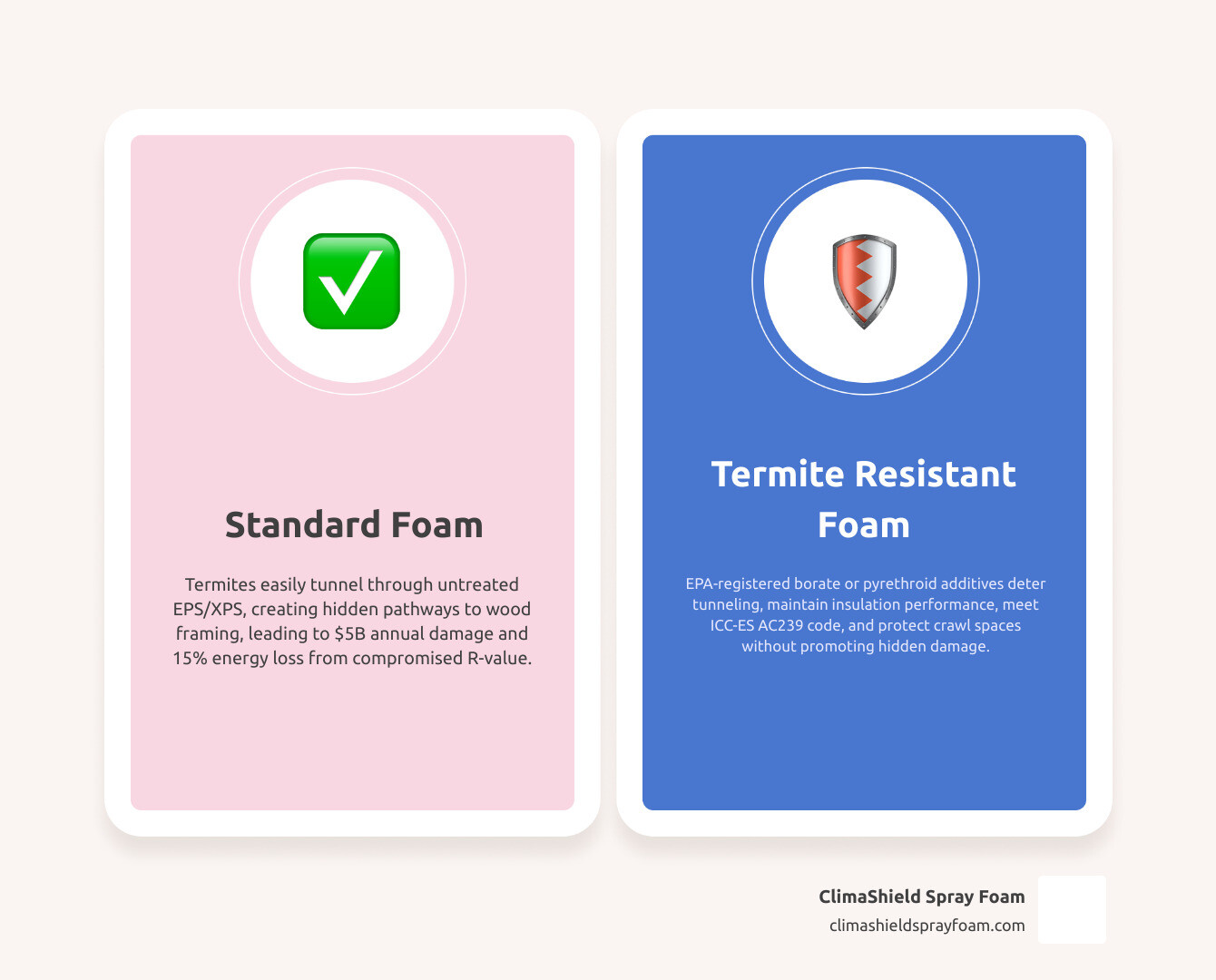
Basic termite resistant foam insulation vocab:
What Is termite resistant foam insulation and Why Does It Matter?
At its core, termite resistant foam insulation is foam insulation that has been manufactured with a termite-deterring treatment built into the product. Most commonly, this means treated EPS, though some treated XPS and graphite polystyrene products also exist.
Why it matters is simple: foundation and crawlspace insulation sits right where moisture, soil, and wood-framed parts of a house all come together. That is prime termite real estate. If termites can move through the insulation unseen, they can reach framing, sill plates, and band joists while also damaging the insulation layer itself.
For homeowners in and around Indiana, PA, that matters for two big reasons:
- Pest prevention
- Energy performance
Foam at the foundation is there to reduce heat loss, manage condensation, and improve comfort. If that layer becomes a hidden tunnel system, it stops doing its job well. And when you already know foundations can account for about 15% of residential energy loss, protecting that insulation stops looking optional.
How termite resistant foam insulation differs from standard foam board
Standard foam board is just insulation. Treated foam board is insulation plus pest deterrence.
Depending on the product, manufacturers may use:
- Borate chemistry, such as disodium octaborate compounds
- EPA-registered mineral additives locked into the EPS matrix
- Pyrethroid insecticides such as deltamethrin
- Systemic treatments such as PREVENTOL TM EPS
The big difference is that treated boards are designed to discourage tunneling or reduce termite survival when insects contact the material. Some products focus more on ingestion toxicity, while others aim for “contact repellency,” meaning termites are deterred before they establish a pathway.
That matters in below-grade and ground-contact-adjacent assemblies, where termite pressure is highest and inspections are hardest.
Why termites attack foam even though they do not eat it
This is the part that surprises people.
Termites generally do not treat foam as food. They use it as cover. Foam gives them:
- A stable temperature
- Moisture retention nearby
- Protection from predators and light
- A hidden route to wood framing
So the foam becomes a sheltered travel corridor. Once they reach wood, the real damage starts.
That also creates an inspection problem. Because termites can move inside or behind foam, visible warning signs may show up late. In other words, the foam can hide the crime scene.
How Insect-Resistant Foam Protects Crawl Spaces, Basements, and Slabs
Treated foam is most useful where insulation meets foundation assemblies:
- Crawl space walls
- Basement walls
- Perimeter foundation walls
- Slab edges
- Under-slab insulation
- Rim or band joists in some assemblies
These are exactly the places where insulation improves comfort and helps control condensation, but also where termite access is easiest.
Done correctly, foundation insulation can pay back surprisingly well. Research cited in this space shows insulating residential slabs and closed crawl spaces can have payback periods as short as 5 to 15 years. That makes protection of the insulation layer a practical issue, not just a theoretical one.
Best places to use termite resistant foam insulation
The best locations are usually the same locations where untreated foam would otherwise be vulnerable.
Common applications include:
- Closed crawl space wall insulation
- Interior basement wall insulation
- Slab edge insulation
- Stem wall insulation
- Band joist or rim joist cut-and-fit board applications
- Under-slab continuous insulation where allowed by code and local practice
A few best-practice details matter a lot:
- Leave an inspection zone where required
- Follow any local code clearance rules
- Maintain a visible gap between exposed earth and above-grade foam where applicable
- Avoid burying transitions where inspectors need to see termite tubes
In code discussions for very heavy termite areas, a 6-inch clearance between above-grade foam and exposed earth is a common rule. Even where that specific rule is not the main local issue, the principle still matters: do not create a hidden bridge from soil to structure.

Why untreated foundation foam can hurt energy efficiency
Untreated foam can fail in a way that is easy to miss. The surface may still look decent, but internal tunneling can interrupt the insulation layer and create air pockets, moisture pathways, and weak spots.
That leads to problems such as:
- Reduced effective R-value
- More thermal bridging around damaged sections
- Higher chance of condensation on colder surfaces
- Added moisture stress in the crawlspace or basement
- Potential mold-friendly conditions nearby
- Lower long-term durability of the assembly
The Development of a Robust Termite-Resistant Foam Insulation research highlighted an important point: termites do not need to consume foam to hurt building performance. Tunneling alone can reduce thermal resistance and open the way to structural materials.
Treatments, Codes, and Compliance Rules You Need to Know
This is where many articles get fuzzy. We prefer to keep it simple: if you are using foam in a termite-risk assembly, you need to think about both product chemistry and code compliance.
The main references that come up most often are:
- ICC-ES AC239
- IRC termite provisions
- IBC Section 2603.8
- ASTM C578 for EPS properties
Active ingredients and technologies used in termite resistant foam insulation
The most common treatment approaches include:
Borates
- Often used in treated EPS products
- Generally valued for low toxicity and established use in wood and building materials
- Intended to deter or poison termites when they contact or ingest affected material
Deltamethrin
- A pyrethroid insecticide
- Research has shown it can provide strong contact repellency
- In foam applications, the plastic matrix can help protect the active ingredient from rapid loss
EPA-registered mineral additives
- Used in certain EPS products
- Promoted as inert, stable, and locked into the insulation during manufacturing
- Marketed for long-term resistance without easy leaching
PREVENTOL TM EPS
- Used in some graphite polystyrene products
- Positioned as a systemic insecticide treatment for termite protection
The best approach depends on the product, application, and what documentation the manufacturer provides. We always recommend looking for an actual code report or technical evaluation, not just marketing language.
IRC and IBC rules for termite-prone regions
Foam insulation near foundations is regulated because of termite risk, not because foam is “bad,” but because it can hide termite activity.
Key code concepts include:
- Restrictions on foam plastic in very heavy termite infestation areas
- Special rules for exterior foundation walls and below-grade use
- Exceptions when approved protection methods are used
- Allowances for interior-side basement wall insulation
- Requirements for inspection access
- Clearance requirements between foam and exposed earth in some assemblies
Depending on the assembly, code-compliant protection may involve:
- Treated foam board
- Approved soil termiticide treatment
- Physical termite barriers
- Pressure-preservative-treated wood in certain structural conditions
- Noncombustible construction in some exceptions
Because codes are adopted and interpreted locally, we always advise checking with the local building department before locking in a foundation detail.
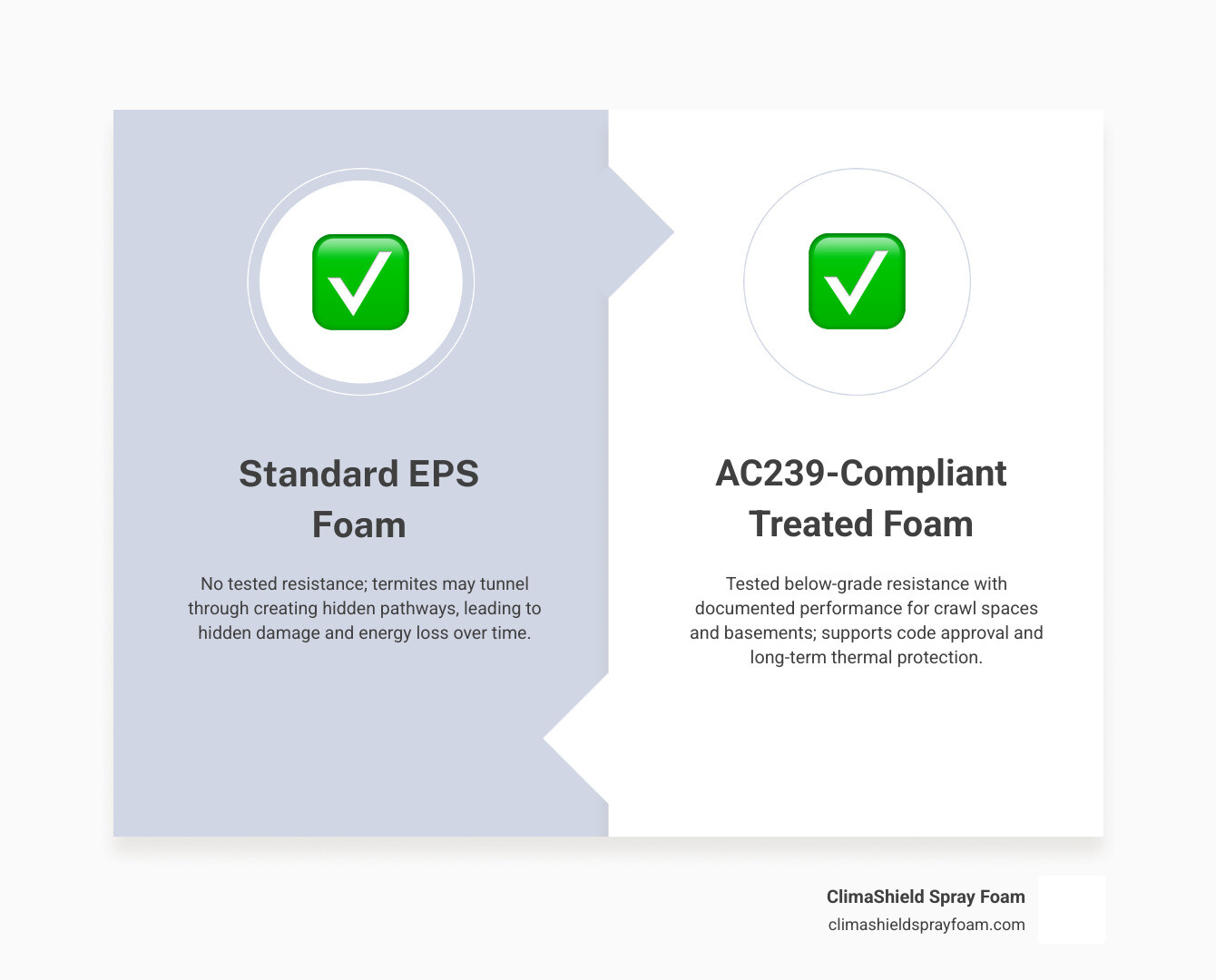
What ICC-ES AC239 means for treated foam performance
ICC-ES AC239 is the acceptance criteria used to evaluate termite-resistant foam plastic. In plain English, it is the benchmark that helps distinguish tested, code-recognized products from generic “insect resistant” claims.
A product meeting AC239 has generally been evaluated for:
- Termite resistance under controlled criteria
- Below-grade performance expectations
- Suitability for identified termite-risk uses
- Documentation that code officials can review
That is why AC239 matters so much. It is not just about whether a board contains a treatment. It is about whether the product has been assessed for the job.
For a deeper technical example, see this technical report on termite-resistant EPS. Another helpful manufacturer bulletin is this Perform Guard technical PDF.
How to Choose the Best Board for Your Project
Not every treated board is the same. We like to compare products using practical criteria rather than hype.
Compare performance factors that matter most
Here are the specs that usually matter most:
| Product | Foam Type | Approx. Thermal Performance | Vapor / Facing Notes | Termite Protection Notes |
|---|---|---|---|---|
| Bora-Foam | EPS | R-10 at 2.5″ | Vapor permeance up to about 0.08, faced board | Meets AC239, intended for crawl spaces and basements |
| Perform Guard EPS | EPS | Varies by thickness | Standard EPS properties by spec | EPA-registered additive, AC239-compliant |
| Terma-Foam Graphite Board | GPS | R-10 at about 2.125″ | Graphite polystyrene, high R per inch | Treated with PREVENTOL TM EPS |
| R-Tech treated EPS | EPS | Varies by thickness | Depends on product configuration | Borate-treated option in market references |
A few notes:
- Bora-Foam stands out for basement and crawlspace use because it combines termite resistance with a low-perm faced board and practical installation features.
- Perform Guard EPS has strong code positioning and documented testing, including use in areas of significant termite risk.
- Graphite boards can offer more R-value per inch, which helps where thickness is limited.
- Faced products can help with moisture control, but they must still be installed so the assembly can dry appropriately.
Buying tips, pickup options, and shipping realities
This is where theory meets real life.
Treated foam can be harder to source than standard board. Homeowners and contractors often run into:
- Special-order lead times
- Distributor-only channels
- Pickup-only restrictions on some listings
- Freight costs that can get expensive fast
- Minimum order quantities for shipped boards
In practical terms, that means:
- Ask local building supply houses whether they can special-order AC239-compliant treated foam
- Check contractor suppliers before assuming it is unavailable
- Confirm whether the listed board size is nominal or actual
- Get shipping quotes before ordering large or bulky board stock
- Verify that the exact product you are buying includes the termite treatment, not just the standard version of the board
If you are comparing products, these pages are useful starting points:
Safety, handling, and environmental considerations
Most treated foam boards are easier to handle than fiberglass. Common manufacturer claims include:
- Noncorrosive surfaces
- No fiberglass itch
- No foil cuts
- Low toxicity when handled as directed
- Recyclable content in some products
- Production without CFCs, HCFCs, or formaldehyde in certain foam lines
That said, there are still important safety points:
- Foam plastic is combustible
- Follow ignition and thermal barrier requirements
- Keep it away from ignition sources during storage and installation
- Use only approved adhesives, tapes, and coverings
- Follow the product label and installation guide
In crawlspaces and basements, we also pay attention to moisture compatibility. A board with low vapor permeance can be a plus, but only if the whole assembly is designed correctly.
Installation Best Practices for Long-Term Pest and Energy Performance
A treated board works best when it is part of a complete system. We never treat insulation as a magic force field. If only it were that easy.
The goal is to combine:
- Air sealing
- Moisture control
- Inspection access
- Code compliance
- Pest management
Crawl space and basement installation details that reduce pest risk
For crawlspaces and basements, we usually focus on the wall system first rather than insulating between floor joists only.
Best practices include:
- Encapsulate the crawlspace when appropriate
- Insulate the crawlspace walls rather than leaving the area vented and damp
- Seal board seams carefully
- Fit insulation tightly at rim and band joists
- Keep an exposed inspection strip where required
- Avoid hiding the sill area behind finish materials without access
- Coordinate wall insulation with the floor liner or vapor retarder
Some termite-resistant boards include practical installation features such as faced surfaces for liner attachment and cut-and-snap inspection flaps. Those details are useful because inspection is half the battle.
For related reading, see our guide on Pest Resistant Spray Foam.
Under-slab and perimeter wall details contractors should not skip
Under slabs and at perimeter walls, details matter even more because repairs are difficult later.
Do not skip:
- Properly compacted base material
- Full-contact board support
- Sealed joints where the system calls for them
- Compatible tape or sealant at seams
- Correct board thickness for load and thermal goals
- Slab-edge continuity so the thermal layer does not break
- Coordination with drainage and waterproofing
- Protection of exposed board edges above grade
If the board will see soil contact or be installed in a critical termite pathway, use a product specifically approved for that condition and follow both manufacturer instructions and code requirements.
Why treated foam should be part of an integrated pest management plan
This is the most important reality check in the whole article:
Termite resistant foam insulation does not replace a complete termite control strategy.
Most manufacturers say the same thing in one form or another. Treated foam should be part of an integrated pest management plan, not the entire plan.
That means combining it with some mix of:
- Annual termite inspections
- Soil termiticide treatment where appropriate
- Bait systems
- Physical barriers such as stainless mesh in key locations
- Termite shields where useful
- Good drainage and moisture control
- Local code compliance checks
For more on pest-focused insulation strategy, see our Spray Foam Insulation Pest Resistant Guide.
Frequently Asked Questions about termite resistant foam insulation
Does termite-resistant foam replace soil treatment or physical termite barriers?
Usually, no.
It helps reduce the risk that termites will use the insulation layer as a concealed route, but it does not eliminate the need for layered protection. Depending on the project, soil treatment, baiting, shields, or physical barriers may still be recommended or required.
Think of treated foam as one strong player on the defense team, not the whole team.
How long does termite-resistant foam last and what do warranties usually cover?
Long-term claims vary by manufacturer. Some treated EPS products are marketed as lasting for the life of the insulation because the additive is built into the foam matrix and is not expected to decompose or leach quickly.
But warranty language matters. Many warranties are limited and may exclude:
- Improper installation
- Code violations
- Existing infestations
- Damage outside the product itself
- Failure to maintain inspection or pest-control measures
So before buying, ask for:
- The written warranty
- The code report
- The installation instructions
- Any exclusions related to termite zones or ground contact
Can treated foam be used in crawl spaces with other pest-control insulation strategies?
Yes, and in many cases it should be.
Hybrid systems can work well. For example, treated board on foundation walls can be paired with air sealing details, moisture management, and other pest-control measures. If rodent control is also a concern, our guide on How To Use Rodent Proof Insulation Foam To Block Intruders is a good companion read.
You can also learn more about squeaks, gaps, and pest pathways in Stop The Squeak With Rodent Resistant Insulation.
Conclusion: The Smartest Way to Protect a Crawlspace from Termites
If you want the short version, here it is: termite resistant foam insulation is one of the best ways to protect a crawlspace or foundation assembly from becoming a hidden insect superhighway while also preserving the thermal performance you are paying for.
The smartest projects do four things well:
- Use code-compliant treated insulation where it makes sense
- Preserve inspection access
- Control moisture and air leakage
- Combine insulation with layered pest defense
That approach protects comfort, helps energy efficiency, and reduces the odds of hidden damage developing where no one wants surprises: at the foundation.
At ClimaShield Spray Foam, we approach crawlspaces and foundation insulation as whole building-envelope systems, not just pieces of foam stuck to concrete. If you want more help with pest-focused insulation decisions, explore our pest control insulation articles or learn more about the uses of spray foam.
