Is GeoLift Foam Worth It? Here’s the Quick Answer
GeoLift foam is a two-component, water-blown polyurethane foam injected under sunken concrete slabs to lift, level, and stabilize them — without demolition. It is made by Huntsman Building Solutions (formerly Demilec) and is available in two densities: 2.5 lb and 4.0 lb.
Quick facts for homeowners and contractors:
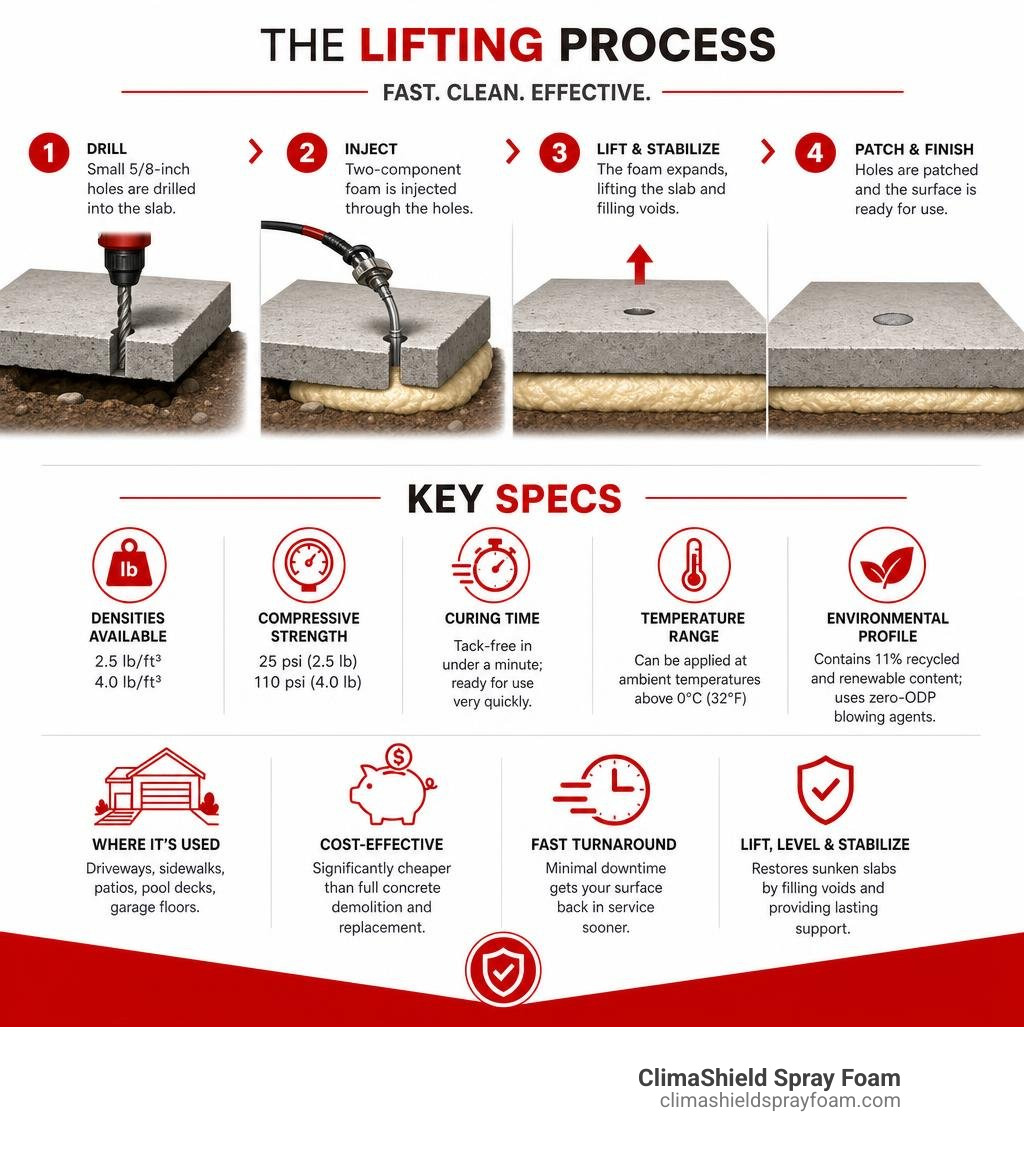
- What it does: Fills voids under concrete and raises sunken slabs back to level
- How it works: Small 5/8-inch holes are drilled, foam is injected, holes are patched
- Where it’s used: Driveways, sidewalks, patios, pool decks, garage floors
- Densities available: 2.5 lb/ft³ and 4.0 lb/ft³
- Compressive strength: 25 psi (2.5 lb) and 110 psi (4.0 lb)
- Curing time: Tack-free in under a minute; ready for use very quickly
- Temperature range: Can be applied at ambient temperatures above 0°C (32°F)
- Environmental profile: Contains 11% recycled and renewable content; uses zero-ODP blowing agents
- Bottom line: Significantly cheaper and faster than full concrete demolition and replacement
Concrete repairs have a reputation for being expensive, messy, and slow. A full demolition and repour means days of downtime, heavy equipment, and a bill that can feel like a gut punch. That’s why GeoLift foam has gotten so much attention — it offers a way to fix sunken slabs in a fraction of the time, with a fraction of the disruption.
Whether you’re a homeowner dealing with a tripping-hazard driveway or a contractor looking to add a profitable new service, this product deserves a hard look.
I’m Dave Brocious, founder of ClimaShield Industries, with over 20 years in the coatings and specialty spray foam industry — including hands-on experience evaluating products like GeoLift foam for real-world residential and commercial concrete repair applications. In this review, I’ll break down exactly what the product delivers, where it shines, and where you need to set realistic expectations.
Important geolift foam terms:
What is Geolift Foam and How Does It Work?
To understand how GeoLift foam works, we have to look at why concrete sinks in the first place. Whether it is a driveway in Indiana, PA, or a commercial warehouse floor, the culprit is almost always the soil beneath the slab. Over time, heavy rains, poor drainage, and Pennsylvania’s aggressive winter freeze-thaw cycles wash away or compact the sub-base. This leaves an empty pocket—a void—underneath the concrete. Without support, the heavy slab cracks and drops.
This is where GeoLift foam steps in as a highly specialized Slab Jacking Foam.
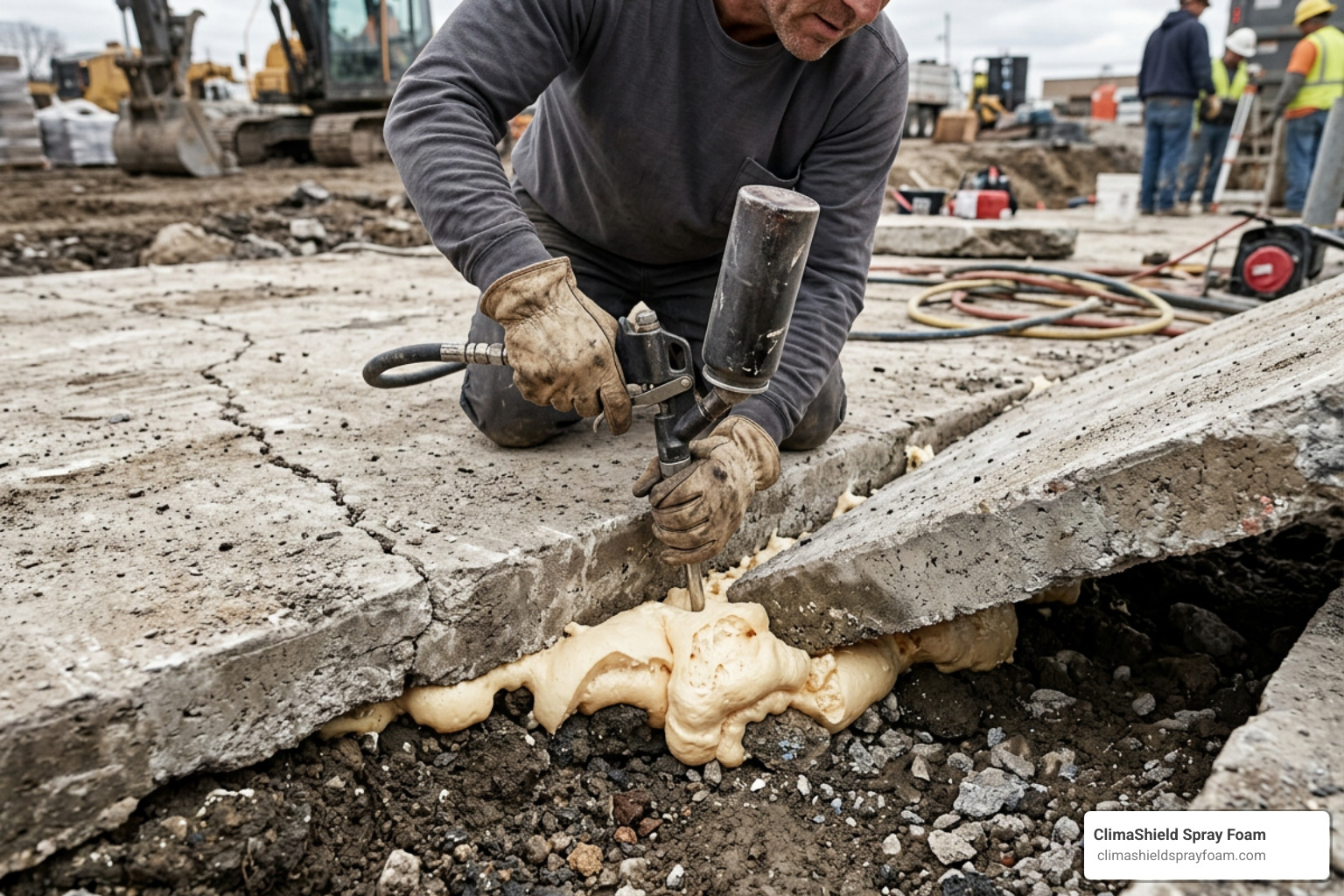
Unlike traditional insulation foams, which are designed to expand slowly and remain soft, GeoLift is engineered for brute strength and controlled, rapid expansion. It is a two-component, closed-cell polyurethane system. When Component A (an isocyanate) and Component B (a proprietary resin) are mixed at high pressure and injected through small, dime-sized holes in the concrete, a chemical reaction occurs.
Within seconds, the liquid mixture transforms into a dense, expanding foam. As it expands, it takes the path of least resistance:
- It flows outward to fill every nook, cranny, and void beneath the concrete.
- Once the voids are completely filled, the foam exerts massive upward pressure (up to several tons per square foot), gently and precisely lifting the sunken concrete slab back to its original position.
- Simultaneously, the foam compacts the loose soil underneath, creating a stable, long-lasting foundation.
One of the most impressive features of this material is its hydrophobic nature. In Western Pennsylvania, wet soil is a constant challenge. If you inject a water-soluble material under a wet slab, it will eventually wash away. GeoLift, however, repels water. It can be injected directly into wet environments without losing its structural integrity, ensuring that once your slab is lifted, it stays lifted.
Technical Specifications of Geolift Foam
When evaluating any structural material, the numbers tell the true story. Huntsman Building Solutions offers this product in two distinct densities to handle different structural demands. Depending on the size of the slab and the load it needs to carry, we choose between the 2.5 lb and the 4.0 lb formulations.
Let’s look at the hard data from the official manufacturer documentation:
GeoLift 2.5 (Standard Lifting & Leveling)
This formulation is the workhorse for residential projects like sidewalks, patios, and standard residential driveways.
- In-Place Density: 2.5 lb/ft³ (pounds per cubic foot)
- Compressive Strength: 25 psi (pounds per square inch) at 5% deflection, providing an incredibly strong, lightweight sub-base.
- Closed-Cell Content: Greater than 85%, which prevents water absorption (measured at less than 1.50% by volume).
- Reactivity Profile: Extremely fast. It has a cream time of 3 to 8 seconds, a gel time of 15 to 25 seconds, and becomes tack-free in just 25 to 35 seconds.
- Max Service Temperature: 300°F (149°C).
- Key Document: For full details, see the 20.00125 Geolift 2.5 TDS_v2 .
GeoLift 4.0 Void Fill (Heavy-Duty & Commercial Support)
When we are dealing with heavy vehicle traffic, industrial warehouse floors, or massive voids that require extra load-bearing capacity, we upgrade to the 4.0 lb formulation.
- In-Place Density: 3.9 to 4.2 lb/ft³
- Compressive Strength: An outstanding 110 psi (according to ASTM D 1621), allowing it to support heavy machinery, commercial trucks, and high-traffic areas.
- Tensile Strength: 127 psi, giving it excellent resistance to pulling and shearing forces.
- Closed-Cell Content: Greater than 90%, making it virtually impervious to water penetration (water absorption is less than 1.00%).
- Reactivity Profile: Formulated to allow slightly more flow before locking up, with a cream time of 5 to 12 seconds, gel time of 12 to 25 seconds, and a tack-free time of 35 to 45 seconds.
- Key Document: Read more in the GEOLIFT ™ 4.0 VOID FILL .
Both systems require a strict 1:1 mixing ratio by volume and a minimum mixing pressure of 700 psi during application to ensure the chemical reaction occurs perfectly. For a broad overview of these systems, you can visit GEOLIFT | Huntsman Building Solutions .
Environmental and Material Advantages
In 2026, we cannot talk about construction materials without discussing their environmental footprint. Fortunately, Huntsman Building Solutions has made sustainability a core focus of this product line.
First, GeoLift contains 11% recycled and renewable content. The raw materials are derived from recycled plastic bottles (PET) and renewable soybeans. This helps divert plastic waste from landfills while reducing reliance on fossil fuels.
Second, the system is formulated with zero-ODP (Ozone Depletion Potential) blowing agents. It is entirely water-blown, meaning it complies fully with the Montreal Protocol and global warming potential (GWP) regulations. When you choose this method, you are not pumping harmful chemicals into the local Pennsylvania soil or releasing ozone-depleting gases into our mountain air. You can review these environmental credentials in the 20.00127 Geolift Sell Sheet .
Geolift vs. Traditional Concrete Demolition: A Cost and Performance Comparison
When faced with a sunken concrete driveway or walkway, property owners usually think they only have two options: live with the tripping hazard or rip it out and start over. Let’s compare these two paths across the metrics that matter most: cost, time, and disruption.
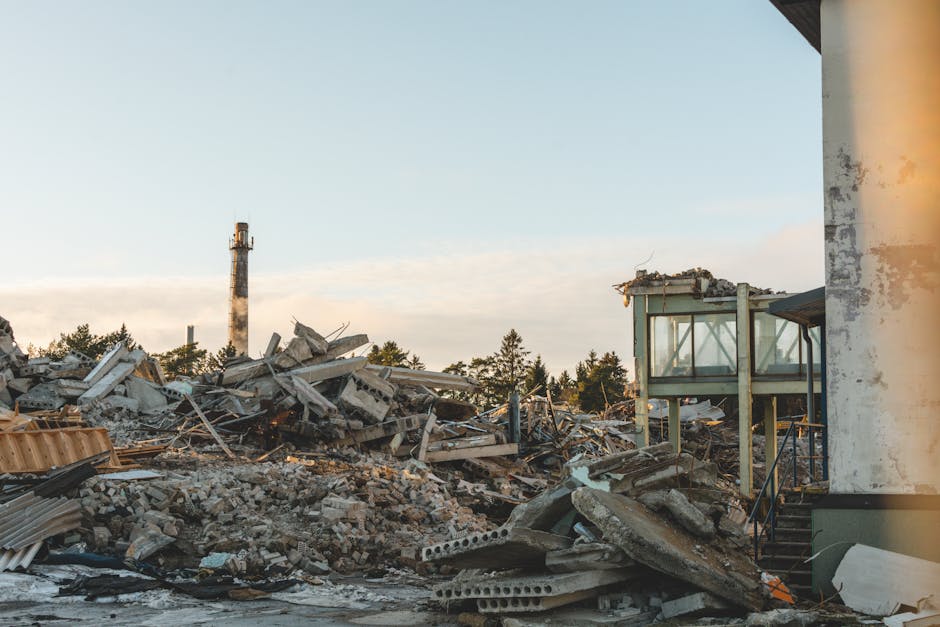
Traditional demolition is a massive undertaking. It requires jackhammers, heavy skid steers tearing up your grass, dump trucks to haul away tons of concrete waste, and concrete mixers to pour the new slab.
Not only is this process incredibly loud and disruptive, but it also leaves you unable to use your driveway or patio for up to a week while the new concrete cures. Furthermore, traditional concrete replacement has a massive carbon footprint; cement production is one of the leading industrial sources of CO2 emissions globally.
By choosing to Stop the Sinking with Foam Concrete Lifting, you bypass almost all of these headaches. Because the existing concrete is preserved, there is zero demolition waste heading to a local Pennsylvania landfill. The entire process is quiet, completed in a few hours, and does not damage your landscaping.
Here is a side-by-side breakdown of how these methods compare:
| Feature | GeoLift Foam Injection | Traditional Demolition & Repour |
|---|---|---|
| Average Cost | 30% to 60% more cost-effective | Expensive (labor, disposal, and material fees) |
| Downtime | Minutes (fully cured and traffic-ready in 1 hour) | 5 to 7 days (waiting for concrete to cure) |
| Lawn & Property Damage | None (no heavy machinery required) | High risk (heavy equipment driving over grass) |
| Environmental Impact | Extremely low (90% CO2 reduction, uses recycled materials) | High (massive CO2 emissions, high landfill waste) |
| Noise & Disruption | Minimal (small drill and a quiet compressor) | Extreme (jackhammers, heavy trucks, dust) |
| Lifting Precision | High (can adjust levels within 1-2 mm) | N/A (requires a completely new pour) |
Residential and Commercial Applications
Because of its versatility and strength, we use this system across a wide variety of settings in the Indiana, PA region. Our local climate—characterized by freezing winter temperatures and humid summers—makes concrete highly susceptible to shifting and cracking.
Common applications include:
- Driveways: Sunken driveway slabs can damage your vehicle’s suspension and create pooling water. We can level them in a single morning.
- Sidewalks and Walkways: Uneven joints are major tripping hazards that expose homeowners to liability. We can quickly lift these slabs to make them safe and code-compliant.
- Patios and Pool Decks: Water pooling near your home’s foundation or pool edge can cause severe structural damage. We use the hydrophobic properties of the foam to stabilize these wet areas.
- Garage Floors: Sinking garage slabs can cause the walls of your home to crack. We use the 4.0 lb density foam to support the weight of parked cars and storage shelves.
- Warehouse and Commercial Slabs: For local business owners, commercial downtime means lost revenue. We can lift warehouse floors with minimal disruption, allowing forklifts to drive over the repaired area within minutes.
To learn more about how this protects your home’s value, check out our guide on Residential Concrete Lifting: Your Foundation for a Stable Home.
Expanding Your Business with Geolift Foam
If you are a spray foam insulation contractor, adding concrete lifting to your service menu is one of the smartest business moves you can make. The barrier to entry is surprisingly low because you already own the most expensive component: your spray foam rig.
Your existing proportioner, heated hoses, and air compressors are fully compatible with concrete lifting chemicals. To get started, you typically only need to invest in a specialized injection gun, some basic drilling equipment, and transfer pumps.
Adding this service allows you to keep your crew busy during the shoulder seasons when traditional insulation work might slow down. It also opens up a completely new stream of high-margin residential and commercial leads.
To explore how this transition works, you can read Lift, Level, and Expand Your Spray Foam Business or check out our professional insights on Raising Concrete with Spray Foam: What Experts Say About Going Solo.
Step-by-Step Installation and Application Guide
The secret to a flawless concrete lift lies in the preparation and the precision of the injection. It is a highly controlled process that requires training and experience.
Here is exactly how our team at ClimaShield Spray Foam executes a standard concrete lifting project:
Step 1: Inspection and Mapping
Before we touch a drill, we analyze the slab. We locate the underlying voids, identify the pivot points of the concrete, and map out exactly where the injection holes need to go. We also check for any utility lines running beneath the concrete.
Step 2: Drilling the Injection Ports
We drill small 5/8-inch holes (about the size of a dime) through the sunken concrete slab. These holes are strategically placed at least 6 inches from the edges of the concrete to prevent cracking. Because the holes are so small, they do not compromise the structural integrity of the concrete.
Step 3: Injecting the Foam
We insert our specialized injection nozzle into the first port. As we pull the trigger, the liquid polyurethane is injected under the slab. We inject the foam in short, controlled bursts. Because the foam reacts and expands within seconds, we can watch the slab rise in real-time, adjusting our injection points to achieve a perfectly level surface with a tolerance of just 1 to 2 millimeters.
Step 4: Monitoring and Curing
As the foam expands and cures, we continuously check the alignment of the slab with adjacent concrete surfaces to ensure a smooth transition. The foam cures incredibly fast, reaching structural stability almost immediately.
Step 5: Patching and Cleanup
Once the concrete is perfectly level, we remove the injection ports. We clean out the drilled holes and patch them with a high-strength concrete grout, matching the color of your existing slab as closely as possible. Within an hour, the area is completely cleaned, patched, and ready for regular traffic.
For a deeper dive into the mechanics of this process, read our Slab Lifting 101 guide or consult Your Essential Guide to Concrete Lifting.
Frequently Asked Questions About Geolift
How long does it take for Geolift foam to cure?
One of the biggest advantages of this polyurethane system is its speed. Unlike traditional mudjacking (which uses a heavy slurry of sand and cement) or a fresh concrete pour that can take days to cure, this foam is tack-free in less than a minute. It is fully cured and ready to support heavy vehicular traffic within just one hour.
You can read more about this in A Homeowner’s Guide to Polylevel and Concrete Lifting.
Can Geolift be applied in cold weather?
Yes, but with some limitations. According to the manufacturer’s technical data sheets, the ambient and substrate temperatures must be above 0°C (32°F). In Indiana, PA, this means we can safely perform concrete lifting throughout the spring, summer, and autumn. During the dead of winter, we have to monitor ground temperatures closely, as frozen soil can prevent the foam from expanding and bonding correctly.
What is the difference between 2.5 lb and 4 lb Geolift densities?
The primary difference is their density and compressive strength. The 2.5 lb foam is lighter and expands more, making it highly cost-effective for standard residential leveling (like sidewalks and patios).
The 4.0 lb foam is much denser and has a compressive strength of 110 psi (compared to 25 psi for the 2.5 lb version). This heavy-duty formulation is designed specifically for high-load applications, such as supporting heavy trucks, stabilizing warehouse floors, or filling massive voids where structural stability is the absolute priority.
Conclusion
If you have sunken, cracked, or uneven concrete, you do not have to spend a fortune on demolition and replacement. GeoLift foam offers a fast, clean, and incredibly durable solution that stabilizes your soil, fills underlying voids, and lifts your slabs back to their original height at a fraction of the cost.
At ClimaShield Spray Foam, we are proud to bring this advanced geopolymer technology to our neighbors in Indiana, PA, and across Pennsylvania. Whether you are looking to make your home’s walkways safer or need to reinforce a heavy-duty commercial slab, our team has the training, experience, and equipment to get the job done right.
Ready to save your concrete and your budget? Contact us today to schedule a professional assessment, or explore our specialized Geotech Slab Lifting services to see how we can restore your property’s safety and curb appeal!
