When the Ground Gives Way: What You Need to Know About Foam Raising Concrete
Foam raising concrete is a repair method where expanding polyurethane foam is injected beneath a sunken slab to lift it back to its original level — and it works fast.
Quick Answer: How Does Foam Raising Concrete Work?
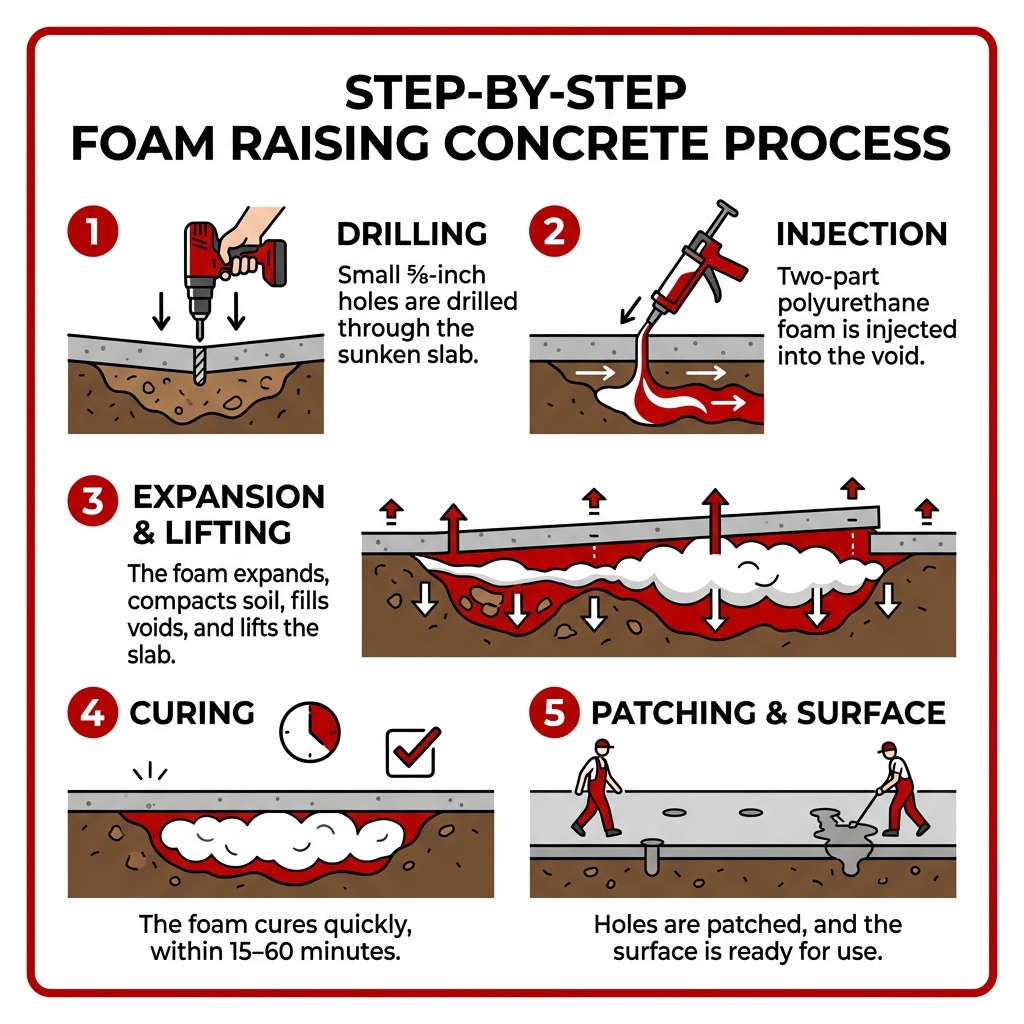
- A technician drills small ⅝-inch holes through the sunken slab
- Two-part polyurethane foam is injected through the holes
- The foam expands, fills voids, compacts loose soil, and lifts the slab
- The foam cures within 15–60 minutes
- The holes are patched and the surface is ready to use — often the same day
That’s the short version. But knowing when to use it, what it costs, and where it can fail — that’s what separates a smart repair from an expensive mistake.
Concrete sinks for a lot of reasons. Soil erodes. Tree roots shift the ground. Poor drainage washes away the base. Over time, slabs that were once level become trip hazards, eyesores, or early signs of bigger structural problems.
The old fix was to tear everything out and start over. That’s expensive, slow, and disruptive. A newer approach — mudjacking — improved on that, but still required large drill holes and a 24-hour wait before use.
Foam raising concrete changed the game. Smaller holes. Lighter material. Faster cure. Less mess.
But it’s not a fix for every situation. Used in the wrong place, it can over-lift a slab or leave voids unfilled — making things worse, not better.
This guide walks you through everything: how it works, where it excels, where it falls short, and what it actually costs.
I’m Dave Brocious, and with two decades in the coatings and specialty construction industry — including hands-on work with spray foam, concrete coatings, and protective systems — I’ve seen how the right application of foam raising concrete can save a property owner thousands of dollars. I’ll give you a straight, practical look at the process so you can make the best call for your situation.
Handy foam raising concrete terms:
What is Foam Raising Concrete and How Does it Work?
At its core, foam raising concrete (often called polyjacking or foam jacking) is a surgical approach to structural repair. Unlike traditional mudjacking, which pumps a heavy slurry of sand and cement under your driveway or patio, we use a sophisticated two-part polyurethane polymer.
When these two liquids meet at the tip of an injection gun, a chemical reaction occurs. This isn’t just “filling a hole.” It is an engineered expansion. To get a better handle on the basics, you can check out our guide on how to understand concrete lifting foam.
The process begins with a technician drilling a series of strategically placed 5/8-inch holes—roughly the size of a dime—through the concrete. We then inject the foam. As it travels beneath the slab, it seeks out the “path of least resistance,” filling every nook, cranny, and air pocket created by soil erosion or poor compaction. For a deep dive into the mechanics, see our slab lifting 101 resources.
The Science of Polyurethane Expansion
The magic happens through an exothermic reaction. As the two components mix, they generate heat and expand rapidly. This expansion creates incredible upward pressure—enough to lift thousands of pounds of concrete.
What makes this special is the density. Polyurethane foam used for lifting typically ranges from 300 to 1800 kg/m³. Because it is so much lighter than traditional fill dirt or cement slurries, it significantly reduces the “dead load” on the underlying soil. In simpler terms, we aren’t adding a massive weight that will cause the soil to sink even further next year. The foam becomes a lightweight, rigid, and waterproof “shelf” that supports the slab.
Precision Injection and Curing
One of the biggest advantages of foam raising concrete is the level of control. We inject the foam in short, incremental bursts. This allows us to monitor the lift in real-time, preventing the “over-lifting” that can sometimes happen with high-pressure mudjacking.
The speed of the cure is where homeowners really win. Most polyurethane products reach an initial cure within just 15 to 60 minutes. While mudjacking requires you to keep cars off the driveway for 24 hours (or more), foam-lifted slabs are often ready for traffic before our truck even leaves your Indiana, PA property. You can learn more about these slab jacking foam applications and how they fit your specific project.

Foam Leveling: The Advanced Solution for Concrete Repair
When you compare foam raising concrete to the alternatives, the differences are stark. We aren’t just talking about a slightly better way to fix a sidewalk; we’re talking about a completely different category of durability and convenience.
| Feature | Foam Lifting (Polyjacking) | Mudjacking | Slab Replacement |
|---|---|---|---|
| Hole Size | 5/8-inch (Dime-sized) | 2 to 3 inches | N/A (Total Demo) |
| Material Weight | 2-4 lbs per cubic foot | 100-120 lbs per cubic foot | Heavy Concrete |
| Cure Time | 15 – 60 Minutes | 24 Hours | 7 – 28 Days |
| Durability | Waterproof/Permanent | Erodes over time | Long-term |
| Mess Level | Very Low | High (Slurry/Hose) | Very High (Dust/Debris) |
If you’re wondering if your project qualifies for this modern approach, our essential guide to concrete lifting breaks down the inspection process. It’s all about how to repair concrete slab the right way without causing more damage in the long run.
Why Foam Raising Concrete is the Modern Standard
The primary reason we recommend foam is its relationship with water. In Pennsylvania, we deal with plenty of rain and snow-melt. Traditional mudjacking material is essentially dirt and cement; over time, water can wash it away, leading to a “re-sink.”
Polyurethane foam is waterproof. Once it cures, it stays there. It won’t wash out, it won’t rot, and it acts as a moisture barrier that prevents further erosion. This makes it the premier choice for residential concrete lifting for stable homes. Plus, the application is incredibly clean. There are no heavy hoses dragging mud through your landscaping, and the small drill holes are nearly invisible once patched.
When to Avoid Foam and Choose Replacement
We’ll be the first to tell you that foam isn’t a magic wand. There are times when you should skip the lift and call the demo crew.
- Severely Crumbled Slabs: If your concrete looks like a jigsaw puzzle with dozens of small cracks, foam won’t help. The foam needs a solid “plate” to push against.
- Structural Foundation Failure: While we can lift slabs, foundation issues often require deep-driven piers. Understanding beyond the cracks: foundation settling is vital here.
- Surface Scaling: If the top layer of your concrete is peeling off (spalling), lifting the slab won’t fix the ugly surface.
- Deep Organic Soil: If the slab is sitting on a bed of rotting peat or organic matter, the foam might lift it temporarily, but the ground will continue to decompose underneath.
Applications: From Tight Spaces to Large 5-Inch Lifts
One of the coolest things about our equipment is its portability. Because the foam travels through relatively small hoses from our truck or trailer, we can reach areas that a heavy cement mixer simply can’t.
Indoor applications are a huge part of what we do. Since the process is low-dust and doesn’t require water, we often work in finished basements, garages, and even commercial spaces like hospital wings or warehouses. If you’ve noticed a gap between your floor and the baseboard, you might be asking, is that floor slab crack a big deal? Often, it’s a sign that the slab has settled and needs a boost.
Risks and Strategies for Large 5-Inch Lifts
Can you lift a slab 5 inches or more? Absolutely. But the risks increase with the height of the lift. When we do a “large lift,” we have to be careful about the “path of least resistance.” If we pump too much foam too fast, it can “pancake” or squeeze out the sides rather than pushing the slab up.
We use specialized geotech slab lifting techniques to manage these large voids. This involves injecting the foam in layers—allowing the first layer to expand and compact the soil before adding the next layer to provide the actual lift. We monitor the pressure constantly to ensure we aren’t putting undue stress on the concrete, which could cause it to crack.
Performance in Extreme Environments
Foam raising concrete is surprisingly resilient. It handles hydrostatic pressure (water pressure from the soil) better than almost any other material. It also provides a secondary benefit of thermal insulation. For a slab-on-grade home, having a layer of high-density foam underneath can actually make your floors feel warmer in the winter.
However, temperature sensitivity is a factor during the installation. While the cured foam is stable in the cold, the chemical reaction during injection requires the components to be heated. Our specialized equipment keeps the material at the perfect temperature, but extreme Pennsylvania winters can sometimes require us to take extra precautions to ensure a proper cure.
The Cost and Longevity of Professional Repairs
Let’s talk numbers. Generally, foam raising concrete will cost more than mudjacking but significantly less than total replacement. Replacing a slab involves demolition, hauling away old concrete, prepping the site, and pouring new material. Foam lifting usually costs about 50% to 70% less than replacement.
When homeowners ask about raising concrete with spray foam: expert advice, we always emphasize the ROI. You aren’t just paying for the lift; you’re paying for the fact that you don’t have to redo your landscaping or wait weeks for concrete to dry.
Factors Influencing the Price of Foam Raising Concrete
No two jobs are the same. When we provide an estimate, we’re looking at:
- Void Size: How much “empty space” is under there? A 5-inch lift over a large area requires significantly more material than a 1-inch tweak on a sidewalk.
- Soil Density: If the soil is very loose, we may need extra foam to compact the base before the slab even starts to move.
- Site Accessibility: Can we park our rig close by, or do we need hundreds of feet of hose?
- Specialized Equipment: For commercial or industrial jobs, we might use geotech slab lifting for commercial use which involves different foam densities.
Durability and Environmental Sustainability
At ClimaShield Spray Foam, we prioritize products that are safe for your family and the environment. Modern polyurethane foams are non-toxic once cured. They don’t leach chemicals into the groundwater, and because they are so durable, they prevent the environmental waste associated with tearing out and disposing of old concrete.
Furthermore, our foam is naturally resistant to mold and pests. It doesn’t provide a food source for termites or a damp environment for mold to grow, which is a major “plus” for indoor residential lifting.
Frequently Asked Questions about Foam Leveling
Can foam leveling be done in cold weather?
Yes, but with caveats. The chemicals must be heated in the truck and through the hoses to approximately 100-120 degrees Fahrenheit to react properly. If the ground is frozen solid, it can be difficult to get an accurate lift because the ice in the soil might melt later, causing the slab to shift again. We typically assess the ground conditions in Indiana, PA before scheduling winter lifts.
How long does the concrete stay level after foam injection?
In most cases, the repair is permanent for the life of the concrete. Because the foam is waterproof and doesn’t biodegrade, it won’t disappear. However, the soil around the foam can still shift if you don’t fix the underlying drainage issues. If a gutter is still dumping water directly under your driveway, new voids can form around the repair.
Is the foam safe for indoor residential use?
Absolutely. We use low-VOC (volatile organic compound) foams designed for indoor environments. The process is remarkably clean—there’s no water, no mud, and the drilling produces very little dust. Most homeowners stay in the house while we work and can walk on the floors immediately after we finish.
Conclusion
If your concrete is sinking, you don’t have to live with the trip hazards or the “sinking feeling” that your property value is dropping. Foam raising concrete offers a fast, clean, and incredibly durable way to restore your home’s foundation and surfaces.
Whether you’re dealing with a lopsided sidewalk or a major garage floor settlement, a professional assessment is the first step toward a permanent fix. At ClimaShield Spray Foam, we bring years of expertise to every job in the Indiana, PA area, ensuring your concrete stays level for years to come.
Ready to stop the sinking? Schedule a Geotech Slab Lifting Consultation with us today and let’s get your property back on solid ground.
