
Why Slab Foundation Settling Deserves Your Attention
Slab foundation settling occurs when the concrete base of your home sinks or shifts due to soil movement beneath it. While some minor settling is normal in the first few years after construction, excessive or uneven settling can lead to serious structural damage, higher energy bills, and costly repairs.
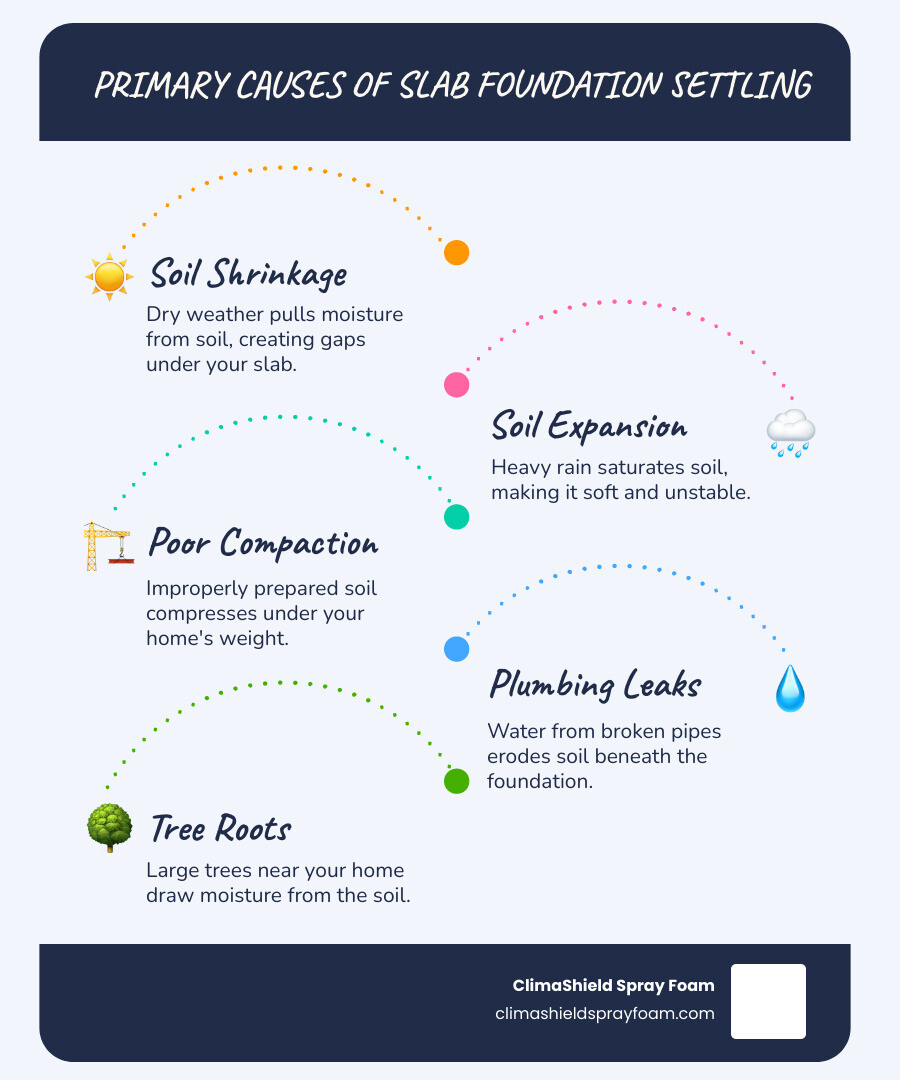
Quick Answer: What Causes Slab Foundation Settling?
- Soil shrinkage – Dry weather pulls moisture from soil, creating gaps under your slab
- Soil expansion – Heavy rain saturates soil, making it soft and unstable
- Poor compaction – Improperly prepared soil compresses under your home’s weight
- Plumbing leaks – Water from broken pipes erodes soil beneath the foundation
- Tree roots – Large trees near your home draw moisture from the soil
Your home’s foundation is its most critical structural element, bearing the entire weight of the house. When it moves, everything above it moves too. This movement causes cracks in walls, sticking doors and windows, uneven floors, and gaps that let in drafts, moisture, and pests, directly impacting your energy bills and comfort.
The challenge for homeowners is knowing when normal settling becomes a problem. While a few hairline cracks might be harmless, significant issues like horizontal foundation cracks, stair-step patterns in brick, or sloping floors signal the need for professional attention. Ignoring these signs risks structural damage, reduced home value, and ongoing comfort and efficiency problems.
Understanding the difference between cosmetic issues and structural concerns is essential. Research shows that settlement exceeding 1 inch per 20 feet is considered excessive and could indicate potential structural issues. Cracks wider than 1/8 inch are another red flag. The good news? Modern repair methods like polyurethane foam injection can stabilize and lift settling slabs with minimal disruption to your home and daily life.
I’m Dave Brocious, founder of ClimaShield Industries, with 20 years of experience in the coatings and construction industry. Throughout my career working with commercial and residential properties, I’ve seen how slab foundation settling impacts home comfort, energy efficiency, and structural integrity—and I’ve helped countless homeowners address these issues before they become major problems.
Understanding Your Foundation: Slabs vs. Other Types
To understand slab foundation settling, it’s helpful to know what a slab foundation is and how it differs from other common types in Pennsylvania, like basements or crawl spaces. This context explains why slabs settle and how problems appear.
What is a Slab Foundation?
A slab foundation, often called a slab-on-grade foundation, is essentially a thick, single layer of concrete that rests directly on the ground. Typically, these slabs are between 6 to 8 inches thick, though some variations exist. To improve their strength and durability, they are often reinforced with steel rebar or post-tension cables embedded within the concrete. This reinforcement helps the slab resist cracking and manage structural loads.
A “monolithic slab” is a type of slab-on-grade foundation where the slab and its footings (the thickened edges) are poured as one continuous piece of concrete. This creates a very strong, integrated structure. Slab foundations provide a level surface and transfer the building’s weight to the underlying soil. You can learn more about different slab types and their components at the Slabs | Building America Solution Center.
How Slabs Differ from Basements and Crawl Spaces
The fundamental difference between a slab foundation and a basement or crawl space foundation lies in the absence of an excavated space beneath the main living area.
-
Slab Foundations: With a slab, your home is built directly on a concrete pad with no accessible void between the ground and first floor. This design is cost-effective and quick to build, requiring less excavation. It also offers good energy efficiency and pest resistance. However, a major drawback is that plumbing and electrical utilities are often embedded within the slab, making repairs more difficult and costly.
-
Basement Foundations: Basements involve excavating a full-height space beneath the entire footprint of the house, creating an additional level of living or storage space. They typically have poured concrete walls and a concrete floor. While offering ample space, basements are more expensive to build, susceptible to water intrusion, and require careful waterproofing.
-
Crawl Space Foundations: Crawl spaces are essentially shallow basements, usually just enough height for someone to “crawl” through for access to utilities. They lift the house off the ground, allowing for easier access to plumbing and wiring than a slab, and can help mitigate moisture issues if properly vented. However, crawl spaces can be prone to moisture problems, pest infestations, and can be less energy-efficient if not properly insulated.
In Pennsylvania, we see a mix of all these foundation types, though slab foundations are particularly common in newer constructions or in areas where soil conditions might make basements more challenging or expensive.
What Causes Slab Foundation Settling and Why It Matters
Diagnosing slab foundation settling requires understanding the forces beneath your home. The stability of your foundation is intrinsically linked to the behavior of the soil it rests on.
Primary Causes of Slab Foundation Settling
The primary culprits behind slab foundation settling are often related to soil mechanics and moisture content. Imagine your home resting on a dynamic, ever-changing surface. When that surface shifts unevenly, so does your foundation.
-
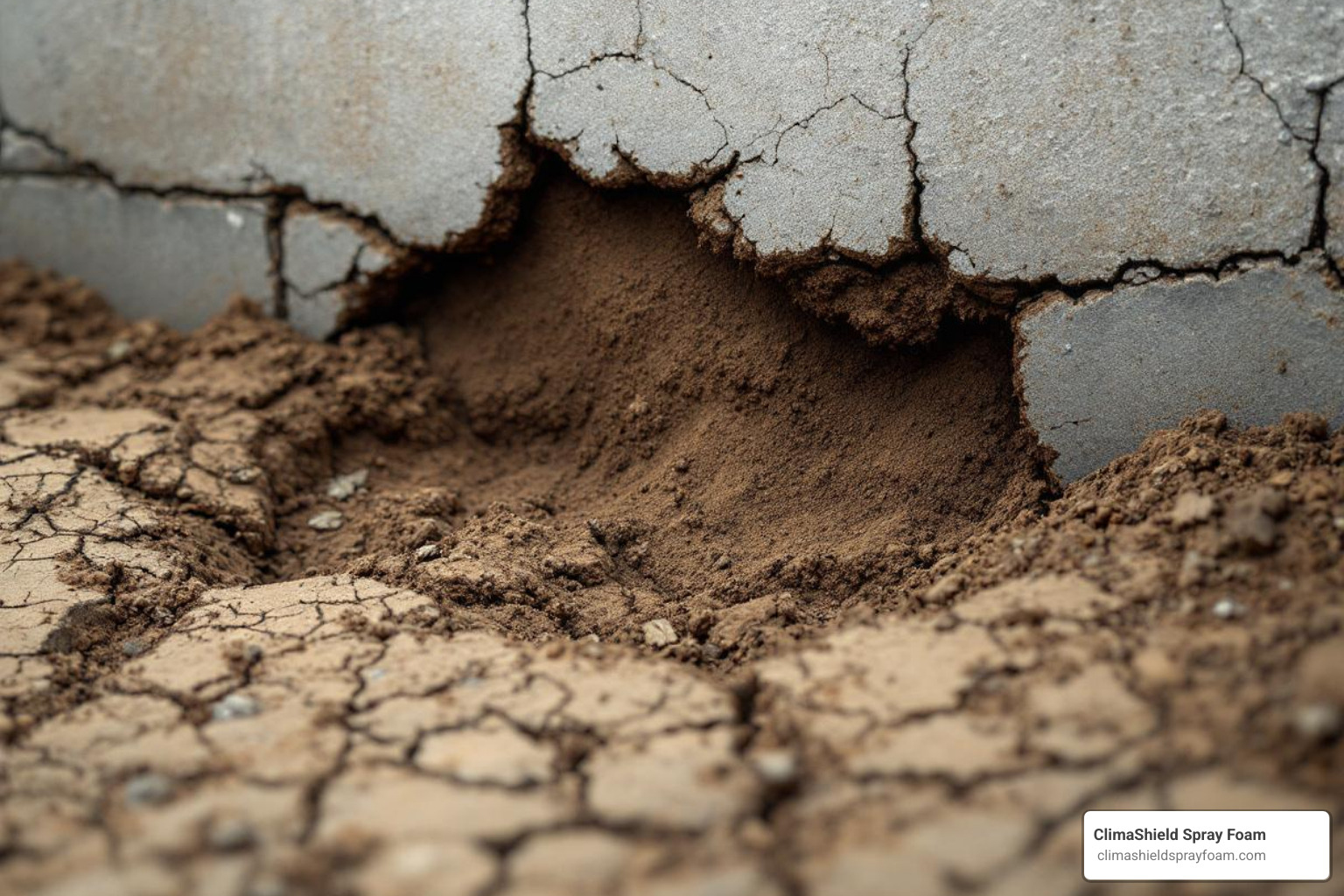
Drying and Shrinking Soil: This is a major factor, especially with expansive clay soils common in Pennsylvania. During dry spells, the soil under your foundation loses moisture and shrinks. This creates voids beneath the slab, removing its support. The weight of your home then causes unsupported sections to drop, leading to settlement. We’ve seen soil pull away from the foundation, leaving significant gaps.
-
Wetting and Softening Soil: Conversely, excessive moisture from heavy rains, poor drainage, or leaks can saturate the soil, making it too soft to support your home’s weight. Saturated soil loses its load-bearing capacity, leading to sinking or differential settlement. If you have active clay soil, it can also swell when wet (heave) and shrink when dry, causing movement.
-
Poorly Compacted Fill Soil: This issue stems from construction. If fill soil wasn’t properly compacted before the slab was poured, it will naturally settle over time under your home’s weight. This uneven compaction creates weak spots, leading to differential settlement.
-
Plumbing Leaks: Hidden leaks from water or sewer lines beneath your slab can be particularly insidious. The constant water flow erodes the soil, creating voids and washing away supporting material. This localized erosion can cause a section of the slab to drop rapidly and significantly.
-
Tree Roots: Large trees and shrubs planted too close to your home can actively draw moisture from the soil beneath your foundation. This exacerbates the drying and shrinking effect, particularly during dry periods, contributing to settlement. Over time, roots themselves can also exert pressure on the foundation, or decay, leaving voids.
-
Poor Drainage: Inadequate grading around your home, clogged gutters, or faulty downspouts can direct rainwater directly towards your foundation. This constant saturation contributes to soil softening and erosion, increasing the risk of slab foundation settling.
Types of Foundation Settlement
Not all settlement is created equal. Understanding the different ways a foundation can settle helps us diagnose the problem and recommend the right solution.
-
Uniform Settlement: This occurs when the entire foundation settles evenly. While it might cause minor cosmetic cracks, it’s generally less damaging because the structure maintains its integrity. This is often considered “normal” settling, especially in newer homes.
-
Differential Settlement: This is the more problematic type. Differential settlement happens when parts of the foundation settle at different rates. One side might sink more than another, creating uneven stress across the structure. This uneven movement is what causes significant cracks, sticking doors and windows, and sloping floors.
-
Tipping Settlement: This is a severe form of differential settlement where one entire section of the foundation (or even the whole house) tilts significantly in one direction. This can be caused by very localized soil failure or extreme differential movement. While less common, it represents a serious structural compromise. A leaning chimney, for example, is a classic sign of localized tipping.
Reading the Signs: Is Your Foundation Settling or Failing?
A challenge for homeowners in Indiana, PA, and across Pennsylvania is distinguishing between normal house settling—which every home experiences to some degree—and more serious slab foundation settling that requires professional intervention. Spotting these signs early can save you significant time, money, and stress.
Common Signs of Slab Foundation Settling
When your slab foundation begins to settle excessively or unevenly, your home will tell you. It’s crucial to pay attention to these common indicators:
- Sticking Doors and Windows: If doors suddenly begin to stick, rub against the frame, or become difficult to open and close, it’s a strong indicator that door frames have become misaligned due to foundation movement. Similarly, windows may jam or not latch properly.
- Uneven or Sloping Floors: This is a classic sign. If you notice a noticeable slope in your floors, or if a marble placed on the floor rolls consistently in one direction, your foundation may be settling unevenly.
- Gaps Between Walls and Ceilings/Floors: As the foundation shifts, walls can pull away from the ceiling or floor, creating visible gaps.
- Drywall Cracks: Cracks appearing in your drywall, especially around door and window frames, in corners, or along seams, can indicate stress from foundation movement. Nail pops (where nail heads push through the drywall) can also be a sign of drywall shifting.
- Tilting Chimneys: A chimney built on its own footing can settle independently from the main house. If you see your chimney tilting or pulling away from the home, it’s a clear sign of localized foundation settlement. You can see examples of this at Tilting Chimneys.
- Cracks in Exterior Brick or Masonry: Stair-step cracks in brick or concrete block walls are particularly telling. These cracks often follow the mortar lines and can indicate significant differential settlement.
- Cracks in the Slab Floor Itself: Visible cracks in your concrete slab floor, especially if they are wide, uneven, or run across the entire slab, are a direct sign of foundation movement.
Analyzing Foundation Cracks
The type, size, and location of cracks can offer critical clues about the severity of your slab foundation settling.
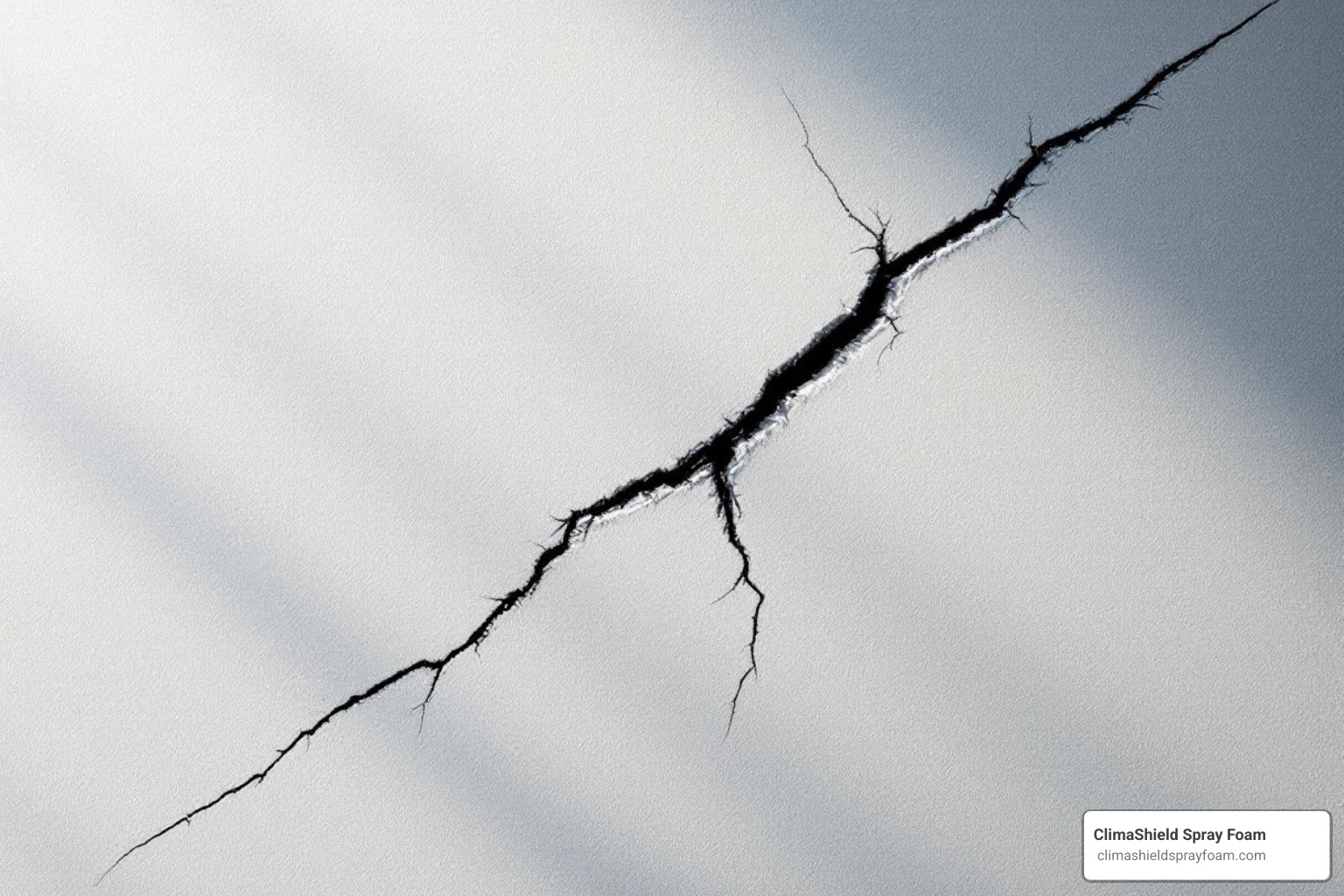
- Hairline Cracks vs. Wide Cracks: Small, thin hairline cracks (less than 1/8 inch wide) are often normal and cosmetic, occurring as concrete cures or due to minor, uniform settlement. However, cracks wider than 1/8 inch are potential red flags and warrant closer inspection.
- Horizontal Cracks: These cracks, particularly in foundation walls or brick veneer, often indicate significant pressure from outside soil (hydrostatic pressure) or severe structural stress.
- Vertical Cracks: While some vertical cracks can be minor, wide or widening vertical cracks can indicate settlement or movement.
- Stair-Step Cracks: As mentioned, these cracks in brick or block walls are strong indicators of differential settlement. If they are wider at the top than the bottom, it often suggests an uneven sinking. You can find more examples of crack locations and types at Common Crack Locations.
- Cracks Rounding Corners: Cracks that extend from a wall and turn to go around a corner are often a sign of structural damage.
- Cracks Spanning from Slab to Wall: These indicate movement where the slab meets the vertical structure.
Consequences of Ignoring Issues: Ignoring significant slab foundation settling can lead to a cascade of problems:
- Structural Damage: The most severe outcome, leading to compromised structural integrity of your home.
- Reduced Home Value: Foundation issues are a major red flag for prospective buyers and can significantly decrease your property’s market value.
- Pest and Moisture Intrusion: Cracks in the foundation create entry points for insects, rodents, and moisture, leading to mold, mildew, and increased energy bills as conditioned air escapes.
- Safety Hazards: Severely uneven floors or compromised structural elements can pose tripping hazards or even lead to unsafe living conditions.
Solutions and Repairs for a Settling Slab
Finding that your home is experiencing slab foundation settling can be daunting, but the good news is that modern repair methods offer effective and often less invasive solutions than you might imagine. In many cases, replacing the entire foundation is rarely necessary.
Overview of Geotech Slab Lifting with Polyurethane Foam
| Application | Method | Benefits | Typical Cost Range | Best For |
|---|---|---|---|---|
| Concrete slabs, driveways, walkways, and foundations | Polyurethane foam injection beneath slab | Lightweight, waterproof, minimal disruption, fast curing, fills voids, increases load-bearing capacity | $2,200–$8,100+ | Settling slabs, void filling, lifting sunken concrete, stabilizing sub-base, preventing future settlement |
Modern Repair: Geotech Slab Lifting
When it comes to addressing slab foundation settling in Pennsylvania, we often recommend and use Geotech slab lifting, also known as polyurethane foam injection. This is a cutting-edge technique that has revolutionized foundation repair.
The process involves injecting a high-density polyurethane foam beneath the compromised concrete slab. This specialized foam rapidly expands and hardens, filling voids, compacting loose soil, and gently lifting the slab back to its desired level.
Here’s why we favor this method:
- Minimal Disruption: Unlike traditional methods that require extensive excavation and heavy machinery, polyurethane injection involves drilling small, penny-sized holes in the slab. This means less mess, less noise, and often allows you to remain in your home during the repair. The process is designed to be non-disruptive, allowing daily operations to continue.
- Lightweight and Durable: The cured foam is incredibly strong yet lightweight, adding minimal burden to the underlying soil. It’s also waterproof, preventing future moisture-related issues and soil erosion.
- Fast Curing: The foam cures quickly, often allowing for immediate use of the repaired area. This means less downtime for your property.
- Precision Lifting: The injection process allows for precise control, enabling us to lift specific sections of the slab to achieve a level surface.
- Void Filling and Soil Stabilization: Beyond just lifting, the expanding foam effectively fills any voids beneath the slab and can compact loose soil, improving the load-bearing capacity of the sub-base, helping to prevent future settlement.
Our Geotech slab lifting service, detailed at Geotech Slab Lifting, is a permanent solution designed to restore structural stability. This technology leverages the unique properties of spray foam, which you can learn more about on our Uses of Spray Foam page.
When to Call a Professional:
If you notice any of the significant signs of slab foundation settling we’ve discussed, it’s time to call in the experts. But who do you call?
- Structural Engineer: For an unbiased assessment of the extent and cause of the damage, a structural engineer is an excellent choice. They can provide a detailed report and repair recommendations. The cost of a foundation inspection by an engineer usually ranges between $300 and $1,000.
- Foundation Repair Specialist (like us!): We offer free foundation inspections and can provide a comprehensive assessment of your slab foundation, identify the causes of settling, and recommend the most effective repair solutions, such as our polyurethane foam injection. We specialize in diagnosing and fixing these issues directly.
Repair Costs: The typical cost associated with foundation repairs for slab foundations can range significantly based on the severity and method. While average costs can be around $5,100, with a low end of $2,200 and a high end of $8,100, our polyurethane foam lifting services often fall within a competitive range, offering a cost-effective and durable solution. A settlement of more than 1 inch per 20 feet is considered excessive and warrants professional attention.
Proactive Prevention: Protecting Your Home’s Foundation
While we have effective solutions for repairing slab foundation settling, the best approach is always prevention. By taking proactive steps, homeowners in Pennsylvania can significantly reduce the risk of future foundation problems and protect their investment.
Preventing Future Slab Foundation Settling
Most preventative measures focus on managing soil moisture around your foundation, as this is the leading cause of settlement.
-
Maintain Consistent Soil Moisture: This might sound counterintuitive, given that both too much and too little moisture cause issues. The goal is consistency. During dry periods, especially if you have expansive clay soils, watering the soil around your foundation (about 10-15 feet out) can prevent it from shrinking too much. A soaker hose on a timer can be very effective. Conversely, ensure proper drainage during wet periods. This can be complex, but a good strategy is to keep the soil moist at all times, especially during droughts.
-
Ensure Proper Drainage Away from the Home:
- Proper Grading: The ground around your home should slope away from the foundation at a rate of at least 6 inches for every 10 feet. This directs rainwater away from the vulnerable soil beneath your slab.
- Gutters and Downspouts: Install and maintain functional gutters and downspouts. Ensure downspouts extend at least 5 feet away from the foundation, discharging water far enough that it doesn’t pool or seep back into the soil near your home.
- French Drains: For persistent drainage issues, a French drain system can effectively collect subsurface water and divert it away from your foundation.
-
Manage Landscaping and Tree Roots:
- Plant Trees Away from Foundation: Plant trees and large shrubs at least 10 feet away from your home’s foundation. Their roots can aggressively seek out moisture, drying out the soil beneath your slab and contributing to settlement.
- Root Barriers: In some cases, root barriers can be installed to protect your foundation from invasive tree roots.
-
Regular DIY Inspections: Periodically walk around your home and inspect your foundation, exterior walls, and interior for any new cracks, changes in existing cracks, or other warning signs. Early detection allows for quicker, less costly intervention.
-
Address Plumbing Leaks Promptly: Be vigilant about any signs of plumbing leaks, whether under the slab or elsewhere. Even small, continuous leaks can erode soil and lead to significant slab foundation settling.
For more comprehensive guidance on maintaining your slab foundation, we recommend consulting resources like the Buyer’s Guide to Slab-on-Ground Foundations, which offers valuable insights into prevention and maintenance. By being proactive, you can help ensure the long-term stability and integrity of your home’s foundation.
Frequently Asked Questions about Slab Foundation Settling
We understand that slab foundation settling can raise many questions for homeowners. Here, we address some of the most common inquiries we receive.
How much foundation settlement is too much?
While some minor settling is a natural process, we consider settlement of more than 1 inch per 20 feet to be excessive and a potential indicator of structural concerns. This level of movement can compromise the safety and integrity of your building.
Beyond this measurement, other signs that indicate settlement is “too much” include:
- Cracks wider than 1/8 inch: Especially if they are horizontal, stair-step, or diagonal cracks in foundation walls, brick, or drywall.
- Noticeable floor slope: If you can clearly feel or see that your floors are no longer level.
- Functional issues: Doors and windows that consistently stick, jam, or won’t close properly, indicating significant frame distortion.
- Gaps: Visible gaps between walls and ceilings or floors.
If you observe these signs, it’s crucial to seek professional help to assess the situation.
Can a house still settle after 50 years?
Yes, a house can absolutely still settle after 50 years, although the most significant settling typically occurs within the first few years after construction as the structure adjusts to its new environment and the underlying soil compacts.
Even in older homes, new or exacerbated slab foundation settling can occur due to:
- Changes in soil moisture: Extended droughts or periods of heavy rainfall can reactivate soil movement.
- Plumbing leaks: New leaks under the slab can cause localized erosion.
- Alterations to landscaping: Removing large trees or adding new heavy structures near the foundation can change soil dynamics.
- Natural disasters: Earthquakes or severe flooding can cause sudden and significant settlement.
- Long-term soil degradation: Over decades, soil properties can change, leading to new settlement patterns.
If an older home starts showing new signs of foundation issues, it’s just as important to investigate as it would be for a newer home.
Is foundation settling covered by homeowner’s insurance?
Generally, homeowner’s insurance policies typically do not cover damage caused by normal slab foundation settling, soil movement, or poor construction. Most policies consider these issues to be maintenance-related or a result of gradual wear and tear, which are usually excluded.
However, there are exceptions where coverage might apply:
- Sudden and accidental events: If the foundation damage is caused by a covered peril, such as a sudden burst pipe (not a slow leak) that leads to soil erosion, there might be coverage for the resulting damage.
- Specific perils: Some policies might cover damage from specific events like earthquakes (often requiring an additional rider) or sinkholes, depending on your policy and location in Pennsylvania.
It’s essential to:
- Review your policy: Carefully read the “Exclusions” section of your homeowner’s insurance policy to understand what is and isn’t covered.
- Consult your provider: Speak directly with your insurance agent or provider to clarify your coverage. They can explain how your specific policy handles foundation issues.
In many cases, even if the direct repair of the foundation isn’t covered, damage to other parts of your home (like drywall cracks or misaligned doors) caused by a covered event might be.
Conclusion
Understanding slab foundation settling is crucial for every homeowner in Pennsylvania. Your home’s foundation is its bedrock, and recognizing the signs of trouble early is the first step in protecting your investment and ensuring the safety and comfort of your living space.
We’ve explored the differences between slab foundations and other types, digd into the primary causes of settlement like soil moisture changes and poor compaction, and highlighted the critical signs to look for—from sticking doors to stair-step cracks. While minor hairline cracks might be normal, anything beyond that, especially cracks wider than 1/8 inch or noticeable sloping, warrants a professional eye.
Proactive maintenance, focusing on proper drainage, consistent soil moisture, and smart landscaping, goes a long way in preventing future issues. But when settlement does occur, modern solutions like polyurethane foam lifting offer a durable, non-invasive, and highly effective way to stabilize and level your slab foundation. This approach minimizes disruption and provides a lasting fix.
At ClimaShield Spray Foam, we’re dedicated to helping homeowners in Indiana, PA, and surrounding areas maintain a stable, energy-efficient, and comfortable home. If you’re concerned about slab foundation settling or any other structural issues, don’t hesitate.
Contact us for a professional assessment and a customized solution for your slab foundation issues. We’re here to ensure your home stands on solid ground.
