Is New Home Spray Foam Worth It? Here’s What You Need to Know
New home spray foam is one of the most effective ways to insulate a new build — sealing air leaks, cutting energy bills, and protecting your home from moisture and mold from day one.
Here’s a quick summary to answer the most common questions:
| Question | Quick Answer |
|---|---|
| What does it cost? | $12,500–$27,000 for a 2,000–2,500 sq ft home |
| How much can I save? | 30–50% on heating and cooling costs |
| How long to install? | 1–2 days for most new builds |
| Open-cell or closed-cell? | Open-cell for most walls; closed-cell for high-moisture or high-performance areas |
| Is it worth the cost? | Yes — typical ROI is 3–5 years |
Building a new home means making hundreds of decisions. But few of them will affect your daily comfort and monthly bills as much as the insulation you choose. Most homeowners focus on countertops and flooring — and don’t give insulation a second thought until they’re dealing with drafts, uneven temperatures, or energy bills that never seem to come down.
Spray foam changes that equation. Unlike traditional fiberglass batts or blown-in cellulose, spray foam doesn’t just slow heat transfer — it seals your home. That air-sealing capability is what sets it apart, and it’s why more new home builders are making spray foam their first choice.
I’m Dave Brocious, founder of ClimaShield Industries and a specialty coatings and insulation professional with over 20 years of experience — including hands-on work with new home spray foam applications across residential and commercial projects. In this guide, I’ll walk you through everything you need to make a confident, informed decision for your new build.
New home spray foam terms you need:
Understanding New Home Spray Foam Technology
When we talk about new home spray foam, we aren’t just talking about “fluff” in the walls. We are talking about a sophisticated chemical reaction that creates a custom-fitted thermal barrier. In the context of Pennsylvania’s fluctuating climate—from humid summers to those biting Indiana, PA winters—this technology is a game-changer.
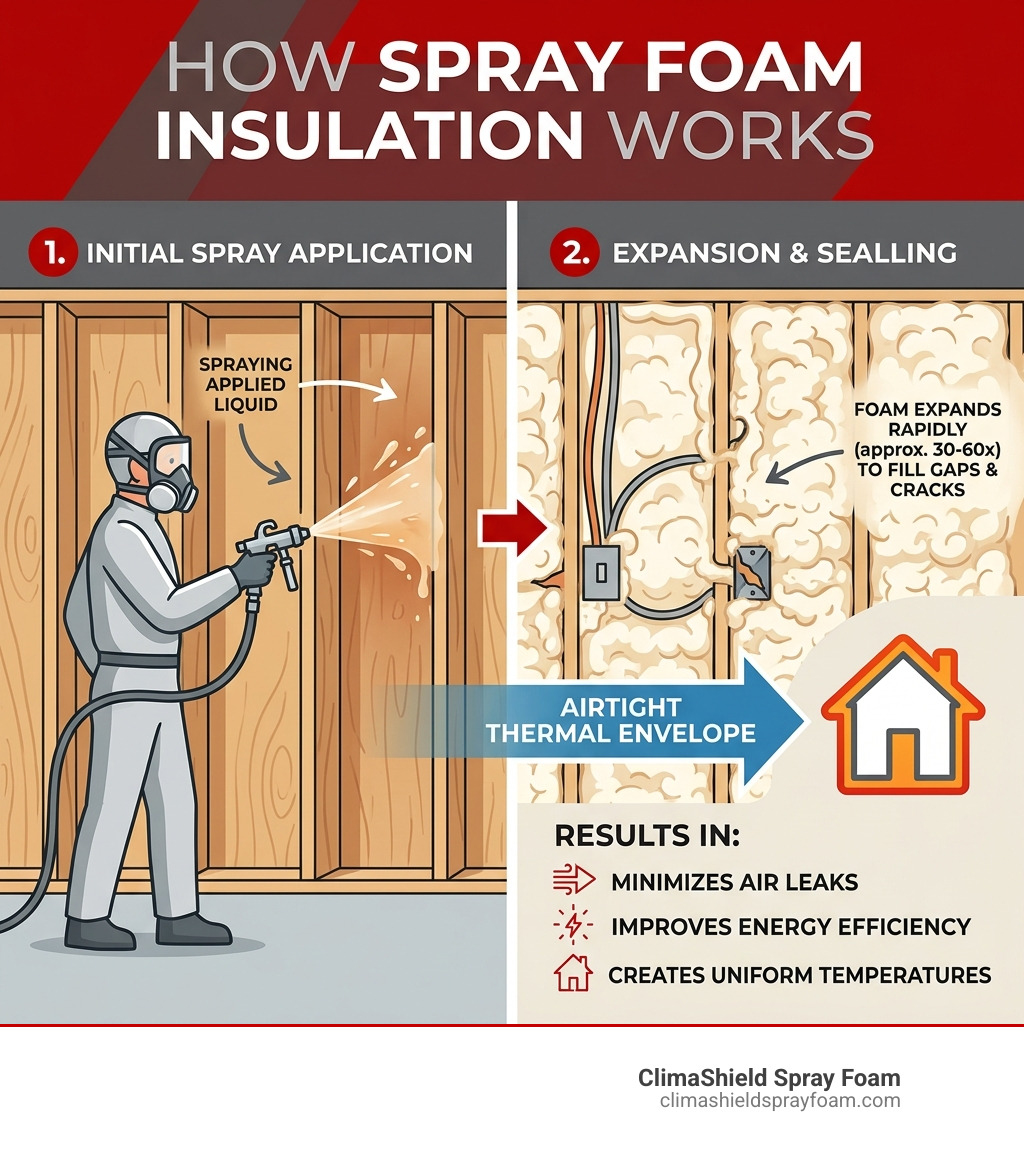
Spray foam is a liquid polyurethane that is applied using specialized high-pressure equipment. As it hits the surface of your wall studs or roof deck, it undergoes a rapid expansion process. Within seconds, it grows up to 30 to 100 times its liquid volume, creeping into every nook, cranny, and electrical box hole that traditional insulation simply can’t reach.
This creates an airtight seal that addresses the three types of heat transfer: radiant, conductive, and convective. While fiberglass only addresses conduction, spray foam stops the “wind” (convection) that whistles through your outlets. To get a deeper look at how this fits into your overall building strategy, check out our Residential Insulation Complete Guide.
How Spray Foam Works in New Construction
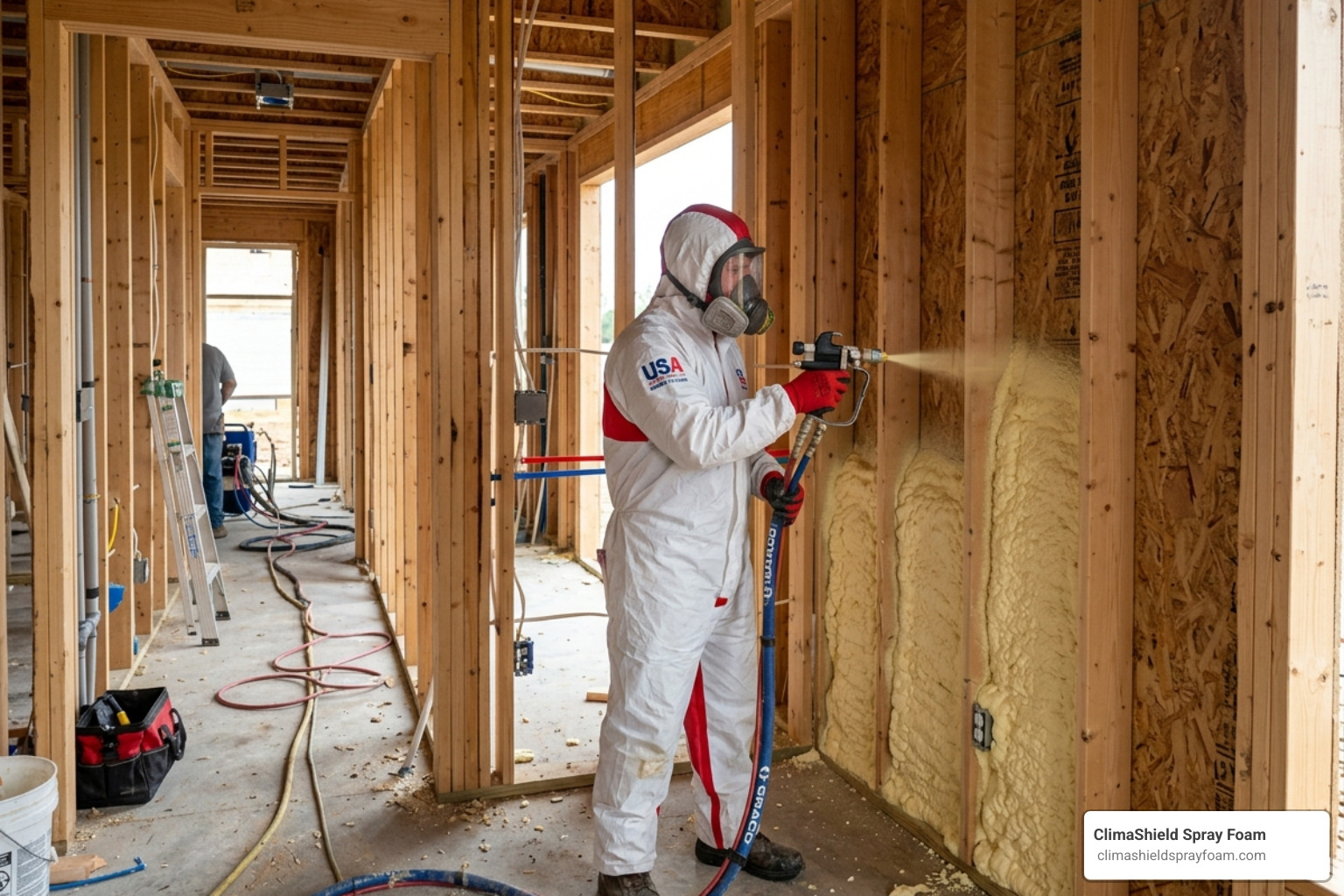
In a new build, we use a two-component system. Two separate liquids—an “A” side (isocyanate) and a “B” side (a blend of polyols, catalysts, and blowing agents)—meet at the tip of the spray gun. The resulting chemical reaction creates a cellular structure that hardens almost instantly.
Because we are working with an open-stud environment, we have the luxury of high-precision application. We can ensure that every square inch of the “thermal envelope” is covered before the drywall goes up. This is much more effective than trying to retrofit an existing home where we might be “spraying blind” into closed cavities. For more on the basics, see our page on Residential Insulation.
Where to Apply New Home Spray Foam for Maximum Impact
To get the most out of your new home spray foam investment, we look at the home as a complete system. Here are the “hot spots” (or cold spots!) where we focus our efforts:
- Exterior Walls: This is your primary defense against the PA elements.
- Unvented Attics: By spraying the roof deck instead of the attic floor, we bring your HVAC system and ductwork into a “conditioned space.” In the summer, instead of your attic being 120°F, it stays within about 10 degrees of your living room temperature.
- Rim Joists: These are the wooden beams that sit on your foundation. They are notorious for air leaks, and spray foam is the only way to seal them perfectly.
- Crawl Spaces and Basement Walls: Preventing moisture from the ground from entering your home is vital for long-term health.
- Garage Ceilings: If you have a bedroom above a garage, spray foam is essential to keep that room from feeling like an icebox in January.
You can explore the various Uses Of Spray Foam to see how versatile this material really is.
The Benefits of Spray Foam for New Builds
The most immediate benefit people notice is the energy savings. While traditional insulation might save you a little, our customers often see a 30-50% reduction in heating and cooling costs. In some cases, we’ve even helped homeowners save up to 60% on their energy bills by creating a truly airtight home.
But it isn’t just about the money. Spray foam provides exceptional moisture resistance. In a new build, moisture is the enemy—it leads to rot and mold. Because closed-cell spray foam is waterproof and airtight, it prevents warm, humid air from hitting cold surfaces and condensing. This is why it’s often considered the ultimate guide to best energy saving insulation.
Improving Indoor Air Quality and Comfort
Have you ever noticed that some houses just feel “drafty,” even when the heat is on? That’s usually due to air leakage. New home spray foam eliminates those cold spots.
Furthermore, because the home is sealed, you have a built-in pollutant barrier. Dust, pollen, and outdoor allergens can’t just “leak” into your bedroom through the walls. This creates a much cleaner environment for families with allergies or asthma. And let’s not forget the noise reduction—spray foam acts as a fantastic sound dampener, making your home a quiet sanctuary from street noise or loud neighbors.
Structural Integrity and Longevity
One of the “secret” benefits of closed-cell spray foam is the wall rigidity it adds to your home. It acts almost like glue, bonding the studs and the sheathing together. Research has shown that closed-cell foam can significantly increase the wind resistance of a structure—a nice peace of mind during those heavy Pennsylvania storms.
Unlike fiberglass, which can sag, settle, or become a cozy home for mice over time, spray foam is durable for the lifetime of the home. It doesn’t lose its R-value or degrade. It’s a permanent solution, as we discuss in our comparison From Fiberglass To Foam Exploring Residential Insulation Types.
Choosing the Right New Home Spray Foam: Open-Cell vs. Closed-Cell
Choosing between open-cell and closed-cell foam is one of the most important steps in your planning phase. We often help clients in Indiana, PA decide based on their specific budget and performance goals.
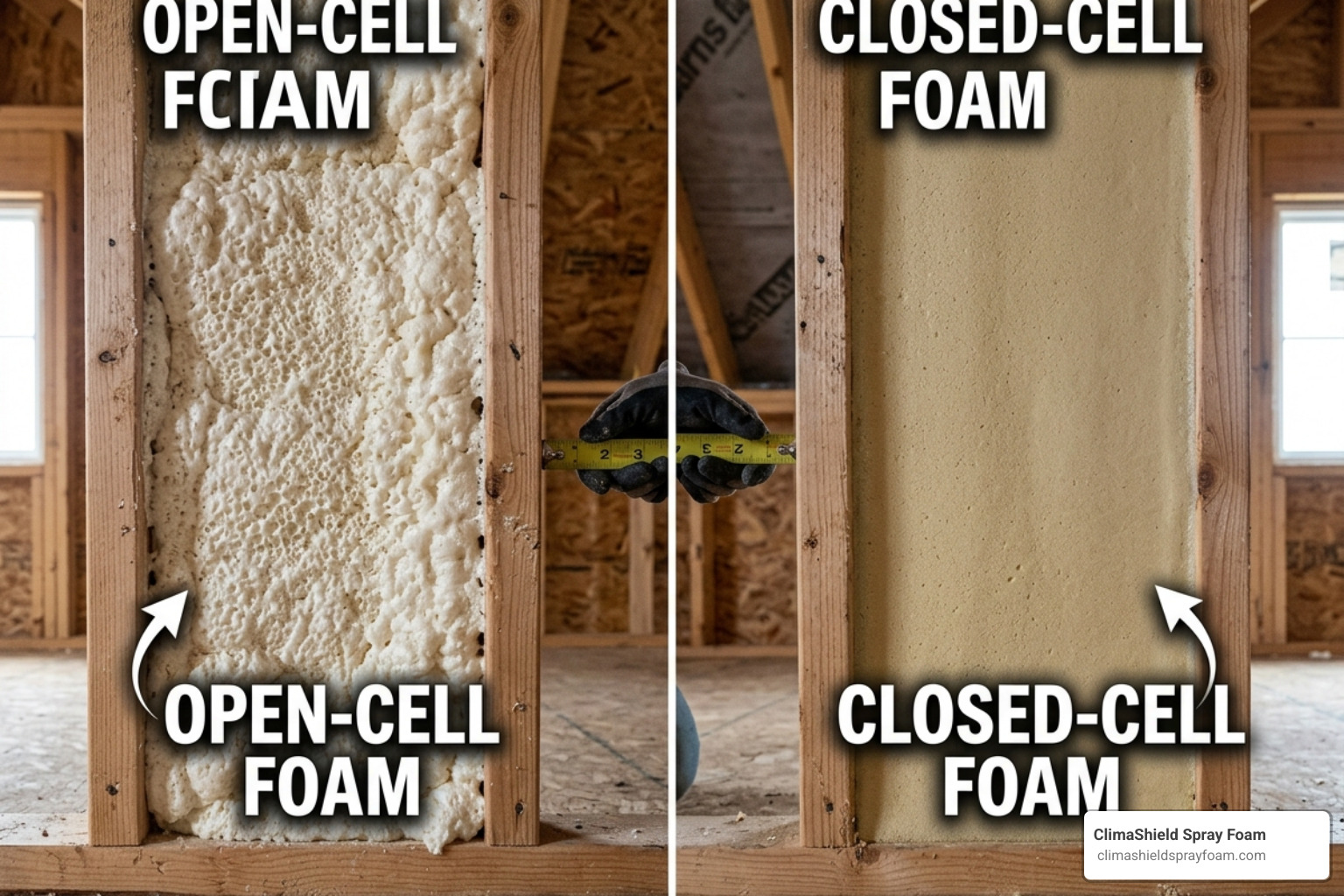
| Feature | Open-Cell Foam | Closed-Cell Foam |
|---|---|---|
| R-Value | ~R-3.5 to R-3.8 per inch | ~R-6.5 to R-7.0 per inch |
| Density | Light and flexible (0.5 lb) | Dense and rigid (2.0 lb) |
| Vapor Barrier | No (Vapor permeable) | Yes (Class II vapor retarder) |
| Cost | $0.45–$0.65 per board foot | $1.00–$1.50 per board foot |
| Best For | Interior walls, soundproofing | Exterior walls, basements, strength |
Open-Cell Foam for Residential Interiors
Open-cell foam is the “softer” cousin. It’s more affordable for residential builds and is excellent at filling large cavities quickly. Its main superpower is flexibility; as a new home settles (and they all do!), open-cell foam moves with the wood rather than cracking. It’s also the superior choice for sound dampening between rooms. For many homeowners, this is the best insulation for home when they want comfort on a budget.
Closed-Cell Foam for Maximum Performance
If you want the “Gold Standard,” closed-cell is it. With an R-value of nearly 7 per inch, it provides the highest level of thermal resistance available. It’s also a built-in vapor barrier, meaning you don’t need to install extra plastic sheeting in high-moisture areas like basements or crawl spaces. While the cost is higher, the structural strength and moisture protection are unmatched. You can dive deeper into this choice with our guide on Choosing The Right Spray Foam For Your Home.
The Investment: Cost and ROI of New Home Spray Foam
We’ll be honest: new home spray foam is an investment. It typically costs 2 to 3 times more upfront than fiberglass or cellulose. For a standard 2,000 to 2,500 square foot home in 2026, you can expect to pay between $12,500 and $27,000, depending on the complexity of your design and the type of foam used.
Smaller homes (around 1,000 sq ft) might range from $7,400 to $13,000, while large custom builds over 6,000 sq ft can exceed $61,000. Factors that affect the price include:
- Square Footage: The more surface area, the more material.
- Design Complexity: High vaulted ceilings or intricate “bonus rooms” require more labor and prep.
- Attic Strategy: Choosing to spray the roof deck (unvented) uses more material than spraying the attic floor, but offers much better energy performance.
For more localized pricing insights, see our Residential Spray Foam Insulation Western Pa page.
Long-Term Savings and Payback Period
While the upfront cost is higher, the ROI is incredibly fast—usually between 3 to 5 years. When you consider that your energy bills will be 30-50% lower every single month, the foam eventually “pays for itself” and then starts putting money back in your pocket.
Additionally, because spray foam creates such a tight seal, you can often downsize your HVAC equipment. A smaller furnace and air conditioner cost less to buy and less to run. Don’t forget to check for 2026 energy efficiency tax credits or local Pennsylvania utility rebates that can further offset the cost.
The Importance of Professional Grade Installation
It can be tempting to look at DIY kits, but for a new home, professional installation is non-negotiable. Professional-grade equipment ensures the “A” and “B” components are heated to the exact temperature and mixed at the correct pressure (usually 1,000+ psi). If the mix is off by even a small percentage, the foam may not cure properly, leading to odors or reduced R-value.
At ClimaShield, we use specialized high-pressure equipment to ensure a lifetime seal. We follow strict safety protocols to ensure the foam is “on-ratio” and safe for your family. This isn’t just about spraying foam; it’s about chemistry and precision.
Installation Timeline and Best Practices
In the grand scheme of building a home, the insulation phase is relatively quick. For a standard 2,500 sq ft home, we are usually in and out in 1 to 2 days. However, timing is everything.
We typically arrive after the “rough-ins” are complete. This means the framing is done, the windows and doors are in, and the electricians and plumbers have finished running their wires and pipes. Most importantly, the electrical and plumbing inspections should be signed off before we spray, as the foam will cover most of their work.
Coordinating with Other Trades
We take great care to protect your investment. Before we start, we mask off windows, doors, and any finished surfaces to prevent “overspray.” Once the foam is applied, we trim it flush with the studs so the drywallers can come in right behind us without any issues. A clean site is a happy site!
Safety and Curing Standards
Safety is our top priority. During the application, we wear full-face respirators and protective suits. Because there is a brief period of off-gassing while the foam cures, we require other trades and homeowners to vacate the site for at least 24 hours.
We use high-quality materials, often featuring GREENGUARD certification, to ensure that once the foam has cured, it is inert and safe. Proper ventilation during and after the spray is a standard part of our process to ensure your new home is healthy from the moment you move in.
Frequently Asked Questions about New Home Insulation
Is spray foam worth the higher upfront cost compared to traditional insulation?
Absolutely. While you pay more today, you save every month for the life of the home. Between the energy savings, the reduced HVAC wear-and-tear, and the increased resale value of a “high-performance” home, the math almost always favors spray foam.
Does spray foam insulation damage roof shingles?
This is a common myth. Research shows that shingles over a spray-foamed roof deck only run about 2-3°F warmer than those over a vented attic. This is well within the manufacturer’s tolerances, and major shingle brands do not void warranties for spray foam applications. In fact, keeping the attic cool helps preserve the wood structure underneath.
How soon can I move into my new home after the foam is sprayed?
For new construction, we recommend waiting 24 hours after the last spray before other trades return to the house. This ensures the foam is fully cured and the air is completely clear. Since you’re likely months away from move-in day during the insulation phase, this won’t delay your timeline!
Conclusion
Building your dream home in Indiana, PA, or the surrounding areas is a massive undertaking. By choosing new home spray foam, you are “sealing the deal” on a home that will be comfortable, quiet, and incredibly efficient for decades to come.
At ClimaShield Spray Foam, we pride ourselves on providing airtight protection that resists mold, pests, and the unpredictable Pennsylvania weather. We don’t just spray insulation; we build peace of mind. If you’re ready to make your new build the most energy-efficient home on the block, we’re here to help.
More info about spray foam applications or contact us today to discuss your blueprints!
