
Why Your Insulation Might Be Inviting Rodents In
Rodent resistant insulation is a category of insulation materials designed to be less attractive — or actively hostile — to mice, rats, and other pests that nest, burrow, and destroy conventional insulation.
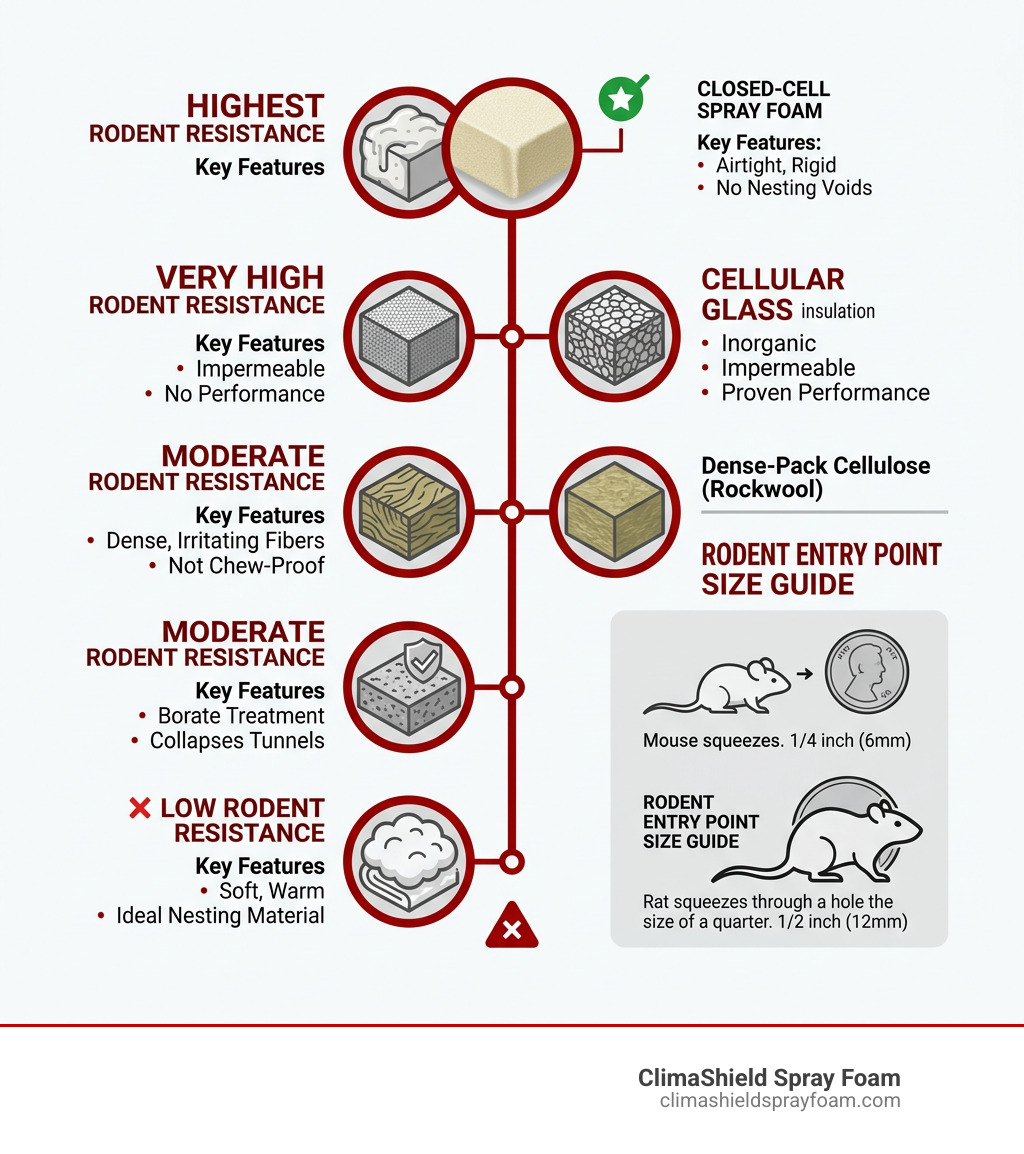
The most rodent-resistant insulation options, ranked:
| Insulation Type | Rodent Resistance | Why |
|---|---|---|
| Closed-cell spray foam | Highest | Airtight, rigid, no nesting voids |
| Cellular glass | Very high | Inorganic, impermeable, proven in studies |
| Mineral wool (rockwool) | Moderate | Dense, irritating fibers, but not chew-proof |
| Dense-pack cellulose | Moderate | Borate treatment irritates, collapses tunnels |
| Fiberglass batts | Low | Soft, warm, ideal nesting material |
No insulation is completely rodent-proof on its own. But some materials make your home far less hospitable than others — and the right choice, combined with proper sealing, makes a significant difference.
Here’s the problem most homeowners don’t see coming.
Rodents don’t just live in your insulation. They shred it, tunnel through it, and contaminate it with droppings and urine. A University of Nebraska-Lincoln study found that all five insulation types tested — including fiberglass, rock wool, and closed-cell polystyrene foam — suffered severe damage from mouse colonies over just six months. Every single one.
That damage isn’t just an insulation problem. Chewed wires start fires. Compromised insulation drives up energy bills. And rodent droppings carry serious health risks like hantavirus and salmonella.
The scratching in your walls isn’t a minor nuisance. It’s a structural and health issue that gets worse fast.
I’m Dave Brocious, founder of ClimaShield Industries and a spray foam insulation specialist with decades of experience in commercial and residential protective coatings — including helping property owners choose rodent resistant insulation solutions that actually hold up. In the sections ahead, I’ll break down exactly what works, what doesn’t, and how to build a real defense against rodents.
Rodent resistant insulation terms made easy:
Why Traditional Materials Fail the Pest Test
When we think of cozy winter bedding, we think of soft, fluffy blankets. Unfortunately, mice and rats think the exact same thing about fiberglass batts. To a rodent, standard fiberglass insulation isn’t just a thermal barrier; it’s a five-star hotel. It is soft enough to shred for nests, loose enough to tunnel through with zero effort, and warm enough to support a rapidly expanding colony.
The scientific data is sobering. In a controlled six-month study by the University of Nebraska-Lincoln Veterinary Science Research Facility, researchers tested five common materials: fiberglass batts, fiberboard panels, rock wool, closed-cell extruded polystyrene foam, and vermiculite. The result? Every single material suffered severe damage. The mouse populations grew three to four times their original size within these insulated environments.
The Hidden Dangers of Infested Insulation
It’s not just about the “ick” factor. When rodents move into traditional insulation, they create three major categories of damage:
- Thermal Conductivity Loss: As mice tunnel, they create air pockets and compress the material. This destroys the R-value of your insulation. Infrared imaging often reveals “warm dots” in attics—spots where the heat from your home is escaping directly through mouse nests.
- Structural Hazards: Rodents are famous for chewing. They will shred aluminum foil vapor barriers to less than half their original mass. Even worse, they often chew through electrical wiring near their nests, which is a leading cause of house fires.
- Health Risks: This is the most critical concern for Pennsylvania families. Rodent droppings and urine contaminate the air you breathe. This can lead to the transmission of hantavirus, a severe respiratory disease, and salmonella, which can spread if rodents move from your walls into your kitchen.
Traditional materials like fiberglass provide the “open-cell” structure that pests crave. Because the material doesn’t resist movement, a mouse can navigate your entire attic without ever touching the floor.

ClimaShield Spray Foam: The Ultimate Rodent Barrier
At ClimaShield Spray Foam, we take a different approach to home protection. While traditional materials act as a playground for pests, our closed-cell spray foam acts as a fortress.
The secret lies in the physical properties of the foam. Unlike batts or loose-fill, spray foam expands to fill every nook, cranny, and crevice. When it cures, it becomes a rigid, dense structure that provides no “give” for a nesting animal.
Why Spray Foam Works Where Others Fail
- Eliminating Voids: Rodents love the “voids” or empty spaces behind fiberglass batts. Spray foam eliminates these voids entirely by bonding directly to the substrate (like your rim joists or wall studs).
- Inorganic Composition: Mice are often attracted to materials that can be used as food or nesting material. Closed-cell spray foam is inorganic; it offers zero nutritional value and isn’t “shreddable” like paper-backed insulation.
- Airtight Sealing: Rodents have incredibly sensitive whiskers that can detect the tiniest drafts. They use these drafts to find entry points into your home. By creating an airtight seal, spray foam removes the “scent” of your home’s warmth, making it less likely that a mouse will even try to get in.
For a deeper dive into how this works, check out our pest-resistant spray foam guide. While some claim mineral wool is the answer due to its density, it still lacks the air-sealing capabilities that truly deter determined pests.
Can rodents chew through rodent resistant insulation?
This is the number one question we get in Indiana, PA. The honest answer? A determined rodent can chew through almost anything—including wood, plastic, and soft metals—if they have a reason to. However, rodents usually chew to get somewhere (like toward food) or to create a nest.
Closed-cell spray foam is significantly harder to gnaw than traditional materials. Because it creates an airtight seal, rodents aren’t attracted to the spot by escaping heat. Furthermore, burrowing through dense foam is exhausting and offers no nesting “fluff,” so they usually give up and look for an easier target elsewhere.
What is the cost of rodent resistant insulation?
Upfront, rodent resistant insulation like closed-cell spray foam costs more than fiberglass—typically 30% to 40% more. However, the Return on Investment (ROI) is massive.
- Energy Savings: Our customers often save up to 60% on energy bills.
- Avoided Repairs: Professional rodent remediation and insulation replacement can cost thousands.
- Added Benefits: You aren’t just getting pest resistance; you’re also getting mold-resistant insulation properties that protect your home’s air quality.
Engineering a Continuous Critter Barrier
Building science experts like Joe Lstiburek often talk about the four critical layers of a “perfect wall”: rain, air, vapor, and thermal. In rural Pennsylvania, we believe there is a fifth essential layer: the critter barrier.
To truly achieve a rodent-free home, you cannot rely on insulation alone. You need a holistic strategy that combines high-performance materials with mechanical exclusion.
The Role of Air Sealing
Mice can squeeze through a hole the size of a dime (about 1/4 inch). Rats only need a gap the size of a quarter. These gaps are most common at the “rim joist”—the area where your home’s frame meets the foundation.
We use spray foam to seal these rim joists, effectively “gluing” the entry points shut. This is much more effective than stuffing fiberglass into the gap, which rodents simply push aside. For larger gaps, we recommend a “sandwich” technique:
- Stuff the gap with stainless steel wool or 1/4-inch hardware cloth.
- Spray our closed-cell foam over and through the mesh.
- The foam holds the mesh in place and provides the air seal, while the metal mesh provides a physical barrier that rodents absolutely cannot chew through.
This approach creates a continuous perimeter. If you want to learn more about our specific methods, visit our guide to pest-resistant barriers.
Maintenance and Detection Strategies
Even with the best rodent resistant insulation, homeowners should remain vigilant. Rodents are persistent, and a “set it and forget it” attitude can lead to trouble down the road.
Using Technology to Spot Pests
One of the most effective ways to detect an infestation is through infrared (thermal) imaging. Because rodents destroy the thermal integrity of insulation, an infrared camera will show “hot spots” in the winter or “cold spots” in the summer where the insulation has been compromised.
If you see visual signs of mouse activity like “warm dots” on your ceiling via a thermal scan, it’s a sign that nesting is occurring.
The Inspection Checklist
We recommend an annual “pest walk” around your property:
- Look for Droppings: Especially along the tops of foundation walls or near attic entry points.
- Check the Perimeter: Ensure no firewood or debris is stacked against the house, which provides “stairs” for rodents.
- Smell the Air: A persistent musky odor often indicates a colony behind a wall.
- Moisture Check: Rodents are attracted to water. Ensure your insulation isn’t damp, as this can also lead to mold. (By the way, is spray foam mold resistant? Yes, our closed-cell foam does not support mold growth).
Frequently Asked Questions about Pest Prevention
Is there truly a 100% rodent-proof insulation?
No single product is 100% rodent-proof if the rest of the house is wide open. However, ClimaShield spray foam is as close as you can get. It creates a robust physical and air-leak barrier that removes the primary reasons rodents enter a home. To be truly “proofed,” you must combine our insulation with mechanical barriers like metal flashing and hardware cloth at key vents and penetrations.
How does borate-treated insulation affect pests?
You may have heard of “TAP” insulation or cellulose treated with boric acid. Borates act as a membrane irritant and a desiccant to insects (like ants and termites) and can irritate the skin of a rodent. While this is better than untreated fiberglass, it doesn’t stop a rat from tunneling. The tunnels in loose-fill cellulose can still stay open, whereas spray foam offers a solid, un-tunnelable mass.
Why ClimaShield Spray Foam is Ideal for Off-Grid Cabins
For rural homes and off-grid cabins in Pennsylvania, pest pressure is extreme. These structures often sit empty for weeks, giving rodents plenty of time to move in. Our spray foam is the ideal choice for these locations because it provides superior thermal performance in cold climates while simultaneously sealing out the field mice and squirrels that frequent wooded areas. By using spray foam in the cathedral ceilings and floors of a cabin, you eliminate the “cozy” nesting spots that typically destroy cabin interiors.
Conclusion
Protecting your home from pests requires more than just a trap in the kitchen; it requires a fundamental shift in how you insulate your building envelope. Choosing rodent resistant insulation is an investment in your home’s structural integrity, your family’s health, and your long-term financial peace of mind.
At ClimaShield Spray Foam, we specialize in creating airtight, durable barriers that keep the heat in and the squeaks out. Whether you are in Indiana, PA, or the surrounding areas, our team is ready to help you upgrade to a system that resists mold, pests, and high energy bills.
Don’t wait until you hear the scratching in the walls. Protect your home with rodent resistant insulation today and experience the difference that professional spray foam installation can make.
