
Why Fire Retardant Insulation is Critical for Home Safety and Comfort
Fire retardant insulation is specially engineered insulation material designed to resist ignition and slow the spread of flames in the event of a fire, providing critical extra time for occupants to evacuate and for firefighters to respond. Here’s what you need to know:
Key Facts About Fire Retardant Insulation:
- Not fireproof – It slows fire spread rather than preventing it entirely
- Buys evacuation time – Delays fire progression by disrupting heat, oxygen, or fuel sources
- Contains special additives – Chemical treatments help resist ignition and form protective barriers
- Must meet fire codes – Tested to standards like ASTM E84 and rated by flame spread index
- Works multiple ways – Forms char layers, releases water vapor, and limits oxygen to slow flames
When you think about protecting your home, fire safety might not be the first thing that comes to mind. But heating and cooling account for 50% to 70% of energy use in the average American home, and the insulation that keeps you comfortable also plays a vital role in fire protection.
Fire safe insulation is vital to help ensure the safety of building occupants, preventing the spread of fire and limiting its structural damage. The right fire retardant insulation doesn’t just save energy—it can save lives by containing fire within one compartment of a building for as long as possible.
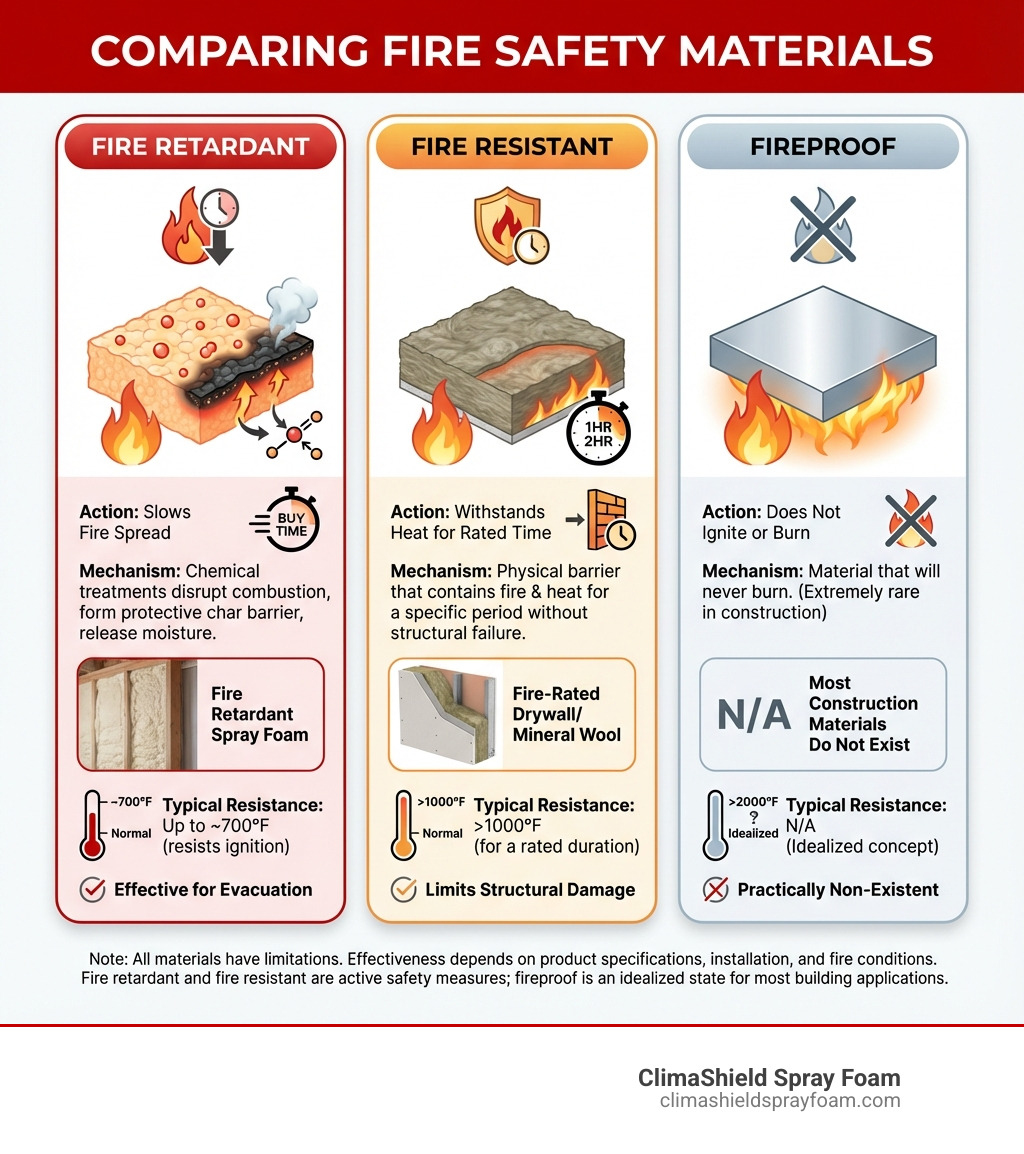
The difference between fire retardant, fire resistant, and fireproof matters more than you might think. Fire retardant materials actively slow fire spread through chemical treatments. Fire resistant materials withstand heat without igniting for a period of time. Fireproof materials (which don’t truly exist in most construction contexts) would never burn at all.
Fire retardant spray foam insulation combines the energy-saving benefits you’re looking for with crucial fire safety features. Modern spray foam products include specialized additives that help them resist ignition at temperatures up to 700°F, while simultaneously sealing air leaks that drive up your energy bills.
I’m Dave Brocious, and over my 20 years in the coatings and insulation industry, I’ve seen how fire retardant insulation like spray foam protects both property and lives while delivering the energy efficiency homeowners demand. As founder of ClimaShield Industries, I’ve helped countless clients understand how the right insulation choice serves as both a thermal barrier and a critical component of passive fire protection.
What is Fire Retardant Insulation and How Does It Work?
At ClimaShield Spray Foam, we often encounter a common misconception: that fire retardant insulation is the same as “fireproof.” Let’s clear that up right away. No building material is truly 100% fireproof. Instead, fire retardant insulation is engineered to resist ignition and significantly slow down the spread of flames. This distinction is crucial because it means these materials provide invaluable time – time for you and your family to evacuate safely, and time for emergency services to arrive and contain the fire.
Think of it like this: if fireproof means a material absolutely cannot catch fire, then fire retardant means it will put up a valiant fight, disrupting the fire’s ability to grow and spread rapidly. This “fight” is what buys precious minutes in an emergency.
So, how does fire retardant insulation achieve this impressive feat? It works by strategically attacking the “fire triangle,” which consists of three essential elements: heat, fuel, and oxygen. Remove or disrupt any one of these, and the fire struggles to sustain itself.
Spray foam insulation, for example, is specifically designed to resist ignition and combust only when it reaches extreme temperatures, often around 700°F. When exposed to heat, its carefully formulated chemical components spring into action.
Key Components of Fire Retardant Spray Foam Insulation
The magic behind fire retardant spray foam insulation lies in its sophisticated chemical composition. During manufacturing, special fire-retardant additives are incorporated directly into the polyurethane foam. These aren’t just surface treatments; they become an integral part of the insulation material itself.
These additives work in several ways:
- Engineered Chemical Formulations: The precise blend of chemicals ensures that when exposed to heat, the foam reacts in a controlled manner, rather than igniting rapidly.
- Inherent Resistance to Ignition: These formulations give the foam an intrinsic ability to resist catching fire, delaying the point at which it becomes a fuel source.
- Air Sealing Properties that Limit Oxygen Flow: One of spray foam’s greatest strengths is its ability to create an airtight seal. This isn’t just great for energy efficiency; it also limits the oxygen supply to any potential fire. By encapsulating building cavities and preventing air movement, spray foam effectively starves a fire of one of its critical components – oxygen – making it harder for flames to spread.
While the foam itself contains fire retardants, some applications may also involve intumescent coatings. These are specialized paints or mastics applied over the spray foam that swell and char when exposed to heat, providing an additional layer of fire protection, often required by local building codes for exposed foam surfaces in accessible areas within structures in Pennsylvania.
The Science of Stopping Flames
When fire retardant spray foam insulation faces the intense heat of a fire, it doesn’t just sit there. It actively engages in a multi-pronged scientific defense:
- Chemical Reactions at High Heat: As temperatures rise, the fire-retardant chemicals within the foam undergo reactions. These reactions can absorb heat, effectively cooling the surface of the insulation and preventing it from reaching its ignition temperature quickly.
- Releasing Water Vapor (in some formulations): Some fire retardants work by releasing inert gases or water vapor when heated. This process not only cools the material but also helps to dilute the flammable gases in the air surrounding the foam, further inhibiting combustion.
- Off-Gassing to Displace Oxygen: Certain additives can cause the foam to release non-combustible gases when heated. These gases displace oxygen from the immediate vicinity of the flame, effectively smothering it and disrupting the fire triangle.
- Creating a Protective Char Barrier: Perhaps one of the most remarkable mechanisms is the formation of a char layer. When exposed to flames, the surface of the fire retardant spray foam insulation will expand and develop a tough, blackened char. This char layer acts as a sacrificial barrier, insulating the underlying, unburned foam from the heat source. It significantly reduces heat transfer to the structural elements it protects, buying invaluable time for evacuation and fire suppression. This char layer is designed to be stable, holding its shape even under extreme temperatures, further impeding the fire’s progress.
By combining these scientific principles, fire retardant spray foam insulation doesn’t just passively resist fire; it actively works to prevent its spread, making your home or business in Indiana, PA, and across Pennsylvania a safer place.
Understanding Types of Fire Retardant Spray Foam Insulation
When we talk about fire retardant spray foam insulation, we’re primarily discussing two main types: open-cell and closed-cell, both of which can be formulated with fire-retardant properties. Each has unique characteristics that make it suitable for different applications, from residential attics to commercial building envelopes.
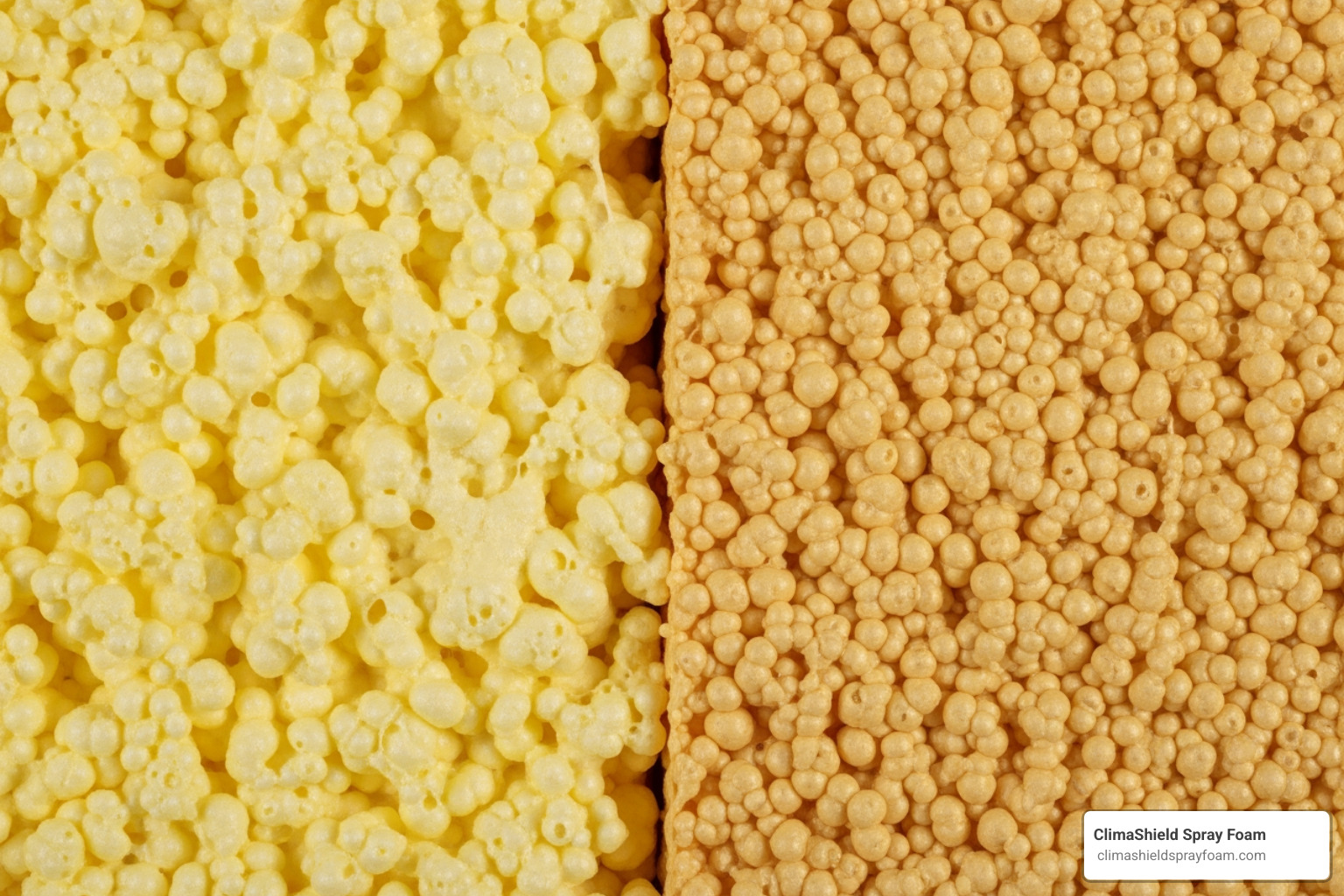
Choosing the right type is essential for optimal performance, not just in terms of energy efficiency but also for fire safety. Here’s a closer look at each:
| Material Type | Fire Rating (Typical) | R-Value/inch | Mold Resistance | Cost (Relative) |
|---|---|---|---|---|
| Open-Cell SPF | Class A (with additives) | 3.5 – 3.8 | Excellent | Moderate |
| Closed-Cell SPF | Class A (with additives) | 6.0 – 7.0 | Excellent | Higher |
| Intumescent Coatings | Improves Class A | N/A | Good | Variable |
Open-Cell Spray Foam
Open-cell spray foam insulation is a lightweight, low-density material that expands significantly upon application, filling every nook and cranny. Its open-cell structure makes it very effective at air sealing and sound dampening, which is why we often recommend it for interior applications like walls, attics, and ceilings in homes and offices across Pennsylvania.
Key characteristics include:
- Lightweight: Its lower density makes it suitable where weight is a concern.
- Expands to fill gaps: Its expansive nature ensures excellent air sealing, preventing drafts and limiting oxygen flow in case of fire.
- Contains fire-retardant additives: Like all spray foam we install, open-cell foam is manufactured with fire-retardant chemicals to meet safety standards.
- Provides air sealing and sound dampening: Beyond fire safety, it significantly improves indoor air quality and reduces noise transfer.
- Suitable for interior applications: Ideal for areas where moisture vapor can escape, contributing to a healthy indoor environment.
Closed-Cell Spray Foam
Closed-cell spray foam insulation is a much denser product compared to open-cell. Its cells are tightly packed and filled with an insulating gas, giving it a higher R-value per inch. This makes it an excellent choice for achieving superior thermal performance in a thinner application, and its rigidity adds structural strength to walls.
Key characteristics include:
- Dense structure: Offers robust insulation and can provide some structural reinforcement to building components.
- Higher R-value per inch: Delivers maximum thermal resistance, making it incredibly energy-efficient.
- Improved moisture resistance: Its closed-cell nature makes it highly resistant to water absorption, an important feature for foundations, basements, and exterior applications.
- Engineered with fire-retardant chemicals: Just like open-cell, closed-cell foam is formulated with fire retardants to ensure it resists ignition and slows fire spread.
- Adds structural strength: Can increase racking strength in wall systems.
- Suitable for exterior and roof applications: Its density and moisture resistance make it ideal for challenging environments.
For a deeper dive into the versatility of spray foam, including both open-cell and closed-cell applications, check out our page on the Uses of Spray Foam.
Intumescent Coatings for Spray Foam
While fire retardant spray foam insulation is inherently treated, certain building codes in Pennsylvania and specific applications may require an additional layer of protection, especially when the foam is left exposed. This is where intumescent coatings come into play.
Intumescent coatings are specialized paints or mastics that are applied over the cured spray foam. Their unique property is that when exposed to heat, they swell dramatically, forming a thick, insulating char layer. This char layer acts as a further barrier, protecting the underlying spray foam from direct flame impingement and intense heat.
- Specialized coatings applied over spray foam: These are not part of the foam itself but are a post-application treatment.
- Swell and char when exposed to heat: This reactive property significantly improves the fire performance of the insulated surface.
- Provide additional fire protection: They add another critical layer of defense, buying even more time in a fire event.
- Often required by building codes for exposed foam: For spaces like unfinished basements, crawl spaces, or attics where spray foam might be exposed, local building codes may mandate an intumescent coating to meet fire safety requirements. We ensure all our installations comply with these vital regulations.
Navigating Fire Safety Standards and Health Considerations
At ClimaShield Spray Foam, we understand that installing insulation isn’t just about keeping your home warm in the winter and cool in the summer. It’s about creating a safe and healthy environment for your family. That’s why we adhere to stringent fire safety standards and are transparent about health considerations. Understanding these aspects is crucial for every homeowner in Pennsylvania.
Building codes, particularly for foam plastic insulation, are designed to ensure safety. For instance, foam plastic insulation generally must have a flame spread index of not more than 75 and a smoke-developed index of not more than 450 when tested according to ASTM E84. These requirements are in place to ensure that the materials we use contribute to passive fire protection, providing occupants with precious time to evacuate.

Fire Safety Testing and Standards
The effectiveness of fire retardant spray foam insulation isn’t just a claim; it’s rigorously tested and certified. Various organizations set standards and conduct tests to ensure building materials meet specific fire performance criteria. When we install spray foam, we ensure it meets or exceeds these critical benchmarks for your peace of mind.
Here are some of the key standards and testing methods:
- ASTM E84 (Standard Test Method for Surface Burning Characteristics of Building Materials): This is one of the most common tests for insulation. It measures how quickly flames spread across the surface of a material (Flame Spread Index) and how much smoke it produces (Smoke-Developed Index). A “Class A Fire Rating” (Flame Spread Index of 0-25 and Smoke-Developed Index of 0-450) is the highest rating and is often required for many building applications. You can learn more about this test from this overview of ASTM E84 testing.
- UL 94 (Standard for Safety of Flammability of Plastic Materials for Parts in Devices and Appliances): While often applied to smaller plastic components, UL 94 measures a material’s ability to extinguish or spread flames after ignition. This helps classify plastics based on their burning characteristics.
- NFPA 285 (Standard Fire Test Method for Evaluation of Fire Propagation Characteristics of Exterior Non-Load-Bearing Wall Assemblies Containing Combustible Components): This is a critical test, especially for commercial buildings and multi-story residential structures, in our service areas. It evaluates the fire performance of entire wall assemblies that include combustible materials like insulation, ensuring that fire does not spread vertically or horizontally within the wall system. Many polyiso continuous insulation products, for example, can be used in a wide range of NFPA 285-compliant wall assemblies.
By adhering to these standards, we ensure that the fire retardant spray foam insulation we install is a reliable component in your home’s overall fire safety strategy.
Health, Mold, and Corrosion
Beyond fire safety, we prioritize the overall health and longevity of your home. When considering any insulation, it’s wise to look at its impact on indoor air quality, potential for mold growth, and risk of corrosion to building components.
Indoor Air Quality (IAQ):
Modern spray foam insulation, once cured, is inert and does not off-gas harmful chemicals. However, during the installation and curing process, specific precautions are necessary. One of the main ingredients, methylene diphenyl diisocyanate, can pose health risks like lung damage and asthma to installers if proper safety protocols are not followed. This is why professional installation is paramount. We ensure that our certified technicians follow strict safety guidelines, including proper ventilation and personal protective equipment. We also advise homeowners to vacate the premises during installation and for a recommended curing period afterward, though there are no government-established evacuation timelines. You can find more general information on health and safety from the Health and safety information from the Insulation Institute.
Mold Resistance:
Mold requires moisture and an organic food source to grow. The good news is that spray foam insulation is an inorganic material. This means it does not serve as a food source for mold. Its excellent air-sealing properties also help control moisture, preventing condensation within wall cavities where mold often thrives. This is a significant advantage over organic insulation types, which can be susceptible to mold growth if not properly treated.
Corrosion:
Unlike some insulation materials that might contain chemicals that could corrode pipes, wires, or fasteners under certain conditions, properly formulated and installed spray foam insulation is non-corrosive. This protects the integrity of your home’s electrical and plumbing systems, ensuring that your insulation provides long-term benefits without hidden drawbacks.
At ClimaShield Spray Foam, we are committed to providing solutions that are not only energy-efficient and fire-safe but also contribute to a healthy and durable living environment for our customers in Pennsylvania.
Benefits, Applications, and Making Your Choice
Choosing fire retardant spray foam insulation for your home or business in Pennsylvania offers a multitude of benefits that extend far beyond just fire safety. It’s a holistic solution that improves comfort, reduces energy consumption, and provides long-term value. Let’s explore these advantages and how they translate into real-world applications.
Applications Across Industries
The versatility of fire retardant spray foam insulation makes it an ideal choice for a wide range of applications, from cozy homes to busy commercial spaces. We regularly apply spray foam in:
- Residential Insulation: For homeowners, spray foam is a game-changer. We use it to insulate attics, crawl spaces, basements, and walls, creating an airtight thermal envelope that dramatically reduces energy bills. Whether it’s a new build or a retrofit, our Residential Insulation services ensure optimal performance.
- Commercial Insulation: Businesses in Indiana, PA, and surrounding areas benefit from spray foam’s superior thermal performance and fire safety. From offices to retail spaces, our Commercial Insulation solutions help maintain stable indoor temperatures, reduce operational costs, and meet stringent building codes.
- Industrial Buildings: In industrial settings, where fire safety and energy efficiency are paramount, spray foam is used in manufacturing plants and warehouses to protect against fire spread and reduce heating/cooling loads for specialized processes.
- Retrofit and New Construction: Whether we’re upgrading existing, inefficient insulation or installing it in a brand-new structure, spray foam adapts seamlessly. Its ability to fill irregular cavities and create a monolithic barrier makes it perfect for both scenarios.
- Specialty Applications: This includes insulating unique spaces like attics, where it can seal off thermal bridges, or crawl spaces and basements, where its moisture resistance is a huge advantage. Its flexibility also allows it to be molded into complex shapes and tight spaces, supporting versatile design choices that traditional materials simply can’t match.
The inherent resistance to fire, combined with exceptional thermal and acoustic properties, makes fire retardant spray foam insulation a preferred choice for safety-critical designs in various sectors.
Choosing the Right Fire Retardant Spray Foam Insulation
Selecting the most appropriate fire retardant spray foam insulation for your project involves considering several factors specific to your needs and local conditions in Pennsylvania. We’re here to guide you through the process, ensuring you make an informed decision.
-
Assessing Your Needs:
- Location: Are you insulating an attic, a basement, exterior walls, or a commercial roof? Different areas have different requirements for R-value, moisture resistance, and fire protection. For example, basements and crawl spaces often benefit from closed-cell foam’s moisture barrier properties.
- Budget: While spray foam might have a higher upfront cost than some traditional insulations, its long-term energy savings and durability often result in a much better return on investment. We can help you with a cost-benefit analysis.
- Local Codes: Building codes in Pennsylvania dictate minimum R-values and fire safety standards. We ensure all our installations meet or exceed these requirements.
-
New Construction vs. Retrofit:
- For new construction, we have the flexibility to design a complete insulation system from the ground up, optimizing for both energy efficiency and fire safety.
- For retrofit projects, spray foam’s ability to expand and fill existing cavities without extensive demolition makes it an excellent choice for upgrading insulation in older homes or businesses.
-
Professional Installation:
- Fire retardant spray foam insulation is not a DIY project. Its proper application requires specialized equipment, training, and knowledge to ensure optimal performance, health safety during installation, and adherence to fire codes. Our experienced technicians are trained to handle these complex installations safely and efficiently.
-
Understanding Product Labels:
- We encourage you to review product labels with us, paying close attention to R-value, thickness, and fire-hazard information, including ASTM E84 ratings (Flame Spread Index and Smoke-Developed Index).
-
Financial Incentives and Grants:
- While we don’t directly offer grants, there may be financial incentives or energy efficiency programs available at local or state levels in Pennsylvania for installing high-performance insulation. We recommend checking with local utility providers or state energy offices for potential rebates or programs that can help offset the cost of your investment in advanced insulation.
By partnering with ClimaShield Spray Foam, you’re not just getting insulation; you’re investing in a comprehensive solution that prioritizes your safety, comfort, and energy savings.
Frequently Asked Questions about Fire Retardant Spray Foam Insulation
Is fire retardant spray foam insulation completely fireproof?
No, it is designed to resist ignition and slow the spread of fire, not to be completely immune to it. It provides critical time for evacuation and response. As we’ve discussed, no building material is truly 100% fireproof. Our fire retardant spray foam insulation is engineered to resist ignition, typically igniting around 700°F, and to form a protective char layer that significantly slows flame spread. This means it provides invaluable extra minutes for occupants to escape and for firefighters to respond, which can make all the difference in an emergency.
Do the fire retardant chemicals wear off over time?
For modern spray foam insulation, the fire-retardant properties are designed to last the lifetime of the structure. The additives are an integral part of the foam’s chemical composition, not a superficial coating that degrades or washes away. Once the foam is cured, these properties are stable and will continue to perform for as long as the insulation is in place, providing consistent fire safety for your home or business in Pennsylvania.
Can I get a discount on my homeowner’s insurance for using it?
Some insurance companies may offer discounts for homes with superior fire protection measures. While fire retardant spray foam insulation significantly improves your home’s safety, insurance policies vary widely. It is always best to check directly with your insurance provider for specific details regarding potential discounts or incentives related to installing advanced fire-resistant building materials. They may require documentation of the insulation’s fire ratings and professional installation.
Conclusion
As we’ve explored, fire retardant spray foam insulation is far more than just a thermal barrier. It’s a sophisticated, multi-functional system that plays a critical role in protecting your property and, most importantly, the lives within it. We’ve seen how it actively resists fire by disrupting the fire triangle, forming protective char layers, and meeting rigorous industry standards like ASTM E84 and NFPA 285.
The benefits extend beyond fire safety to include superior thermal performance, excellent acoustic insulation, and unparalleled design flexibility, all while resisting mold and corrosion. Whether you’re building a new home or upgrading an existing one in Indiana, PA, or anywhere across Pennsylvania, choosing the right insulation is a decision with lasting impact.
At ClimaShield Spray Foam, we believe in providing solutions that offer both ultimate protection and peace of mind. Our expertise ensures that your fire retardant spray foam insulation is installed professionally, adhering to all local codes and maximizing its potential for energy savings and safety. It’s an investment that pays dividends in comfort, efficiency, and a safer environment for everyone.
Ready to upgrade your home’s protection and energy efficiency? Find out how much you could save on your energy bill by contacting us today.
