
Open Cell vs. Closed Cell Spray Foam: What You Need to Know Before Choosing
Open cell spray foam is a light-density polyurethane insulation that expands up to 120 times its liquid volume, fills gaps and voids completely, and creates an effective air barrier — all at a lower cost than closed cell foam.
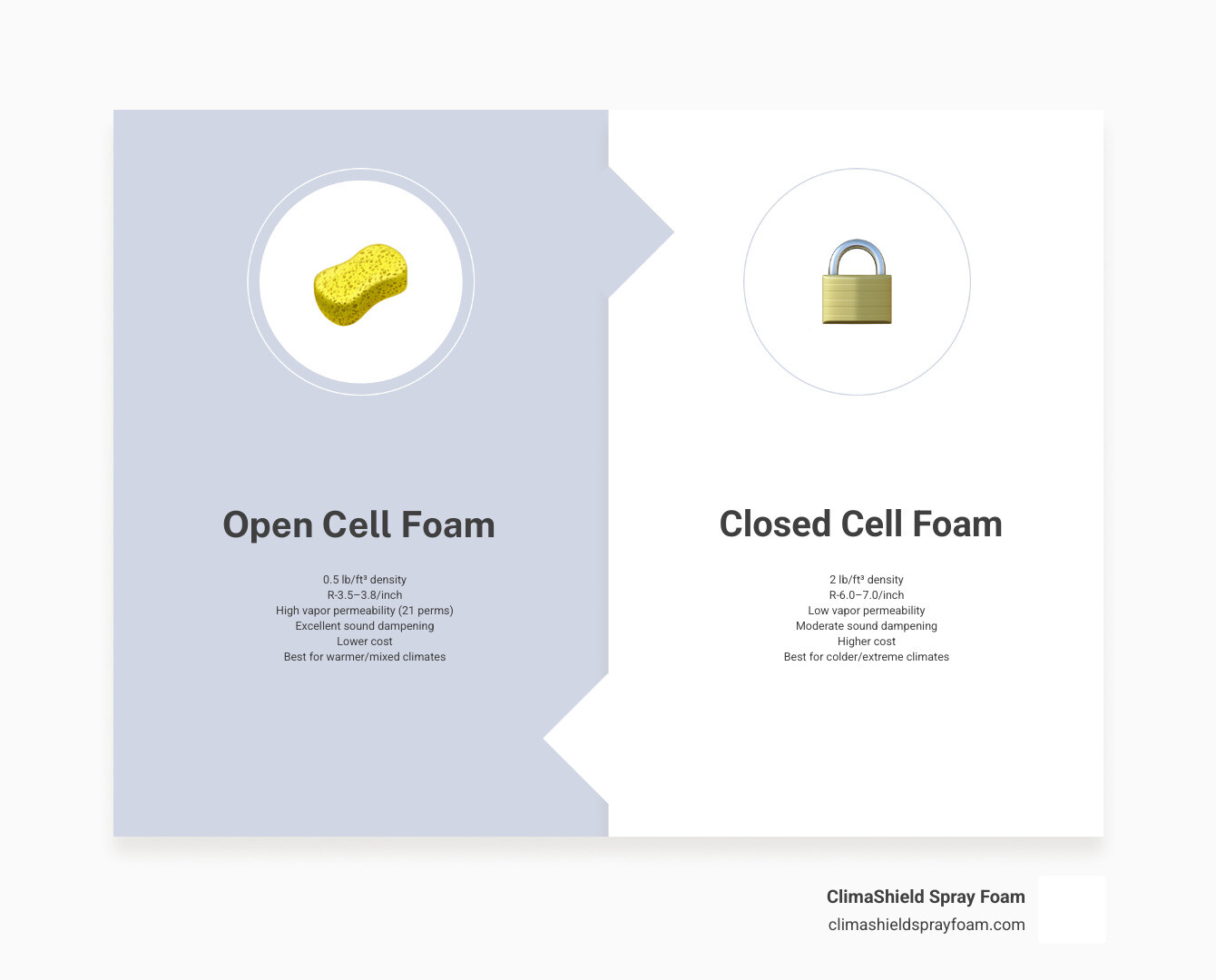
Here’s a quick comparison to help you decide:
| Feature | Open Cell Foam | Closed Cell Foam |
|---|---|---|
| Density | 0.5 lb/ft³ | 2 lb/ft³ |
| R-value per inch | 3.5 – 3.8 | 6.0 – 7.0 |
| Vapor permeability | High (21 perms) | Low (vapor barrier) |
| Air sealing | Yes (at 3.5″ thickness) | Yes (at 1″ thickness) |
| Sound dampening | Excellent | Moderate |
| Cost | Lower | Higher |
| Best climate | Warmer/mixed | Colder/extreme |
If you’re dealing with high energy bills, drafts, or uneven temperatures, the right foam type can make a significant difference. Open cell foam excels at air sealing, sound control, and cost-effectiveness — but it’s not the right fit for every situation.
This guide breaks down exactly how open cell spray foam works, where it performs best, and how it compares to closed cell foam, so you can make the right call for your home.
I’m Dave Brocious, founder of ClimaShield Industries and a specialty coatings contractor with 20 years in the coatings industry — I’ve installed and evaluated open cell spray foam across dozens of residential and commercial projects. In the sections below, I’ll walk you through everything you need to know to choose confidently.
Open cell spray foam terms made easy:
What is Open Cell Spray Foam?
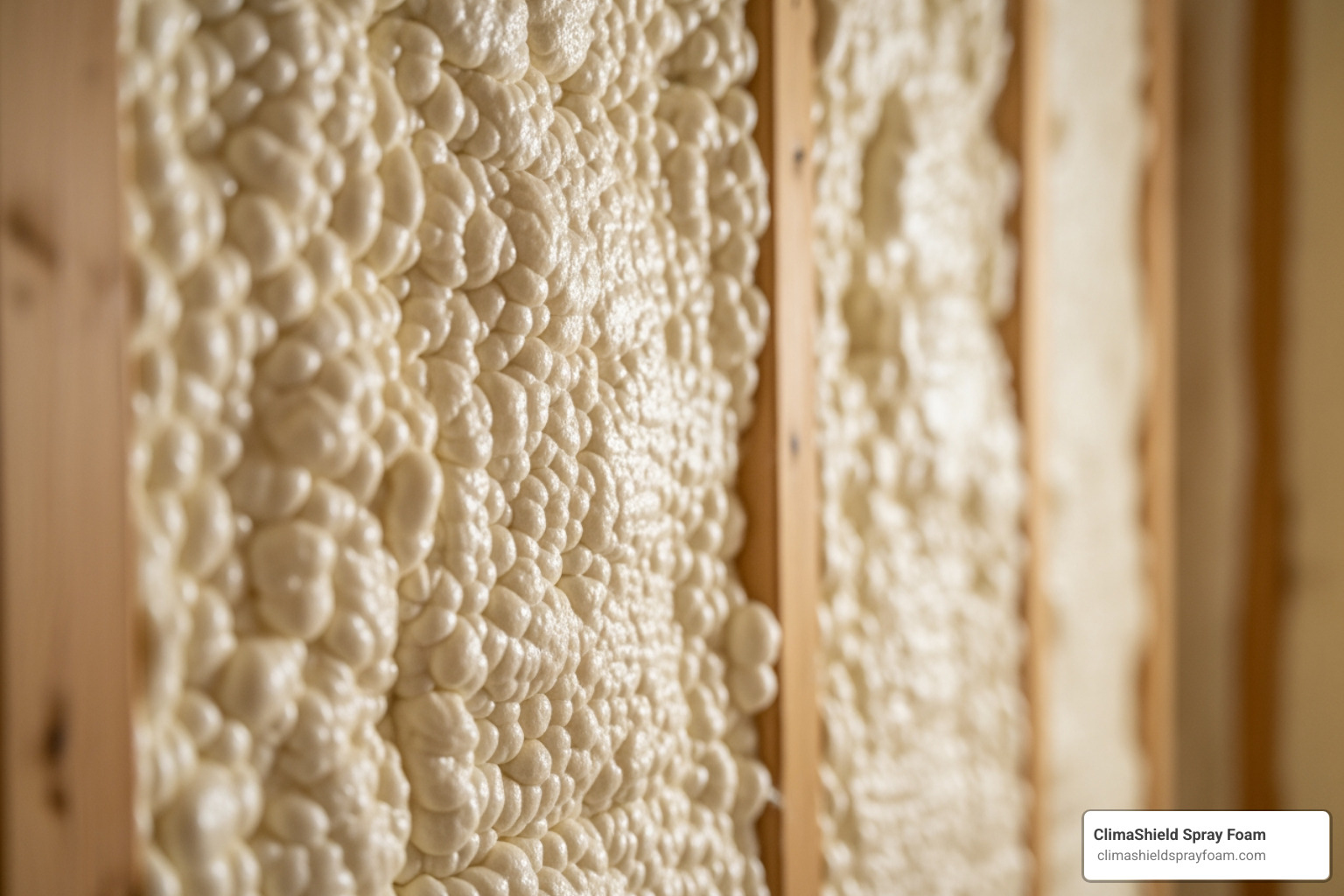
When we talk about open cell spray foam, we are describing a spray-applied polyurethane foam where the tiny cells of the foam are not completely closed. Instead, they are “open” and filled with air. This structure gives the material a soft, sponge-like texture that is incredibly effective at filling every nook and cranny of a building’s envelope.
Technically, this is a light-density polyurethane, often referred to as “half-pound foam” because of its core density of 0.5 lb per cubic foot. One of its most impressive features is its expansion rate; when the liquid components are sprayed, the foam expands 120 times its original volume. This massive expansion is powered by water-blown technology, making it an environmentally conscious choice compared to some older chemical blowing agents.
Because it expands so aggressively, it is a master at air sealing. It reaches behind wires, around pipes, and into those awkward “hidden voids” that traditional fiberglass batts simply can’t cover. This creates an air-impermeable barrier (at specific thicknesses) that stops drafts in their tracks. To learn more about how this material is utilized, you can read about the various uses of spray foam.
Understanding Open Cell Spray Foam R-Values
R-value measures a material’s resistance to heat flow. The higher the R-value, the better the insulating power. For open cell spray foam, the typical R-value ranges from 3.5 to 3.8 per inch of thickness. Some advanced products even reach an aged thermal resistance of 4.0 or higher.
To put this into perspective for a standard home in Indiana, PA, a 3.5-inch application (filling a standard 2×4 wall cavity) provides an R-value of approximately R-13.0. These values are determined through rigorous testing, such as the ASTM C-518 standard.
| Application Thickness | Total R-Value (Approx.) | Assembly Type |
|---|---|---|
| 1 Inch | R-3.7 | Shallow Cavities |
| 3.5 Inches | R-13.0 | 2×4 Wall Studs |
| 5.5 Inches | R-19.0 – R-21.0 | 2×6 Wall Studs |
| 10 Inches | R-35.0 – R-38.0 | Roof Decks / Attics |
Density and Performance of Open Cell Spray Foam
As mentioned, the core density of open cell spray foam is roughly 0.5 lb per cubic foot. While it is lightweight and flexible, it maintains excellent dimensional stability, meaning it won’t shrink or pull away from the studs over time (typically less than 15% volume change under extreme conditions).
Its flexible nature is actually a benefit in residential construction. As a house settles or shifts with the seasons, the foam moves with the structure rather than cracking. This ensures the airtight seal remains intact for the life of the building. For those interested in the deep technical specs, you can Download Open Cell Foam Tech Data Sheet (TDS) for more data on tensile strength and yield.
Moisture Management and Vapor Permeability
One of the most common questions we get at ClimaShield Spray Foam is about moisture. Open cell spray foam has a water vapor permeance of about 21 perms at 1 inch of thickness. This means it is “vapor permeable” or breathable.
In our Pennsylvania climate, this breathability allows moisture to diffuse through the foam rather than getting trapped against wood members, which helps prevent rot in certain assemblies. However, because it allows vapor through, building codes in colder regions often require a separate vapor retarder (like vapor-retardant paint or poly sheeting) on the “warm-in-winter” side of the wall. For safety and handling information, you can Download Open Cell Foam Safety Data Sheet (SDS).
Key Benefits of Open Cell Insulation
Choosing open cell spray foam isn’t just about R-value; it’s about the total performance of your home. If you are looking for a comprehensive overview, check out the ultimate guide to energy saving insulation.
1. Superior Sound Dampening Because of its open, porous structure, this foam is an incredible sound absorber. It has a Sound Transmission Coefficient (STC) rating of 42-50, making it the go-to choice for media rooms, nurseries, or home offices. It effectively “quiets” a home by reducing the transmission of airborne noise.
2. Complete Air Sealing While it is vapor permeable, it becomes air impermeable at a thickness of 3.5 inches (less than 0.02 L/s-m²). This stops the “chimney effect” in homes where warm air escapes through the attic, significantly reducing energy waste.
3. Cost-Effectiveness Open cell foam is generally more affordable than closed cell foam. Because it uses fewer raw materials to fill the same space (thanks to that 120x expansion), the material cost is lower, allowing you to achieve a high-performance building envelope on a tighter budget.
4. Improved Indoor Air Quality By sealing out dust, pollen, and outdoor pollutants, we help create a healthier indoor environment. Since the foam doesn’t settle like fiberglass or cellulose, it doesn’t create dust over time.
Best Applications and Installation Requirements
At ClimaShield Spray Foam, we recommend open cell spray foam for a variety of residential insulation services and commercial insulation services.
- Unvented Attics: Spraying the underside of the roof deck to create a conditioned attic space.
- Interior Walls: For soundproofing between bedrooms or bathrooms.
- Rim Joists: Sealing the critical gap where the house frame meets the foundation.
- Between Floors: Reducing footfall noise and heat transfer between levels.
Installation is a precise science. We use a 1:1 mix ratio of two components (ISO and Resin). The substrate temperature is critical; ideally, the surface should be between 40°F and 120°F for the chemicals to react properly and adhere correctly. We monitor these conditions closely to ensure the foam reaches its full yield and performance potential.
Safety, Fire Ratings, and Code Compliance
Safety is our top priority. Most modern open cell spray foam products are designed to meet strict building codes.
- Thermal and Ignition Barriers: In most cases, the code requires a 15-minute thermal barrier (like half-inch gypsum board) over the foam. In some specific attic applications, certain foams are “ignition barrier-free,” meaning they don’t need an extra coating if the attic is only used for service access.
- Certifications: Look for Greenguard Gold certification, which ensures low VOC emissions for better indoor air quality. You can also Download Open Cell Foam IAPMO Evaluation Report to see how these products comply with international building codes.
Frequently Asked Questions about Open Cell Foam
Is open cell spray foam suitable for DIY?
In short: No. While there are small “froth kits” available for tiny patches, a whole-home application requires professional-grade equipment. This includes high-pressure proportioners, heated hoses, and specialized spray guns. Furthermore, the chemicals require precise temperature and pressure control to stay “in ratio.” If the mix is off, the foam may not cure properly, leading to odors or poor performance. For a deeper look at attic projects, see our attic spray foam guide.
Does it resist mold and pests?
Yes. Open cell spray foam is a non-food source for mold, fungi, and pests. While it is vapor permeable, it does not hold water like a sponge; it allows moisture to move through. However, it should not be used in areas where it will be in direct contact with bulk liquid water (like a leaky basement). For more tips on the best materials, read about the best insulation for home.
How does the cost compare to other types?
While the upfront cost is higher than fiberglass or cellulose, the ROI is often much faster. Because we are providing both insulation and an air seal in one step, you save on the labor of secondary air sealing. When you compare it to closed cell foam, open cell is significantly cheaper per board foot. You can see a full breakdown of the transition from fiberglass to foam on our blog.
Conclusion
Choosing open cell spray foam is an investment in the comfort, quiet, and efficiency of your home. At ClimaShield Spray Foam, we’ve seen how a properly installed air seal can transform a drafty house into a cozy, energy-efficient sanctuary. By saving up to 60% on energy bills and providing a durable, airtight seal that lasts for decades, spray foam is the clear winner for modern construction in Pennsylvania.
Ready to see the difference for yourself? Explore the various uses of spray foam or contact us today for a consultation. Let’s build a more comfortable home together.
