
Is a Concrete Lifting Foam Kit the Right Fix for Your Sunken Slab?
A concrete lifting foam kit is a two-part polyurethane product that expands beneath a sunken slab to lift, level, and stabilize it — without tearing out and replacing the concrete. Here’s a quick snapshot of what you need to know:
| Question | Quick Answer |
|---|---|
| What does it do? | Fills voids and lifts settled concrete slabs back to level |
| How does it work? | Two-part polyurethane foam is injected through small holes; it expands and hardens |
| Cure time | Ready for traffic in as little as 15 minutes |
| Cost vs. replacement | Typically less than half the cost of pouring new concrete |
| DIY or pro? | DIY kits exist, but structural slabs (garages, foundations) usually need a pro |
| Key limitation | Won’t work long-term if the underlying soil problem isn’t fixed first |
Concrete slabs sink. It happens to driveways, patios, sidewalks, and garage floors — usually because water erodes the soil underneath, leaving a void the slab slowly drops into. The result is a tripping hazard, an eyesore, and sometimes a sign of a bigger structural problem.
The traditional fix — breaking out the old concrete and pouring new — is expensive, messy, and puts your driveway or patio out of commission for days. That’s why more homeowners and contractors are turning to foam jacking as a faster, cheaper alternative.
But not all kits are equal, and not every situation calls for a DIY approach.
I’m Dave Brocious, founder of ClimaShield Industries with over 20 years in specialty coatings and spray foam applications — including hands-on experience with the same polyurethane chemistry used in a concrete lifting foam kit. In this guide, I’ll walk you through everything you need to know before you buy, so you can make a smart, informed decision.
Concrete lifting foam kit definitions:
What is Concrete Lifting Foam and How Does It Work?

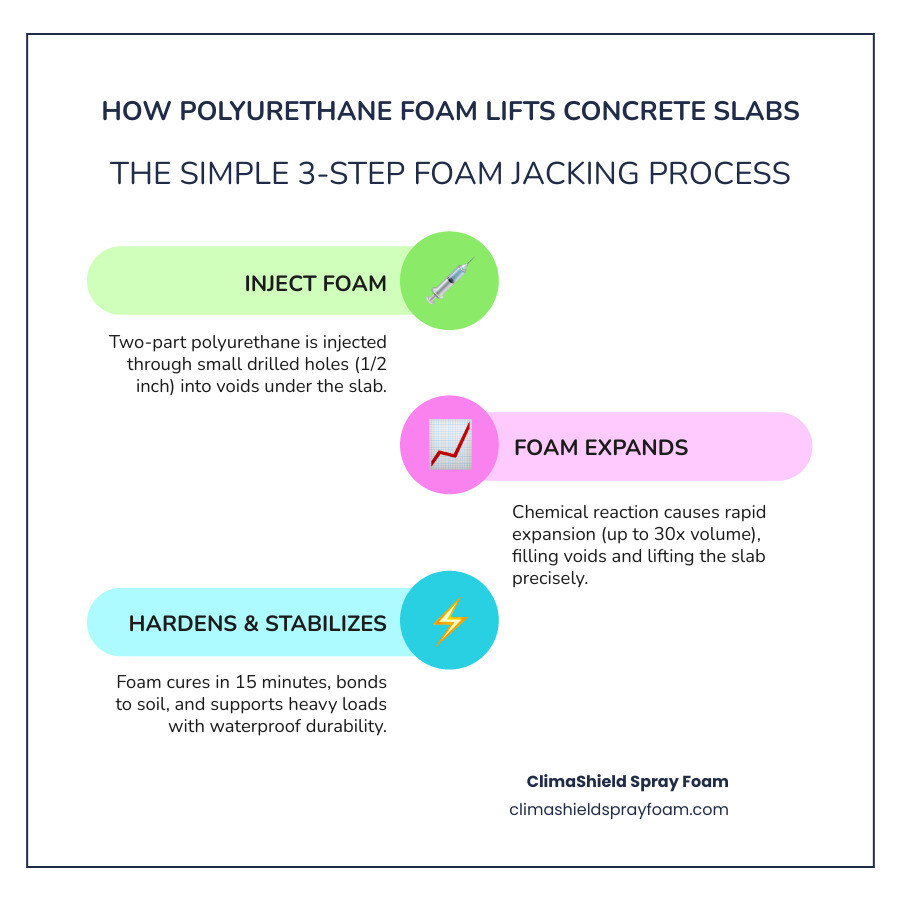
If you have ever seen a “snake in a can” firework or watched bread dough rise, you have a basic grasp of how a concrete lifting foam kit works—only with much more power. At its core, this technology involves injecting a two-component polyurethane liquid beneath a settled concrete slab.
When these two components (typically called Part A and Part B) meet, a chemical reaction occurs. The liquid transforms into a rigid, closed-cell foam that expands rapidly. Because the foam is confined between the heavy concrete slab and the soil, it exerts tremendous upward pressure. This pressure is what actually “jacks” the concrete back to its original height.
This process is often referred to as Slab Lifting 101 because it addresses the root cause of the sinking: the void. By filling the empty space created by erosion or soil settling, the foam provides a new, stable foundation. Unlike mudjacking, which uses a heavy slurry of sand and cement, polyurethane is incredibly lightweight. This is a huge win for the structural integrity of your property because it doesn’t add significant “overburden” or weight to soils that are already struggling to hold up the slab.
One of the most impressive features of high-quality lifting foam is that it is hydro-insensitive. This means it doesn’t just tolerate water; it actually displaces it. If there is a puddle under your driveway, the foam will push the water out of the way and bond directly to the soil and the bottom of the concrete.
The Science of Polyurethane Concrete Lifting Foam
To truly How to Understand Concrete Lifting Foam in 5 Easy Steps, you have to look at its cellular structure. Most lifting foams are “closed-cell.” Imagine millions of tiny, independent bubbles packed tightly together. Because these bubbles are sealed off from one another, they don’t soak up water like a sponge. This makes the foam waterproof and resistant to rot or decay.
The load-bearing capacity of these foams is staggering. Even a “standard” heavy-duty foam can support thousands of pounds per square foot. Some specialized structural foams are rated to support up to 14,000 lbs per square foot—strong enough to hold up a fully loaded concrete truck without flinching.
The expansion rate is the “magic” that makes the lift happen. Depending on the specific formula, the liquid can expand 15 to 24 times its original volume. This high expansion rate means you can fill a massive void with a relatively small amount of liquid product.
Why Foam Density Matters in Concrete Lifting
When you start shopping for a concrete lifting foam kit, you’ll notice different “weights” or densities, usually measured in pounds per cubic foot (lb/ft³).
- 2 lb to 4 lb Density: These are often used for “void filling” where you aren’t necessarily trying to lift a heavy slab but just want to stop it from rocking or sinking further. They are great for undersealing and light stabilization.
- 6 lb to 8 lb Density: This is where the real lifting power lives. High-density structural foam provides the compressive strength needed to move massive slabs of concrete.
Higher density usually translates to higher compressive strength. For example, a 6 lb density foam is much better at stabilizing loose soil and providing long-term structural support than a lighter insulation-grade foam. It also ensures “traffic readiness”—the ability for you to drive your car over the repaired section within minutes of the injection.
Advantages of Foam Jacking Over Traditional Mudjacking
For decades, “mudjacking” was the only way to save a slab. It involved pumping a thick mixture of water, dirt, and cement under the concrete. While it worked, it had some serious drawbacks that modern polyurethane has solved.
| Feature | Polyurethane Foam Jacking | Traditional Mudjacking |
|---|---|---|
| Port Size | Tiny (5/8″ or smaller) | Large (1.5″ to 2″) |
| Weight | 2-4 lbs per cubic foot | 100-120 lbs per cubic foot |
| Cure Time | 15–30 minutes | 24–72 hours |
| Water Resistance | Waterproof; won’t wash away | Can erode or shrink over time |
| Mess Factor | Very low; self-contained | High; slurry can spill or spray |
The most significant advantage is the weight. If your soil is already sinking, the last thing you want to do is add 2,000 pounds of “mud” on top of it. Polyurethane is so light that it adds almost zero load to the soil, making it a much more Residential Concrete Lifting: Your Foundation for a Stable Home.
Additionally, the “ports” (the holes drilled into the concrete) for a concrete lifting foam kit are about the size of a dime. Mudjacking requires holes the size of a soda can, which often leaves the finished driveway looking like a polka-dot project. With foam, the holes are easily patched and virtually disappear.
The Foam Jacking Process: What to Expect
Whether you are using a DIY kit or watching a professional team, the steps are generally the same. Here is a look at Your Essential Guide to Concrete Lifting:
- Site Preparation: We start by cleaning the area and identifying the “low spots.” It’s also vital to check for any underlying issues, like Is That Floor Slab Crack a Big Deal? that might indicate a structural failure rather than just simple settling.
- Drilling: Small holes are drilled through the slab at strategic intervals. These are the injection points.
- Temperature Conditioning: This is a pro tip—polyurethane is “temperature sensitive.” If the chemicals are too cold, they won’t react properly. Professionals use heaters, but DIYers often have to pre-warm their canisters in a warm room or box.
- Injection: The foam is injected through the ports. This is done in short bursts (often 10–30 seconds) to allow the foam to spread and expand. If you inject too much at once, you risk “over-lifting” and cracking the slab.
- Monitoring: We watch the slab carefully. As the foam fills the void, the slab will eventually begin to move. We use levels or string lines to ensure the slab returns to its original position.
- Patching: Once the lift is complete, the injection ports are removed, and the holes are filled with a concrete matching grout.
A Note on Safety: PPE is non-negotiable. Polyurethane is incredibly sticky and can be an irritant. Always wear gloves, eye protection, and long sleeves when working with a concrete lifting foam kit.
When to Choose Professional Concrete Lifting
While a DIY concrete lifting foam kit can be tempting for a small sidewalk or a single patio stone, there are many times when “going solo” is a gamble.
According to Raising Concrete with Spray Foam: What Experts Say About Going Solo, precision is the biggest hurdle for homeowners. It is very easy to inject too much foam and create a new “hump” in your driveway that is even worse than the original dip. Once the foam is in and hardened, you can’t exactly “un-lift” it.
At ClimaShield Spray Foam, we bring industrial-grade proportioners and heated hoses to every job. This ensures the chemical mix is perfect every time, resulting in a stronger, more stable lift. We also have the experience to spot Beyond the Cracks: A Homeowner’s Guide to Understanding Slab Foundation Settling issues that a simple foam kit won’t fix—like a broken sewer line or a major foundation shift.
If you are in Indiana, PA, or the surrounding Pennsylvania area, hiring a professional also gives you a warranty. If the slab sinks again within a year, we come back and fix it. If your DIY kit fails, you’re out the money and the time.
Frequently Asked Questions about Concrete Lifting
How much does typical concrete lifting cost?
A basic DIY concrete lifting foam kit can range from $150 for small crack-filling kits to $2,500+ for large-scale structural sets. However, professional services are often more cost-effective than you’d think. In many cases, we can lift a driveway for less than half the cost of replacement. Factors that influence the price include the size of the void, the weight of the slab, and the amount of Slab Jacking Foam required to reach the desired height.
Is foam jacking a permanent solution for sunken slabs?
Polyurethane foam itself is practically permanent—it won’t biodegrade or wash away. However, the lift is only as stable as the soil beneath it. If you don’t fix the drainage issue that caused the erosion in the first place, the soil around the foam could continue to sink. When done correctly, foam jacking is a long-term fix that can last decades.
What are the ideal applications for concrete lifting foam?
It is perfect for residential driveways, sidewalks, and patios. It is also the gold standard for industrial settings like warehouse floors, where downtime is expensive. Because the foam cures so quickly, a warehouse can have forklifts driving over the repaired slab in less than an hour.
Conclusion
A concrete lifting foam kit is a powerful tool in the right hands. It offers a fast, clean, and incredibly strong way to restore your property’s value and safety. However, the most important part of any Geotech Slab Lifting project happens after the foam is injected.
To ensure your slab stays level for the long haul, you must address drainage. Make sure your gutters have extenders and that the ground slopes away from your concrete. If water continues to flow under your slab, even the best foam in the world can’t stop the earth from moving.
If you’re tired of looking at that trip hazard on your sidewalk or the puddle in your garage, give us a call at ClimaShield Spray Foam. We’ll help you decide if a simple lift is the answer or if your foundation needs a more comprehensive plan.
