Not All Foam Is Created Equal — Here’s What Low Density Foam Can Do
Low density foam is one of the most versatile insulation and cushioning materials available today — but most buyers don’t fully understand what “low density” actually means or which product is right for their needs.
Quick answer: What is low density foam?
| Feature | Low Density Foam |
|---|---|
| Density range | 1–6 lbs/ft³ (polyurethane); 20–70 kg/m³ (LDPE) |
| Cell structure | Typically open-cell, but closed-cell versions exist |
| Best for | Insulation, filtration, cushioning, gasketing, packaging |
| Key strength | Lightweight, compressible, thermally efficient, cost-effective |
| Service temperature | -40°F to 194°F (-40°C to 90°C) |
| Not ideal for | Heavy load bearing, high tensile strength needs |
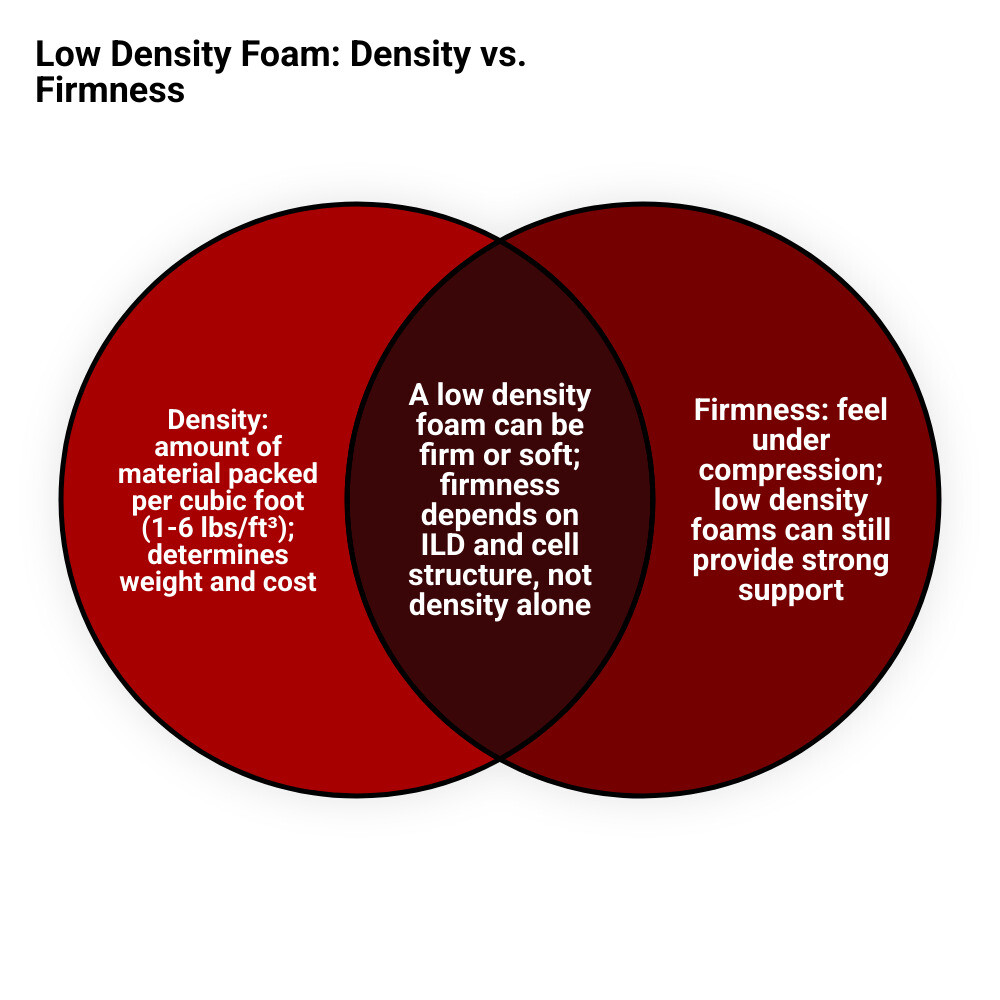
Here’s the thing most people get wrong: density does not equal firmness. A low density foam can actually be quite firm, and a high density foam can be surprisingly soft. The density number tells you how much material is packed into a cubic foot — not how hard or soft it feels underfoot.
This guide compares the top low density foam products across insulation, filtration, cushioning, fabrication, and waterproofing applications — so you can find the right match without wasting money on the wrong material.
I’m Dave Brocious, founder of ClimaShield Industries and a specialty coatings and spray foam contractor with over 20 years of hands-on experience — including extensive work with low density foam in spray foam insulation, air barrier systems, and commercial roofing. That field experience shapes every recommendation in this guide.
Low density foam vocab to learn:
What Low Density Foam Really Means
When we talk about low density foam in the insulation and manufacturing world, we are referring to the weight of the material per unit of volume. In the United States, this is almost always measured in pounds per cubic foot (lbs/ft³), often abbreviated as PCF.
Think of it like a loaf of bread versus a brick. They might be the same size, but the brick has much more mass packed into that space. In the foam world, “low density” means there is more air (or gas) and less plastic polymer in every cubic inch. This high air-to-polymer ratio is exactly what makes these foams so lightweight and, in many cases, such excellent insulators.
How density is measured in polyurethane and polyethylene foams
Measuring density depends slightly on the type of foam and how it is applied. For spray polyurethane foam (SPF), we often look at two different numbers:
- Free-rise density: This is how the foam expands when sprayed into open air without any restrictions. For many low-density spray foams, this is around 0.75 lbs/ft³.
- In-place density: This is the actual density once the foam is sprayed into a wall cavity or between studs. Because it is slightly restricted, the density usually climbs to about 1.1 lbs/ft³.
For polyethylene (LDPE) foams, which often come in sheets or rolls, the density is measured in a controlled factory setting, typically ranging from 20 to 70 kg/m³ (which is roughly 1.2 to 4.4 lbs/ft³). These measurements are standardized by organizations like ASTM to ensure that when you buy a “2-pound foam,” you are getting exactly that.
Why low density foam is not the same as soft foam
This is the biggest “aha!” moment for our customers in Indiana, PA. You might assume that a low density foam is always soft like a sponge, while a high-density foam is hard like a board. That’s not always true!
Firmness is measured by Indentation Load Deflection (ILD) or Compression Force Deflection (CFD), which measures how many pounds of pressure it takes to compress the foam by a certain percentage. It is entirely possible to manufacture a low density foam that is quite rigid (like the modeling foams used in CNC machining) or a high-density foam that is incredibly plush (like high-end memory foam). Density is about durability and weight; firmness is about “feel.”
Typical density ranges for low-density vs high-density foam
To help you visualize where low density foam sits on the spectrum, we’ve put together this comparison:
| Foam Category | Typical Density (lbs/ft³) | Common Uses |
|---|---|---|
| Low Density | 1.0 – 6.0 | Residential insulation, soundproofing, light packaging, filtration |
| Medium Density | 7.0 – 9.0 | Industrial gaskets, upholstery support, athletic padding |
| High Density | 10.0 – 20.0+ | Structural supports, heavy-duty gaskets, vibration isolation |
As you can see, low density foam covers a lot of ground, from the 0.5-lb “half-pound” open-cell spray foam we use in attics to the 4-lb or 6-lb rigid boards used for making industrial patterns.
Low Density Foam vs High Density Foam: Which Performs Better?
The “best” foam depends entirely on what you’re trying to achieve. Because low density foam has larger, more open cells (or more gas-filled space), it behaves very differently than its high-density cousins.
Cell structure, firmness, and performance differences
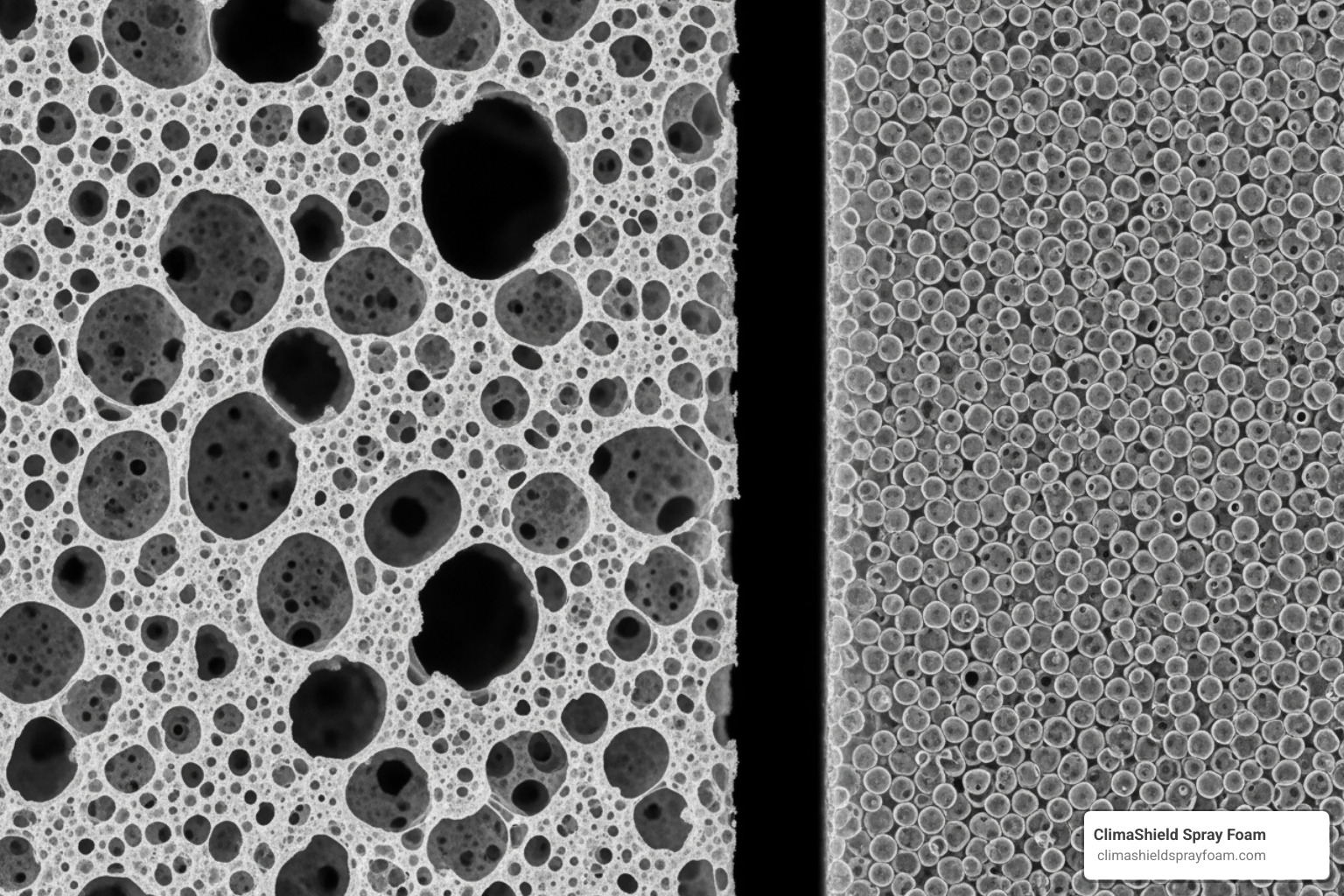
High-density foams have a compact, tight cell structure. This makes them incredibly strong and resistant to tearing, but it also makes them heavy and expensive. Low density foam, on the other hand, features larger pores. In polyurethane spray foam, these cells are often “open,” meaning they aren’t fully encapsulated. This allows air to move through the foam (making it great for filtration) but also allows the foam to be compressed easily and spring back to its original shape.
Compression set, resilience, sound absorption, and insulation
One of the standout features of low density foam is its acoustic performance. Because the cell structure is more open, sound waves get trapped in the “labyrinth” of the foam rather than bouncing off it. This is why we often recommend it for home theaters or office partitions.
In terms of insulation, low density foam offers a fantastic “aged R-value.” For example, some low-pressure spray foams offer an R-value of about 4.3 per inch. While high-density closed-cell foam has a higher R-value per inch (usually R-6 to R-7), the low-density version is much more cost-effective for filling deep wall cavities where you have plenty of space.
When low density foam wins and when high density foam is the better choice
Choose low density foam when:
- You need to fill a large void (like a cathedral ceiling) affordably.
- You want to deaden sound between rooms.
- You are making a gasket for a door that needs to compress and decompress thousands of times (high resilience).
- You are shipping lightweight, delicate items.
Choose high density foam when:
- The foam needs to provide structural support.
- The application involves heavy loads that would “bottom out” lighter foam.
- You need a 100% waterproof vapor barrier in a very thin space.
Best Low Density Foam Types for Real-World Uses
Now that we understand the science, let’s look at the specific products you might encounter in May 2026.
Best low density foam for insulation and energy savings
In home efficiency, “half-pound” open-cell spray foam is the undisputed king. We use this extensively in Indiana, PA, for attics and wall cavities. It expands up to 100 times its liquid volume, reaching into every nook and cranny to create an airtight seal. This is one of the primary ways we help our customers save up to 60% on their energy bills. If you’re wondering which type is right for your specific home layout, check out our guide on choosing the right spray foam for your home.
Best low density foam for filtration, cushioning, and gasketing
If you’ve ever looked at an aquarium filter or a window air conditioner seal, you’ve seen low density foam in action. Open-cell polyurethane is perfect for filtration because its “reticulated” (web-like) structure allows air or water to pass through while trapping dust and debris. For gasketing, these foams are often laminated with a pressure-sensitive adhesive (PSA), making them “peel-and-stick” solutions for sealing out drafts around doors and windows.
Best low density foam for waterproof, closed-cell applications
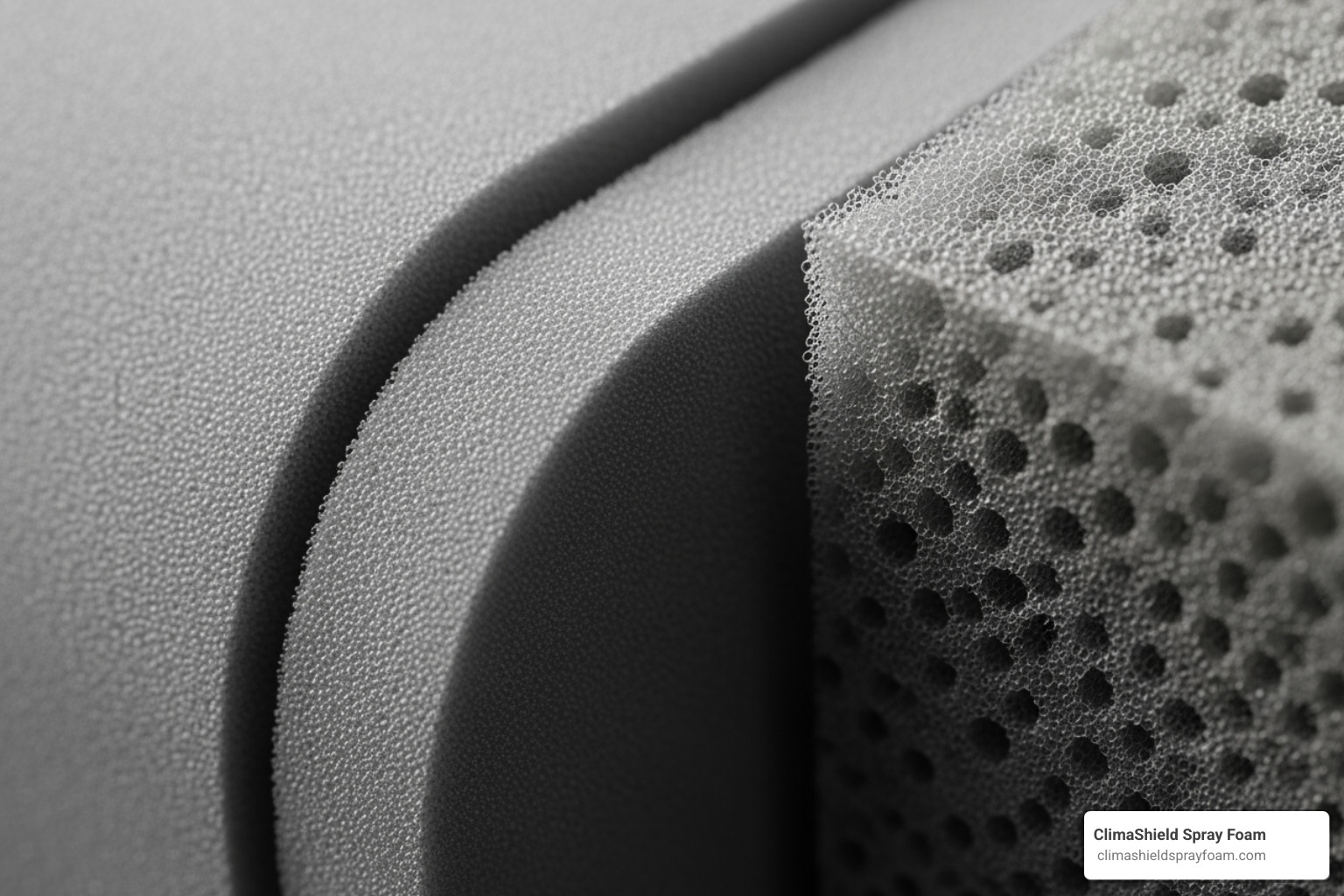
Wait—didn’t I say low density is usually open-cell? Usually, yes, but Low-Density Polyethylene (LDPE) is the exception. LDPE is a closed-cell low density foam. Because the cells are sealed shut, it won’t absorb water, and it’s naturally resistant to mold and bacteria. This makes it the go-to choice for pipe insulation, life jackets, and waterproof insulation in marine environments.
Best low density foam for carving, fabrication, and composite patterns
For the DIYers and industrial fabricators, rigid polyurethane boards are a dream to work with.
- Multi-Purpose Polyurethane Foam Board – General Plastics : This is a “gold standard” for modeling. It’s grain-free, meaning you can carve it in any direction without it splintering like wood.
- PF40 Low Density Polyurethane Foam 100mm – Easy Composites : At about 48 kg/m³, this is a lightweight block perfect for creating large-scale patterns for car bodies or boat hulls. It’s fast to cut and incredibly cost-effective for large prototypes.
How Blowing Agents and Additives Change Low Density Foam Performance
You might wonder: how do we get plastic to turn into a foam that’s 95% air? The secret is in the “blowing agents.” These are chemicals added to the liquid mix that boil or react to create gas bubbles.
How manufacturers create lower density and larger cell structures
By adjusting the ratio of blowing agents, manufacturers can control how much the foam “rises.” In low density foam, more gas is generated, which stretches the plastic polymer into thinner walls and larger cells. This is often done in a “free rise” environment to ensure the foam reaches its maximum potential volume without being squashed.
Additives that improve fire behavior, acoustics, flexibility, and durability
Raw foam can be flammable, so we add flame retardants to meet building codes (like ASTM E84 Class 2 ratings). Other additives include:
- Surfactants: These control the cell size and prevent the bubbles from collapsing before the foam hardens.
- UV Inhibitors: Especially important for LDPE foams used outdoors, as sunlight can break down unprotected foam over time.
- Low MDI Formulas: Modern foams are moving toward lower diisocyanate content (less than 0.1%) to make them safer for installers and homeowners alike.
Open-cell vs closed-cell low density foam and what it means for your project
It’s vital to know the difference before you start a project. Open-cell low density foam is like a sponge; it’s great for sound and air sealing but can hold moisture if it gets wet. Closed-cell low density foam (like LDPE) is a barrier; it stops water and vapor in its tracks. To see a full breakdown of the costs and perks of each, see our article on insulation types, perks, and prices.
How to Choose and Fabricate Low Density Foam for Industrial and Vehicle Applications
At ClimaShield, we don’t just do houses; we also insulate commercial vehicles and specialized industrial equipment. Low density foam is a favorite for van conversions and truck insulation because weight is everything when you’re trying to save on fuel.
Matching foam density to application needs
If you’re insulating a van for camping, you want a foam that provides high thermal resistance but doesn’t add 500 pounds to your vehicle. A low-density spray foam or LDPE sheet is perfect here. However, if you are insulating a floor that will have heavy toolboxes bolted to it, you might need to step up to a higher density to prevent the foam from crushing over time.
Bonding low density foam with adhesives and laminates
Because low density foam is porous, not every glue works. For polyurethane blocks, we often use “foaming” PU adhesives (like Gorilla Glue) because the adhesive expands into the pores of the foam, creating a bond that is actually stronger than the foam itself. For sheets, pressure-sensitive adhesives (PSA) are the standard for “peel-and-stick” ease.
Using low density foam in truck and van insulation
A challenge in vehicle insulation is condensation. Metal van walls “sweat” when the temperature changes. Using a closed-cell low density foam helps prevent this moisture from reaching the metal, protecting your vehicle from rust. Plus, the sound-deadening properties make for a much quieter ride on the highway. For a deep dive into how this compares to traditional materials, read from fiberglass to foam: exploring residential insulation types. You can also find more efficiency tips in The Ultimate Guide To Best Energy Saving Insulation.
Frequently Asked Questions About Low Density Foam
Is low density foam usually open-cell or closed-cell?
It depends on the material! Low-density polyurethane (like spray foam) is almost always open-cell (about 95% open). However, low-density polyethylene (LDPE) is closed-cell. This is why polyurethane is better for sound and LDPE is better for waterproofing.
Is low density foam good for sound absorption and thermal insulation?
Yes! It is fantastic for both. Its open-cell structure gives it a high Noise Reduction Coefficient (NRC), often absorbing up to 70% of sound waves. Thermally, it provides a solid R-value (around 3.5 to 4.3 per inch) that helps keep homes in Pennsylvania warm in the winter and cool in the summer.
What service temperature and durability should you expect?
Most low density foams have a service temperature range of -40°F to 194°F. This makes them suitable for most attic and vehicle applications. In terms of durability, when protected from UV light and excessive mechanical stress, these foams can last 20 to 30 years or more.
Conclusion: How to Pick the Right Low Density Foam for Softness, Savings, and Performance
Choosing the right low density foam comes down to balancing your need for softness, insulation, and budget. Whether you are looking to quiet a noisy office, insulate a van for your next road trip, or carve a prototype for a new product, there is a low-density option designed for the task.
For homeowners in Indiana, PA, the biggest win with low density foam is the energy savings. By creating a custom, airtight seal in your attic or crawlspace, you aren’t just making your home more comfortable — you’re putting money back in your pocket every month.
Ready to see how low density foam can transform your home’s efficiency? We can help you navigate the options and find the perfect fit for your project. Learn more about the various uses of spray foam or contact us at ClimaShield Spray Foam today to get started on your path to a 60% lower energy bill!
