Why Mobile Spray Foam Insulation Is a Game-Changer for Contractors and Property Owners
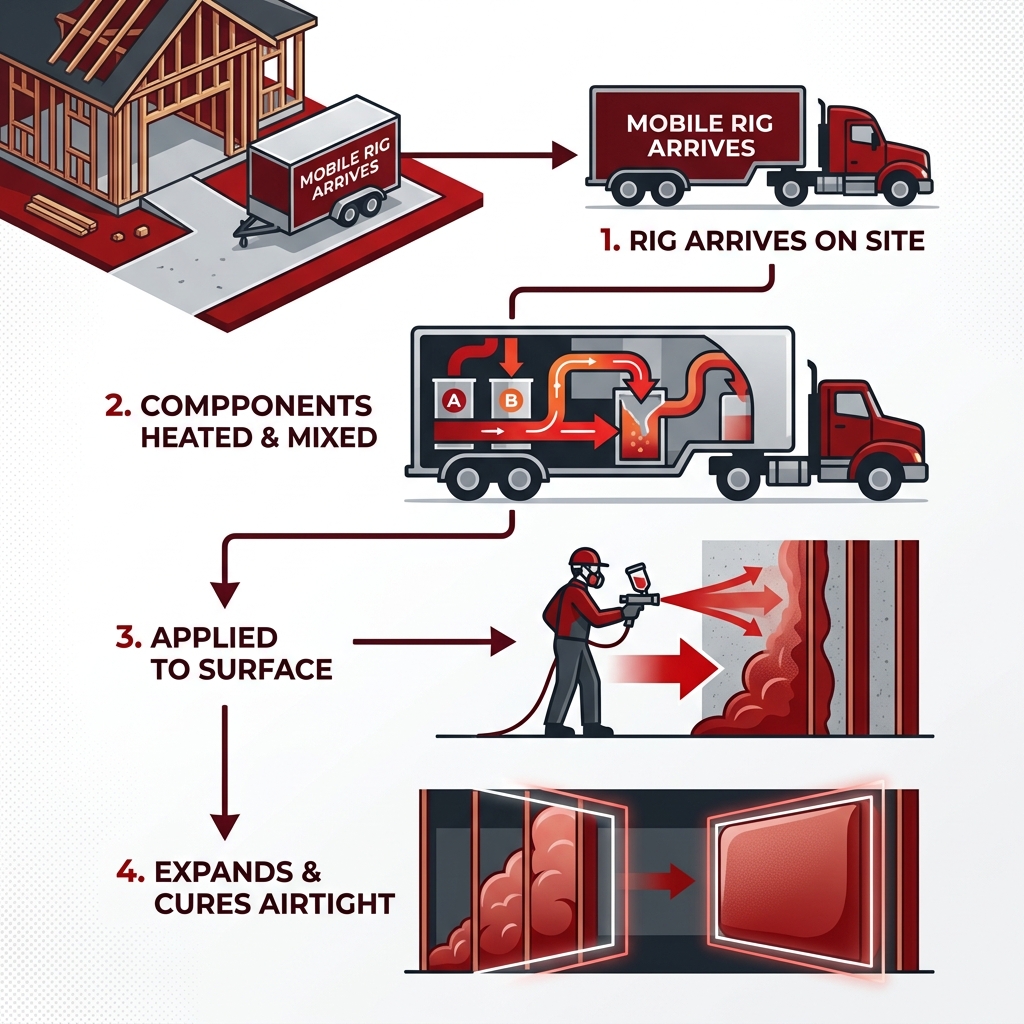
Mobile spray foam insulation refers to a self-contained, truck- or trailer-mounted system that brings professional spray foam equipment directly to any job site — no fixed facility needed.
Here’s what you need to know at a glance:
| Feature | What It Means for You |
|---|---|
| Portability | Equipment travels to your property — residential or commercial |
| Applications | Walls, roofs, crawlspaces, concrete lifting, polyurea coatings |
| Output range | 20 to 50+ lbs per minute depending on rig size |
| Rig types | Trailers (16–20 ft), box trucks, Sprinter vans |
| Power sources | Gas, diesel, or shore power |
| Foam types | Open-cell and closed-cell spray polyurethane foam |
| Cost range | Entry-level rigs from ~$35,000; high-production rigs up to $200,000+ |
Whether you’re a contractor building out your business or a property owner trying to understand what shows up in your driveway, this guide covers everything about mobile spray foam equipment — from rig configurations and power systems to smart technology and safety.
Drafty walls, high energy bills, and moisture problems are exactly the issues spray foam addresses. And mobile rigs make that solution available anywhere.
I’m Dave Brocious, founder of ClimaShield Industries and a specialist in mobile spray foam insulation with over 20 years of experience in the coatings industry, including spray foam, commercial roof coatings, and protective coatings for both residential and commercial properties. That hands-on field experience shapes everything in this guide — so you get practical, real-world insight, not just specs off a brochure.
Easy mobile spray foam insulation glossary:
Understanding Mobile Spray Foam Rig Configurations
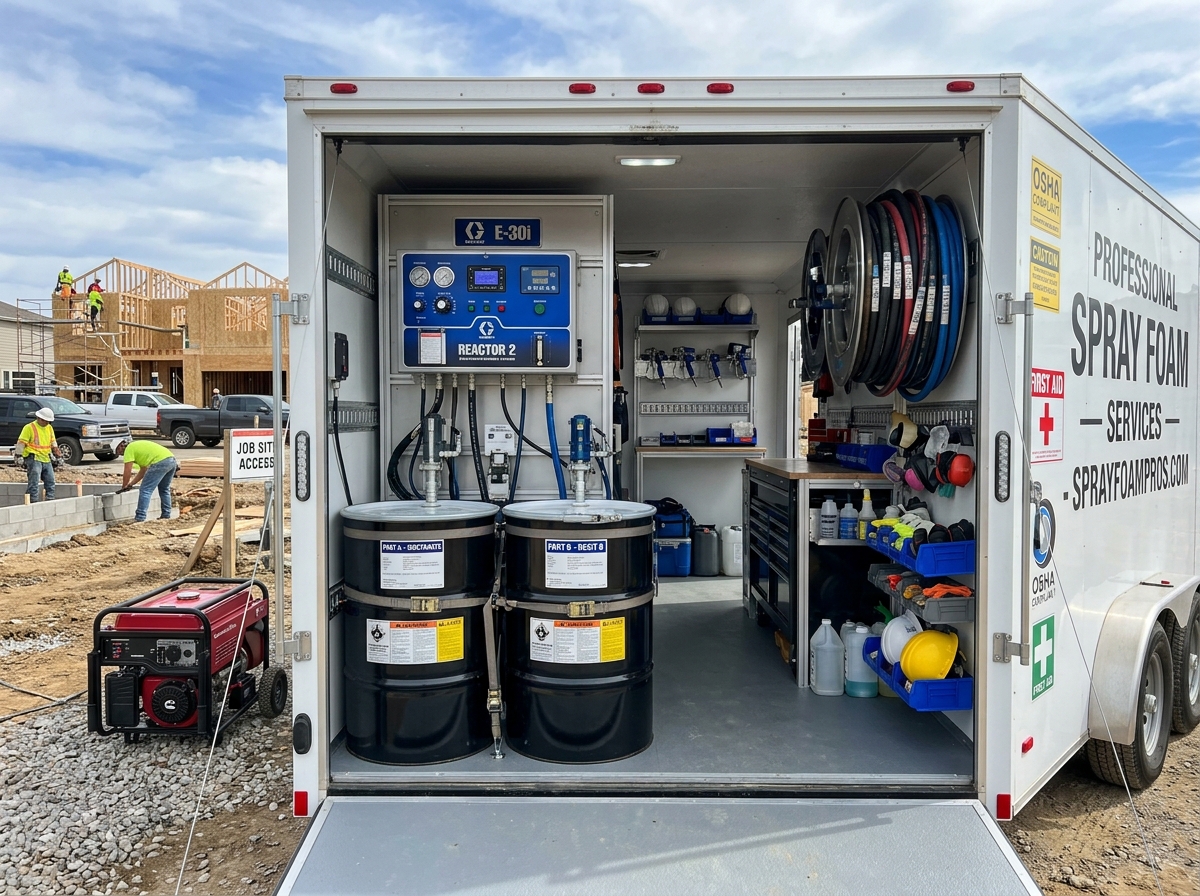
When we talk about mobile spray foam insulation, we aren’t just talking about a machine sitting in the back of a pickup. A professional rig is a meticulously engineered workspace. Think of it as a rolling factory where raw chemicals are transformed into high-performance insulation through heat, pressure, and precision chemistry.
For contractors in Indiana, PA, and across Pennsylvania, the configuration of the rig dictates how many board feet you can spray in a day and what kind of jobs you can tackle. A well-designed rig separates components to allow for better cooling and easier maintenance, ensuring that when you’re on a job site, you’re spraying foam, not fixing leaks.
Trailer-Based Mobile Spray Foam Insulation Systems
Trailers are the “bread and butter” of the industry. They offer a dedicated space that can be unhooked from a truck, freeing up the vehicle for other tasks.
- 16-Foot Trailers: These are often considered the “sweet spot” for residential-focused contractors. They are compact enough to maneuver into tight driveways in Pennsylvania neighborhoods but large enough to house a full Graco or PMC proportioner system and several sets of chemical drums.
- 20-Foot and Gooseneck Trailers: For high-production commercial work, a 20-foot trailer provides the necessary space for larger generators (up to 45 kW) and additional storage for materials. Gooseneck options offer superior towing stability, which is vital when hauling heavy sets of A and B chemical components.
- V-Nose Designs: These are aerodynamic and often provide a bit of extra interior room for a “workbench” area or safety equipment stations.
If you want to see exactly how these are laid out, you can Take a 360° Virtual Tour of a Spray Foam Rig to see the equipment placement in real-time. For those looking to apply these systems to mobile living, check out our ultimate guide to camper comfort.
Box Trucks and Integrated Vans
While trailers are popular, box trucks and integrated vans are the “special forces” of mobile spray foam insulation.
- Box Trucks: These eliminate the need for towing. They offer incredible mobility in urban environments where parking a 20-foot trailer is a nightmare. Because the equipment is integrated into the truck chassis, these rigs often feature better climate control for the chemical drums, which is a huge plus during our cold Pennsylvania winters.
- Sprinter Van Setups: These are the ultimate in “stealth” and maneuverability. While they have a smaller footprint, they are perfect for small residential touch-ups, air sealing, or specialized cargo van insulation projects.
Essential Components and Power Sources
A mobile rig is only as good as the sum of its parts. To get that perfect 1:1 mix ratio that ensures your insulation is durable and effective, several key components must work in harmony.
High-Pressure Proportioners and Mixing Systems
The heart of the rig is the proportioner (often called the “reactor”). This machine is responsible for heating the A (Isocyanate) and B (Resin) components to the exact temperature required—usually between 110°F and 140°F—and pumping them at high pressure (up to 2,000 PSI) through heated hoses to the spray gun.
- Entry-Level (20 lbs/min): Ideal for small residential attics or rim joists.
- Mid-Range (30 lbs/min): The industry standard for most residential and light commercial contractors.
- High-Output (40-50 lbs/min): Designed for large-scale commercial roofing or warehouse projects where speed is everything.
Integrated Power and Air Supply
You can’t just plug a professional spray foam rig into a standard wall outlet. These systems require massive amounts of power to run the heaters and the air compressor.
| Power Source | Best Use Case | Pros | Cons |
|---|---|---|---|
| Gas Generator | Entry-level / Small residential | Lower initial cost, widely available | Louder, higher fuel consumption |
| Diesel Generator | Professional / High-production | Reliable, fuel-efficient, long-lasting | Higher upfront cost |
| Shore Power | Fixed locations / Specialized shops | Quiet, no exhaust fumes | Requires 240V high-amp hookup on site |
Beyond the generator, an air compressor is vital. It powers the transfer pumps that move chemical from the drums to the proportioner and provides the “air purge” for the spray gun to keep it from clogging. To ensure the foam stays high-quality, we use air dryers to remove moisture from the lines—because moisture is the enemy of good foam chemistry.
Choosing the Right Mobile Spray Foam Insulation Setup
Choosing a rig is a “Goldilocks” scenario—you don’t want one that’s too small for your goals, but you don’t want to overspend on a massive commercial rig if you only plan to do residential basements in Indiana, PA.
Budgeting and Financing Options
The entry point for a professional mobile spray foam insulation rig typically starts around $35,000 for a “shore power” or “economy” series. However, a fully turnkey, high-production diesel rig can easily exceed $150,000.
For new businesses, many suppliers offer 12 months of 0% interest financing or equipment leasing programs to help bridge the gap between startup and your first big paycheck. The ROI (Return on Investment) is often realized quickly because spray foam is in such high demand—homeowners are eager to save that 60% on their energy bills. If you’re ready to see what a rig might cost for your specific needs, you can Request a Custom Quote for a Rig.
Customization for Specialized Applications
Not every rig is built for walls. We often see rigs customized for:
- Concrete Lifting: Using high-density “slab jack” foam to level driveways and sidewalks.
- Polyurea Coatings: High-pressure rigs designed for waterproof liners in trucks or industrial tanks.
- Roof Systems: Specialized setups for high-volume “spray foam roofing” that requires different pressure settings and material outputs.
Advanced Technology and Smart Features
The days of “spraying by feel” are over. Modern mobile spray foam insulation rigs are packed with smart technology that makes the job easier and more precise.
Smart Features in Mobile Spray Foam Insulation
New “SMART” rigs include touchscreen interfaces that communicate directly with the proportioner.
- Ratio Assurance: If the machine detects that it’s spraying too much “A” or too much “B,” it will automatically shut down to prevent “bad foam.”
- Remote Diagnostics: Some systems allow a technician to log in to your rig via a smartphone app to troubleshoot a pressure issue while you’re still on the job site.
- Data Analytics: You can track exactly how many pounds of material were used on a specific job, which is great for quoting accuracy. For more on how these vehicles are outfitted, see the definitive guide to truck van insulation.
Maintenance and Operator Support
Maintenance is what separates a rig that lasts 15 years from one that dies in three.
- Barrel Blankets and Drum Heaters: These are essential in Pennsylvania. They keep your chemicals at a “ready-to-spray” temperature overnight, so you don’t waste two hours in the morning waiting for the heaters to catch up.
- Predictive Maintenance: Smart rigs can now alert you when it’s time to change pump seals or filters before a breakdown occurs.
Training, Safety, and Operational Best Practices
You are handling pressurized chemicals—safety isn’t just a suggestion; it’s a requirement.
Operator Training and Certification
While not always legally required, we highly recommend professional training. Many suppliers offer 3-to-4-day hands-on workshops. These classes cover:
- Chemical Safety: Understanding Isocyanates and proper ventilation.
- Gun Maintenance: How to tear down and rebuild a Fusion AP or Probler gun in the field.
- Spray Technique: How to achieve a smooth “picture frame” spray pattern for maximum yield.
Jobsite Safety and Environmental Compliance
Every mobile rig should be equipped with:
- Fresh Air Systems: Respirators that pump clean, filtered air to the sprayer.
- MSDS Stations: Clearly marked Safety Data Sheets for all chemicals on board.
- Spill Kits and Fire Extinguishers: Standard equipment for any industrial mobile unit.
- Low-GWP Blowing Agents: Modern foams (like HFO-based systems) are much better for the environment and comply with the latest Pennsylvania building codes.
Frequently Asked Questions about Mobile Rigs
How long do mobile spray foam rigs typically last?
With proper maintenance, a high-quality rig has a lifespan of 10 to 15 years. The trailer or truck chassis usually lasts longer than the proportioner pumps, which may need a rebuild every few years depending on the volume of foam sprayed.
What are the primary power source options for mobile rigs?
The big three are gas, diesel, and shore power. Diesel is the gold standard for reliability and longevity. Gas is great for starters. Shore power is only viable if you have access to a 240V, 50-100 amp circuit at every job site (which is rare in residential work).
Is professional training required to operate a mobile rig?
Legally, no, but practically, yes. Spraying foam is a science. If you get the mix ratio wrong, the foam can shrink, crack, or even produce odors. Training ensures you provide a high-quality product that saves your customers money and keeps them safe.
Conclusion
At ClimaShield Spray Foam, we know that the right equipment is the foundation of a job well done. Whether we are insulating a historic home in Indiana, PA, or a commercial warehouse in York, our mobile spray foam insulation rigs allow us to deliver a superior product directly to your door.
By utilizing these advanced mobile systems, we provide insulation that is not only airtight and waterproof but also resistant to the mold and pests common in Pennsylvania. Our goal is simple: to help you save up to 60% on your energy bills while creating a more comfortable, durable living space.
Ready to see how spray foam can transform your property? Explore the many uses of spray foam or contact us today to learn more about our mobile services.
