
When Your Basement Floor Pushes Back: What’s Really Happening
Basement floor heaving is one of those problems that’s easy to dismiss — until the cracks spread, the doors stick, and you’re staring at a floor that looks like it’s trying to escape the house.
Here’s what you need to know right away:
- What it is: Heaving is when the ground beneath your basement slab expands and pushes the concrete upward
- What causes it: Expansive clay soil, frost, plumbing leaks, or poor drainage — often a combination
- Key warning signs: Floor cracks, a raised center, sticking doors, gaps at walls, and uneven surfaces
- What to do first: Identify and stop the moisture source before any repair
- When it’s serious: A 3.5-inch rise across a 9×13 ft area is a major problem requiring professional intervention
- Repair cost range: Roughly $3,000–$4,000 for localized fixes; $13,000+ for full slab and drainage replacement
Unlike foundation settlement — where things sink — heaving pushes up. That difference matters a lot, because the wrong diagnosis leads to the wrong repair.
The problem tends to sneak up on homeowners. A small crack here, a door that catches there. But heaving is usually a symptom of something bigger: soil that’s absorbing moisture it shouldn’t be, or freezing water expanding with nowhere to go. Left alone, it doesn’t fix itself.
I’m Dave Brocious, founder of ClimaShield Industries with over 20 years of experience in coatings, concrete floor systems, and protective solutions — including hands-on work with the kinds of basement floor heaving problems that start with moisture and end with major structural repairs. In this guide, I’ll walk you through exactly what’s happening under your slab, how to tell heaving from settlement, and what your real options are.
Basement floor heaving terms you need:
What Basement Floor Heaving Actually Means
At its simplest, basement floor heaving means the slab is being pushed up from below. The concrete itself usually is not the original problem. The real issue is the soil, moisture, freezing, or pressure under the slab.
A basement slab is basically along for the ride. If the material beneath it swells, freezes, or shifts upward, the floor lifts, cracks, and distorts.
Basement floor heaving vs. foundation settlement
Heaving and settlement can look similar at first glance, but they are opposites.
| Issue | Heaving | Settlement |
|---|---|---|
| Direction of movement | Upward | Downward |
| Common floor shape | Center higher than edges | Center or edges lower than surrounding areas |
| Typical crack clues | Triangles, loops, peaked slab cracks | Separating, dropping, sinking patterns |
| Door/window symptoms | Sticking from upward distortion | Misalignment from sagging or dropping |
| Main driver | Expanding soil, frost, trapped moisture | Soil compression, erosion, bearing failure |
If your basement floor is higher in the middle than around the perimeter, that strongly suggests heaving. If sections are dropping instead, settlement is more likely.
Why slabs heave more often than foundation walls
Slabs are more vulnerable because they are lighter than foundation walls and footings. They do not have as much structural weight resisting upward pressure.
This matters in Pennsylvania, where moisture swings, clay-heavy soils in some areas, and winter freeze-thaw conditions can all work against a slab. Research also shows heaving is often seen in the first few years after construction, when soils disturbed during building gradually regain moisture and expand.
How soil moisture changes create upward pressure
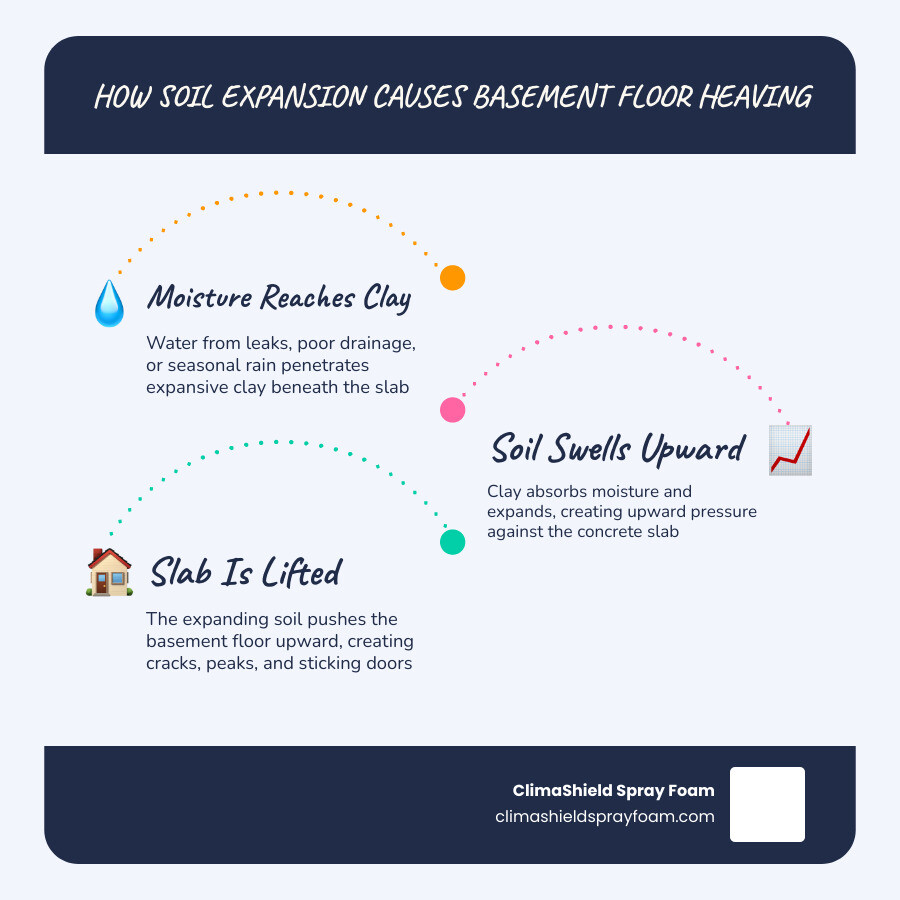
The most common mechanism is this:
- Soil under the slab gets wetter.
- Certain soils, especially clay, expand.
- That expansion pushes on the underside of the slab.
- The slab cracks or lifts where resistance is weakest.
Freezing can make things worse. Water expands about 9% when it freezes. In wet soil, that expansion can create major uplift pressure. Frost forces can raise concrete and even lift parts of a foundation by several inches in severe conditions.
The Main Causes of Basement Floor Heaving
Heaving rarely has just one cause. Usually it is a stack of problems: moisture, soil type, drainage, and seasonal conditions all teaming up like an uninvited basement band.
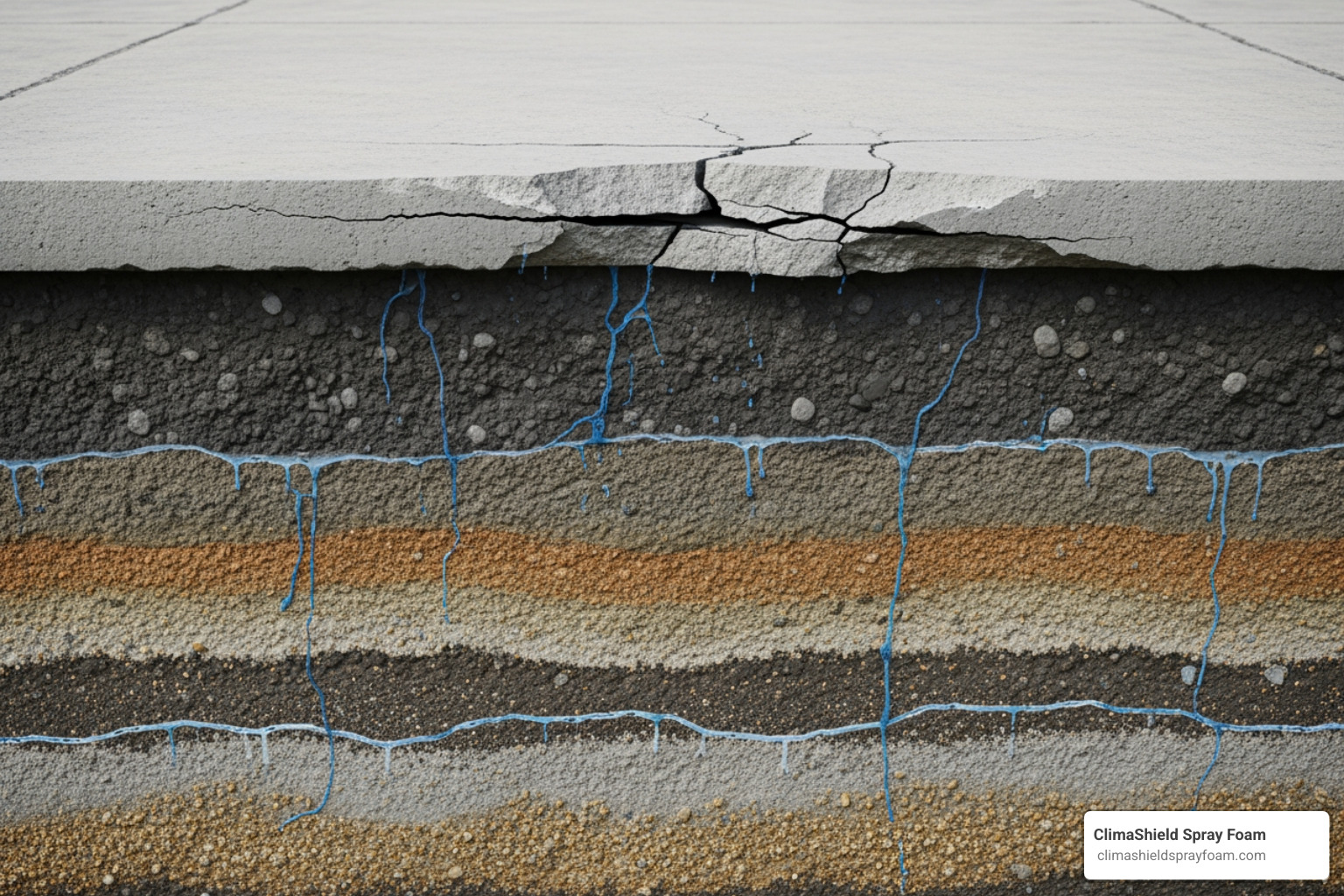
Expansive clay soils and post-construction moisture rebound
Expansive clay is the classic cause. When dry, it shrinks. When it absorbs water, it swells. If a basement slab sits above that soil, the slab can be pushed upward.
This is especially common after construction. Soil gets disturbed, moved, compacted unevenly, or replaced with fill. Later, normal groundwater or seasonal moisture returns, and the soil “rebounds.” That rebound can lift the slab.
Best practice during construction is to build over stable, properly prepared subgrade. Undisturbed soil is usually less risky than poorly compacted fill.
Frost heave in cold climates
In Indiana, Pennsylvania and other cold-weather areas, frost heave is a real concern. Wet soil plus freezing temperatures equals upward force.
Frozen water does not just sit there politely. It expands and can form frost lenses that lift slabs and interior footings. In severe cases, frost-related movement can push surfaces up by several inches.
The more moisture available under the slab, the worse the risk.
Plumbing leaks, broken drains, and hidden water sources
A hidden leak under or near the basement can cause very localized heaving. We see this happen under bathrooms, laundry areas, or utility lines.
Possible culprits include:
- Leaking water supply lines
- Broken drain lines
- Failed sump discharge lines
- Exterior hose bib leaks
- Damaged underground piping
These leaks keep the soil wet in one concentrated spot, which can lead to one section of slab lifting more than the rest.
Drainage problems around the home
Bad drainage is one of the biggest repeat offenders.
If gutters overflow, downspouts dump water near the foundation, or the yard slopes toward the house, water collects around the basement walls and eventually migrates under the slab. Old or clogged footing drains and weeping tile systems can also contribute.
Common drainage-related triggers include:
- Short downspouts
- Negative grading
- Clogged gutters
- Failed perimeter drainage
- Heavy or prolonged rainfall
- Sump pump discharge too close to the house
If basement moisture is already part of the story, our guide on basement vapor barrier walls can help explain how moisture control fits into overall basement performance.
Less obvious triggers homeowners miss
A few causes surprise people:
- Tree removal, which can allow soil to stay wetter than before
- Poorly compacted fill under the slab
- Site prep shortcuts during original construction
- Heavy precipitation after long dry periods
- Changed landscaping that traps runoff near the house
Signs Your Basement Floor Is Heaving
The clues are often visible before the diagnosis is obvious.
The most common basement floor heaving symptoms
Watch for:
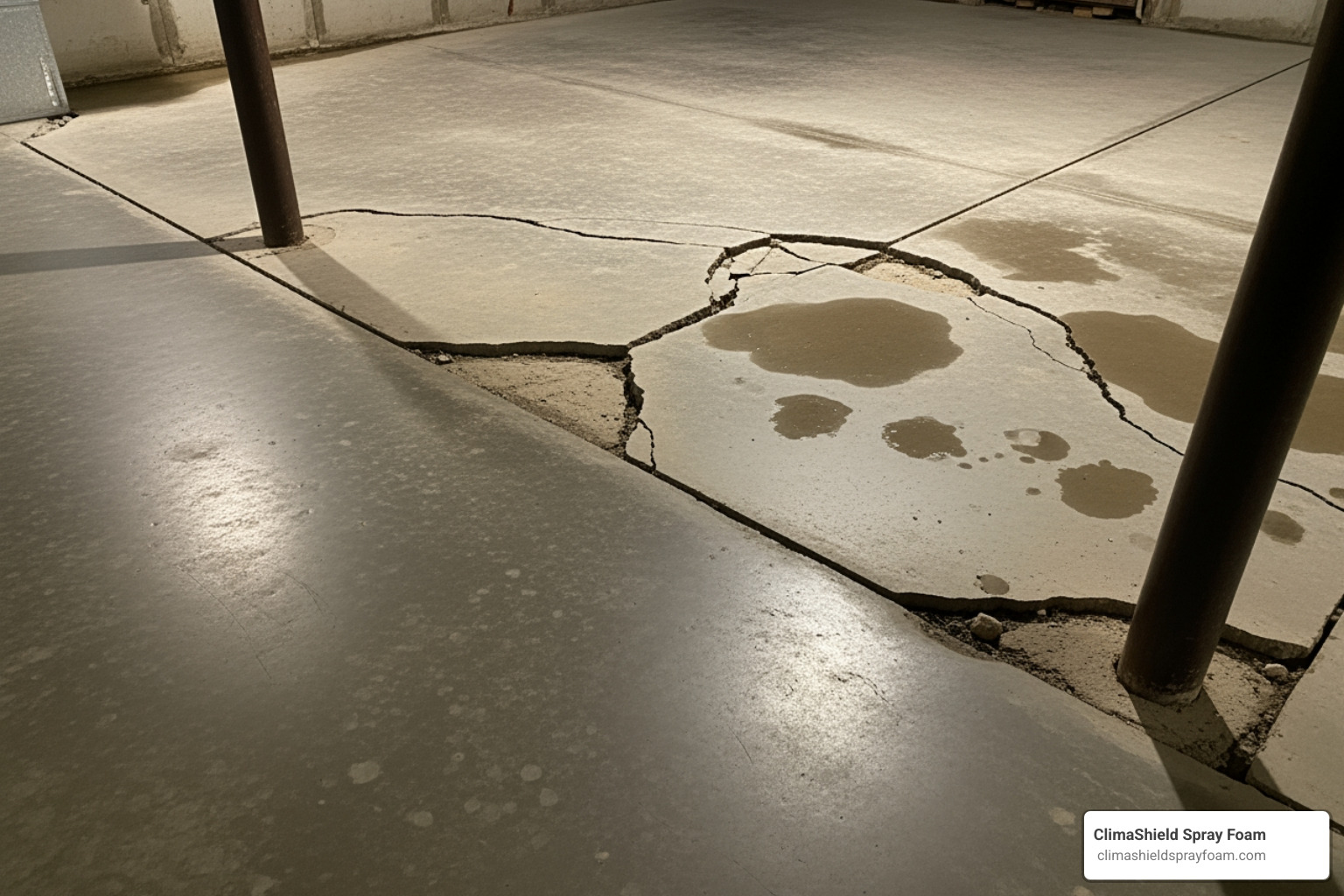
- Cracks in the basement floor
- A hump or high spot in the middle of the slab
- Uneven or tilted walking surfaces
- Slab sections pushing against each other
- Gaps where the floor meets the wall
- Trip hazards that were not there before
One strong clue is displacement. Heaving often causes one side of a crack to sit higher than the other.
Crack patterns that suggest upward pressure
Not every crack means disaster. Concrete can develop minor shrinkage cracks as it cures. But certain patterns suggest real movement from below.
More concerning crack patterns include:
- Triangle-shaped cracks
- Enclosed loops
- Cracks radiating from a high point
- Cracks with vertical offset
- Interior wall cracks above a lifted slab area
These patterns can indicate the slab is being pushed up at the point of greatest pressure.
How heaving affects doors, windows, and finishes
Basement floor heaving does not always stay in the floor. It can transfer stress into the rest of the house.
You might notice:
- Sticking basement doors
- Windows that suddenly bind
- Drywall cracks near corners
- Trim separating from walls
- Gaps where walls meet ceilings or floors
- Cracked tile or rigid flooring finishes
When interior partitions sit on the slab, upward movement can push those walls up too.
When a crack is cosmetic and when it signals trouble
A hairline crack in a basement slab is not automatically a structural emergency. Concrete often develops small cracks within the first year after pouring.
But a crack deserves closer attention when it is:
- Wider than about 1/8 inch
- Growing over time
- Allowing water seepage
- Accompanied by lifting or unevenness
- Creating a trip edge
- Connected to door, wall, or finish problems
If the slab is changing elevation, this is no longer just a cosmetic crack issue.
How to Tell Basement Floor Heaving From Settlement
Correct diagnosis matters. A repair that works for sinking concrete may do absolutely nothing for a floor being pushed up by wet soil.
A simple field check for basement floor heaving
Homeowners can do a basic screening before calling a pro.
Try this:
- Place a marble or ball on the floor and see which direction it rolls
- Use a long level or laser level to map the floor
- Check whether the center is higher than the perimeter
- Mark crack widths and elevations over time
- Look for a nearby moisture source
This is not a substitute for professional evaluation, but it can help you describe the problem clearly.
Signs that point more toward settlement instead
Settlement usually looks different. Warning signs may include:
- Sinking edges or corners
- Exterior cracks associated with downward movement
- Footing drop
- Slabs pulling apart rather than peaking upward
- More obvious downward slope
In short, heave tends to create pressure from below. Settlement tends to create loss of support below.
Why misdiagnosis leads to the wrong repair
This is where homeowners lose money.
If someone simply patches cracks, grinds a hump, or installs the wrong structural fix without stopping the water source, the heaving often returns. Cosmetic repairs over active movement are like putting a rug over a speed bump and hoping no one notices.
That is why moisture diagnosis, elevation mapping, and sometimes structural or geotechnical review come first. For a general overview of how foundations move from frost and soil expansion, see frost heaving and expansive clay.
When to monitor and when to test immediately
Monitoring can make sense when movement seems slow and minor. Some professionals use plaster patches or crack markers and watch them for 3 to 4 months.
But do not wait if you see:
- Active water intrusion
- Sudden slab lifting
- Rapidly widening cracks
- Suspected plumbing leaks
- Wall movement
- Doors or windows changing quickly
Those signs call for prompt testing and inspection.
Repair Options and Long-Term Prevention
The best repair always starts with the root cause. If water is still feeding the problem, repairs are just expensive rehearsal.
Fix the water source before anything else
Before slab repair, identify and correct the moisture issue.
That may include:
- Plumbing leak detection and repair
- Extending downspouts away from the house
- Regrading the yard
- Cleaning and correcting gutters
- Replacing failed perimeter drainage
- Installing interior drain tile and a sump pump where needed
If the moisture source stays active, even a brand-new slab can heave again.
Repair options for minor, moderate, and severe heave
Repair depends on severity.
Minor heave:
- Limited grinding may help in small, stable, non-structural areas
- Crack repair after movement stops
Moderate heave:
- Sectional slab removal and replacement
- Rebuilding damaged slab areas after correcting drainage
- Tying new concrete into adjacent slab where appropriate
Severe heave:
- Full slab removal and replacement
- New drainage installation
- Repair of affected interior walls or footings
- Possible structural reconstruction if load-bearing elements moved
A reported 3.5-inch heave across a 9 ft by 13 ft area is considered very serious and often points to the need for slab removal plus drainage correction, not just surface patching.
When structural support details may come into play
If heaving affects more than the slab, structural repairs may be needed.
These situations can include:
- Interior footings that are moving
- Load-bearing walls that have been lifted
- Sections that need support separate from active soil pressure
- Engineered slab replacement designs that account for future soil movement
The exact method depends on the structure, the soil conditions, and the repair plan developed by the professionals involved.
Soil stabilization and moisture management
In some cases, soils can be improved through stabilization methods such as engineered subgrade correction or polymer-based approaches. These are not one-size-fits-all and should match the soil conditions and structure.
Moisture management is the long game:
- Control drainage outside
- Reduce basement humidity
- Limit bulk water entry
- Maintain a stable basement environment
- Pair slab repair with waterproofing or vapor control where appropriate
For more on slab-related repair planning, see how to fix your basement floor without breaking a sweat.
Prevention steps that reduce future heaving risk
You cannot change the weather, but you can lower the odds of another upheaval.
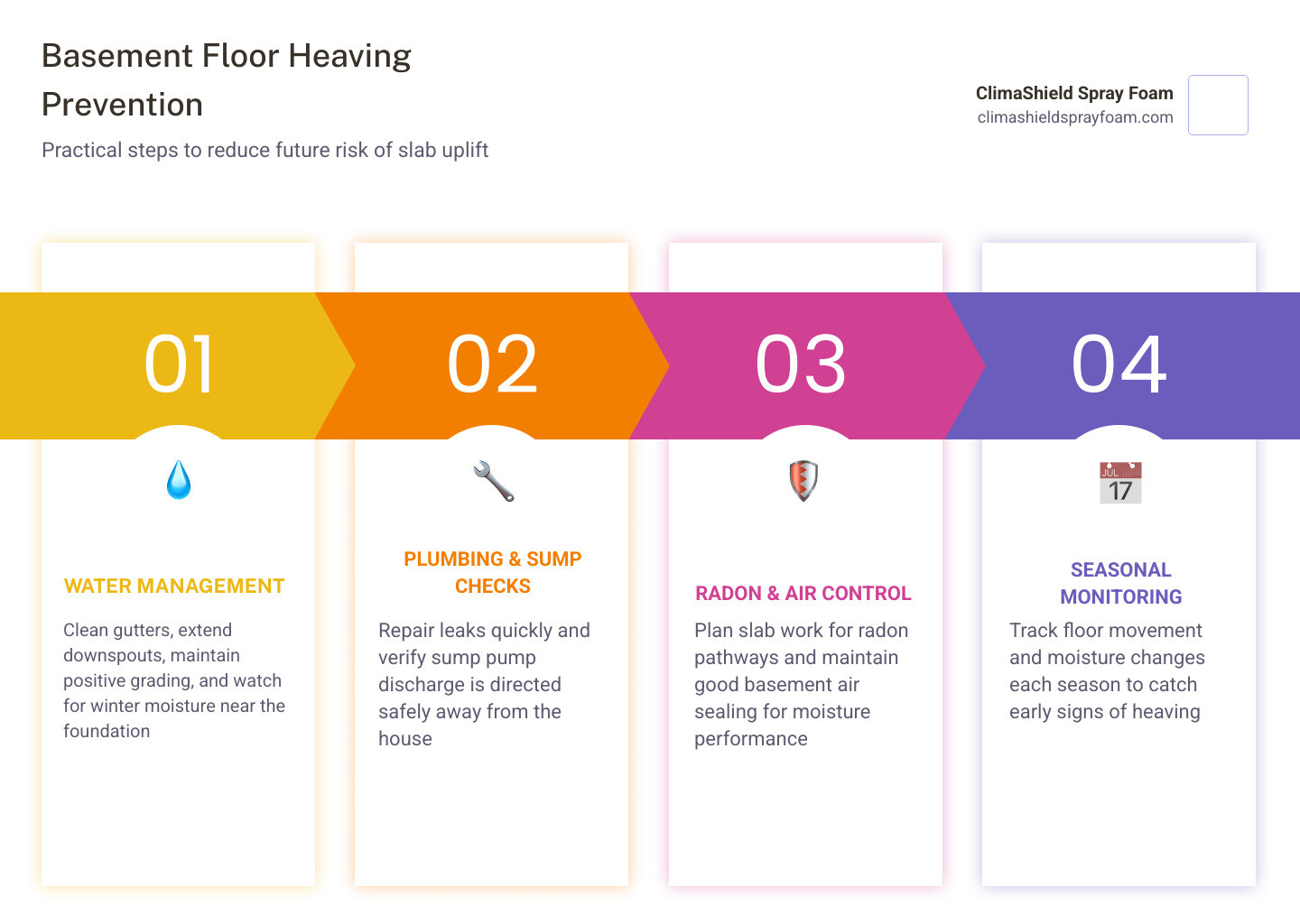
Practical prevention steps:
- Keep gutters clean
- Extend downspouts well away from the foundation
- Maintain positive grading
- Repair plumbing leaks quickly
- Check sump pump discharge locations
- Watch for winter moisture buildup near the home
- Consider radon pathways when cutting or replacing slabs
- Maintain good basement air control and enclosure performance
A tighter, drier basement is easier to protect. Our guide to air sealing a basement explains how better envelope control supports overall moisture performance.
Repair costs and severity examples homeowners should expect
Costs vary with cause, access, drainage work, and structural involvement. Based on the research, a rough range is:
- About $3,000 to $4,000 for smaller localized slab replacement jobs
- $13,000 or more for full slab replacement with drainage upgrades and broader remediation
Those numbers are examples, not guarantees, but they show why early action matters. A small heave can turn into a large project when ignored.
When to Call a Professional and What to Ask
There is a point where DIY observation needs to hand off to actual diagnosis.
Red flags that mean you should not wait
Call a professional promptly if you have:
- Rapid lifting or new floor humps
- Cracks with vertical displacement
- Water entering through floor cracks
- Sticking doors plus slab movement
- Suspected plumbing leak under the slab
- Wall cracking tied to floor changes
These signs suggest active movement, not old cosmetic damage.
The right experts for diagnosis and repair
Depending on the situation, the right team may include:
- Foundation repair specialist
- Structural engineer
- Geotechnical engineer
- Plumber or leak detection specialist
- Drainage or waterproofing contractor
For complicated cases, especially where soil behavior is uncertain, a geotechnical opinion can be extremely valuable before replacing the slab.
Questions to ask before approving work
Before signing anything, ask:
- What is the confirmed cause of the heaving?
- How was that cause verified?
- Is there evidence of plumbing leakage or drainage failure?
- Has floor elevation been mapped?
- How thick is the existing slab?
- Will the repair address the moisture source first?
- Is structural support involved?
- What monitoring is recommended after repair?
- What warranty applies to both drainage and slab work?
Good answers should be specific, not vague.
How floor heaving can affect comfort, moisture, and energy efficiency
This is where our world at ClimaShield Spray Foam overlaps with structural issues.
A heaved slab can create:
- Air leakage paths
- Damp basement conditions
- Mold-friendly moisture levels
- Cold floor surfaces
- Gaps in the basement envelope
- Reduced comfort and harder-to-control humidity
Once the structural and moisture causes are fixed, improving insulation and air sealing can help restore basement comfort and efficiency. If you are planning broader upgrades, our residential insulation complete guide is a good next step.
Frequently Asked Questions About Basement Floor Heaving
Can basement floor heaving go back down on its own?
Sometimes partially, yes. If the soil dries out, some rebound can happen. But it may take months or longer, and there is no guarantee the slab will return to its original position or stop cracking. If the cause is ongoing, such as a leak or drainage issue, it usually will not resolve on its own.
Is basement floor heaving covered by insurance?
Often, standard homeowners insurance does not cover long-term soil movement, drainage defects, or gradual foundation issues. But sudden damage from a covered plumbing leak may be treated differently. The only safe answer is: check your policy and document everything early.
Can I just level over a heaved basement floor?
Usually no, at least not as a permanent solution. Leveling over an actively heaving slab hides the real problem. The movement can continue, new flooring can fail, and moisture can get trapped where you do not want it. First stop the cause, then decide whether leveling, replacement, or a structural repair is appropriate.
Conclusion
Basement floor heaving is not just an ugly crack problem. It is a sign that the slab is reacting to pressure from below, usually because of moisture, soil expansion, freezing, or drainage failure.
The good news is that this problem is understandable and fixable when approached in the right order:
- Confirm whether it is heaving or settlement
- Find and stop the water source
- Match the repair to the severity
- Improve long-term moisture control and basement performance
The earlier you act, the better your odds of avoiding major structural repairs and major wallet pain.
At ClimaShield Spray Foam, we care about the whole basement environment, not just one symptom. After the underlying cause of movement is addressed, better moisture control, air sealing, and insulation can help create a healthier, drier, more energy-efficient space.
If you are dealing with slab movement or moisture-driven basement problems, learn more about our geotech slab lifting services.
