Why Choosing the Right Insulation for Commercial Buildings Matters
Insulation in commercial buildings is one of the highest-impact decisions you can make for long-term energy costs, occupant comfort, and building durability. Get it right, and you cut heating and cooling bills significantly. Get it wrong, and you pay for it every month — for decades.
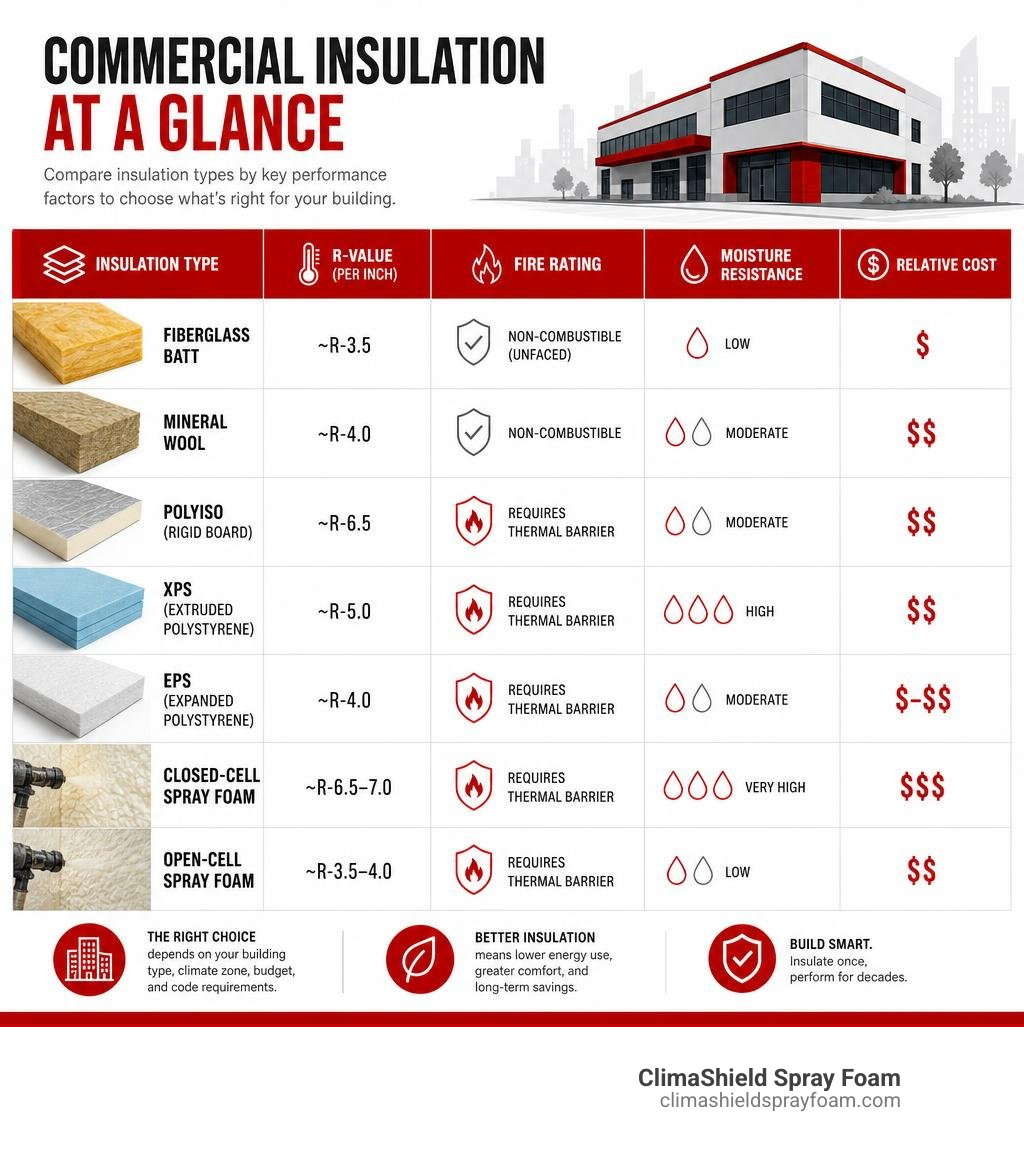
Here’s a quick comparison of the most common commercial insulation types:
| Insulation Type | R-Value per Inch | Fire Rating | Moisture Resistance | Relative Cost |
|---|---|---|---|---|
| Fiberglass Batt | ~R-3.5 | Non-combustible (unfaced) | Low | Low |
| Mineral Wool | ~R-4.0 | Non-combustible | Moderate | Moderate |
| Polyiso (Rigid Board) | ~R-6.5 | Requires thermal barrier | Moderate | Moderate |
| XPS (Extruded Polystyrene) | ~R-5.0 | Requires thermal barrier | High | Moderate |
| EPS (Expanded Polystyrene) | ~R-4.0 | Requires thermal barrier | Moderate | Low–Moderate |
| Closed-Cell Spray Foam | ~R-6.5–7.0 | Requires thermal barrier | Very High | High |
| Open-Cell Spray Foam | ~R-3.5–4.0 | Requires thermal barrier | Low | Moderate |
The right choice depends on your building type, climate zone, budget, and code requirements — and there’s rarely a one-size-fits-all answer.
Buildings aren’t cheap to operate. In fact, the energy used to run existing commercial buildings accounts for roughly 30% of all economy-wide greenhouse gas emissions in the United States. Poorly insulated buildings force HVAC systems to work harder, driving up utility bills and accelerating equipment wear. Over a 30-year period, insulation improvements across the commercial building stock are estimated to save operators more than $65 billion in energy costs — a number that’s hard to ignore.
Whether you’re building new, replacing a roof, or retrofitting an older facility, understanding your insulation options is essential before you spend a dollar.
I’m Dave Brocious, founder of ClimaShield Industries, with over 20 years of experience in coatings and specialty contracting — including hands-on work in insulation for commercial buildings through spray foam, air barriers, roof coatings, and protective systems. In the sections below, I’ll walk you through everything you need to make a confident, informed decision.
Discover more about insulation commercial buildings:
Core Materials for Insulation Commercial Buildings
As the demand for energy efficiency accelerates, the commercial insulation market has grown dramatically. According to the Commercial Building Insulation Market Research Report 2034 , the global commercial building insulation market was valued at $28.6 billion in 2025 and is projected to reach $47.3 billion by 2034, expanding at a CAGR of 5.8%.
This massive growth is driven by tightening building codes, rising energy costs, and a push for green building certifications. When analyzing market share by material type in 2025, fiberglass held the largest share at 34.2%, closely followed by mineral wool at 28.7%. In terms of applications, wall insulation represented the largest category at 42.3% of global revenues, while roof insulation accounted for 35.6%. Geographically, the offices segment represented the largest end-use category at 31.4% of global revenues.
Choosing the right material for insulation commercial buildings requires balancing thermal performance, fire safety, moisture control, and budget. Let’s look closely at how these core materials compare.
Fiberglass and Mineral Wool Solutions
Fiberglass and mineral wool remain highly popular due to their cost-effectiveness and excellent fire performance.
- Fiberglass Batts and Loose-Fill: Typically consisting of 40% to 60% recycled glass content, fiberglass is highly cost-efficient and lightweight. Unfaced fiberglass is naturally non-combustible (meeting ASTM E136 standards) and does not rot or decay. However, fiberglass can lose a portion of its thermal performance if compressed or exposed to air movement, and it absorbs moisture easily if the building envelope is compromised.
- Mineral Wool: Made from basalt volcanic rock and steel slag (often containing up to 70% to 75% recycled content), mineral wool is a heavy-duty champion. It has a high density (often around 2 lb/ft³) and is completely non-combustible, holding up against temperatures exceeding 2,000°F. Beyond fire resistance, mineral wool provides outstanding acoustic control, achieving a Sound Transmission Class (STC) rating of up to 43 in standard wall assemblies and a Noise Reduction Coefficient (NRC) of up to 1.0.
For a deeper dive into how these traditional materials stack up, check out our Commercial Insulation Complete Guide.
Rigid Foam Boards (Polyiso, XPS, and EPS)
Rigid foam boards are the go-to choices when you need high R-value per inch and continuous insulation to block thermal bridging.
- Polyisocyanurate (Polyiso): Polyiso is widely used in commercial roof and wall assemblies because it offers one of the highest thermal resistances of any rigid board (typically R-6.0 to R-6.5 per inch). It consists of a uniform closed-cell core bonded to foil or glass facers. However, its thermal performance can slightly degrade in extremely cold conditions, which designers must account for in northern climates like Pennsylvania.
- Extruded Polystyrene (XPS): Recognized by its blue, green, or pink color, XPS is a closed-cell foam board with an integral smooth skin. It provides an R-value of R-5.0 per inch and offers exceptional moisture resistance, making it ideal for below-grade foundation walls and protected membrane roof assemblies.
- Expanded Polystyrene (EPS): The most budget-friendly of the rigid foam boards, EPS has a slightly lower R-value (around R-4.0 per inch) and is more vapor-permeable than XPS. It is frequently used in wall systems, under-slab applications, and insulated concrete forms (ICFs).
To understand how these rigid materials prevent water damage and condensation, read The Definitive Guide to Waterproof Insulation.
Spray Polyurethane Foam (SPF) in Commercial Projects
Spray polyurethane foam is a premium insulation material that expands on-site to create a fully adhered, seamless thermal, air, and moisture barrier.
- Closed-Cell SPF: With a density of approximately 2.0 to 2.8 lb/ft³, closed-cell spray foam provides an incredibly high R-value of R-6.5 to R-7.0 per inch. It is highly rigid, adds structural strength to wall assemblies, and acts as a Class II vapor retarder at a thickness of just 1.5 inches. This makes it virtually waterproof and ideal for harsh commercial environments.
- Open-Cell SPF: Open-cell foam is lighter (about 0.5 lb/ft³) and expands significantly more than closed-cell, making it excellent for filling deep cavities and absorbing sound. It has an R-value of R-3.5 to R-4.0 per inch and is vapor-permeable, meaning it requires a separate vapor retarder in cold climates.
For businesses in our local service areas, we outline the exact regional benefits in our guide to Commercial Spray Foam Insulation Western PA.
Understanding Continuous Insulation (ci) and Thermal Bridging
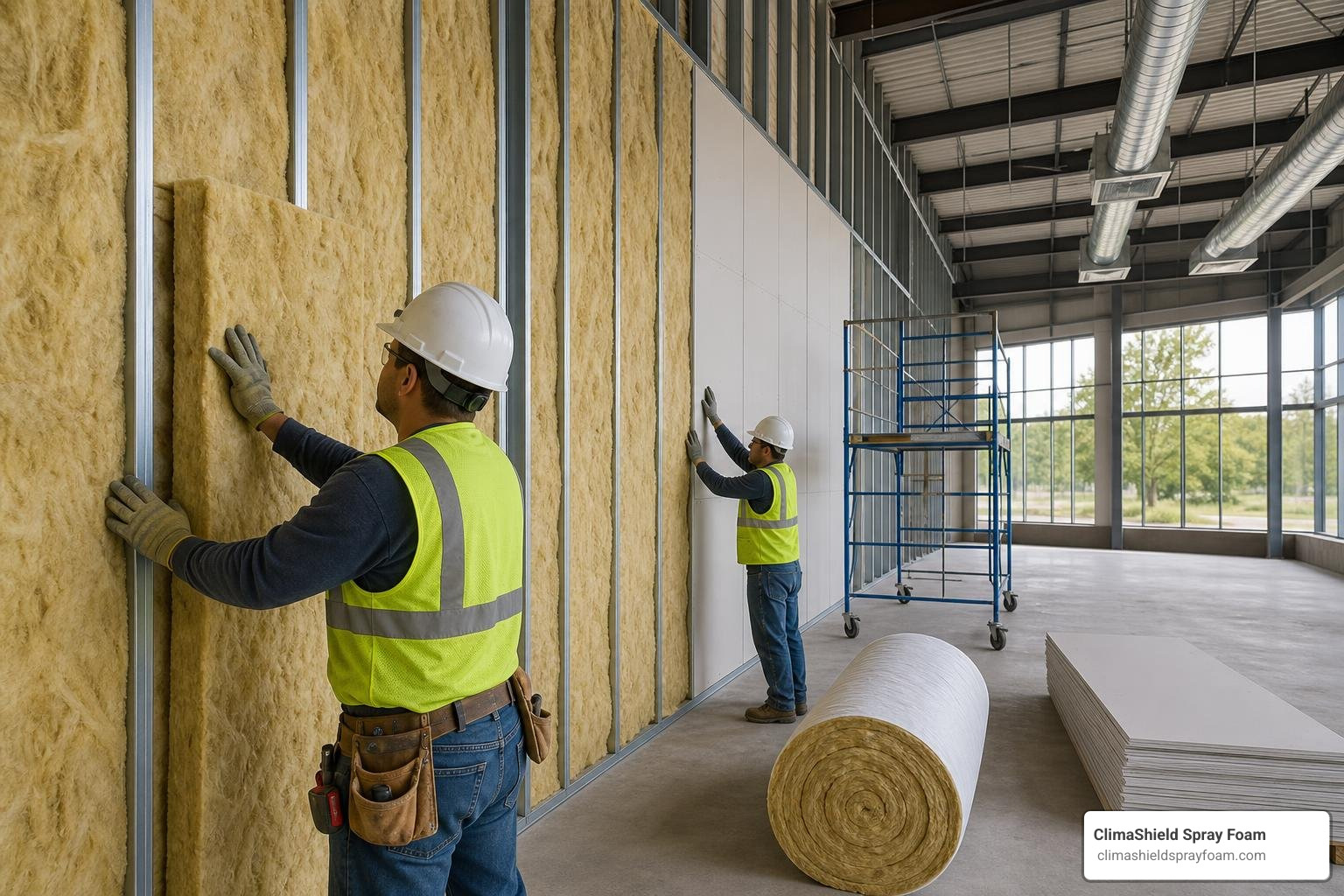
In modern commercial construction, achieving a high “nominal” R-value on an insulation product package is no longer enough to satisfy energy codes. We must look at the “effective” R-value of the entire wall or roof assembly. This is where continuous insulation (ci) and the elimination of thermal bridging become critical.
How Thermal Bridging Compromises R-Value
Thermal bridging occurs when highly conductive structural elements, such as steel studs, concrete slabs, or metal fasteners, bypass the insulation layer and create an easy path for heat to escape.
Steel studs are exceptionally conductive. In a standard commercial wall with steel studs spaced at 16 inches on center, the studs act as thermal highways. If you install R-19 fiberglass batts inside the stud cavities, the metal studs can reduce the effective R-value of that wall by up to 50% to 60%, leaving you with an actual performance of around R-8.
Using traditional framing attachments like vertical Z-girts to hold exterior cladding can also reduce the thermal efficiency of exterior insulation by 60% to 80%. To combat this, modern specifiers use low-conductivity alternatives like stainless steel clips (which maintain 65% to 85% thermal efficiency) or fiberglass clips and long screws through rigid insulation (achieving 70% to 95% efficiency).
By enclosing the building in a continuous thermal blanket, you keep the interior structural elements warm, eliminate condensation planes, and keep your HVAC system from running overtime. To learn more about how this works, read Unwrapping the Thermal Envelope: A Guide to Energy Efficient Buildings.
For detailed structural details on cladding attachments, you can consult the Commercial New Construction Builder’s Guide .
Code Requirements for Continuous Insulation Commercial Buildings
Because of these thermal losses, building codes have increasingly mandated continuous insulation. In Pennsylvania, commercial building projects must comply with the state-adopted energy codes, which reference the International Energy Conservation Code (IECC) and ASHRAE Standard 90.1.
Under these regulations, commercial exterior walls must utilize a combination of cavity insulation and continuous insulation (ci) or meet a strict overall assembly U-factor. For example, in typical Pennsylvania climate zones (Climate Zone 5, which includes Indiana, PA), steel-framed commercial walls generally require at least R-10 to R-13 continuous insulation on the exterior, depending on the compliance path chosen.
To ensure your project meets these local standards, refer to our breakdown of Understanding Pennsylvania’s insulation rules for commercial walls .
Commercial Building Energy Codes and Standards Evolution
Energy codes have undergone a massive transformation over the last two decades, shifting from basic thermal recommendations to stringent, holistic systems-based mandates.
Key Changes from 2009 to 2024/2025
To understand how far we’ve come, we can look at the timeline of the IECC and ASHRAE 90.1:
- 2009 IECC: Focused primarily on prescriptive R-values for cavities. Continuous insulation was encouraged but not universally mandated for all climate zones and wall types. You can view the historical baseline in the Chapter 5 Commercial Energy Efficiency – UpCodes archives.
- 2012–2015 IECC: This era marked a major turning point. The 2012 IECC officially made continuous insulation mandatory for steel-framed walls in almost all climate zones to address the thermal bridging issues discussed above.
- 2018–2021 IECC: Introduced more flexible compliance pathways, including the Energy Rating Index (ERI) and a heavier focus on airtightness testing. The 2021 code pushed buildings closer to net-zero readiness, requiring increased R-values for roofs and slabs.
- 2024 IECC (and beyond): The latest code cycles place an intense focus on decarbonization, zero-energy building pathways, and integration with renewable energy systems like solar and electric vehicle charging infrastructure.
Staying ahead of these code cycles is key to keeping building lifecycle costs low. Explore our strategies in The Frugal Guide to Reducing Energy Expenses.
Green Building Certifications (LEED & BREEAM)
For developers aiming higher than minimum code, green building certifications like LEED (Leadership in Energy and Environmental Design) and BREEAM offer valuable marketing, financial, and environmental advantages.
Insulation choices directly influence several LEED v4 credit categories:
- Energy and Atmosphere (EA Credit 1 – Optimize Energy Performance): Upgrading insulation beyond code baselines is the fastest way to earn points here, as high-performance envelopes drastically reduce energy simulation model baselines.
- Materials and Resources (MR Credit 4 & 5): Specifying insulation with high recycled content (like fiberglass or mineral wool) or sourcing materials manufactured regionally (within 500 miles of the project site) helps secure these credits.
To see how high-performance insulation helps achieve these benchmarks, check out our guide on Energy Saving Insulation.
Application-Specific Best Practices: Roofs, Walls, and Below-Grade

Different parts of a commercial building face distinct environmental threats. A great insulation strategy matches the material to the physical demands of the application. For a broader look at commercial building assemblies, see the Commercial Building Systems & Specialty Trade Guide (2026) | TCG .
Low-Slope Commercial Roofing Systems
Low-slope roofs (often called “flat roofs”) are harsh environments exposed to extreme heat, UV radiation, and pooling water.
- Polyiso Boards: The industry standard for low-slope roofing is polyiso board insulation. Because of its high R-value per inch, it allows designers to meet strict roof R-value targets (typically R-30 or higher) without creating excessively thick roof profiles.
- Tapered Insulation: Standing water is the enemy of any roof. Tapered polyiso systems are custom-engineered to create slope on a flat deck, directing water toward drains and scuppers.
- Cover Boards: To protect soft insulation boards from foot traffic, hail, and wind uplift, a high-density cover board (such as gypsum or high-density polyiso) is installed directly beneath the single-ply membrane (TPO, EPDM, or PVC).
- Spray Foam Roofing: Alternatively, spray polyurethane foam roofing systems combine insulation and a waterproofing membrane into a single, seamless, self-flashing system that eliminates seams entirely.
Learn about these advanced roofing options in The Ultimate Roundup of Spray Foam Roofing Systems.
Below-Grade and Foundation Insulation Commercial Buildings
Insulating below-grade foundation walls and under concrete slabs is essential because the earth conducts heat away from a building year-round.
However, below-grade insulation must withstand constant moisture, hydrostatic pressure, and soil compression. Traditional fiberglass or open-cell foam will fail quickly in these conditions by absorbing water, which completely destroys their insulating value.
For below-grade applications, extruded polystyrene (XPS) or closed-cell spray foam are the gold standards. They are highly hydrophobic, resist water absorption, and maintain their R-value even when buried under wet soil. They also act as a vital barrier against radon gas and moisture vapor trying to migrate through concrete foundation walls.
Protect your foundation from water intrusion by reading Stop the Leaks with Waterproof Spray Foam.
Financial Analysis: Costs, ROI, and Incentives
While upgrading insulation increases upfront construction or renovation costs, it is one of the few building investments that pays you back every single day.
Inflation Reduction Act (IRA) Section 179D and Rebates
In 2026, the financial equation for upgrading insulation commercial buildings is better than ever, thanks to federal tax incentives and local utility programs:
- Section 179D Tax Deduction: Expanded under the Inflation Reduction Act, the Section 179D Energy Efficient Commercial Buildings Deduction allows building owners to claim a deduction of up to $5.00 per square foot for projects that achieve a 50% reduction in energy use compared to ASHRAE 90.1 standards. High-performance insulation and air sealing are fundamental to hitting these targets.
- Utility Rebates: Many local utilities in Pennsylvania offer commercial rebates based on the square footage of insulation added or the total projected kilowatt-hour (kWh) savings. These rebates can offset up to 20% to 50% of the insulation material and labor costs.
- ROI and Payback: With energy price inflation, the typical payback period for commercial insulation retrofits has dropped. While a comprehensive roof or wall retrofit used to carry a 10-to-12-year payback, many projects now reach full ROI in 5 to 7 years, followed by decades of pure operational savings.
Learn how to maximize your savings on large-scale facilities in Warehouse Insulation Strategies for Massive Savings and explore general efficiency tips in The Ultimate Guide to Best Energy Saving Insulation.
Frequently Asked Questions about Commercial Insulation
Navigating commercial building codes, fire testing, and material properties can be overwhelming. Here are answers to some of the most common questions we receive from contractors and building owners.
What is the difference between open-cell and closed-cell spray foam for commercial buildings?
The primary differences lie in density, R-value, moisture resistance, and structural strength:
- Closed-cell foam is highly dense, rigid, has a high R-value (R-6.5+ per inch), and acts as a complete water and vapor barrier. It is ideal for exterior walls, below-grade applications, and unvented roof assemblies.
- Open-cell foam is lightweight, flexible, has a lower R-value (R-3.5 to R-4.0 per inch), and is vapor-permeable. It is highly effective for interior walls where acoustic dampening is needed, or in deep roof cavities where budget-friendly air sealing is the main goal.
Read our complete breakdown of these foam types in Which Foam is for You? Exploring Insulation Types, Perks and Prices.
How do fire performance requirements affect commercial insulation selection?
Fire safety is non-negotiable in commercial construction. Materials must meet strict standards:
- ASTM E84: This test measures the Flame Spread Index (FSI) and Smoke Developed Index (SDI) of materials. Class A materials require an FSI of 0 to 25.
- NFPA 285: This standard fire test evaluates the flammability characteristics of exterior non-load-bearing wall assemblies containing combustible components (like foam plastic insulation). If you use polyiso, XPS, or spray foam on a high-rise exterior wall, the entire wall assembly must pass NFPA 285 testing.
- Non-Combustible Materials: For high-occupancy or high-hazard buildings, designers often opt for mineral wool, which is naturally non-combustible and requires no chemical flame retardants.
Understand how to protect your property by checking out Fire Retardant Insulation.
What are the most common mistakes in commercial insulation installations?
Even the best insulation will underperform if installed poorly. The most frequent errors include:
- Compression: Squeezing fiberglass batts into cavities reduces the trapped air pockets that provide thermal resistance, severely lowering the effective R-value.
- Thermal Gaps: Leaving small gaps between rigid foam boards or failing to seal joints allows air loops to form, bypassing the insulation.
- Improper Vapor Barrier Placement: Placing a vapor barrier on the wrong side of the wall assembly traps moisture inside, leading to mold growth and structural decay.
- Failing to Air Seal: Insulation stops heat transfer, but it doesn’t always stop air leakage. Standard insulation must be paired with a dedicated air barrier system.
Ensure your project is handled by qualified professionals. Learn more in our directory of building insulation companies and contractors.
Conclusion
Upgrading your commercial building’s thermal envelope is one of the smartest investments you can make. By choosing the right materials, eliminating thermal bridging, and complying with modern building codes, you can protect your structure from moisture, enhance occupant comfort, and save up to 60% on your energy bills.
At ClimaShield Spray Foam, we specialize in high-performance, durable, and waterproof insulation solutions tailored to Pennsylvania’s climate. Whether you need to secure a complex commercial wall assembly, seal a low-slope roof, or insulate a commercial vehicle, we are here to help.
Ready to transform your building’s energy efficiency? Contact us today to discuss your project and discover how our advanced systems can work for you. Learn more on our ClimaShield Spray Foam Commercial Insulation page.
