Why Commercial Warehouse Ceiling Insulation Is the Highest-Impact Upgrade You Can Make
Commercial warehouse ceiling insulation is one of the most effective ways to cut energy costs, protect inventory, and create a comfortable working environment in a large facility.
Here’s what you need to know at a glance:
| Goal | What Ceiling Insulation Does |
|---|---|
| Reduce energy bills | Can cut heating and cooling costs by up to 40% |
| Protect inventory | Prevents moisture, condensation, and temperature swings |
| Improve worker comfort | Stabilizes indoor temperatures year-round |
| Control moisture | Stops condensation and mold growth in metal buildings |
| Meet code requirements | Helps satisfy IECC and ASHRAE energy standards |
Warehouses are notoriously tough to keep comfortable. Expansive metal roofs absorb heat in summer and bleed it out in winter. Tall ceilings create dramatic temperature gradients — sometimes a 10°C (18°F) difference between floor and ceiling. And without the right insulation, you’re essentially paying to heat or cool the outdoors.
The ceiling is the single biggest source of heat gain and heat loss in most warehouse buildings. Yet it’s often the last thing facility managers address.
That’s a costly mistake — and one that’s very fixable.
I’m Dave Brocious, founder of ClimaShield Industries and a specialist in commercial spray foam insulation and protective coatings, with hands-on experience solving exactly the kind of energy loss and moisture problems that make commercial warehouse ceiling insulation such a critical investment. In the sections below, I’ll walk you through the strategies that deliver the biggest savings.
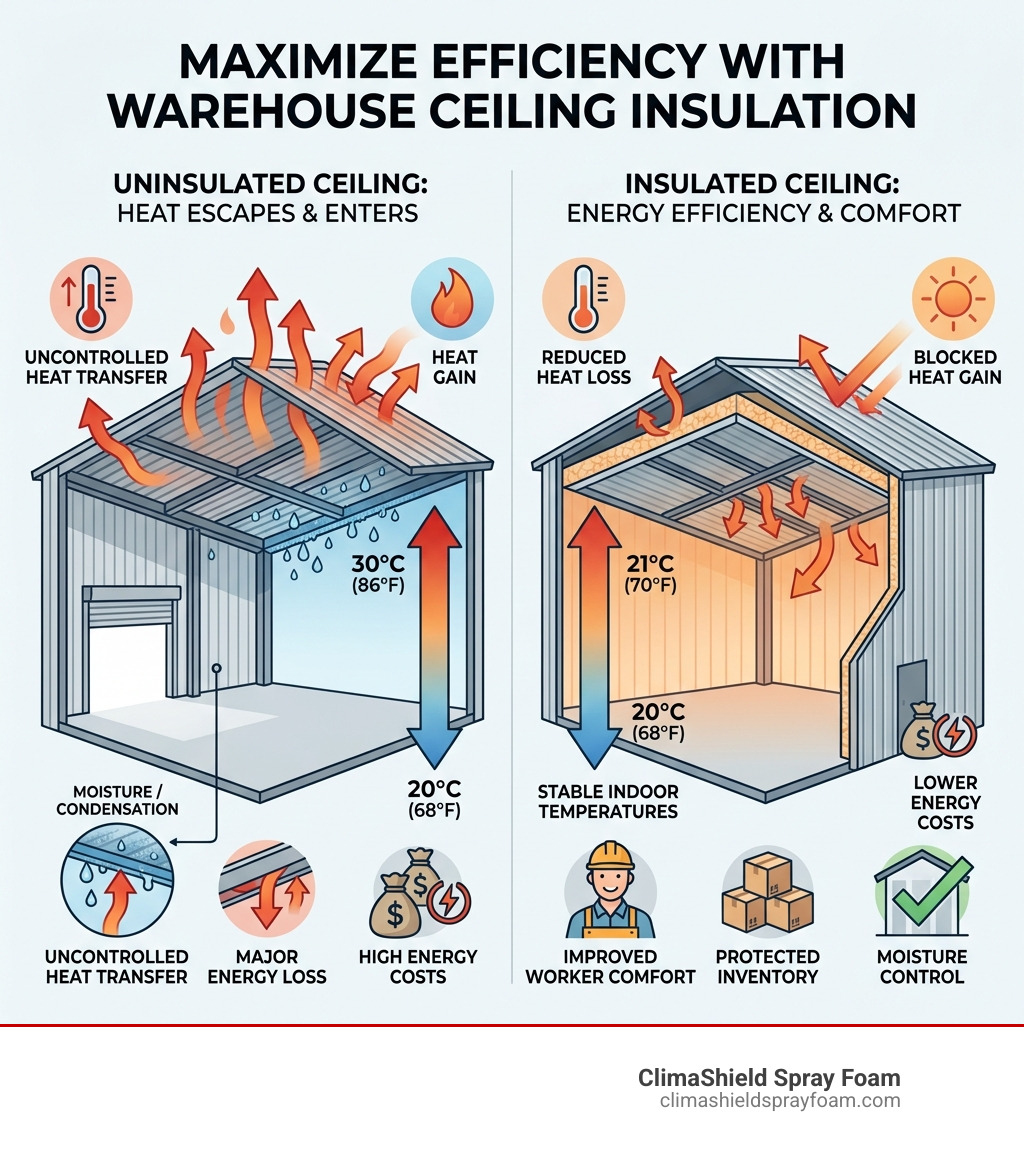
Basic commercial warehouse ceiling insulation terms:
The Critical Role of Commercial Warehouse Ceiling Insulation
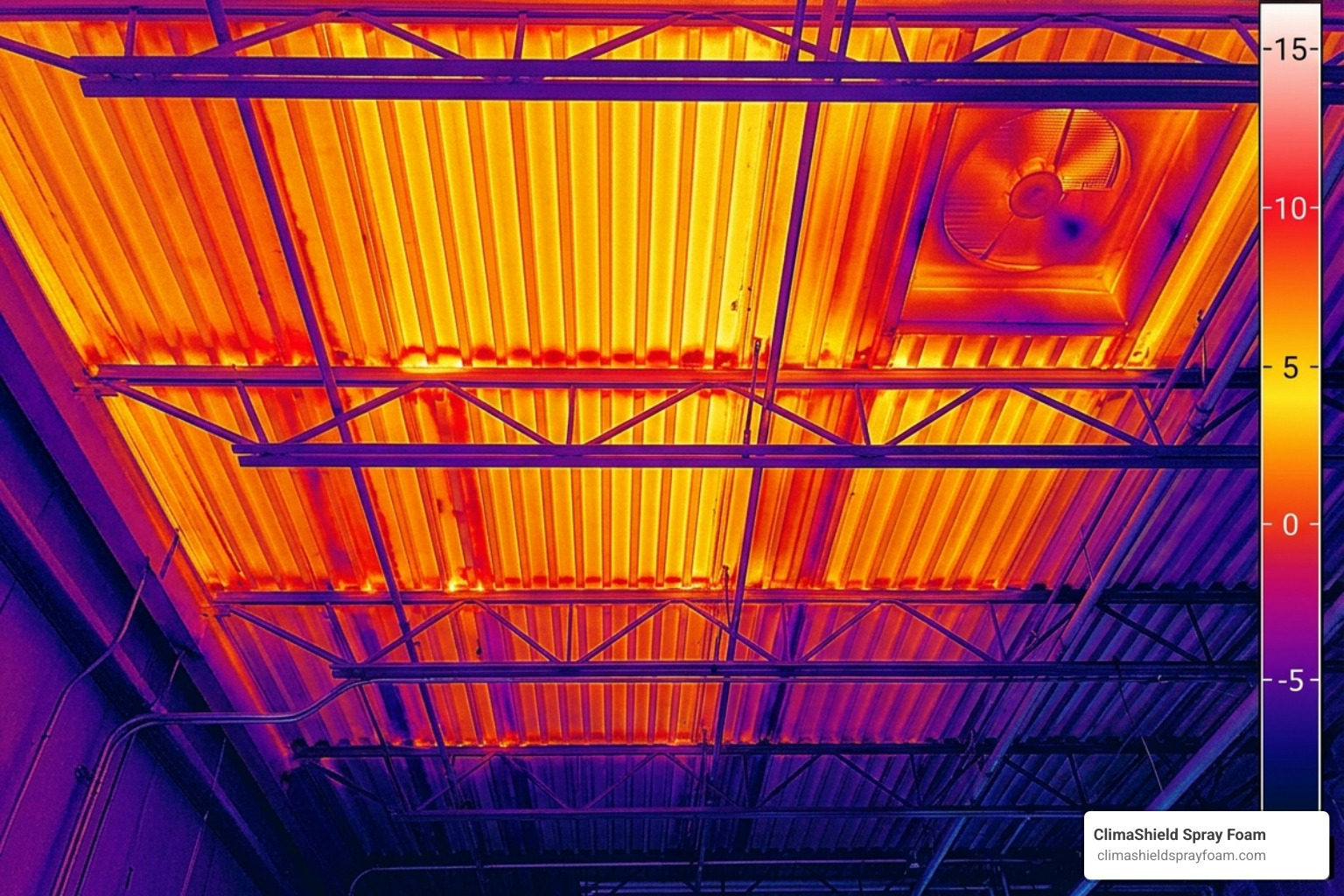
In the commercial sector, we often view buildings as giant shells. However, in Pennsylvania, where we deal with biting winters and humid summers, that shell needs to be high-performing. The roof of a warehouse is its most vulnerable point. During a typical July in Indiana, PA, the sun beats down on metal roofing sheets, turning the ceiling into a giant radiator that pushes heat downward. In the winter, the reverse happens: the heat you’ve paid for rises and escapes through the roof deck almost instantly.
Properly implemented commercial warehouse ceiling insulation acts as a thermal shield. It’s not just about stopping heat; it’s about climate control. For facilities storing sensitive electronics, pharmaceuticals, or even specialized manufacturing equipment, maintaining a stable interior temperature isn’t a luxury—it’s a requirement for business continuity.
By investing in high-quality Commercial Insulation Services, you are essentially “tightening” the building envelope. This reduces the workload on your HVAC systems, which in the massive volumes of a warehouse, can lead to substantial operational savings.
Key Benefits of Commercial Warehouse Ceiling Insulation
The advantages of insulating your ceiling extend far beyond the monthly utility bill. While energy savings of up to 40% are a primary driver, we see several other “hidden” benefits:
- Worker Productivity: It’s a simple fact: employees work better when they aren’t freezing or heat-exhausted. Improving the thermal comfort of a 50,000-square-foot floor can reduce errors and improve morale.
- Noise Reduction: Warehouses are loud. Between heavy machinery and the echo of a vast open space, the acoustics can be punishing. Spray foam and fiberglass both offer significant sound-dampening qualities, making the environment safer and more pleasant.
- Inventory Protection: We’ve seen cases where extreme heat gain in an uninsulated warehouse caused packaging to warp or products to degrade. Insulation ensures your stock remains in “factory-fresh” condition.
For more details on how these benefits apply to your specific facility, check out our more info about commercial insulation services.
Managing Thermal Stratification and Airflow
A challenge in a warehouse is “stratification.” Because heat rises, the air near your 40-foot ceiling might be 15 to 20 degrees warmer than the air at the floor level where your team is actually working.
By combining commercial warehouse ceiling insulation with High-Volume Low-Speed (HVLS) fans, you can achieve “destratification.” The insulation keeps the heat from escaping (or entering), and the fans gently push the conditioned air back down to the floor. This synergy can save an additional 20% on heating costs because your heaters don’t have to run constantly to replace the heat that’s stuck at the ceiling.
Why Spray Foam Outperforms Traditional Warehouse Insulation
When selecting materials for a commercial project in Western Pennsylvania, we have to look at R-value, airtightness, and durability.
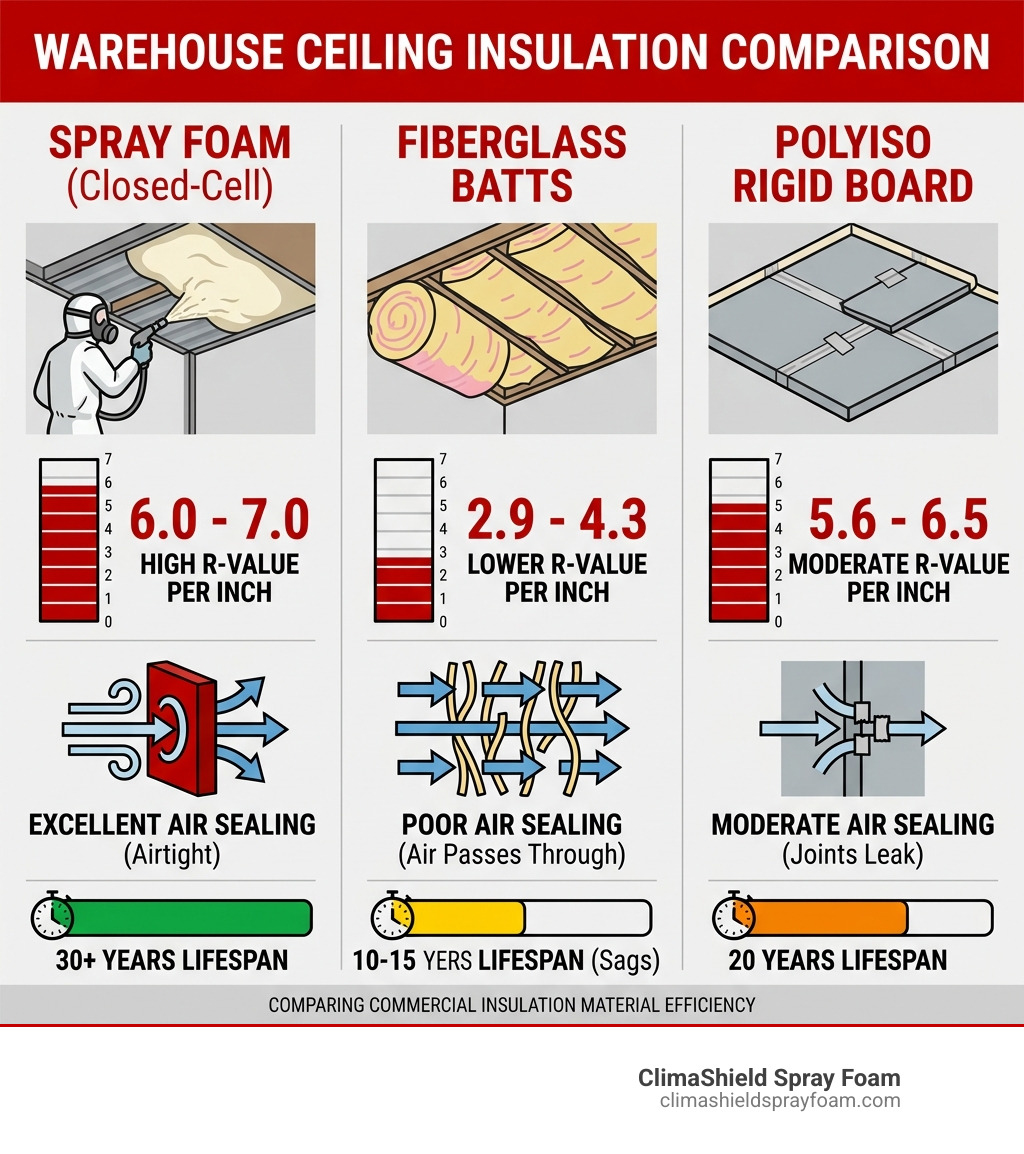
| Material Type | R-Value (per inch) | Air Sealing Capability | Lifespan |
|---|---|---|---|
| Closed-Cell Spray Foam | 6.0 – 7.0 | Excellent (Airtight) | 30+ Years |
| Fiberglass Batts | 2.9 – 4.3 | Poor (Air passes through) | 10-15 Years (Sags) |
| Polyiso Rigid Board | 5.6 – 6.5 | Moderate (Joints leak) | 20 Years |
| Radiant Barrier | N/A | None | Variable (Dust affects it) |
Spray Foam: The Airtight Solution
In our experience at ClimaShield, spray foam is the gold standard for commercial warehouse ceiling insulation. Specifically, closed-cell spray foam provides a dual benefit: it offers the highest R-value per inch (up to 7.0) and creates a permanent, seamless air barrier.
Because it expands upon application, it fills every nook, cranny, and irregular surface of the metal roof deck. This eliminates drafts and prevents the “chimney effect” where air leaks out of the top of the building. For those looking for the most robust solution in our region, Commercial Spray Foam Insulation Western Pa offers the structural reinforcement and thermal performance needed for industrial-scale buildings.
Limitations of Traditional Materials in Large Facilities
While fiberglass or polyiso boards might seem cheaper upfront, they often struggle in a warehouse environment:
- Fiberglass Sagging: Over time, gravity and moisture cause fiberglass batts to sag or pull away from the ceiling, leaving “thermal holes.”
- Joint Leaks: Polyiso boards are great, but every joint between boards is a potential air leak. In a massive ceiling, that’s thousands of feet of potential leakage.
- Radiant Barrier Limits: While radiant barriers reflect 97% of radiant heat, they don’t stop conductive heat. In a cold Pennsylvania winter, a radiant barrier does very little to keep your heat inside.
For a deeper dive into these comparisons, see our Complete Guide to Commercial Insulation.
Solving Metal Building Challenges: Condensation and Thermal Bridging
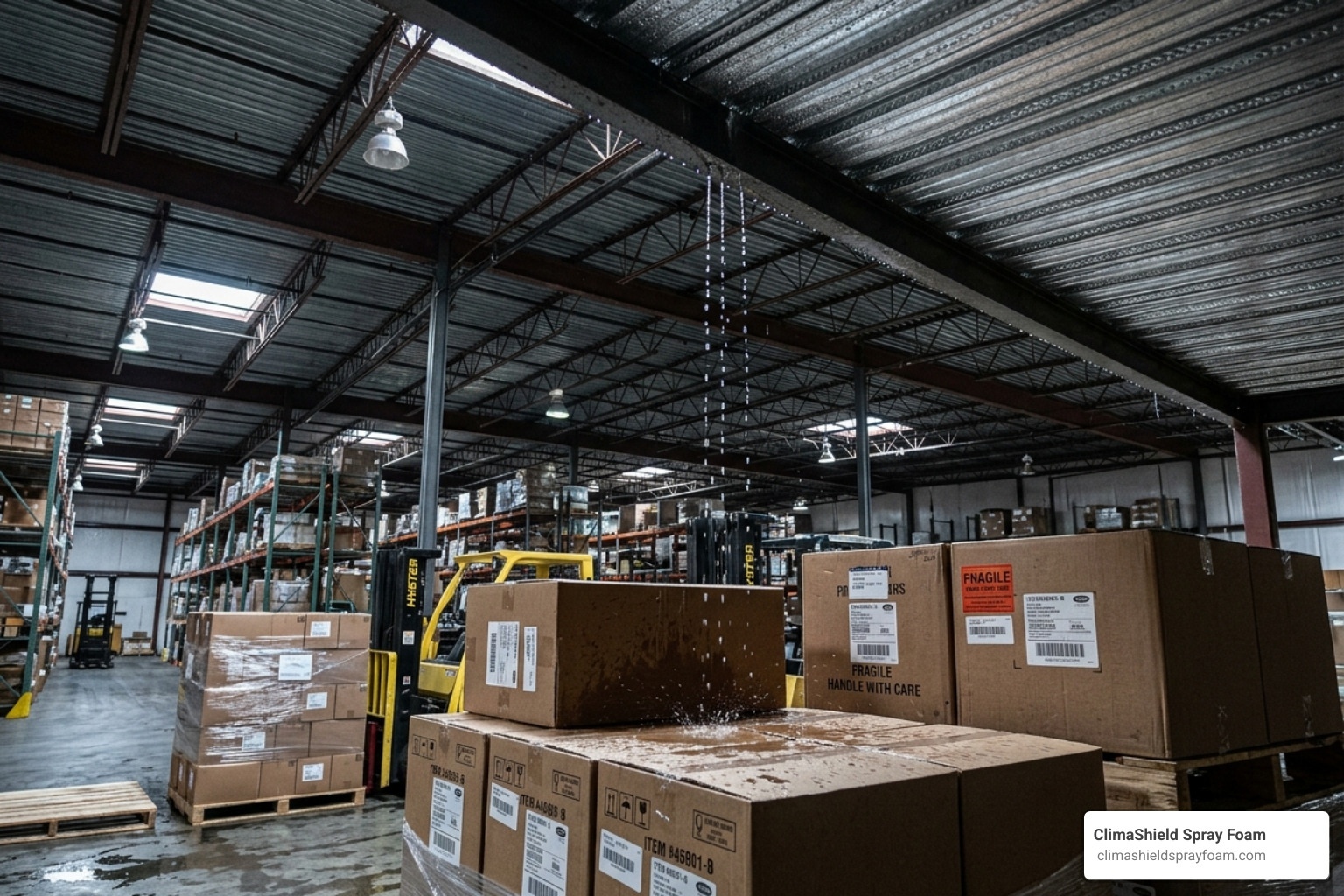
If you’ve ever seen it “raining” inside a warehouse on a cold day, you’ve witnessed the dew point in action. Metal buildings are notorious for condensation. When warm, moist air inside the warehouse hits the cold metal roof, it turns into liquid water. This drips onto inventory, corrodes steel racking, and creates a breeding ground for mold.
Preventing Condensation in Commercial Warehouse Ceiling Insulation
The key to stopping “warehouse rain” is ensuring the interior surface temperature of the ceiling stays above the dew point. An Essential Guide To Roof Insulation explains that by applying a continuous layer of closed-cell spray foam, you create a vapor barrier that prevents moist air from ever touching the cold metal. This effectively eliminates condensation, protecting your structure from rust and your inventory from water damage.
Eliminating Thermal Bridging in Steel Structures
Steel is an incredible conductor of heat. In a typical warehouse, the metal purlins and beams act as “thermal bridges,” allowing heat to bypass your insulation and travel directly to the outside.
Standard insulation often leaves these beams exposed. However, spray foam encapsulates the entire structure. By covering the purlins, we break that thermal bridge, ensuring a truly continuous insulation layer. This is critical for meeting modern energy standards and maximizing your ROI.
Financial Impact: ROI, Energy Savings, and Compliance
Insulation shouldn’t be viewed as a cost; it’s a strategic capital asset. Across the commercial sector, proper insulation can achieve up to $9.5 billion in annual energy savings. For an individual warehouse owner, the numbers are just as compelling.
Calculating ROI for Commercial Warehouse Ceiling Insulation
Most of our clients see a full return on investment through energy savings alone within 3 to 5 years. Beyond the 40% reduction in heating and cooling costs, consider these financial boosters:
- Insurance Premiums: Proper insulation upgrades, especially those that reduce fire risk or moisture damage, can lead to a 15% reduction in commercial property insurance premiums.
- HVAC Longevity: When your system doesn’t have to work as hard, it lasts longer and requires fewer repairs.
- Property Value: An energy-efficient building with a high-performing envelope is worth significantly more on the secondary market.
Discover more about how we calculate these returns at Commercial Spray Foam Solutions.
Meeting 2026 Energy Codes and Sustainability Standards
As of May 2026, energy codes like the IECC and ASHRAE have become stricter than ever. Compliance is no longer optional for new builds or major retrofits. High-performance commercial warehouse ceiling insulation ensures your facility meets these “green” standards, reducing your carbon footprint and potentially qualifying you for federal tax incentives or local Pennsylvania rebates.
Frequently Asked Questions about Warehouse Insulation
What is the best insulation for a metal warehouse ceiling?
For most warehouses in Pennsylvania, closed-cell spray foam is the best choice. It provides the highest R-value, acts as a vapor barrier to stop condensation, and won’t sag over time like fiberglass.
How long does it take to see a return on investment for warehouse insulation?
Typically, owners see a payback in 3 to 7 years. However, if you factor in the 15% reduction in insurance premiums and the extended life of your HVAC equipment, the “real” ROI often happens much sooner.
Can insulation be installed in an active warehouse without stopping operations?
Yes! While spray foam requires some safety cordons, it can often be installed in sections. We work with facility managers to schedule work during off-peak hours or in zones to ensure your operations keep moving.
Conclusion
At ClimaShield Spray Foam, we specialize in transforming drafty, expensive warehouses into high-efficiency assets. Our insulation solutions are designed to save you up to 60% on energy bills by providing a durable, waterproof, and airtight seal that keeps pests and mold at bay.
Whether you’re dealing with “raining” ceilings or skyrocketing utility bills in Indiana, PA, or the surrounding areas, we have the expertise to help. Don’t let your profits leak through the roof.
Contact us for Commercial Insulation today for a thermal audit and a custom quote for your facility.
