
When the Ground Beneath You Gives Way: What a Sinking Basement Floor Really Means
Concrete basement floor sinking is one of the most misunderstood — and most ignored — problems homeowners face. That small dip or hairline crack gets written off as normal aging. But underneath that floor, something more serious may be happening.
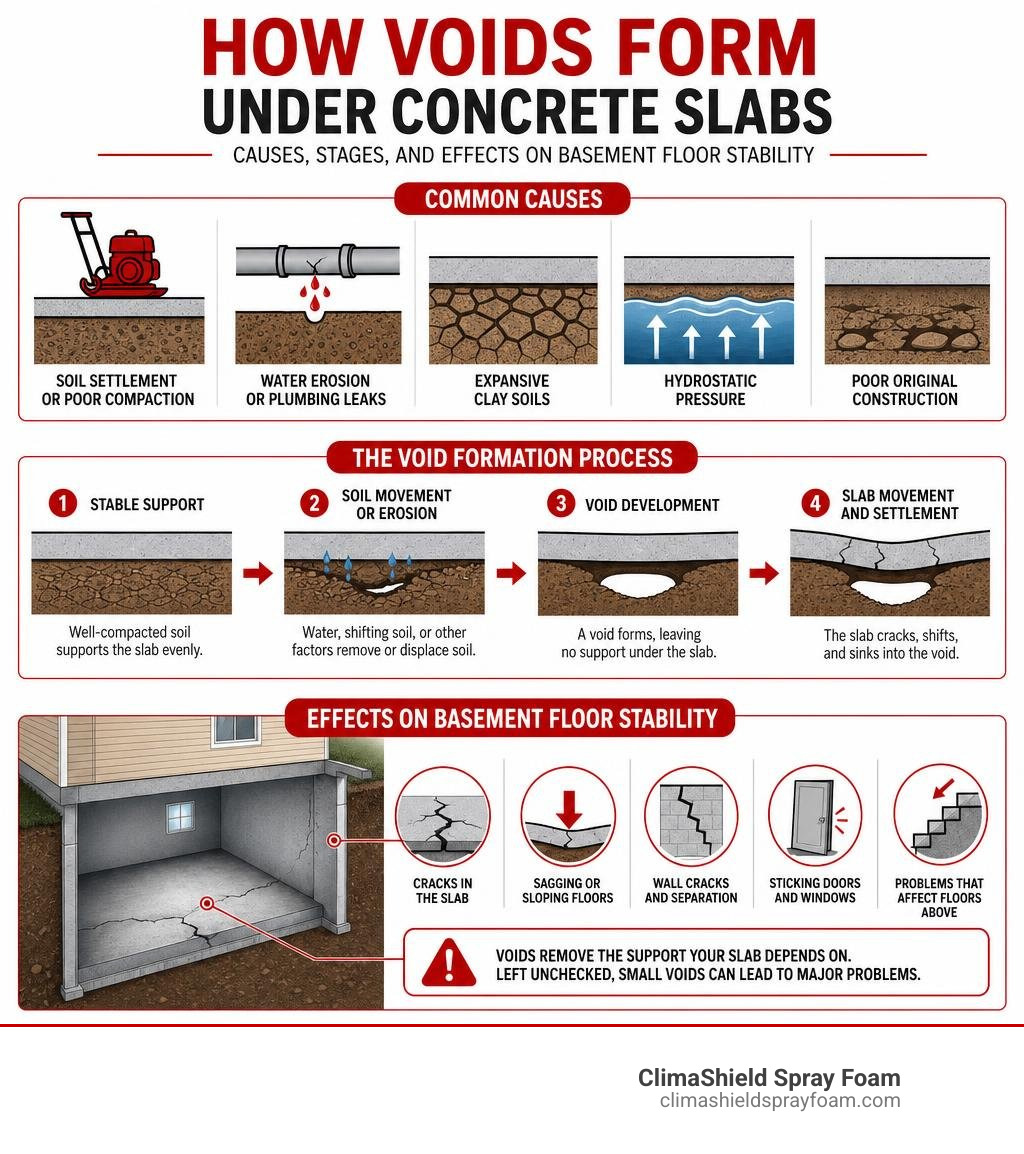
Quick answer: What causes a concrete basement floor to sink?
| Cause | What Happens |
|---|---|
| Soil settlement or poor compaction | Fill soil compresses or shifts, creating voids under the slab |
| Water erosion or plumbing leaks | Water washes soil away, leaving hollow pockets beneath the concrete |
| Expansive clay soils | Clay swells when wet and shrinks when dry, causing repeated movement |
| Hydrostatic pressure | Rising groundwater pushes up or erodes the subgrade |
| Poor original construction | Inadequate compaction during building leaves weak spots from day one |
When voids form beneath your slab, the concrete has nothing to rest on. It cracks. It shifts. It sinks. And if load-bearing walls sit on that slab, the problems can travel all the way upstairs — showing up as sticking doors, cracked drywall, and sloping floors above grade.
This isn’t just a cosmetic issue. It’s a structural one.
Think of your basement floor like a table. It doesn’t matter how strong the tabletop is — if the legs are gone, it falls. Sub-slab voids are the missing legs. They form silently, often over years, and by the time you notice the floor moving, the gap beneath it may already be significant.
One real-world example makes this clear: a homeowner’s basement floor dropped 3.5 to 4 inches in just six months — and that kind of rapid settlement is almost always tied to an underlying soil or water problem that was already brewing long before the floor moved.
The good news? Once you understand what’s happening beneath your feet, the path forward becomes much clearer.
I’m Dave Brocious, and my background in protective coatings, concrete floor systems, and specialty applications — including epoxy, urethane cement, and polyurea coatings — gives me a practical, ground-level understanding of what concrete basement floor sinking does to a structure over time. In this guide, I’ll walk you through what’s really going on under your slab, how to spot the warning signs early, and what actually works to fix it.
Simple guide to concrete basement floor sinking:
Why is Your Concrete Basement Floor Sinking?
To understand why your basement floor is sinking, we have to look at the relationship between the heavy concrete slab and the earth it rests upon. When a home is built, the contractor excavates the foundation hole, pours the footings and basement walls, and eventually pours a concrete slab for the basement floor.
Unlike the foundation footings, which are deeply anchored to handle the weight of the entire house, the basement floor is typically a “floating slab” about three to four inches thick. It is designed to rest directly on the subgrade soil. If that soil changes, shifts, or washes away, the slab has no choice but to follow.
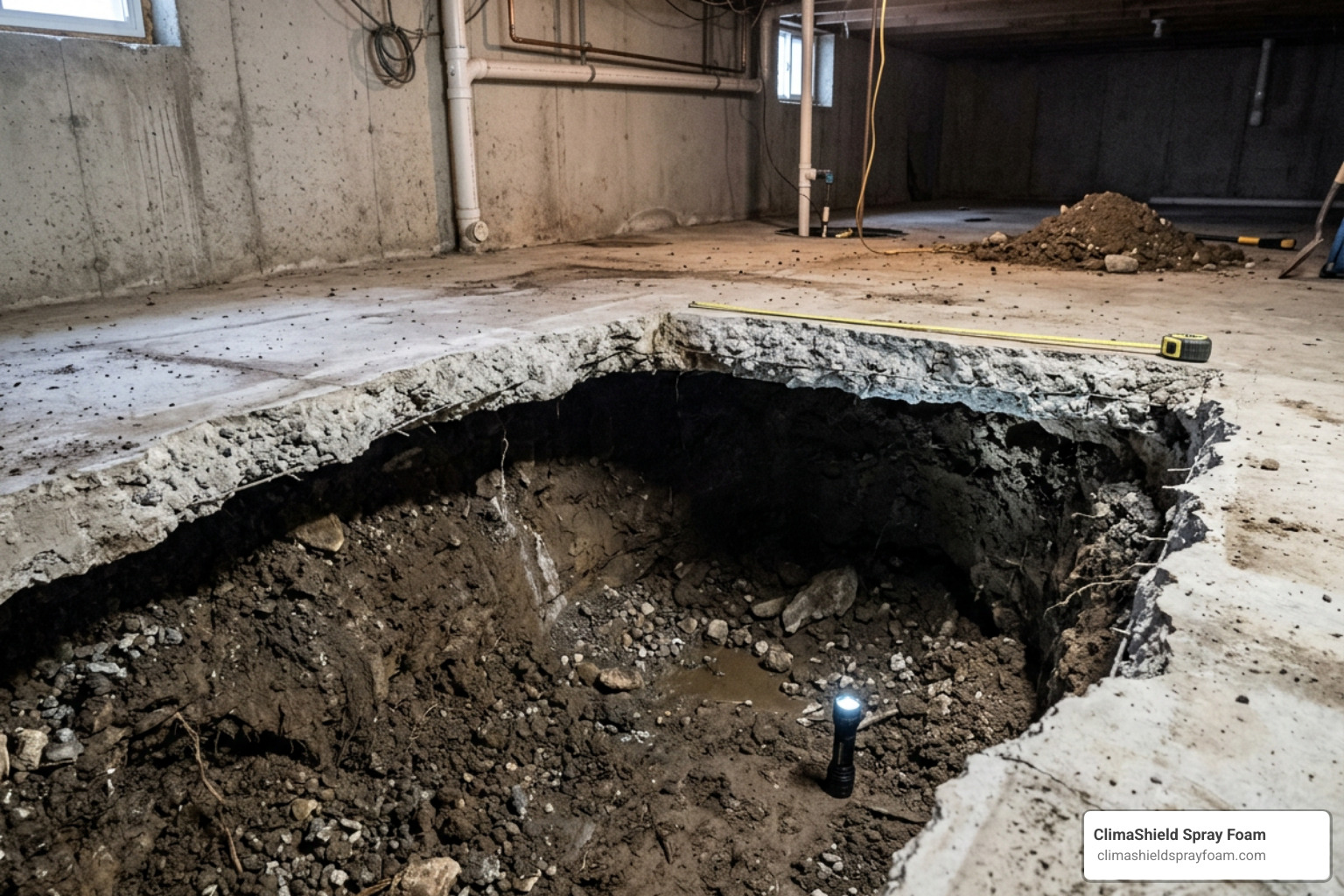
There are several primary culprits behind this movement, and they all start with what is happening in the dirt beneath your home.
Soil Settlement and Poor Compaction
During the construction of many homes in Western Pennsylvania, massive amounts of soil are moved around. To achieve a level surface before pouring the basement slab, “fill soil” is often added to low areas.
If the builder fails to properly compact this fill soil using heavy mechanical compactors, the soil remains loose and full of tiny air pockets. Over time, the sheer weight of the concrete slab, combined with gravity and normal household use, compresses this loose earth. As the soil particles tightly pack together, the ground level drops, leaving a hollow space — or void — directly beneath the concrete.
Hydrostatic Pressure and Water Erosion
Water is the ultimate shape-shifter of the subterranean world, and it is the single greatest enemy of a stable basement floor. In Pennsylvania, our seasonal rains, snowmelt, and high water tables keep the ground highly saturated.
When water pools around your foundation due to clogged gutters or poor grading, it seeks the path of least resistance. It can seep under your foundation walls and travel beneath your basement slab. As this water moves, it physically washes away the fine sand and soil particles supporting your concrete. This process, known as washout or soil erosion, can also be triggered by hidden plumbing leaks under the slab. Over months or years, this slow erosion carves out substantial underground caverns, leaving your heavy concrete floor suspended in midair.
Expansive Clay Soils
In many parts of Pennsylvania, the ground is rich in expansive clay soils. Clay behaves like a giant, underground sponge. When it gets wet, it can expand by up to 20% in volume, exerting an upward force of up to 30,000 pounds per square foot (psf). This immense pressure is more than enough to crack concrete and push floors upward, a process explained in our guide on Basement Floor Heaving When Your House Tries to Stand Up.
However, the real trouble for sinking slabs starts when the wet season ends. During dry summer spells, these clay soils shrink drastically as they lose moisture. As the clay contracts, it pulls away from the underside of the concrete slab, creating massive voids. When the soil shrinks back down, the concrete slab settles into the newly formed empty space, leading to progressive, seasonal concrete basement floor sinking. Nationally, these expansive soil movements cause billions of dollars in annual property losses, making it a major concern for local homeowners.
Identifying the Warning Signs of Slab Movement
Catching a sinking floor early can save you thousands of dollars in structural repairs. While a major drop is hard to miss, the early signs of slab settlement are often subtle. Performing a regular visual inspection of your basement is the best way to catch these issues before they turn into emergencies.
Early Warning Signs of a Concrete Basement Floor Sinking
If you suspect your floor is beginning to settle, look for these common indicators:
- Sloping or Uneven Surfaces: You might feel a slight tilt when walking across the room, or notice that round objects consistently roll toward one wall.
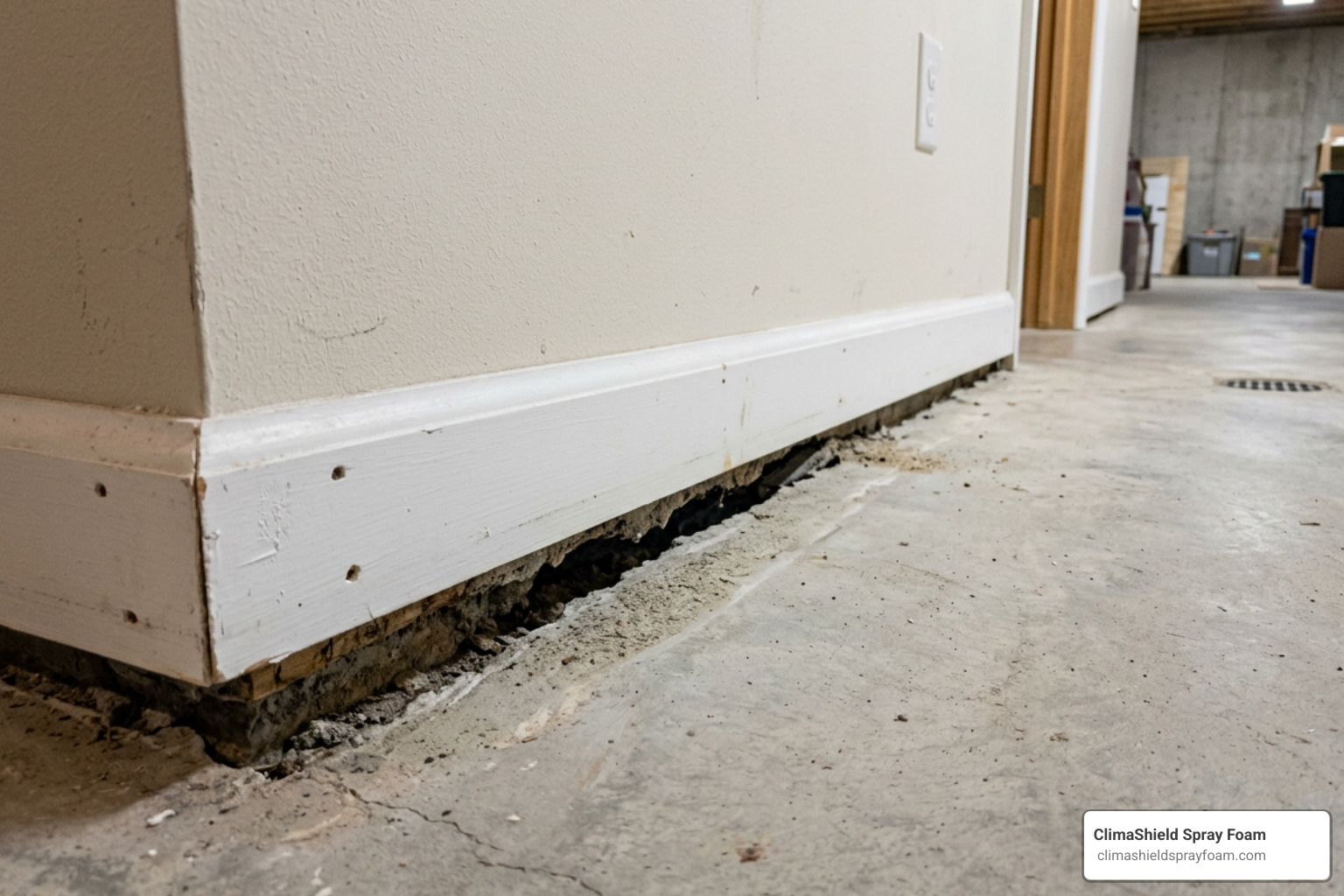
- Gaps at the Baseboards: If you have a finished basement, look closely at where the bottom of the wall meets the floor. If the slab is sinking, you will see a visible gap open up between the baseboard trim and the floor.
- Widening Floor Cracks: While minor hairline cracks can occur from concrete shrinkage during curing, cracks that grow wider, show a height difference from one side to the other, or actively seep water are major warning signs. If you are asking yourself, Is That Floor Slab Crack a Big Deal?, the answer is yes if there is any vertical displacement.
- Sticking Doors and Windows Upstairs: Because interior walls often rest on the basement slab, a sinking floor can pull these walls downward. This slight shift distorts the door and window frames on the main level of your home, causing them to stick or jam.
Distinguishing Settlement from Basement Floor Heaving
It is incredibly common for homeowners to confuse slab settlement (sinking) with slab heaving (rising). However, because they require completely different repair strategies, getting the diagnosis right is critical.
Here is a simple breakdown to help you tell them apart:
| Diagnostic Feature | Slab Settlement (Sinking) | Slab Heaving (Rising) |
|---|---|---|
| Primary Cause | Soil compression, water washout, or shrinking clay | Expansive clay swelling or frost heave (water freezing and expanding 9% by volume) |
| Floor Profile | Dips, depressions, and low spots, often near the center or along walls | Humps, domes, and high spots, often localized near wet areas or utilities |
| Wall Gaps | Gaps open up below baseboards as the floor drops | Walls may buckle, or the floor pushes tightly against the baseboards |
| Crack Patterns | Wide, V-shaped cracks where the slab has dropped away | Hairline to moderate cracks radiating outward from a high central point |
| Seasonal Timing | Often worsens during dry, hot summer spells as clay shrinks | Often peaks in late winter or wet spring as soils saturate and freeze |
The Dangers of Sub-Slab Voids
Ignoring a sinking basement floor is a gamble that rarely pays off. What starts as a minor cosmetic nuisance can rapidly escalate into severe structural damage, safety hazards, and a dramatic drop in your home’s resale value.
The Long-Term Risks of a Concrete Basement Floor Sinking
The most significant danger of a sinking floor is its impact on the rest of your home. While the perimeter walls of your house rest on deep concrete footings, many interior partition walls are built directly on top of the floating basement slab.
When the slab sinks, it pulls these interior walls down with it. This movement transfers structural stress upward through your home, leading to:
- Sagging, unlevel floors on the first and second stories.
- Large, unsightly cracks in upstairs drywall, especially around door frames and corners.
- Damaged plumbing lines that run through or beneath the slab, which can lead to hidden leaks that accelerate the soil erosion cycle.
In extreme cases, if load-bearing columns or support posts rest on a settling slab rather than independent footings, the structural integrity of the entire house can be compromised.
Structural Damage and Water Intrusion
A cracked, sinking basement floor also acts as an open invitation for environmental hazards to enter your home. When a slab cracks and pulls away from the foundation walls, it breaks the airtight seal of your basement. This creates direct pathways for:
- Radon Gas: This invisible, odorless radioactive gas naturally occurs in Pennsylvania soils and can easily seep through floor cracks, reaching dangerous levels in your living spaces.
- Moisture and Water Entry: Hydrostatic pressure can force groundwater up through the cracks, leading to standing water, high humidity, and ruined finished basements.
- Mold and Pests: Damp, dark voids beneath a cracked slab are the perfect breeding ground for mold spores and wood-destroying pests like termites.
Professional Repair Methods for Sinking Slabs
When it comes to stabilizing a sinking basement floor, homeowners are often faced with several choices. The goal is to fill the empty voids beneath the concrete, lift the slab back to its original level, and stabilize the soil to prevent future movement.
Why Polyurethane Foam Injection is the Superior Solution
For decades, the standard method for lifting concrete was “mudjacking,” which involves pumping a heavy slurry of water, soil, sand, and cement under the slab. While mudjacking can lift concrete, it has a major drawback: the slurry is incredibly heavy (weighing up to 100–120 lbs per cubic foot). Adding this massive weight on top of already unstable, failing soil often causes the floor to sink again a few years down the road.
This is why we recommend polyurethane foam injection (often called polyjacking or slab jacking). Instead of heavy grout, we inject a lightweight, high-density geotechnical foam. This foam expands rapidly, filling every nook and cranny of the sub-slab void before curing into a strong, waterproof, and durable support structure.
Using polyurethane foam offers several distinct advantages:
- Lightweight Support: It adds virtually no extra weight to the fragile subgrade soil.
- Waterproof and Durable: Unlike mudjacking slurry, polyurethane foam will never wash away, erode, or degrade when exposed to water.
- Rapid Cure Time: The foam cures and is ready for full weight-bearing use in as little as 15 to 30 minutes, compared to days of drying time for concrete or mudjacking mixes.
- Eco-Friendly: Modern geotechnical foams are environmentally inert and will not leach harmful chemicals into the surrounding soil.
To learn more about how this technology can save your basement, take a look at our detailed articles on Slab Jacking Foam and Stop the Sinking with Foam Concrete Lifting.
How Polyurethane Foam Injection Works
The process of lifting your basement floor with polyurethane foam is remarkably clean, fast, and non-invasive. Here is how we do it:
- Preparation: We map out the settled areas and identify the optimal injection points to ensure an even, controlled lift.
- Drilling: We drill tiny, penny-sized holes (about 5/8 of an inch) through the concrete slab. This is a massive contrast to mudjacking, which requires large, unsightly 2-inch holes.
- Injection: We inject the liquid polyurethane through these holes. As the two-part liquid mixes beneath the slab, a chemical reaction occurs, causing it to expand rapidly.
- Lifting and Consolidation: As the foam expands, it first sweeps through the void, consolidating loose soil particles and filling the empty space. Once the void is filled, the upward pressure gently and precisely lifts the concrete slab back to its original level.
- Patching: Once the lift is complete, we patch the tiny drill holes with non-shrink concrete grout, leaving your floor smooth and ready for paint, carpet, or tile.
Why Pouring New Concrete Over the Old Slab Fails
When faced with an uneven, sinking floor, some homeowners attempt a DIY shortcut: pouring a fresh layer of self-leveling compound or a thin concrete topping directly over the old, sunken slab.
This is a critical mistake.
Pouring new concrete does absolutely nothing to address the hollow voids underneath the original floor. In fact, concrete is incredibly heavy. By adding a new layer of concrete, you are adding hundreds or thousands of pounds of extra weight to an already unstable, failing foundation. This extra load will compress the underlying soils even faster, accelerating the settlement and causing the entire floor to sink further and crack even worse than before.
Preventive Measures to Protect Your Foundation
While professional repairs can permanently restore your sinking floor, taking proactive steps to manage water and protect your soil is the best way to prevent future settlement issues.
Soil Grading and Drainage Improvements
Since water is the primary driver of soil erosion and clay movement, keeping water away from your foundation is paramount.
- Clean Your Gutters: Clogged gutters overflow, dumping thousands of gallons of water directly next to your basement walls. Clean them at least twice a year.
- Extend Your Downspouts: Ensure your downspouts discharge water at least 6 to 10 feet away from your home’s foundation.
- Correct the Grade: The ground surrounding your home should slope away from the foundation walls at a rate of at least 6 inches of drop over the first 10 feet. This simple slope directs rainwater away from the subgrade soils beneath your basement.
Monitoring and Maintenance Tips
Keeping your basement dry and stable requires a little bit of routine maintenance:
- Seal Small Cracks Early: Use a flexible, high-quality concrete caulk to seal minor hairline cracks as soon as they appear. This prevents surface water from seeping under the slab and starting the erosion process.
- Control Indoor Humidity: Use a high-capacity dehumidifier to keep your basement’s relative humidity below 50%. This helps prevent moisture from condensing on the concrete and seeping into the subgrade. For comprehensive moisture protection, explore our guides on Don’t Let Your Basement Get Soggy and installing a Basement Vapor Barrier Wall.
- Schedule Inspections: If you notice new cracks forming after a period of heavy rain or a major freeze-thaw cycle, have a professional evaluate the slab early.
Frequently Asked Questions
How much does it cost to repair a sinking basement floor?
The cost to repair a sinking basement floor depends on the size of the settled area, the depth of the voids, and the repair method used. For a typical residential basement, polyurethane foam injection generally costs between $2,000 and $7,000.
While this is more expensive than a temporary DIY patch, it is significantly cheaper and far less disruptive than tearing out and replacing the entire concrete slab, which can easily cost tens of thousands of dollars and take weeks to complete. If the settlement is structural and requires steel slab piers to reach deep bedrock, the costs can run higher depending on the number of piers needed.
Is polyurethane foam injection a permanent solution?
Yes! When performed correctly by experienced professionals, polyurethane foam injection is considered a permanent, lifetime repair. The high-density geotechnical foam we use does not biodegrade, shrink, or wash away over time. It remains stable in the soil for decades.
However, for the repair to be truly permanent, you must also address any underlying water drainage issues — such as leaking pipes or poor gutter systems — that caused the soil to wash out in the first place.
Can a sinking basement floor cause damage to the rest of the house?
Absolutely. Because your home’s interior walls and partition frames often rest directly on the basement slab, any downward movement of the floor will pull those walls down as well. This structural shift can cause cracked drywall, sticking doors and windows on the upper levels, and even damage to second-story flooring and crown molding. Addressing basement floor issues early prevents these costly cosmetic and structural damages from traveling upstairs.
Conclusion
A sinking basement floor is a clear warning sign that the ground beneath your home is shifting. Whether it is caused by loose fill soil, seasonal clay movement, or water washing away the earth, ignoring sub-slab voids will only lead to larger cracks, water intrusion, and structural damage throughout your entire house.
At ClimaShield Spray Foam, we are dedicated to helping homeowners in Indiana, PA, and throughout Pennsylvania protect their greatest investments. Our high-density polyurethane foam injection systems provide a fast, clean, and permanent solution to lift and stabilize your sinking concrete, filling the voids and putting your home back on solid ground.
Don’t let a sinking floor drag down your home’s comfort, safety, and value. For more information on our advanced concrete leveling services, explore our guide on Geotech Slab Lifting.
Key Takeaways to Remember:
- Voids form when soil settles, shrinks, or washes away, leaving the concrete slab unsupported.
- Pouring new concrete over a sinking floor is a temporary band-aid that actually worsens the problem by adding weight.
- Polyurethane foam injection is lightweight, waterproof, cures in minutes, and provides a permanent lift without the mess of traditional mudjacking.
- Proper water management — including clean gutters and correct soil grading — is essential to protect your foundation for the long haul.
Ready to restore your basement floor? Contact us today to schedule your professional evaluation and take the first step toward a stable, secure home!
