Does Closed-Cell Spray Foam Insulation Actually Block Water?
Closed cell spray foam insulation is waterproof in all the ways that matter most for your home or building — here’s the short answer:
| Property | Closed-Cell Spray Foam |
|---|---|
| Water absorption | Less than 1–2% by volume (ASTM D2842) |
| Vapor permeance | Below 1 perm at 1.25–2 inches (Class II vapor retarder) |
| Flood resistance | FEMA-classified flood-resistant material |
| R-value when wet | Retained — does not degrade like fiberglass |
| Mold risk | Very low when properly installed |
Bottom line: Closed-cell spray foam won’t absorb bulk water, won’t lose its R-value when exposed to moisture, and is recognized by FEMA as a flood-resistant material. It is not 100% “waterproof” in the absolute sense — no insulation is — but it is the most water-resistant insulation widely available today.
Water damage is one of the most expensive problems a property owner can face. Wet insulation doesn’t just lose its ability to keep your building comfortable — it can quietly fuel mold growth, rot structural framing, and drive up your energy bills for months before you even notice. Choosing the wrong insulation for a damp basement, crawl space, or flood-prone area is a costly mistake that many property owners only realize after the damage is done.
That’s why so many homeowners and contractors are asking a very direct question: Is closed-cell spray foam actually waterproof? The answer is more nuanced than a simple yes or no — and understanding the difference between “waterproof,” “water-resistant,” and “watertight” can save you from making the wrong call.
I’m Dave Brocious, founder of ClimaShield Industries, with 20 years in the coatings industry and hands-on experience specifying and installing closed cell spray foam insulation for waterproof and moisture-critical applications across residential and commercial projects. In this guide, I’ll cut through the confusion and give you the facts you need to make a confident decision.
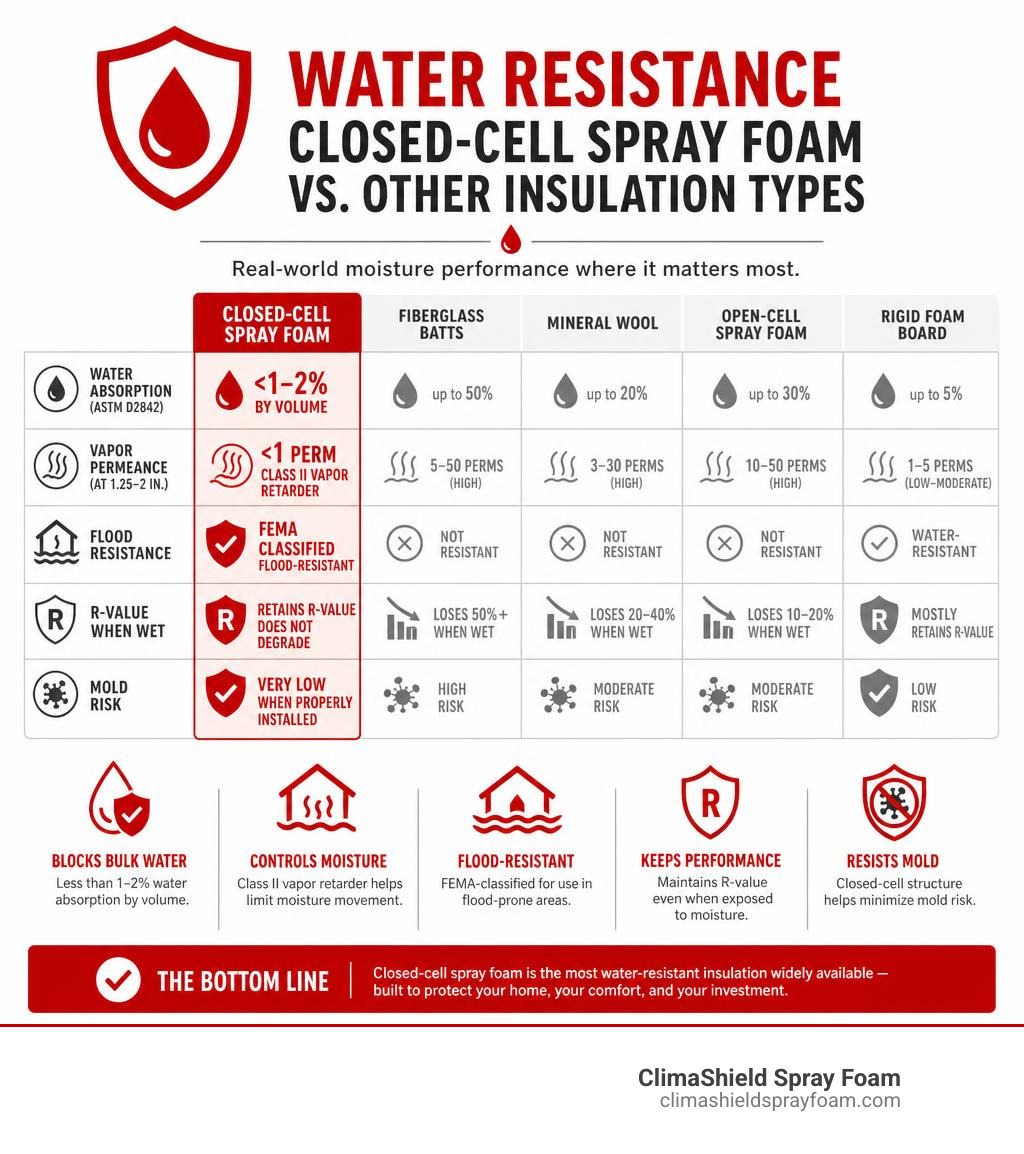
Simple guide to closed cell spray foam insulation waterproof:
Waterproof vs. Water-Resistant: The Science of Moisture Barriers
To understand how insulation handles water, we have to look past the marketing buzzwords and dive into actual building science. In the construction industry, terms like “waterproof,” “water-resistant,” and “watertight” have distinct technical meanings.
- Water-resistant materials can repel water to a certain degree, but prolonged exposure or pressure will eventually cause them to absorb moisture.
- Watertight refers to a system or assembly that is sealed tightly enough to prevent water from passing through under normal operating conditions.
- Waterproof implies an absolute barrier that is completely impervious to water penetration, regardless of exposure time or hydrostatic pressure.
When it comes to insulation, achieving a true “waterproof” status is crucial. Traditional insulation materials like fiberglass batts and cellulose are highly hydrophilic—meaning they love water. If a pipe leaks or humidity spikes in your crawl space, these materials soak up moisture like a sponge.
When fiberglass gets wet, its R-value plummets. Water fills the tiny air pockets that are supposed to trap heat, turning your insulation into a cold, wet blanket. Worse, it holds that moisture against your wood framing, paving the way for structural rot and mold.
If you want to understand the broader mechanics of how different materials handle moisture, check out The Definitive Guide to Waterproof Insulation to see how various barriers stack up against one another.
Is Closed Cell Spray Foam Insulation Waterproof?

The short answer is: yes, closed-cell spray foam is highly water-resistant and acts as a waterproof barrier for all practical residential and commercial applications.
To understand why, we have to look at its physical structure. Unlike open-cell foam – which is full of tiny, interconnected air bubbles – closed-cell foam is composed of millions of microscopic, completely sealed cells. These cells are packed tightly together and filled with a specialized blowing agent. Because the cells are closed, they are inherently hydrophobic (water-repelling). Water cannot easily penetrate the dense, plastic-like matrix of the cured polyurethane.
This dense structure gives closed-cell foam a nominal density of about 2.0 pounds per cubic foot (PCF). This density, combined with its closed-cell nature, allows the material to perform multiple duties at once. When we apply it at a thickness of 1.5 to 2 inches, it doesn’t just insulate; it creates a seamless, monolithic air barrier and functions as a Class II vapor retarder.
If you are dealing with active moisture intrusion points before an insulation project, those leaks should be addressed first so the building assembly is dry and ready for foam. You can learn how to stop the leaks with waterproof spray foam to secure your building envelope.
Why Closed Cell Spray Foam Insulation Waterproof Properties Matter
In a climate like Indiana, PA, where we experience freezing winters, humid summers, and frequent rain, moisture control is everything. The waterproof properties of closed-cell spray foam provide several critical benefits:
- Preservation of Structural Integrity: Because closed-cell foam does not absorb bulk water, it protects the wood studs, rim joists, and roof sheathing it adheres to. It acts as a shield, preventing liquid water from reaching the wood and causing dry rot.
- FEMA Class 5 Flood Resistance: The Federal Emergency Management Agency (FEMA) classifies closed-cell spray foam as a Class 5 Flood-Resistant Material. This is the highest rating possible for building materials. It means the foam can withstand direct contact with floodwaters for up to 72 hours without sustaining significant damage, absorbing water, or losing its structural shape. For reference, FEMA explains these requirements in its flood damage-resistant materials guidance. After a flood, the foam can simply be cleaned, sanitized, and left in place.
- Long-Term Durability: Closed-cell foam has a high compressive strength (typically between 37 to 47 PSI). It doesn’t sag, settle, or pack down over time, even if it is exposed to high humidity or minor bulk water events.
Testing and Standards for Closed Cell Spray Foam Insulation Waterproof Performance
We don’t just rely on our own observations; the water-blocking capabilities of closed-cell foam are backed by rigorous industry testing:
- ASTM D2842 (Water Absorption Test): This standard testing method measures the volume of water absorbed by plastics when submerged. High-quality closed-cell spray foams absorb less than 1% to 2% water by volume under this test. This is an incredibly low absorption rate compared to open-cell foam or fiberglass, which can absorb their own weight in water.
- Vapor Permeance (ASTM E96): Water vapor can travel through materials even if liquid water cannot. Closed-cell spray foam achieves a vapor permeance rating of less than 1.0 perm at a thickness of just 1.25 to 1.5 inches. This officially qualifies it as a Class II vapor retarder. At greater thicknesses (such as 3.5 inches), the perm rating drops even lower (around 0.23 perms), acting as a highly effective vapor barrier that stops condensation in its tracks.
Comparing Closed-Cell to Open-Cell Spray Foam
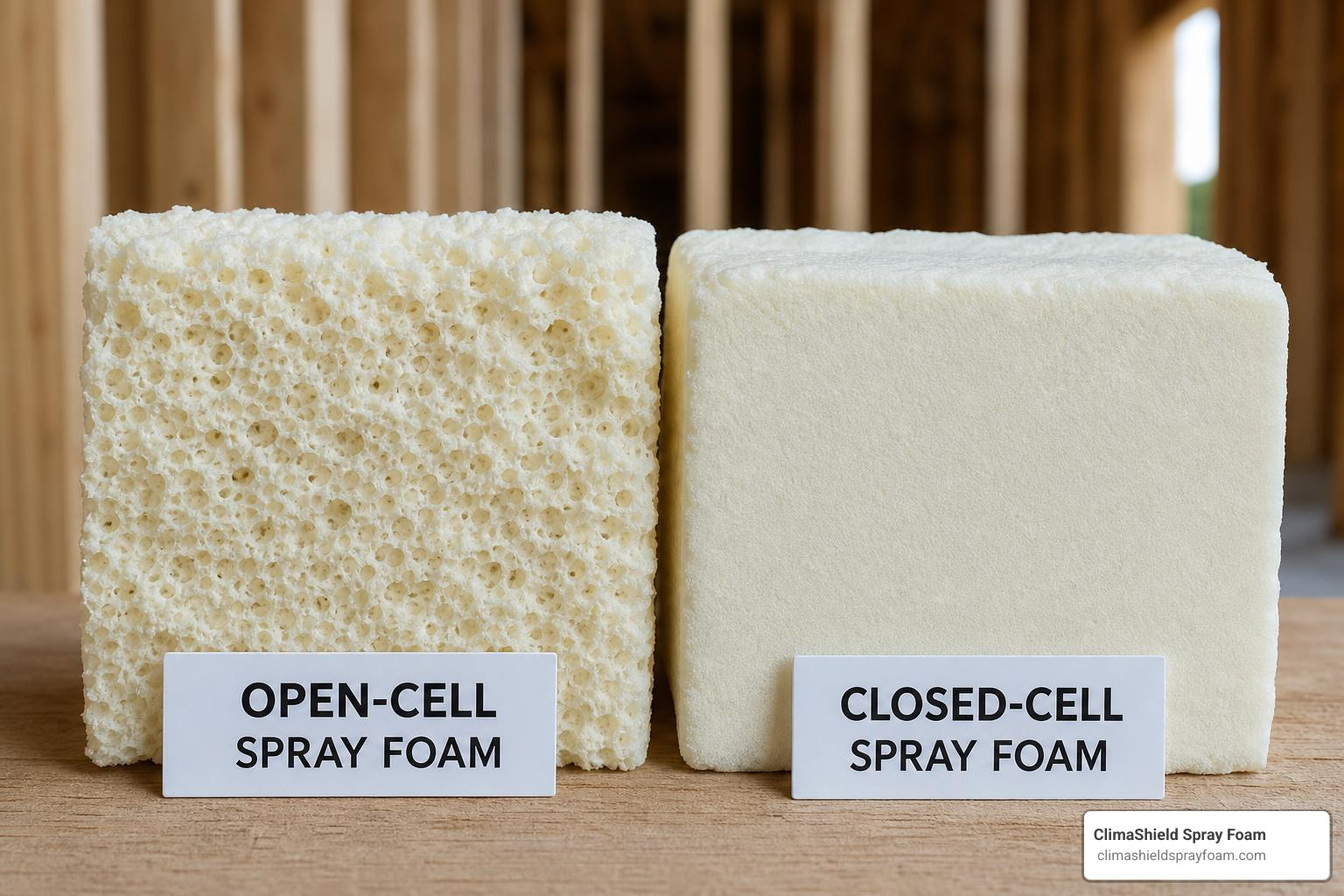
It is common for property owners to confuse closed-cell and open-cell spray foam, but when it comes to water, they behave like two entirely different materials.
Open-cell spray foam is incredibly lightweight (around 0.5 PCF) and flexible. Its cells are intentionally left open, which makes it an excellent sound dampener and a highly cost-effective air barrier. However, because the cells are open, open-cell foam acts like a giant sponge when exposed to water. It has a high vapor permeance (usually 10 to 21 perms), meaning moisture moves through it easily. If open-cell foam gets wet, it holds onto that water, loses its R-value, and must often be torn out and replaced to prevent mold.
To help you visualize the differences, here is a comparison of how different insulation types handle moisture:
| Insulation Type | R-Value per Inch | Water Absorption | Vapor Permeability | R-Value Retention When Wet |
|---|---|---|---|---|
| Closed-Cell Spray Foam | R-6.0 to R-7.2 | Excellent (<2% by volume) | Low (<1 perm at 1.5") | Excellent (100%) |
| Open-Cell Spray Foam | R-3.5 to R-3.8 | Poor (High absorption) | High (10–21 perms) | Poor (Drops significantly) |
| Rigid Foam (XPS) | R-5.0 | Good (~1% by volume) | Low (~1 perm) | Good |
| Fiberglass Batts | R-3.0 to R-4.0 | Poor (Saturates easily) | High (>10 perms) | Extremely Poor (0%) |
For a deeper dive into how these various materials compare in terms of performance and overall project costs, read our guide on exploring insulation types, perks, and prices. If you are still trying to decide which type of foam is best for your specific property, our article on choosing the right spray foam for your home offers practical, step-by-step advice.
Practical Applications and Moisture Protection Strategies
Because of its unique ability to block air, water, and vapor simultaneously, closed-cell spray foam is our go-to recommendation for several high-moisture zones in Western Pennsylvania homes and commercial buildings:
1. Crawl Spaces and Basements
Crawl spaces and basements are notorious for high humidity, damp foundation walls, and seasonal water intrusion. By applying closed-cell spray foam directly to concrete block or poured concrete foundation walls, we create a seamless moisture barrier that stops dampness from seeping into the living space. It also eliminates the cold rim joist condensation that commonly occurs during Pennsylvania’s freezing winter months.
2. Metal Buildings and Pole Barns
Metal structures are highly susceptible to “sweating” – condensation that forms on the underside of metal roof panels when warm, humid indoor air meets cold metal. Spraying closed-cell foam directly onto the metal panels eliminates this thermal bridging and stops condensation from forming, protecting your tools, equipment, or livestock from dripping water.
3. Preventing Mold and Moisture Damage
Mold needs three things to grow: mold spores (which are everywhere), a food source (like wood or drywall), and moisture. By sealing out moisture and air drafts, closed-cell spray foam removes the third and most controllable element of that equation. Because the foam is inorganic, mold cannot use it as a food source. You can read more about these protective mechanisms in our article: Is Spray Foam Insulation Mold Resistant?.
4. Exterior and Outdoor Applications
Can you use closed-cell foam outside? Yes, but with one major caveat: UV protection. While closed-cell foam is highly water-resistant, prolonged exposure to sunlight will degrade the polyurethane over time, causing it to yellow, become brittle, and eventually crumble. For exterior walls, agricultural buildings, or any exposed application, the foam should not be left open to direct sunlight. It must be protected with an approved exterior covering or finish that is appropriate for the specific assembly.
To explore all the creative and structural ways this material can be applied to protect your property, check out our comprehensive guide on the uses of spray foam.
Frequently Asked Questions about Spray Foam and Water
Can closed-cell spray foam get wet during a flood?
Yes. Because it is a FEMA Class 5 flood-resistant material, closed-cell spray foam can handle direct immersion in floodwaters. Unlike fiberglass or cellulose, which must be discarded after a flood due to contamination and structural collapse, closed-cell foam maintains its shape, adhesion, and R-value. Once the floodwaters recede, the foam can be pressure-washed, disinfected, and left in place, saving property owners thousands of dollars in reconstruction costs.
Does closed-cell spray foam require an additional vapor barrier?
In most cases, no. When applied at a thickness of 1.5 to 2 inches, closed-cell foam achieves a perm rating below 1.0, making it an approved Class II vapor retarder under the International Residential Code (IRC). Adding an extra plastic poly vapor barrier over the foam can actually trap moisture inside the wall cavity, leading to rot. However, always consult with a professional who understands local building codes in Pennsylvania to ensure compliance for your specific climate zone.
Can mold grow behind closed-cell spray foam?
If closed-cell foam is installed correctly by a certified professional, it adheres directly to the substrate (wood, concrete, or metal), leaving zero air gaps. Without air gaps, moisture cannot condense behind the foam, and mold cannot grow.
However, if the foam is applied to a wet substrate (wood with a moisture content over 18%), or if the installer leaves gaps due to poor technique, moisture can become trapped. This is why proper surface preparation and professional installation are absolutely critical.
Conclusion
When it comes to protecting your property from the elements, closed cell spray foam insulation waterproof qualities make it one of the most reliable and durable investments you can make. It doesn’t just keep your home warm in the winter and cool in the summer; it acts as a permanent shield against drafts, humidity, and water damage.
At ClimaShield Spray Foam, we specialize in helping homeowners and businesses in Indiana, PA, and surrounding Western Pennsylvania areas secure their properties. Our professional-grade closed-cell insulation systems can save you up to 60% on your energy bills while providing a durable, airtight, and highly water-resistant seal that resists mold and pests for decades to come.
Ready to protect your property from moisture and high energy bills? Explore the many uses of spray foam or contact us today to schedule your professional assessment!
