Why Adding Roof Insulation Is One of the Best Home Upgrades You Can Make
Adding roof insulation is the single most impactful step most homeowners can take to cut energy bills and stay comfortable year-round. Here’s a quick summary of what you need to know:
The three safest methods for insulating your roof:
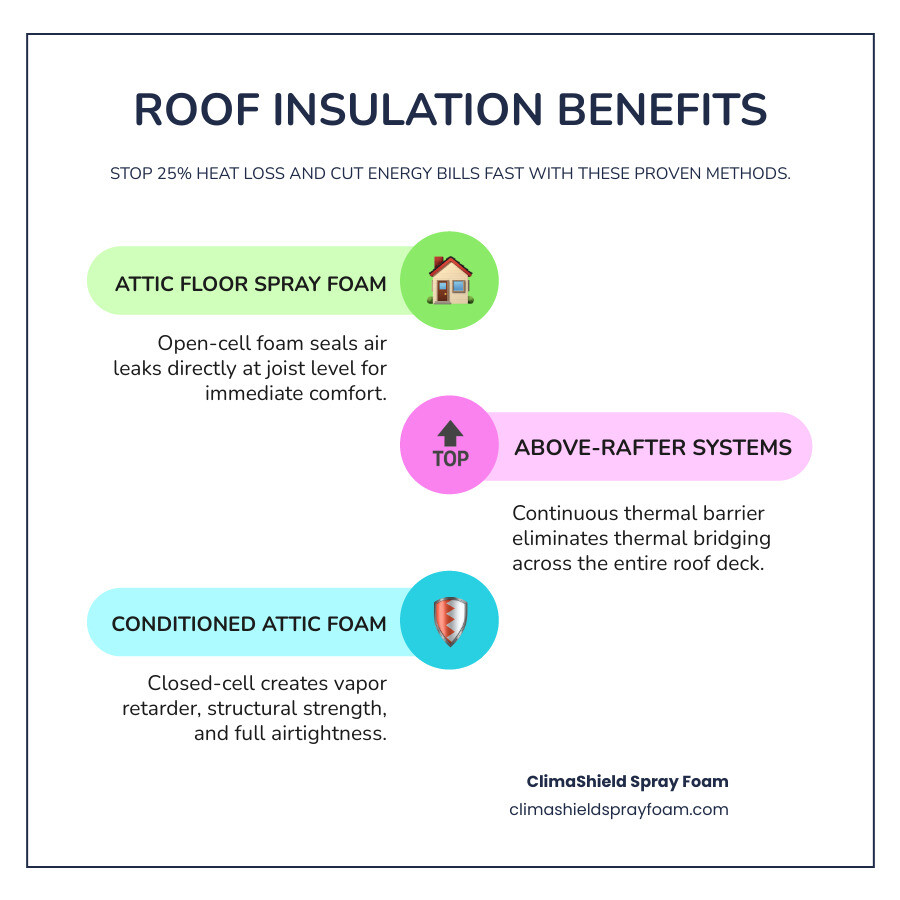
- Spray foam on the attic floor — open-cell foam seals air leaks at joist level
- Above-the-rafter spray foam systems — continuous thermal barrier that eliminates thermal bridging
- Closed-cell spray foam for conditioned attics — vapor retarder, structural reinforcement, and airtightness in one
An uninsulated home loses around 25% of its heat through the roof. That’s a quarter of every dollar (or pound) you spend on heating, rising straight out of your home before it can keep you warm.
The good news? Roof insulation fixes this fast. Most homeowners see their investment pay for itself within four to five years — and the right insulation can last 40 years or more.
Whether you’re dealing with drafty rooms, high heating bills, or cold ceilings, the root cause is often the same: heat escaping through an under-insulated roof.
I’m Dave Brocious, founder of ClimaShield Industries and a specialty coatings and spray foam contractor with over 20 years of experience — including adding roof insulation across hundreds of residential and commercial projects. In this guide, I’ll walk you through the three safest, most effective methods so you can make the right call for your home.
Important adding roof insulation terms:
The Fundamentals of Adding Roof Insulation
When we talk about adding roof insulation, we are talking about more than just tossing some material into a dark corner of your house. We are creating a “thermal envelope.” Think of it like a high-quality winter coat for your home. If that coat has holes (air leaks) or is too thin (low R-value), you’re going to feel the bite of a Pennsylvania winter.
Proper insulation works by providing thermal resistance, slowing down the rate at which heat moves through your building materials. In the winter, it keeps the heat inside your living spaces. In the summer, it prevents the sun’s radiation from baking your attic and driving up your cooling costs.
Beyond just temperature, modern insulation is a powerhouse for moisture control. By preventing warm, moist indoor air from hitting cold roof surfaces, we stop condensation in its tracks. This is vital for preventing wood rot and mold growth. For a deeper dive into these concepts, check out An Essential Guide to Roof Insulation or our Residential Insulation Complete Guide.
Recommended R-Values and Building Codes
R-value is the measure of a material’s ability to resist heat flow. The higher the R-value, the better the insulation performance. In Pennsylvania, including areas like Indiana PA, we deal with significant seasonal temperature swings, which means our building codes are strict.
Current energy standards often recommend attic insulation levels between R-49 and R-60 for our region. To put that in perspective, if you were using traditional loose-fill fiberglass, you’d need nearly 20 inches of material to hit those targets! Spray foam allows us to achieve high performance with a much slimmer profile because of its superior R-value per inch.
You can find specific state-by-state data via the Minimum Insulation R-value Requirements by State and State Energy Code Fact Sheets | PIMA.
Key Considerations Before Adding Roof Insulation
Before we spray a single drop of foam, we have to look at the “health” of your roof. Adding roof insulation over a problem is like putting a band-aid on a broken leg. We always check for:
- Damp issues: Any existing leaks must be repaired. Insulation is not a roof repair tool; it’s a performance upgrade.
- Ventilation gaps: In a traditional vented attic, we must ensure that we don’t block the airflow from the eaves to the ridge.
- Storage needs: If you plan on walking in your attic or storing heavy boxes, we need to choose a method that doesn’t compress the insulation.
- Air leakage points: Most heat loss isn’t just through the material; it’s through “bypasses”—tiny gaps around pipes, wires, and attic hatches.
Three Safest Methods for Insulating Your Roof

There are many ways to skin a cat, but in building science, three methods stand out as the safest and most effective for homeowners in our climate.
| Feature | Attic Floor Spray Foam | Above-the-Rafter System | Conditioned Attic (Closed-Cell) |
|---|---|---|---|
| Primary Goal | Stop heat leaving living space | Stop heat at the roofline | Create usable, tempered space |
| Material | Open-cell spray foam | Rigid foam/Spray foam hybrid | Closed-cell spray foam |
| Air Sealing | Excellent at joist level | Continuous over roof deck | Absolute at the rafter line |
| Vapor Barrier | Breathable | External | Built-in Class 2 Retarder |
Method 1: Spray Foam for Attic Floors (Open-Cell)
This is the most common approach for homeowners who use their attic only for “dead” storage or not at all. We apply open-cell spray foam directly to the attic floor (between the joists).
The magic here is the air sealing. Unlike fiberglass batts, which act like a dusty filter that air can blow right through, open-cell foam expands to fill every nook and cranny. This stops the “chimney effect” where warm air is sucked out of your home through recessed lights and wire penetrations. It’s an incredibly cost-effective way to boost your Energy Saving Insulation performance.
Method 2: Above-the-Rafter Spray Foam Systems
This is often called a “warm roof” setup. Instead of putting insulation inside the house, we place it on top of the structural roof deck, usually during a roof replacement.
This method is the gold standard for preventing “thermal bridging.” In a normal house, the wood rafters act as bridges that let heat bypass the insulation. By wrapping the entire roof from the outside in a continuous layer of high-performance foam, we eliminate those bridges entirely. It protects the roof deck from temperature extremes and moisture. Learn more about this at Above the Rafters: The Smart Way to Insulate Your Pitched Roof.
Method 3: Closed-Cell Spray Foam for Conditioned Attics
If you want to turn your attic into a home office, a playroom, or just a safe place to store your wedding photos without them melting in July, this is the way to go. We apply closed-cell spray foam directly to the underside of the roof deck.
Closed-cell foam is dense and rigid. It doesn’t just insulate; it actually adds structural strength to your roof. Most importantly for Pennsylvania homes, it acts as a Class 2 vapor retarder. This means moisture from inside your house can’t reach the cold roof sheathing, preventing rot. It effectively brings your attic “inside” the conditioned space of your home.
Check out our guides on Choosing the Right Spray Foam for Your Home and Is Spray Foam Roofing Right for Your Next Project? for more details.
Why Spray Foam Is a Smart Choice for Roof Insulation
Why do we specialize in spray foam rather than old-fashioned rolls of pink stuff? It comes down to three words: Continuous Air Barrier.
Traditional insulation materials like fiberglass or cellulose are “air permeable.” If you have a gap in your drywall, air will simply move through the insulation. Spray foam is the only product that insulates and air-seals in one single step.
For homeowners adding roof insulation, spray foam offers:
- Long-term Stability: It won’t sag, settle, or pack down over time, meaning your R-value stays the same for decades.
- Reduced Drafts: By stopping air movement, we eliminate those annoying cold spots in your home.
- Moisture Resistance: Closed-cell foam is waterproof and does not provide a food source for mold.
- Pest Deterrence: It’s much harder for mice or squirrels to nest in dense foam than in soft fiberglass.
If you are wondering which rafter approach is best for you, see What’s the Best Rafter Insulation? Your Roof Deserves the Top Picks.
Costs, Savings, and Financial Support in 2026
Let’s talk turkey. How much does adding roof insulation cost, and when do you get your money back?
In 2026, the average professional loft or attic insulation project can range from $1,500 to $4,000 depending on the size of the home and the type of foam used. While that’s more expensive than a DIY bag of cellulose, the ROI is significantly higher.
The Savings Breakdown:
- Heating/Cooling Bills: Homeowners typically save between 15% and 25% on their total energy bills. In some cases, we’ve seen customers save up to 60% after a full home seal.
- Payback Period: At current energy prices, most systems pay for themselves in 4 to 5 years.
- Home Value: Energy-efficient homes are currently selling for up to 14% more than their uninsulated neighbors.
There is also financial help available. In 2026, various federal and state programs provide tax credits and rebates for energy efficiency upgrades. You can check resources like Bill Busters: Home to find current local incentives for Pennsylvania residents.
Professional Installation vs. DIY for Adding Roof Insulation
We love the DIY spirit, but adding roof insulation—specifically spray foam—is a job for the pros. Here’s why:
- Chemical Precision: Spray foam requires a precise 1:1 ratio of chemicals heated to specific temperatures. If the mix is off by even a little, the foam may not cure properly, leading to odors or poor performance.
- Safety: Our installers use full-body suits and fresh-air supplied respirators. The fumes during the application process are not something you want to breathe in.
- Code Compliance: We ensure that fire-rated coatings are applied where necessary and that all local Indiana PA building codes are met.
- Equipment: The professional “rigs” we use cost over $100,000. The small “froth kits” you find at big-box stores are fine for filling a gap around a window, but they are incredibly expensive and inconsistent for a whole-roof project.
Frequently Asked Questions about Roof Insulation
Can I install roof insulation myself?
You can certainly handle some of the “prep” work, such as clearing out old junk or sealing small gaps with canned foam. However, for a full-scale upgrade, especially with spray foam, it is safer and more effective to hire a professional. We have the thermal imaging cameras to find hidden leaks that the naked eye misses.
How long does roof insulation typically last?
If installed correctly, spray foam insulation is designed to last the lifetime of the building. Unlike mineral wool or fiberglass, which can settle or be ruined by a single roof leak, closed-cell spray foam is durable and moisture-resistant. It typically maintains its R-value for 40 to 50 years.
What are the benefits beyond energy savings?
- Comfort: No more “hot upstairs” in the summer.
- Noise Reduction: Spray foam is an excellent sound dampener, perfect if you live near a busy road or have a metal roof.
- Pest Resistance: It seals off the entry points that bugs and rodents use to get into your attic.
- Structural Integrity: Closed-cell foam can actually increase the wind-uplift resistance of your roof.
Conclusion
At ClimaShield Spray Foam, we believe that every homeowner deserves a home that is cozy, efficient, and healthy. Adding roof insulation is the most effective way to achieve that goal. From our base in Indiana PA, we’ve helped countless neighbors across Pennsylvania transform their drafty attics into high-performance thermal barriers.
Whether you choose an open-cell floor seal or a full closed-cell conditioned attic, you’re making an investment that pays dividends in comfort and cash for decades to come. Ready to stop throwing money out through your roof? Discover the many uses of spray foam for your home and let’s get your project started.
