Why Uneven Concrete Is a Problem You Shouldn’t Ignore
A concrete raising specialist can be the difference between a safe, level surface and a costly liability waiting to happen. Before diving into the full guide, here’s a quick answer to what you should look for:
Quick Answer: What to Look for in a Concrete Raising Specialist
- Experience — Look for contractors with a proven track record and many completed projects
- Method — Polyurethane foam injection is faster, cleaner, and less invasive than traditional mudjacking
- Warranty — A reputable specialist should offer at least a 5-year warranty on workmanship
- Cost transparency — Expect pricing in the $2–$5 per square foot range, roughly half the cost of full replacement
- No heavy equipment on your lawn — Professional crews use hoses and portable rigs, not heavy trucks on your property
- Same-day usability — Quality foam-based lifting cures in as little as 15 minutes
That sunken slab in your driveway or along your walkway isn’t just an eyesore. It’s a trip hazard, a drainage problem, and — in some cases — a legal liability. In fact, New York City alone settled $60 million in trip hazard lawsuits in a single year. Left untreated, uneven concrete only gets worse as the soil beneath it continues to shift, erode, or compact unevenly.
The good news? In most cases, you don’t need to tear it out and start over. Concrete raising is a faster, more affordable solution — and choosing the right specialist makes all the difference.
I’m Dave Brocious, founder of ClimaShield Industries, with 20 years of experience in specialty coatings, concrete floor systems, and spray foam applications — all areas that intersect directly with what a qualified concrete raising specialist does and the materials they rely on. That background gives me a practical lens for helping you evaluate who’s worth hiring and why.
Must-know Concrete raising specialist terms:
Understanding the Role of a Concrete Raising Specialist
When you notice a corner of your patio dipping or your garage floor developing a suspicious slope, you might think you need a mason or a demolition crew. In reality, you need a concrete raising specialist. These professionals specialize in “slabjacking” or “polyjacking”—the art and science of restoring sunken concrete to its original height without removing the existing slab.
A specialist doesn’t just “lift” things; they are experts in subgrade stabilization. They look beneath the surface to identify why the concrete moved in the first place. Whether it is filling a massive void created by a broken pipe or stabilizing loose soil that wasn’t compacted correctly during your home’s construction, their goal is to create a permanent, stable foundation. For a deeper dive into these professional services, check out Your Essential Guide to Concrete Lifting.
How Concrete Raising Works
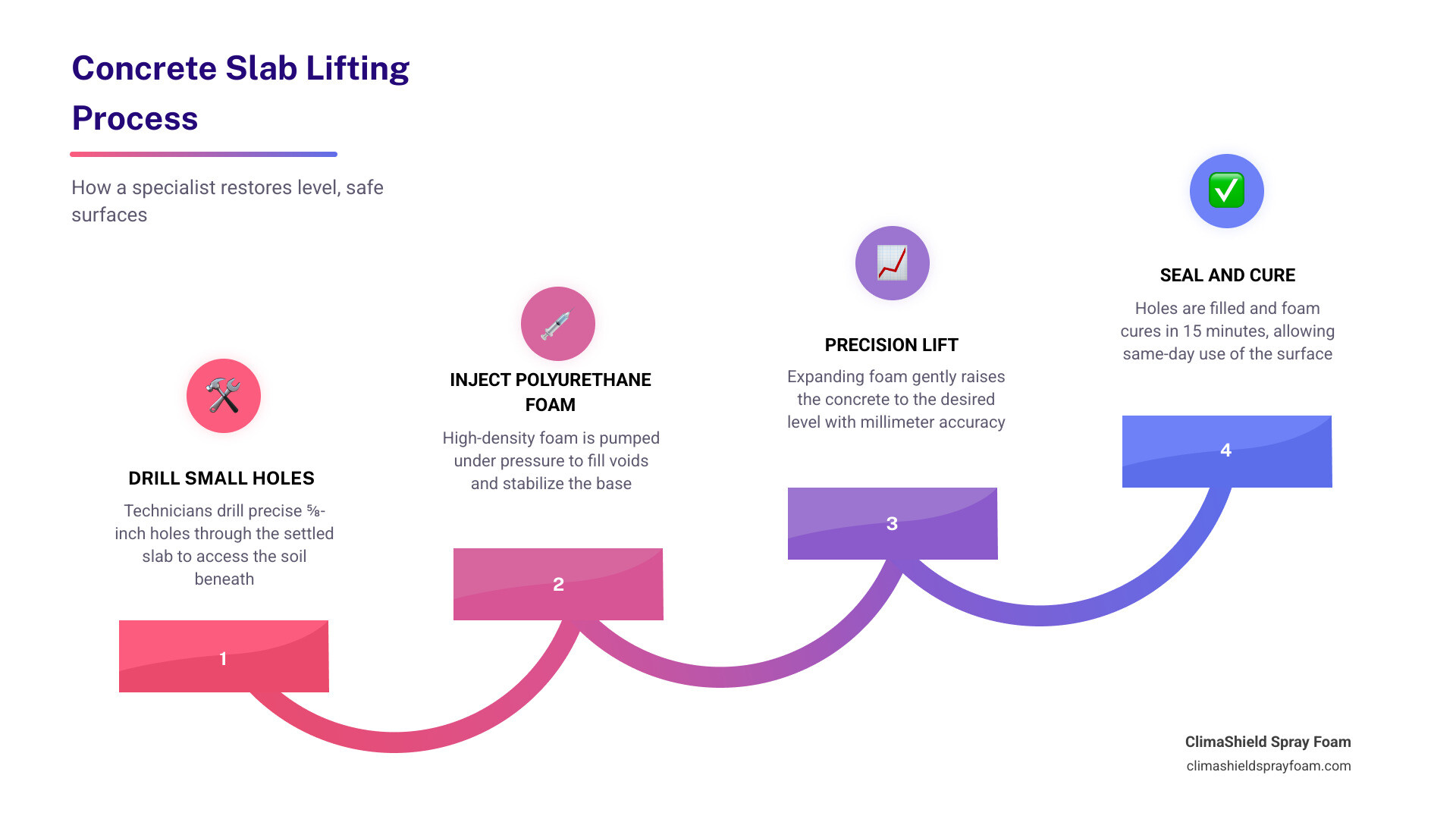
The process is remarkably surgical. A concrete raising specialist begins by drilling a series of small, strategically placed injection holes—usually no larger than a penny (about 5/8 of an inch). Through these holes, they inject a specialized material (either a cement-based slurry or a high-density polyurethane foam) under the slab.
As the material expands or fills the space, it creates upward pressure. This expansion is controlled with extreme precision, allowing the specialist to monitor the lift in real-time. Once the slab reaches the desired height, the holes are patched with a concrete mixture that blends into the existing surface. This precision is what makes the process so effective for everything from simple sidewalks to complex Slab Lifting 101 projects.
Common Causes of Sinking Slabs
Understanding why your concrete is sinking is the first step in ensuring a long-lasting repair. In our region of Pennsylvania, several factors are usually at play:
- Soil Erosion: Heavy rains or poor drainage can wash away the supporting soil beneath a slab, leaving a hollow “void.”
- Poor Compaction: If the soil wasn’t properly packed down before the concrete was poured, it will naturally settle over time under the weight of the slab.
- Moisture Fluctuations: In Indiana, PA, our clay-heavy soils expand when wet and shrink during dry spells. This constant “breathing” of the earth can leave concrete unsupported.
- Freeze-Thaw Cycles: Water that gets under the slab freezes and expands, then thaws and leaves gaps, leading to a cycle of instability.
To understand how these factors affect your home specifically, read Beyond the Cracks: A Homeowner’s Guide to Understanding Slab Foundation Settling.
Polyurethane Foam vs. Mudjacking: Which Method is Best?
For decades, “mudjacking” was the only game in town. It involves pumping a heavy mixture of sand, water, and cement (slurry) under the concrete. However, modern specialists increasingly prefer polyurethane foam. Here is a breakdown of how they compare:
| Feature | Polyurethane Foam | Traditional Mudjacking |
|---|---|---|
| Weight | ~2 lbs. per cubic foot | ~100 lbs. per cubic foot |
| Hole Size | 5/8 inch (Penny size) | 1 5/8 inch (Soda can top size) |
| Cure Time | 15–30 minutes | 24–72 hours |
| Durability | Waterproof; won’t wash away | Can erode or shrink over time |
| Lawn Impact | Minimal (hoses only) | High (heavy trucks/pumps) |
While mudjacking is still used for certain agricultural or large-scale void-filling projects, polyurethane is the gold standard for residential work. Its lightweight nature is a massive advantage; adding 100 lbs of mudjacking slurry to already failing soil can sometimes cause the slab to sink again. Foam, on the other hand, stabilizes the soil without adding significant weight. Learn more about the technical side of this at Geotech Slab Lifting.
The Benefits of Choosing a Polyurethane Concrete Raising Specialist
Choosing a specialist who uses polyurethane foam offers several unique advantages. First, the material is eco-friendly. Many modern foams contain up to 40% renewable content and are USDA Certified Biobased. Because the foam is waterproof, it won’t wash away during the next Pennsylvania thunderstorm, providing a much more permanent fix than soil-based mixtures.
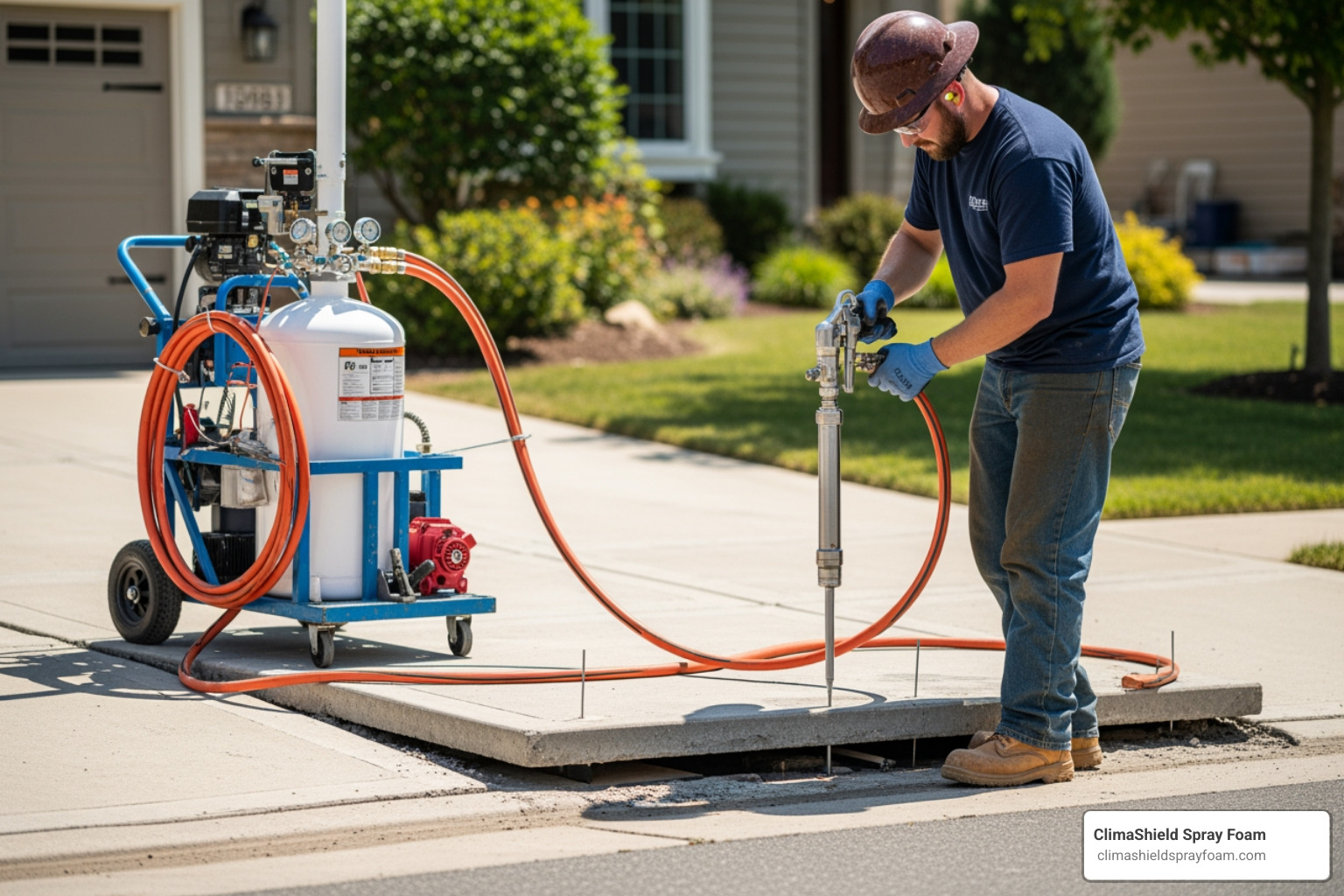
The process is also incredibly non-invasive. Because the equipment is often contained in a truck parked on the street, there is no need for heavy machinery to drive across your lawn. The foam is injected as a liquid, then expands and hardens into a rigid, structural solid that bonds with the soil. This makes it an ideal solution for homeowners who want a “one and done” repair. For more details, see How to Understand Concrete Lifting Foam in 5 Easy Steps.
Why Raising is Superior to Full Concrete Replacement
Many homeowners assume that if a driveway is cracked or sunken, it needs to be replaced. This is a costly misconception. A concrete raising specialist can typically complete a repair for about 50% of the cost of full replacement.
Beyond the financial savings—which have totaled over $20 million for customers across various industries—there is a significant environmental benefit. Every year, millions of pounds of concrete are saved from landfills through slabjacking. Instead of contributing to the 3.5 million pounds of concrete waste generated annually by unnecessary demolition, lifting reuses the perfectly good concrete you already have. It’s a sustainable choice that protects your wallet and the planet. This is especially true for Residential Concrete Lifting: Your Foundation for a Stable Home.

Surfaces a Concrete Raising Specialist Can Restore
If it’s a solid slab of concrete, a specialist can likely lift it. This includes:
- Driveways and Sidewalks: Eliminating trip hazards and restoring curb appeal.
- Pool Decks: Ensuring the area around your pool is level to prevent water from pooling or people from tripping.
- Garage and Warehouse Floors: Restoring a flat surface for vehicles or heavy machinery.
- Interior Slabs: Basement floors can be lifted cleanly with foam, as the material is non-toxic and low-odor.
- Stamped and Decorative Concrete: Because the injection holes are so small, a specialist can often patch them to match the color and texture of your decorative concrete, making the repair virtually invisible.
If you are worried about a specific crack, check out Is That Floor Slab Crack a Big Deal? to see if you need professional intervention.
Evaluating a Reputable Concrete Raising Specialist
Not all contractors are created equal. When you are looking for a concrete raising specialist in Indiana, PA, or the surrounding areas, you need to look past the price tag and evaluate their professionalism.
Check the Warranty: A reputable specialist should offer a solid guarantee. Many top-tier companies offer a 5-year warranty on workmanship and settlement. If the foam or the installation fails, they should come back and fix it. Some even offer transferable coverage, which adds value if you decide to sell your home.
Experience Matters: Look for a team that has completed thousands of projects. Concrete raising is as much an art as it is a science; knowing exactly how much foam to inject to get a perfectly level result takes years of practice. You want a crew that uses professional injection equipment and has a deep understanding of local soil conditions. To ensure you’re getting the best service, read How to Repair Concrete Slab the Right Way.
Frequently Asked Questions about Concrete Leveling
How long does the process take and is it disruptive?
One of the best things about hiring a concrete raising specialist is the speed. Most residential projects—like a two-car driveway or a front walkway—are completed in just a few hours. Because polyurethane foam cures in about 15 to 30 minutes, the surface is ready for full use the same day. You can drive your car onto a lifted driveway almost immediately after the crew packs up. The noise is minimal, and because no heavy machinery is required on your lawn, your landscaping remains untouched. For more on the convenience of this method, see Stop the Sinking with Foam Concrete Lifting.
How much does concrete raising typically cost?
While every project is unique, most concrete raising falls into the $2 to $5 per square foot range. This is usually about half the cost of tearing out the old slab, hauling it away, and pouring new concrete. Factors that influence the cost include the size of the area, the depth of the voids underneath, and the amount of material required to achieve a level surface. Many specialists now offer virtual estimates—you can simply send a photo of your sunken slab and receive a quote without anyone even visiting your home. Learn more about the materials involved in Slab Jacking Foam.
Is the lifting material environmentally friendly?
Yes! The high-density polyurethane used by modern specialists is non-toxic and inert once cured. It won’t leach chemicals into the surrounding soil or groundwater. Furthermore, by choosing to lift instead of replace, you are reducing landfill waste and the carbon footprint associated with manufacturing and transporting new concrete. It’s a win for your property and the environment. For an expert perspective on the materials, check out Raising Concrete with Spray Foam: What Experts Say About Going Solo.
Conclusion
At ClimaShield Spray Foam, we understand that the integrity of your home starts from the ground up. While we are known for our energy-saving insulation that can cut utility bills by up to 60%, our expertise in polyurethane technology extends to the very foundations of your property. A sunken slab is more than just a minor annoyance; it is a threat to your home’s structural integrity and your family’s safety.
By choosing a professional concrete raising specialist, you are investing in a long-term, stable solution that saves you time, money, and stress. Don’t let a sinking driveway or a tripping hazard on your sidewalk decrease your property value. Whether you’re in Indiana, PA, or anywhere in Pennsylvania, our team is committed to providing durable, waterproof, and airtight solutions for your home.
Contact our specialists for a geotech slab lifting assessment today and let us help you get back on level ground!
