
What High Density Foam Actually Is (And Why It Matters)
High density foam is a category of foam material that contains more physical matter per cubic foot than standard foam — making it stronger, more supportive, and longer-lasting.
Here’s a quick snapshot of what you need to know:
| Feature | High Density Foam |
|---|---|
| Density | Typically 2.5 lbs per cubic foot or higher |
| Best for | Seating, insulation, mattresses, packaging, industrial use |
| Key benefit | Resists sagging, compression, and breakdown over time |
| Common types | Polyurethane, melamine, closed-cell spray foam |
| Firmness rating | Measured in ILD/IFD (higher number = firmer feel) |
Most people come across high density foam in sofa cushions, mattresses, or spray foam insulation — but its uses go far beyond furniture. From wheelchair cushions to aircraft cabin seats to building insulation that cuts energy bills, this is one of the most versatile materials in modern construction and manufacturing.
The core reason it matters? Low density foam breaks down faster. It compresses, sags, and loses its shape under repeated use or pressure. High density foam holds up — sometimes for decades.
I’m Dave Brocious, founder of ClimaShield Industries and a specialty coatings contractor with over 20 years of experience in the coatings and insulation industry, including hands-on work with high density foam in spray foam insulation applications across commercial and residential projects. In the sections ahead, I’ll walk you through everything — from how density ratings work to which type of foam is right for your specific situation.
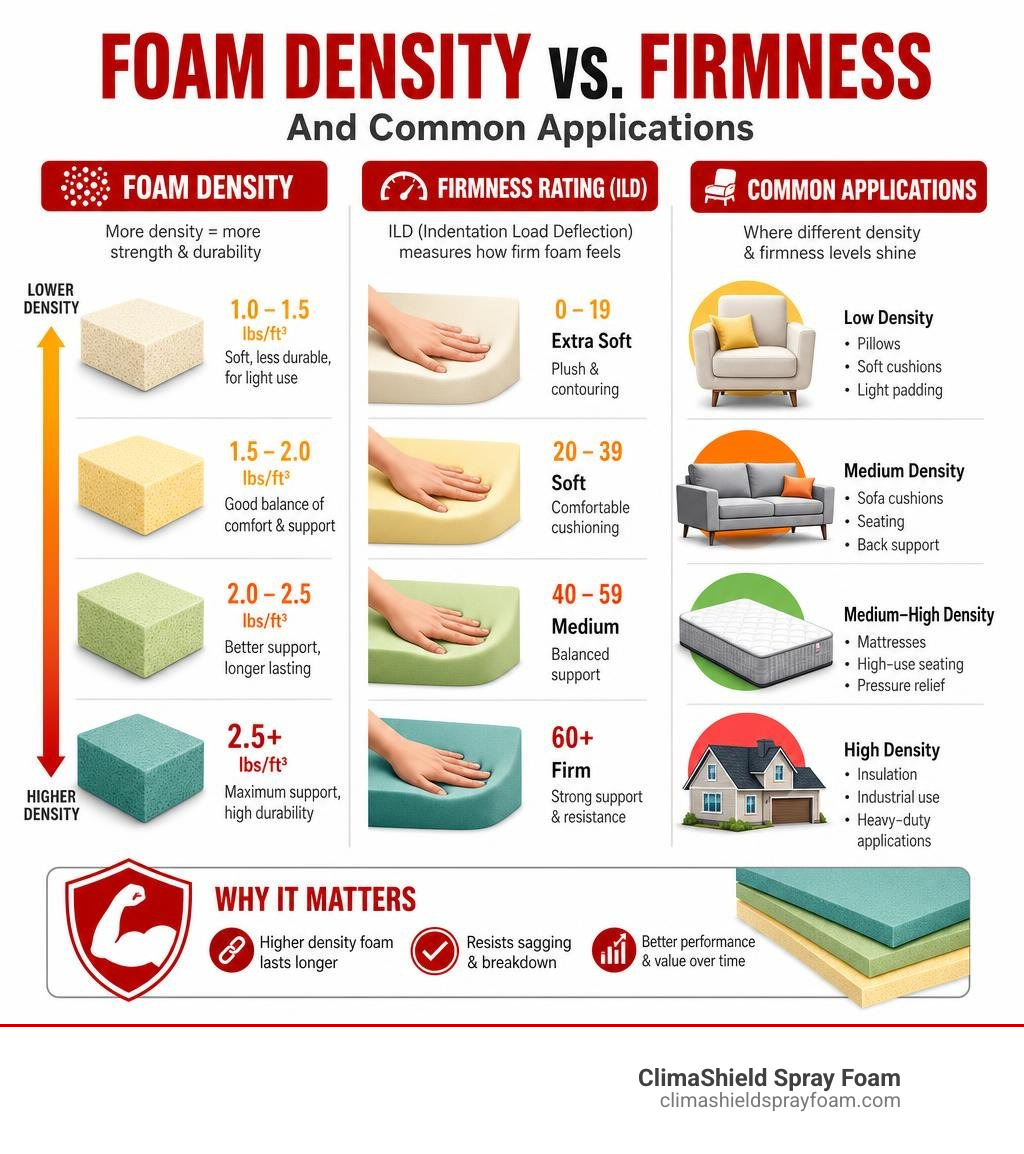
Essential high density foam terms:
What is High Density Foam?
To truly understand high density foam, we have to look at how it is constructed. At its core, foam is made by mixing chemicals that react, expand, and trap air. Flexible polyurethane foam (FPF) is an open-cell polymeric product with a broad range of load-bearing capability and resiliency.
The “density” of foam refers to how much actual polymer material is packed into a specific volume. It is calculated by weighing a 12″ x 12″ x 12″ cube (one cubic foot) of the foam. If that block weighs 2.8 pounds, it has a density of 2.8 lbs/ft³ (often referred to as PCF, or pounds per cubic foot).
Low-density foams contain a lot of air and very little actual material. They feel light, airy, and soft. While they are great for adding a plush layer of comfort, they lack the structural integrity to withstand heavy, repeated loads. For a deep dive into why those softer options have their own place, check out Why Low Density Foam Is The King Of Softness.
High-density foam, on the other hand, contains far more physical material per cubic foot. This dense structure means the cell walls are thicker and more resilient. When you sit on it, step on it, or use it to seal a wall, it fights back against compression.
| Property | Low Density Foam | High Density Foam |
|---|---|---|
| Weight (PCF) | Under 1.8 lbs/ft³ | 2.5 lbs/ft³ and higher (up to 60+ lbs/ft³ for rigid types) |
| Cell Structure | Thin-walled, highly open | Thick-walled, highly structured (or completely closed-cell) |
| Longevity | 1 to 3 years under regular use | 8 to 15+ years (virtually lifetime for rigid insulation) |
| Primary Benefit | Maximum initial softness, lightweight | Exceptional support, durability, and moisture resistance |
While polyurethane is the most common chemical backbone for these foams, other materials like melamine are also compressed to create high-density cleaning sponges and acoustic panels. Regardless of the base chemical, the rule of thumb remains: more material equals more durability.
Understanding Density and Firmness Ratings
One of the biggest points of confusion we encounter in the field is the difference between density and firmness. Many people assume that high density automatically means “hard as a rock.” This is a myth!
Density measures weight, while firmness measures how the foam reacts to pressure. You can easily manufacture a high-density foam that feels incredibly soft (like high-end gel memory foam) or a low-density foam that feels stiff but bottoms out the second you put real weight on it.
To understand how these properties work together, we look at the industry standards discussed in High-Density Polyurethane Foam: What It Is and Where It’s Used. Manufacturers use a two-number system to label foam. The first number tells you the density (weight), and the second number tells you the firmness, measured by Indentation Load Deflection (ILD) or Indentation Force Deflection (IFD).
Compressive strength is another key rating, especially for rigid foams used in construction and prototyping. It measures the amount of force required to compress the foam by a certain percentage of its original height. High-density rigid foams can have greater compressive strength than sidewalk cement, making them incredibly valuable for structural support.
How Firmness Differs in High Density Foam
Firmness is officially measured using the ILD/IFD scale. To find this rating, a laboratory machine presses a flat, circular plate into a 50-square-inch section of foam until it compresses the foam by 25% of its original thickness. The number of pounds of force required to hit that 25% mark is the ILD rating.
- Medium (35 ILD): Perfect for back cushions, mattress toppers, and body-conforming wraps. It provides a balance of contouring comfort and structural support.
- Firm (44 to 45 ILD): The gold standard for seat cushions, benches, and heavy-use upholstery. It keeps your tailbone from bottoming out on the wooden frame of your furniture.
- Extra Firm (60 ILD): Used for heavy-duty commercial seating, equipment padding, or applications where maximum support is required.
In regions like Pennsylvania, where local manufacturing has a rich history, sourcing these specific ratings is highly accessible. For those looking to source custom-cut materials, exploring the resources provided by Pennsylvania Foam Cushions Manufacturers – IQS Directory can connect you with specialized fabricators who understand these exact specifications.
Key Applications and Uses of High Density Foam
Because high-density foam is so structurally stable, its footprint can be found across dozens of everyday items and heavy industries.

In the consumer market, upholstery and cushion replacement are massive drivers of demand. On online marketplaces like Amazon, searches for high-density foam products yield over 50,000 results, showing just how many homeowners and DIYers are taking comfort into their own hands. Popular products like GoTo Foam’s 1″ x 24″ x 72″ (44ILD) cushion or FoamTouch’s 3″ x 24″ x 72″ sheets hold tens of thousands of highly rated reviews because they instantly revive sagging couches.
When your favorite living room chair starts sinking, you don’t need a new chair; you usually just need a high-density polyurethane core swap. Local experts like Foam Cushion Replacements – Kauffman’s Upholstery Inc. specialize in retrofitting worn-out furniture with premium-grade foam that restores original comfort and posture support.
Industrial and Prototyping Uses
Step outside of the living room, and high-density foam shifts from soft and springy to rigid and machinable. In industrial design, aerospace engineering, and sign-making, rigid polyurethane foams with densities ranging from 15 lb/ft³ to 60 lb/ft³ are highly prized.
These materials are grain-free, meaning they can be carved, drilled, and milled with CNC routers without splitting or splintering like natural wood. According to Machinable Foam | McMaster-Carr , high-density prototyping foams are ideal for creating detailed 3D models, molds, and casting patterns.
For sign makers, 15 lb and 20 lb densities are the most popular choices. As detailed by CNC and Modeling Foam (Rigid Polyurethane Foam) – High Density 15lb/ft – MakerStock , this rigid foam resists atmospheric weathering, solvents, and moisture, making it a highly durable, paintable alternative to wood for outdoor commercial signage.
High Density Foam in Insulation and Vehicles
In the building and construction world, high-density closed-cell spray foam is the ultimate champion of energy efficiency. Unlike open-cell foam, which is soft and sponge-like, closed-cell spray foam is dense, rigid, and packed with closed cells that block both air and water.
At ClimaShield Spray Foam, we utilize high-density closed-cell foam to create continuous, airtight barriers in homes, offices, and commercial vehicles. In cold, damp climates like Indiana, PA, this is crucial. High-density spray foam offers an impressive R-value of approximately 7 per inch, providing superior thermal protection compared to traditional fiberglass batts.
This dense structure also acts as a built-in vapor retarder, preventing ground moisture and humid summer air from seeping into your walls. To explore how this matches up against other options on the market, take a look at Which Foam Is For You? Exploring Insulation Types, Perks, And Prices and learn more about choosing the best fit for your property with Choosing The Right Spray Foam For Your Home.
For those looking into regional projects, professional applications of high-density polyurethane spray foam reinforce building structural integrity while sealing out drafty Pennsylvania winter winds.
Factors to Consider When Choosing High Density Foam
Before you purchase high-density foam for your next project, you need to evaluate several key variables:
- Thickness: For seating, a thickness of 3 to 5 inches is ideal. Anything thinner might bottom out under heavy weight, while anything thicker can feel overly stiff. For insulation, thickness directly correlates with your desired R-value.
- Size: Always measure twice and cut once. For DIY projects, purchasing pre-cut sheets (like standard 24″ x 72″ sizes) is often the most cost-effective route, whereas custom commercial spaces require precision-cut slabs or on-site spray application.
- Material Type: Are you looking for flexible comfort or rigid structure? Flexible polyurethane is best for cushions, while closed-cell polyurethane or machinable boards are required for structural, thermal, or prototyping tasks.
- Environmental Factors: If your foam will be exposed to moisture, UV rays, or extreme temperatures, you must select a formulation designed to resist these elements. For example, closed-cell foam is highly water-resistant, whereas standard open-cell upholstery foam will act like a sponge if left out in the rain.
For commercial properties, understanding the fire ratings, local building codes, and environmental certifications of your foam is non-negotiable. You can read up on these industrial standards in Everything You Need To Know About Commercial Insulation Types.
Specialized Foam Variants
The foam industry has evolved to offer highly specialized variations of high-density materials to solve unique problems:
- Gel Memory Foam: Infused with gel beads to prevent heat retention, making it a popular choice for premium mattresses and orthopedic cushions.
- Charcoal Foam: Infused with activated charcoal to absorb odors and moisture, frequently used in packaging and protective cases for delicate electronics.
- Rebonded Foam: Made from recycled scrap foam bound together under high pressure. It is incredibly dense, cost-effective, and commonly used for carpet underlayment and motorcycle seats.
- High-Density Melamine Foam: This unique open-cell foam is highly heat-resistant and has exceptional sound-absorbing properties. Manufacturers like Future Foam and specialized industrial suppliers highlight its use in demanding acoustic environments.
- Acoustic & Cleaning Melamine: According to technical data from High-Density Melamine Foam – Custom Industrial Solutions , compressed melamine foam can withstand temperatures from -200°C to +240°C while offering a high Sound Absorption Coefficient (NRC of 0.9 at 80mm). Furthermore, as showcased by Kangerna High-Density Melamine Foam – Melamine Sponge for Cleaning , its micro-abrasive open-cell structure makes it the active material in “magic eraser” cleaning sponges, lifting tough stains using only water.
Frequently Asked Questions About High Density Foam
What is the difference between foam density and firmness?
Density refers to the weight of the foam per cubic foot (measured in PCF), which indicates how much physical material is packed into the foam. Firmness (measured in ILD/IFD) refers to how soft or hard the foam feels when you press down on it. High-density foam can be manufactured to feel soft, medium, or extra firm.
How long does high density foam last?
In upholstery applications, high-density foam (2.5 PCF or higher) typically lasts between 8 to 15 years under normal daily use without significant sagging or softening. In insulation applications, rigid closed-cell high-density spray foam is designed to last the entire lifetime of the building structure.
Can high density foam be used for outdoor applications?
Yes, but you must choose the correct type. Standard open-cell upholstery foam will absorb water and mold if left outdoors. For outdoor furniture, marine seating, or building envelopes, you must use closed-cell high-density polyurethane foam, which is completely impermeable to water, air, and moisture.
Conclusion
Whether you are rebuilding the cushions on a family heirloom, carving out a new prototype in a machine shop, or looking to slash your home heating bills, high density foam is the high-performance material you need.
At ClimaShield Spray Foam, we specialize in harnessing the power of high-density closed-cell spray foam to protect homes and businesses throughout Indiana, PA, and the wider Pennsylvania region. Our durable, waterproof, and airtight insulation solutions seal out drafty air, resist mold and pests, and can save you up to 60% on your monthly energy bills.
Ready to see how high-density foam can transform your property’s comfort and efficiency? Discover the many uses of spray foam or reach out to our expert team today to schedule your professional consultation!
