Why Home Efficiency Foam Insulation Could Be the Smartest Investment You Make This Year
Home efficiency foam insulation is one of the most effective ways to cut energy bills, stop drafts, and protect your home from moisture and mold — all in a single upgrade.
Here’s what you need to know right away:
- Energy savings: Spray foam can reduce heating and cooling costs by 20–30%, with some homeowners reporting up to 40–60% lower energy bills
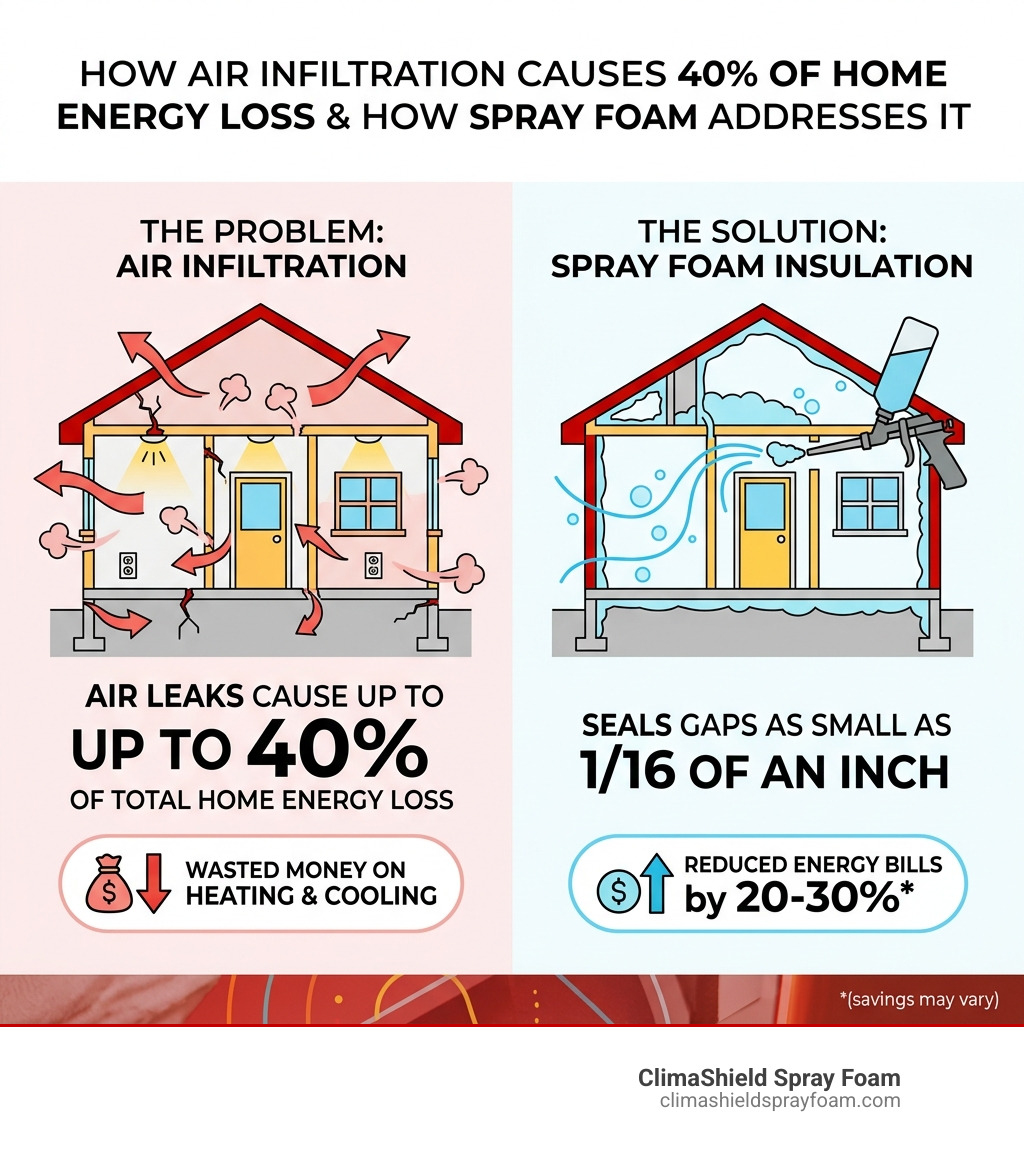
- Air sealing: It seals gaps as small as 1/16 of an inch, addressing the air leaks that cause up to 40% of a home’s total energy loss
- Tax credits: Qualifying installations may be eligible for a 30% federal tax credit, up to $1,200 under the Energy Efficient Home Improvement Credit
- Longevity: Properly installed spray foam can last 50+ years with virtually no maintenance
- HVAC savings: A well-insulated home may allow you to downsize your HVAC system by as much as 35%
The U.S. Department of Energy estimates that 56% of a home’s energy use goes toward heating and cooling. If your home has air leaks, poor insulation, or old fiberglass batts that have sagged over time, you’re likely paying far more than you should every single month.
This guide walks you through everything — from understanding foam types and R-values to unlocking rebates, tax credits, and the best places to install foam for maximum impact.
I’m Dave Brocious, founder of ClimaShield Industries and a specialist in home efficiency foam insulation with 20 years of experience in coatings and insulation for both residential and commercial properties. In the sections below, I’ll share what actually works — based on real-world installation experience, not just theory.
Understanding Home Efficiency Foam Insulation: How It Works
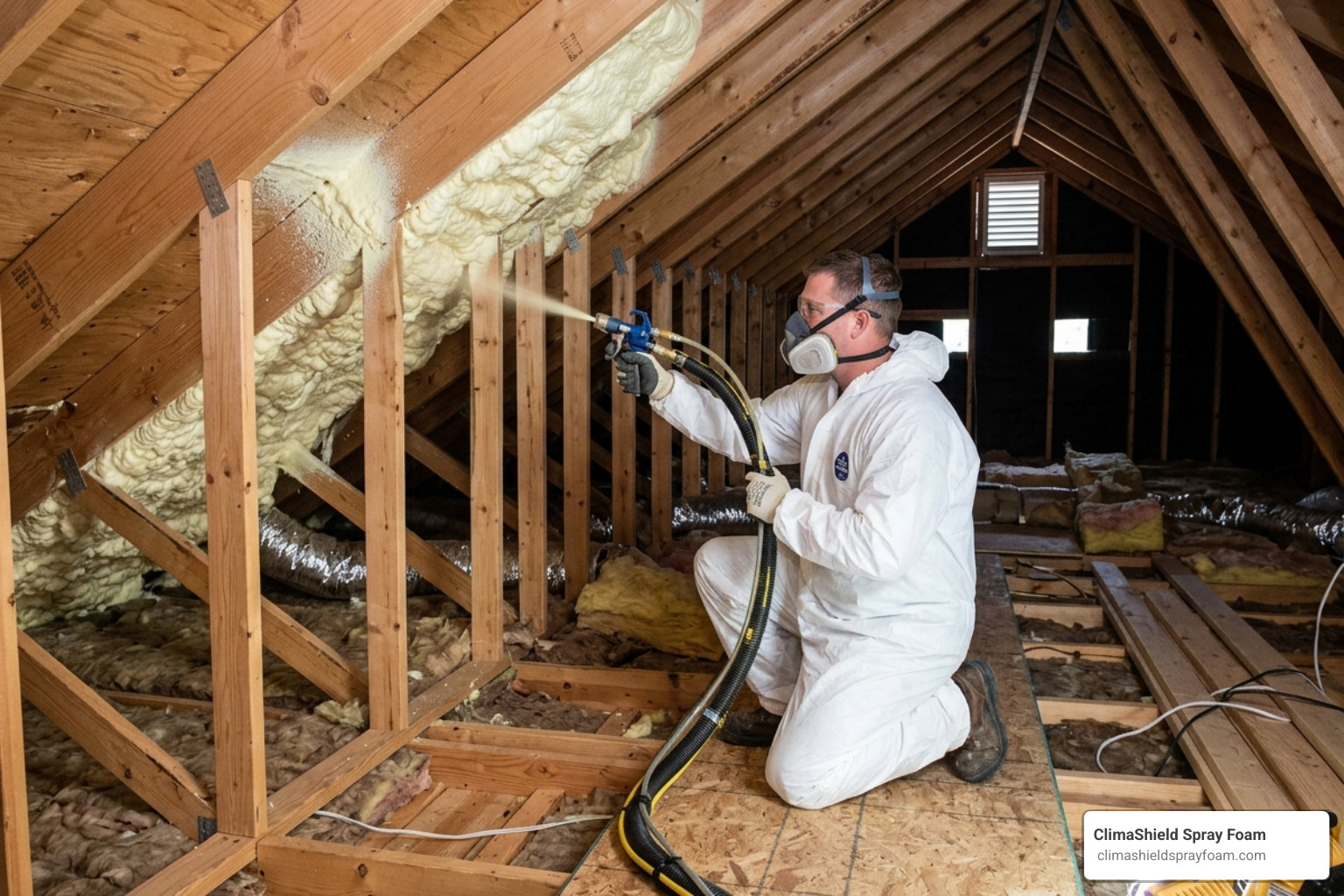
To understand why home efficiency foam insulation is so effective, we have to look at the chemistry. Spray foam is created by a reaction between two main components: isocyanate and polyol resin. When these two liquids meet at the tip of a professional spray gun, they undergo a chemical reaction that causes the mixture to expand rapidly—sometimes up to 100 times its liquid volume.
As it expands, the foam fills every nook, cranny, and crevice, creating an airtight seal that traditional materials like fiberglass or cellulose simply cannot match. This process eliminates “thermal bridging,” which is a fancy way of saying it stops heat from traveling through the structural elements of your home. For a deeper look at the basics, check out our Residential Insulation Complete Guide.
The Science of Air Sealing
Most people think of insulation only in terms of keeping heat in during the winter. However, the real “secret sauce” of spray foam is its ability to stop air infiltration. Heat moves in three ways: radiation, conduction, and convection. While traditional batts can slow down conduction, they do very little to stop convection (the movement of air).
By creating an airtight envelope, we eliminate drafts and prevent the “chimney effect,” where warm air escapes through the attic and pulls cold air in through the basement. This level of moisture control also prevents humid air from condensing inside your walls, which is the leading cause of hidden mold growth.
R-Value and Climate Zones
R-value measures a material’s thermal resistance—basically, how well it resists heat flow. The higher the R-value, the better the insulation. In Indiana, PA, and throughout Western Pennsylvania, we deal with significant temperature swings, meaning we need robust R-values to keep homes comfortable.
The Department of Energy (DOE) sets specific standards for different climate zones. Because spray foam provides a much higher R-value per inch than traditional materials, we can often achieve the required thermal resistance in much tighter spaces, such as 2×4 wall cavities. You can learn more about these requirements in our guide to Energy Saving Insulation.
Comparing Open-Cell vs. Closed-Cell Spray Foam
Choosing the right foam is critical for your project’s success. Here is a quick breakdown of the two primary types:
| Feature | Open-Cell Foam | Closed-Cell Foam |
|---|---|---|
| Density | Low (approx. 0.5 lb/cu. ft.) | High (approx. 2.0 lb/cu. ft.) |
| R-Value | R-3.5 to R-3.8 per inch | R-6.0 to R-7.0 per inch |
| Moisture Resistance | Vapor permeable | Vapor retarder (Class II) |
| Structural Integrity | Flexible | Adds significant strength |
| Best Use | Interior walls, soundproofing | Exterior walls, basements, attics |
For a more detailed comparison, see our article Which Foam Is For You Exploring Insulation Types Perks And Prices.
Why Foam Outperforms Traditional Materials
Old-fashioned insulation like fiberglass batts or blown-in cellulose has a few major flaws. First, it sags over time, leaving gaps at the top of wall cavities. Second, it acts like a filter rather than a barrier; it lets air pass right through it, carrying dust, allergens, and heat along for the ride.
Home efficiency foam insulation never settles, sags, or shrinks. It stays exactly where we spray it for the life of the building. This superior longevity means you won’t be crawling back into your attic in 15 years to “top off” your insulation. Explore the differences further in From Fiberglass To Foam Exploring Residential Insulation Types.
Choosing the Right Home Efficiency Foam Insulation
The “best” foam depends on your specific needs. If you’re looking to soundproof a home theater or a home office, open-cell foam is fantastic because its softer structure absorbs sound waves. However, if you’re insulating a damp basement or want to add structural strength to your walls to resist high winds, closed-cell is the clear winner. We help you navigate this choice in our guide on Choosing The Right Spray Foam For Your Home.
Maximizing ROI: Costs, Tax Credits, and Rebate Programs

Let’s talk about the elephant in the room: the initial cost. Yes, spray foam is more expensive upfront than fiberglass. However, looking at the “sticker price” is a mistake. You have to look at the Return on Investment (ROI). With a typical payback period of 3 to 7 years through energy savings, spray foam eventually pays for itself and then starts putting money back in your pocket. To get a better idea of the numbers, read our Deep Dive Into Average Prices And Square Foot Rates.
Federal Tax Credits and Incentives
As of May 2026, homeowners can still take advantage of significant federal incentives. The Energy Efficient Home Improvement Credit (Section 25C), expanded by the Inflation Reduction Act, allows you to claim 30% of the project cost, up to $1,200 annually for weatherization upgrades like insulation and air sealing.
By combining this with other credits for heat pumps or windows, you can strategically upgrade your home over a few years to maximize your tax returns. Just ensure the products used carry the necessary Manufacturer’s Certification Statement for Energy Star compliance.
The Financial Benefits of Home Efficiency Foam Insulation
The savings don’t stop at your monthly utility bill. Because spray foam is so efficient at regulating temperature, your furnace and air conditioner don’t have to work nearly as hard. This often allows homeowners to install smaller, less expensive HVAC units when it comes time for replacement—sometimes reducing the required size by 35%.
Additionally, a home with a documented history of low energy bills and high-performance insulation often commands a higher resale value. Stop throwing money out the window and start building equity instead.
Strategic Application: Where to Install Foam for Maximum Impact
Not all areas of the home are created equal when it comes to energy loss. To get the most “bang for your buck,” we focus on the “nine critical areas” of air leakage. If you’re wondering where to start, check out 5 Ways To Know If Spray Foam Insulation Is Right For You In Indiana Pa.
Sealing the Building Envelope
- Rim Joists: This is where your home’s wood frame meets the concrete foundation. It is almost always a major source of cold drafts in the winter.
- Attic Hatches and Knee Walls: These are often overlooked but act like open chimneys for your conditioned air.
- Electrical Outlets and Plumbing Penetrations: Small gaps around wires and pipes can add up to the equivalent of leaving a window open year-round.
- Roof Decks: Spraying the underside of the roof deck transforms your attic into a “semi-conditioned” space, keeping it within 10-15 degrees of your living area temperature.
The Necessity of Professional Installation
While you can buy small “gap and crack” cans at Home Depot or Lowe’s for minor DIY fixes, whole-home insulation requires professional equipment.
Professional installers ensure the chemical mixing ratios are perfect. If the mix is off, the foam may not cure properly, leading to odors or reduced effectiveness. We also use specialized Personal Protective Equipment (PPE) and follow strict safety protocols to ensure your home is safe to re-occupy within 24 hours. Learn more about how to pick the best home insulation pro.
Safety, Sustainability, and Long-Term Maintenance
Modern home efficiency foam insulation is designed with both your health and the planet in mind. We use low-GWP (Global Warming Potential) blowing agents and formulations that are GREENGUARD Gold certified for low chemical emissions.
Why Home Efficiency Foam Insulation is the Best Choice for Net Zero Living
If you are aiming for a Net Zero home—one that produces as much energy as it consumes—spray foam is almost a requirement. It provides the airtightness necessary to make solar panels and high-efficiency heat pumps truly effective. By reducing the overall carbon footprint of your home’s operation, you’re contributing to a more sustainable future. Plus, because it blocks moisture so effectively, it is inherently mold resistant.
Debunking Common Myths
- “It will rot my roof”: This is a myth. When installed correctly on a roof deck, spray foam does not cause shingle damage. Studies show shingles may only be 2-3 degrees warmer, which is well within their design tolerances.
- “It’s toxic”: Once cured (usually within 1 to 2 hours, though we recommend 24 hours for safety), spray foam is an inert polymer. It doesn’t off-gas or release fibers like fiberglass can.
- “It hides leaks”: While it is true that closed-cell foam is waterproof, leaks will still find a way out or show up as stains on the foam itself, allowing for detection.
Frequently Asked Questions about Foam Insulation
How long does spray foam insulation last?
Spray foam is incredibly durable. Because it is an inert polymer that doesn’t settle or degrade, it can easily last 50 to 80 years. In many cases, it will outlast the building itself. Unlike fiberglass, which may need replacement every 15-20 years due to moisture damage or sagging, spray foam is a “one and done” solution.
Is spray foam insulation safe for indoor air quality?
Yes, absolutely. By sealing out dust, pollen, and outdoor pollutants, spray foam actually improves indoor air quality. During the installation, we require residents to vacate the home for 24 hours to allow for proper ventilation and curing. Once that period is over, the home is completely safe for children, pets, and those with respiratory sensitivities.
Can spray foam really reduce my HVAC size?
It can. HVAC contractors use “Manual J” load calculations to determine the size of your furnace or AC. When they see the airtightness and R-value provided by home efficiency foam insulation, those calculations often show that you need a much smaller system. A smaller system not only costs less to buy but also runs more efficiently, further lowering your bills.
Conclusion
Investing in home efficiency foam insulation is about more than just numbers on a utility bill; it’s about the comfort of your family and the longevity of your home. At ClimaShield Spray Foam, we pride ourselves on being the energy efficiency leader in Indiana, PA. Our mission is to provide you with an airtight, mold-resistant seal that can save you up to 60% on your energy costs.
Ready to stop throwing money out the window? Whether you’re in Indiana, PA, or the surrounding Western Pennsylvania area, we’re here to help you achieve a high-performance home.
Explore our Residential Spray Foam Insulation services in Western PA today and take the first step toward a more efficient future.
