PA Concrete Leveling: What You Need to Know Before Your Property Gets Worse
A PA concrete leveling company can restore sinking, cracked, or uneven concrete slabs — without the cost and disruption of full replacement. Here’s a quick overview of what that means for Pennsylvania property owners:
Quick Answer: What Does a PA Concrete Leveling Company Do?
| What You Need | What a PA Concrete Leveling Company Provides |
|---|---|
| Sunken driveway or patio | Lifts slab back to original position |
| Cracked or uneven sidewalk | Stabilizes and levels the surface |
| Pooling water near your home | Corrects slope to redirect drainage |
| Tripping hazards on steps or walkways | Eliminates dangerous height differences |
| High cost of concrete replacement | Saves 50%-70% vs. full replacement |
| Long downtime after repair | Back in use within hours, not weeks |
That sunken slab at the edge of your driveway? It’s not just an eyesore. In Pennsylvania, concrete settlement is a widespread problem — driven by the state’s heavy clay soils, frequent freeze-thaw cycles, and ground moisture fluctuations. Over time, these forces carve out voids beneath concrete slabs, and what starts as a minor dip can quickly become a serious tripping hazard, a drainage problem, or a liability issue.
The good news: you don’t need to tear out and repour your concrete. Modern leveling techniques can lift and stabilize sunken slabs in a fraction of the time — and at a fraction of the cost.
I’m Dave Brocious, and with 20 years in the specialty coatings and construction industry — including hands-on experience with floor coatings, concrete overlays, and polyurethane applications through ClimaShield Industries — I know why finding the right PA concrete leveling company makes all the difference for your property’s long-term stability. Let’s break down exactly what you need to know.
Understanding Concrete Settlement in Pennsylvania
If you live in Indiana, PA, or anywhere across the Keystone State, you’ve likely noticed that the ground isn’t as stable as it looks. Pennsylvania’s geology is a mix of beauty and engineering headaches. We deal with a high concentration of clay in our soil, which is notoriously “expansive.”
When it rains (and we know it rains plenty here), that clay soaks up water like a sponge and expands. When the weather dries out, the soil shrinks. This constant “breathing” of the earth creates gaps and voids beneath your heavy concrete slabs. Eventually, gravity wins, and the concrete sinks into those empty spaces.
Furthermore, Pennsylvania’s freeze-thaw cycle is a major contributor to concrete failure. During our winters, water seeps into the soil and the pores of the concrete. When it freezes, it expands with incredible force. When it thaws, it leaves behind weakened soil and larger voids. This cycle happens dozens of times every season, slowly but surely undermining your driveway, patio, or sidewalk. To get a deeper look at this phenomenon, check out our guide on Beyond the Cracks: A Homeowner’s Guide to Understanding Slab Foundation Settling.
Why You Need a Professional PA Concrete Leveling Company
It’s tempting to look at a sunken sidewalk and think, “I’ll get to that next summer.” But in Pennsylvania, waiting is a gamble. Uneven concrete is a primary cause of “trip and fall” accidents. As a homeowner or business owner, a jagged edge on a walkway is a significant liability.
Beyond safety, there’s the issue of structural integrity. When a slab sinks, it often tilts toward your home’s foundation. This creates a “funnel” effect, where rainwater is directed straight toward your basement or crawlspace. This can lead to mold, wood rot, and even more expensive foundation repairs. By hiring a PA concrete leveling company early, you stop the damage before it spreads. Learn more about how this protects your home in our article on Residential Concrete Lifting: Your Foundation for a Stable Home.
Identifying Issues for a PA Concrete Leveling Company
How do you know if you’re looking at a simple cosmetic crack or a structural settlement issue? Here are the red flags we look for:
- The “Trip Lip”: One section of a sidewalk or driveway is higher than the other.
- Pooling Water: After a rainstorm, puddles sit on your concrete instead of draining away.
- Garage Floor Gaps: You notice a space between the bottom of your garage door and the floor, or the floor is pulling away from the walls.
- Cracked Slabs: Large, jagged cracks that seem to be getting wider or where one side of the crack is lower than the other.
If you’re wondering about a specific crack, read our breakdown: Is That Floor Slab Crack a Big Deal?
Precision Engineering by a PA Concrete Leveling Company
Modern concrete leveling isn’t just about “jacking up” a slab; it’s about precision engineering. We use high-density polyurethane foam that is specifically designed for the load-bearing requirements of concrete.
Unlike older methods, this foam is waterproof. It won’t wash away during the next Pennsylvania spring downpour. It also stabilizes the soil itself, filling the microscopic voids that caused the sinking in the first place. This process, often called Geotech Slab Lifting, provides a permanent solution that addresses the root cause of the problem.
Polyurethane Foam vs. Traditional Mudjacking
For decades, “mudjacking” was the go-to solution. This involved pumping a heavy slurry of sand, cement, and soil under the concrete. While it worked for a while, it had major drawbacks—primarily that the “mud” was incredibly heavy (adding more weight to already failing soil) and it eventually washed away.
Today, we use polyurethane foam injection (often branded as PolyLevel® in the industry). The difference is night and day.
| Feature | Polyurethane Foam | Traditional Mudjacking |
|---|---|---|
| Cure Time | 15 Minutes | 24+ Hours |
| Material Weight | 2 lbs per cubic foot | 100+ lbs per cubic foot |
| Drill Hole Size | 5/8″ (Penny-sized) | 1″ to 2″ (Quarter-sized or larger) |
| Water Resistance | 100% Waterproof | Can wash away/erode |
| Longevity | Permanent soil stabilization | Temporary fix; prone to re-settling |
By choosing a PA concrete leveling company that uses foam, you are opting for a method that offers a 1217% cost savings over the long term compared to total replacement, and an 833% time savings during the repair itself. For a deeper dive into the mechanics, see How to Understand Concrete Lifting Foam in 5 Easy Steps.
The Step-by-Step Process of Modern Concrete Lifting
We pride ourselves on a process that is “minimally invasive.” You won’t have heavy machinery tearing up your lawn or loud jackhammers running for days. Here is how a professional PA concrete leveling company typically handles your project:
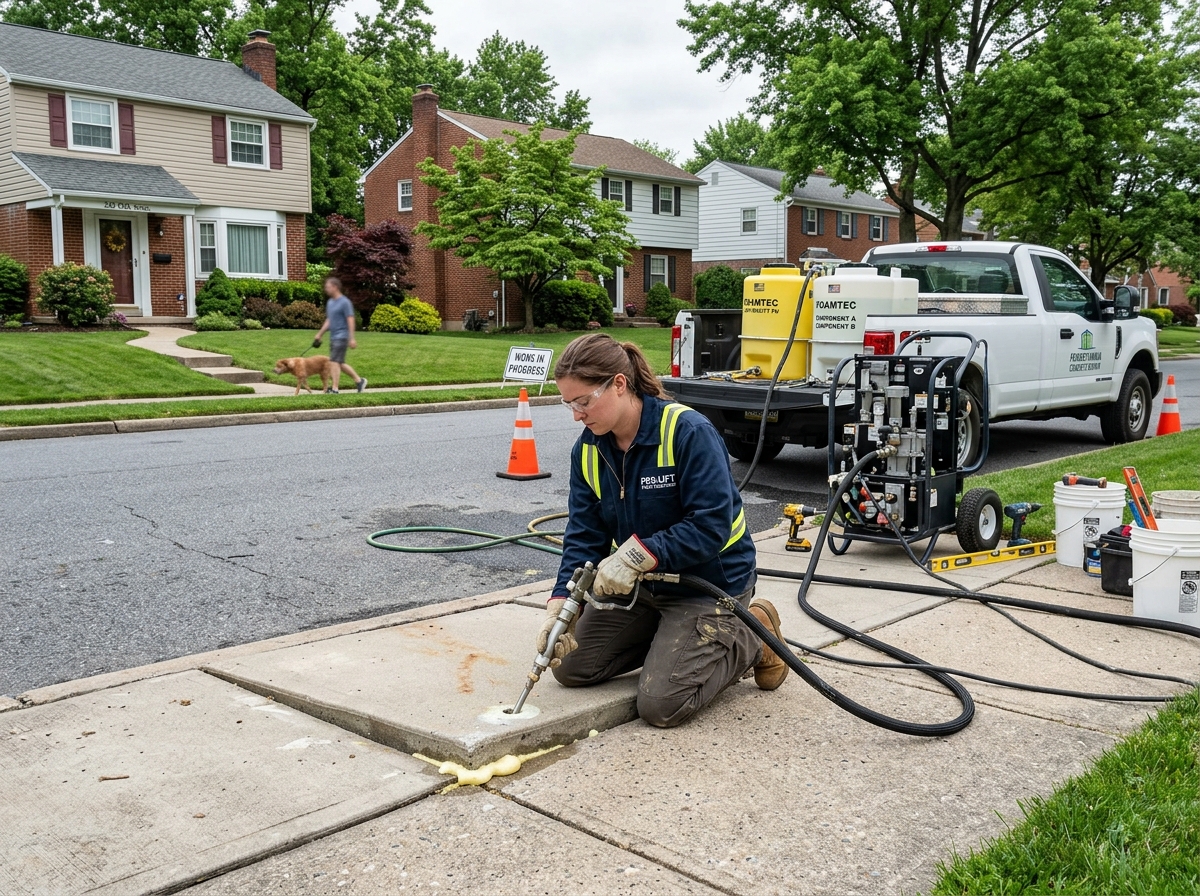
- Site Inspection: We assess the slabs, identify the voids, and calculate the amount of lift needed to reach the original grade.
- Drilling: We drill tiny, 5/8-inch holes in the sunken sections. These are about the size of a penny and are strategically placed for maximum lift.
- Injection: We inject the two-part polyurethane foam through the holes. As the liquid components mix, they undergo a chemical reaction that causes the foam to expand rapidly.
- Expansion and Lift: As the foam expands, it fills every nook and cranny of the void. Once the void is full, the upward pressure gently and precisely lifts the concrete slab back into place.
- Sealing: Once the slab is level, we remove the injection ports and seal the small holes with a concrete-matched grout. We also recommend sealing any cracks or joints to prevent future water intrusion.
The best part? The foam cures in about 15 minutes. You can drive your car over the repaired driveway or walk on the sidewalk almost immediately. To learn more about the technical side, check out Slab Lifting 101 and Your Essential Guide to Concrete Lifting.
Cost-Effectiveness and Versatility of Concrete Repair
One of the most common questions we get is: “Why not just replace the whole thing?”
The answer is simple: Money and Time.
Concrete leveling typically costs 50% to 70% less than tearing out and replacing a slab. When you replace concrete, you aren’t just paying for the new pour; you’re paying for demolition, hauling away the old heavy debris, and the labor of a large crew. Plus, new concrete takes weeks to fully cure before it can handle the weight of a vehicle.
Leveling is versatile. We can fix:
- Driveways: Restore curb appeal and stop the “bump” every time you pull into the garage.
- Sidewalks and Walkways: Eliminate tripping hazards for neighbors and mail carriers.
- Patios and Pool Decks: Ensure your outdoor entertaining space is safe and level.
- Garage Floors: Fill the voids that cause “hollow” sounding floors or structural cracks.
If you want to ensure you’re doing things the right way, read How to Repair Concrete Slab the Right Way.
Commercial Applications for a PA Concrete Leveling Company
It’s not just homeowners who suffer from the “abyss” of sinking soil. Businesses in Indiana, PA, and surrounding areas often deal with uneven warehouse floors, sinking retail entryways, and unstable industrial slabs.
In a commercial setting, downtime is lost revenue. If a warehouse floor is uneven, forklifts can tip, and employees can get injured. Our foam injection process allows businesses to keep running. We can level a warehouse floor in sections, often working overnight or during off-hours, so the floor is ready for heavy machinery by morning. This specialized process is known as Slab Jacking Foam application for high-load environments.
Frequently Asked Questions about PA Concrete Leveling
How long does the concrete leveling process take?
Most residential projects—like a three-slab sidewalk or a section of a driveway—can be completed in just a few hours. Because the foam cures in 15 to 25 minutes, you don’t have to wait days to use your property. You can host a BBQ on your patio the same evening we level it!
Is polyurethane foam environmentally friendly?
Yes. The high-density foam we use is “non-invasive” and “non-leaching.” Once it cures, it is an inert solid. It won’t degrade into the soil or release harmful chemicals into the Pennsylvania groundwater. It’s a much “greener” choice than traditional mudjacking or the massive carbon footprint associated with manufacturing and transporting new concrete.
How much does concrete leveling cost compared to replacement?
On average, you can expect to save between 50% and 70%. For example, if a new driveway costs $10,000, leveling might only cost $3,000 to $4,000. Additionally, because the foam stabilizes the soil, you won’t have to pay for the same repair again in two years, which is often the case with “patch-and-pray” DIY methods.
Conclusion
Your Pennsylvania property is likely your biggest investment. Don’t let a sinking driveway or a cracked patio devalue your home or create a safety hazard. At ClimaShield Spray Foam, we bring the same commitment to energy efficiency and structural durability to our concrete leveling services as we do to our insulation projects.
Whether you’re in Indiana, PA, or the surrounding regions, our goal is to provide a stable, waterproof, and long-lasting solution that keeps your property “above the abyss.” By choosing a professional PA concrete leveling company, you’re choosing a smarter, faster, and more affordable way to maintain your home.
Ready to see how we can lift your property? Get a Free Estimate on Slab Jacking Foam today and let us help you build a more stable foundation for your future.
